Skip to the content
4 layers68.5 × 43.5 mmPunchcard Reader, the printed circuit board in 3D

Punchcard Reader

Robert-Mones/Claculator5

A reverse Polish notation calculator with added features such as comparisons, branching, and custom recursive operators taken from the Clac project from the 15-122 course at Carnegie Mellon University. The project is built around a 6502 microprocessor with a custom architecture to reduce CPU load by making peripherals operate asyncronously.

Size
68.5 × 43.5 mm
Copper layers
4
Thickness
1.6 mm
Parts
36
Nets
25
Pads
106
Tracks, vias
0, 0
Pours
2
Routed
Not yet
KiCad
KiCad 9.0 (file 20241229)
Created
10 Sep 2024
Updated
17 Jul 2026

Overview

Punchcard Reader is an open-source printed circuit board by Robert-Mones, from the Robert-Mones/Claculator repository on GitHub. It is a 4-layer board of 68.5 × 43.5 mm with 36 parts on 25 nets.

It is built around the 74HC14 and APS2012SP1C. Its parts include 12 capacitors, 11 resistors, 11 diodes and 2 ICs.

Main components

2

README

README.md

Claculator

A reverse Polish notation calculator with added features such as comparisons, branching, and custom recursive operators taken from the Clac project from the 15-122 course at Carnegie Mellon University. The project is built around a 65C02 microprocessor with a custom architecture to reduce CPU load by making memory-mapped peripherals operate asynchronously. All logic and board design was done in KiCAD. All 3D modeling was done in Autodesk Fusion.

Fully assembled Claculator
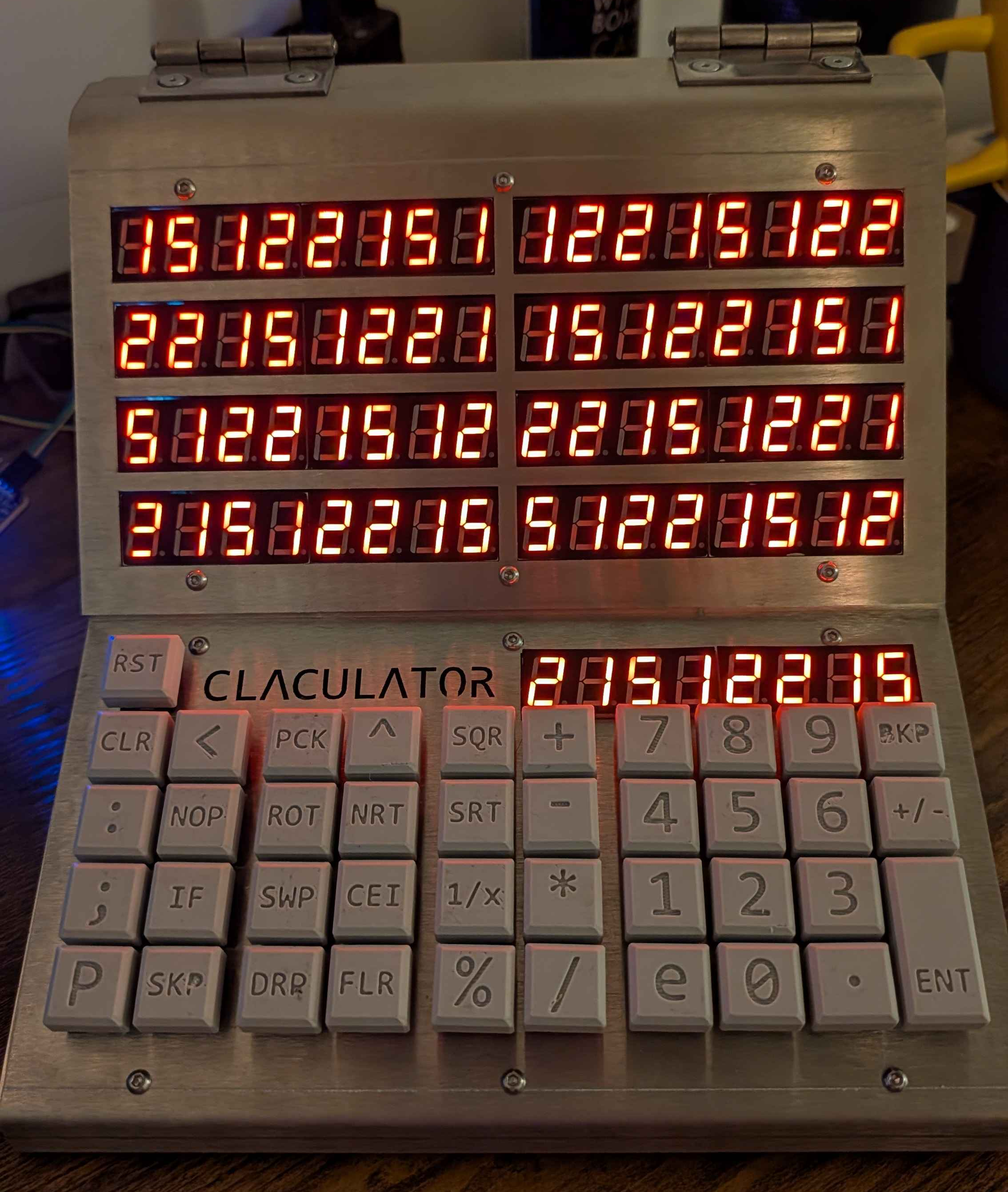
Fully assembled Claculator

Display

The seven-segment display board supports nine numeric displays, each with eight digits. It contains an SRAM chip which interfaces to the rest of the computer as a memory-mapped peripheral. When selected, the address and data bus is connected to the computer to be written to (but not read from) transparently. When the memory is not selected, a counter with a selectable clock source loops through each of the seventy-two digits, reads the corresponding byte from memory, and drives the corresponding digit using one bit for each segement (seven for the numeric part, one for the decimal point) with an array of P- and N-channel MOSFETs.

The front of the display, showing eight numeric displays
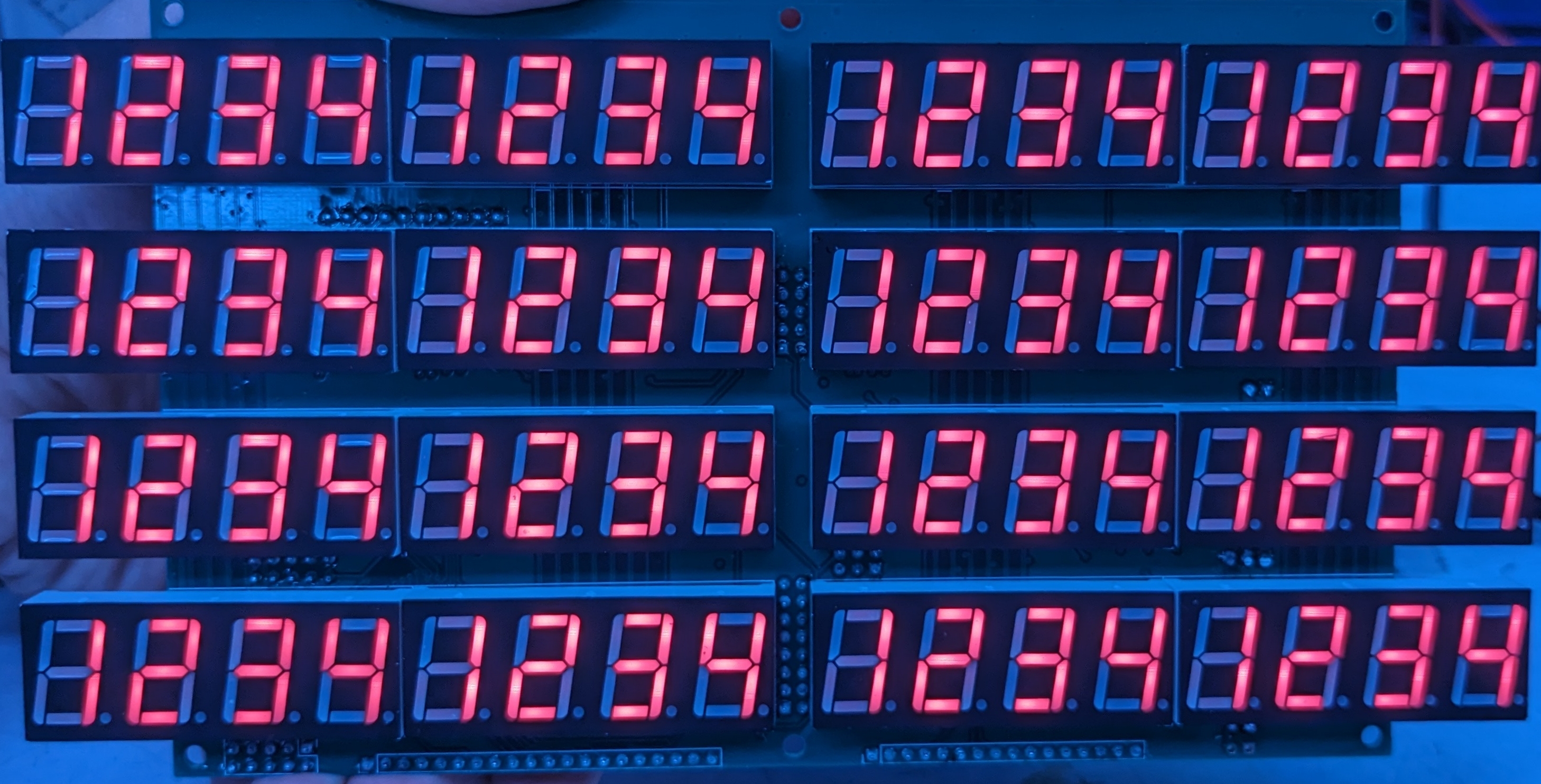
The front of the display, showing eight numeric displays

The back of the display, showing the logic and driver chips
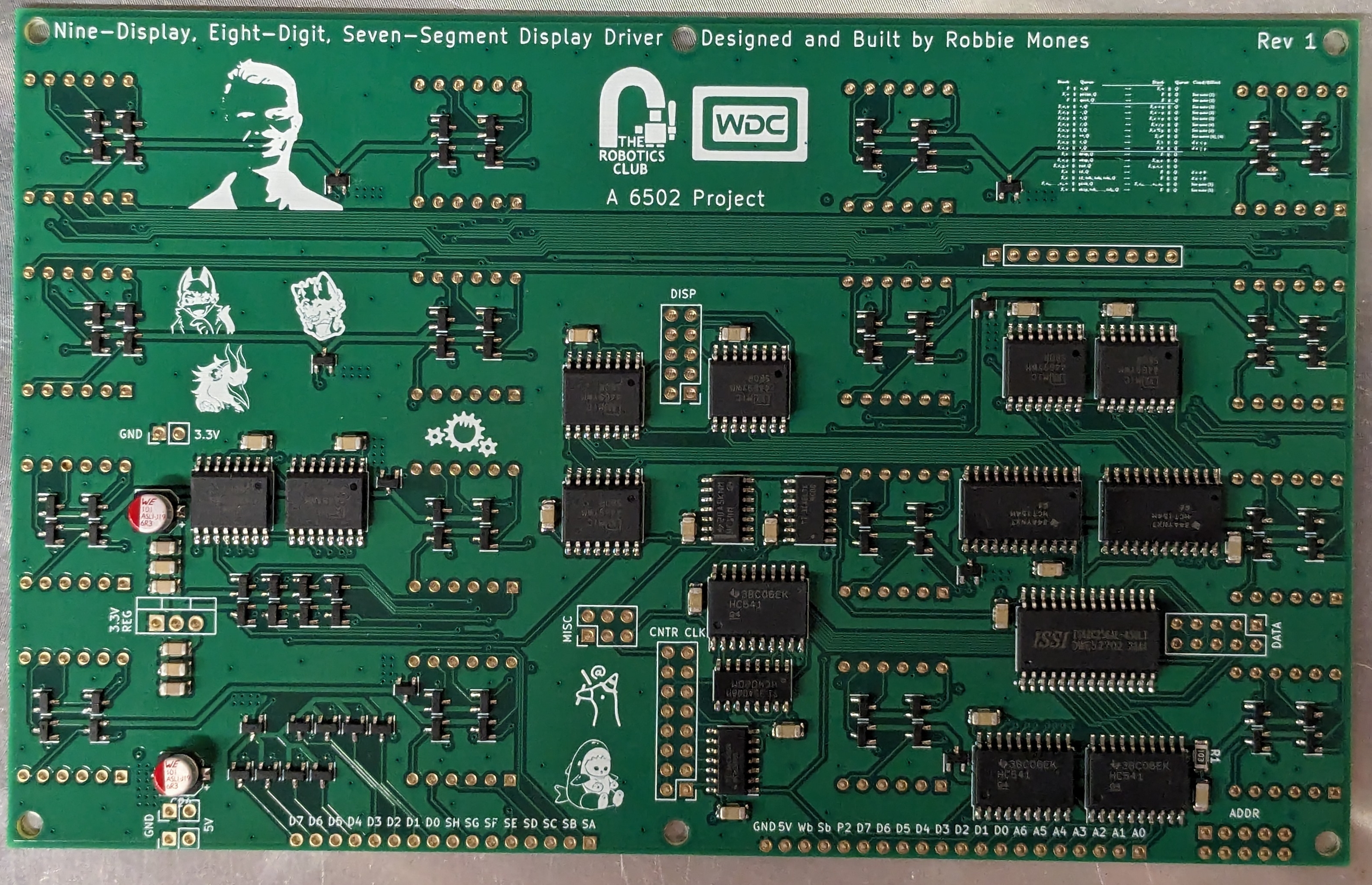
The back of the display, showing the logic and driver chips

Keypad

The keypad input board supports up to sixteen rows (5 are implemented), each with eight buttons. It detects rising edges of each button (equivalent to KeyDown events) with hardware RC debouncing and writes this information to a hardware FIFO buffer which is interfaced directly to the address and data bus of the system and can be configured to send an interrupt on new information in the buffer. It also has a header and location for a seven-segment display (not populated in these photos) as the ninth display that is driven from the display board.

The front of the keypad, showing five groups of eight keys
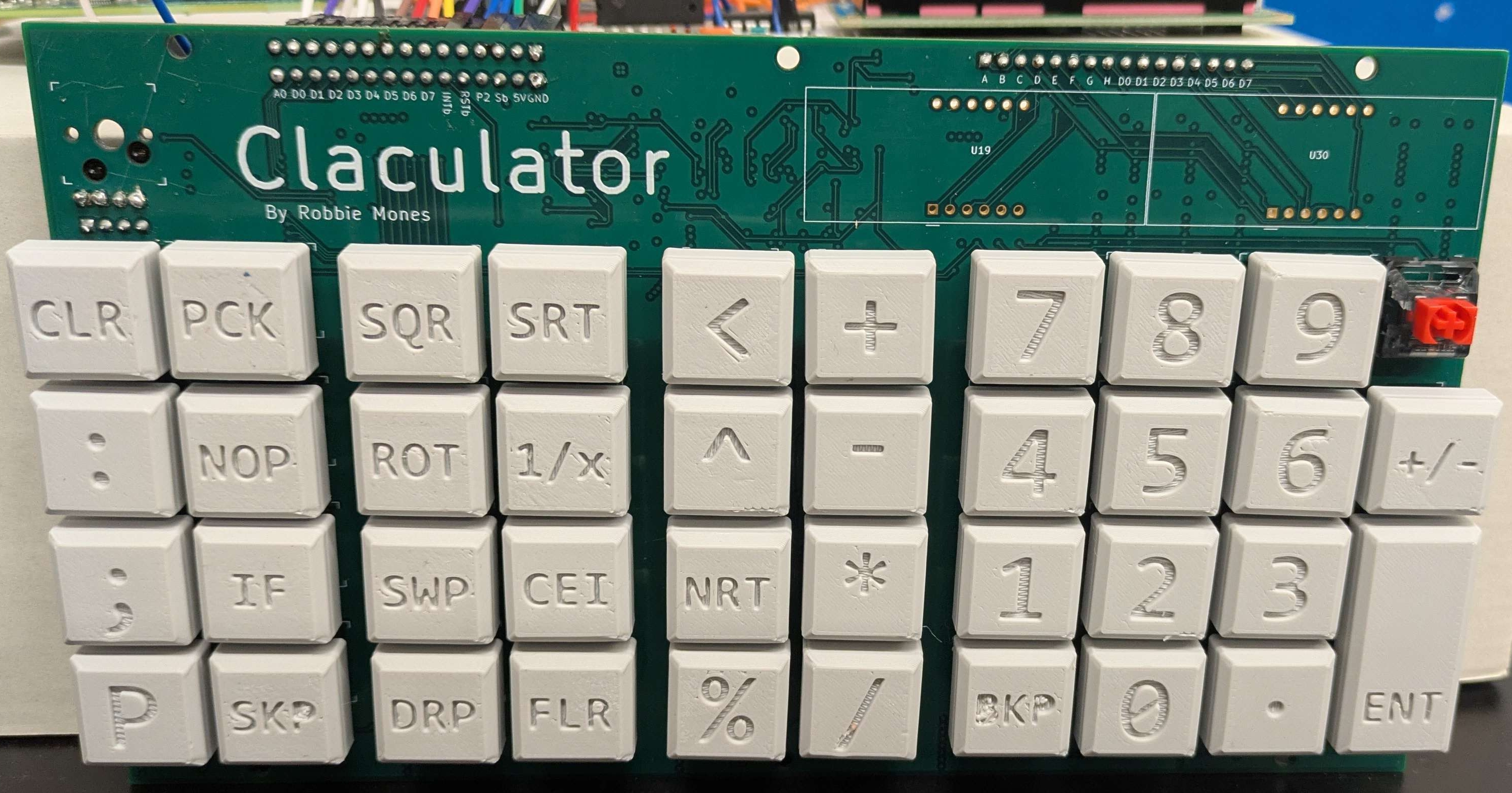
The front of the keypad, showing five groups of eight keys

The back of the keypad, showing the logic chips and hot-swappable key sockets
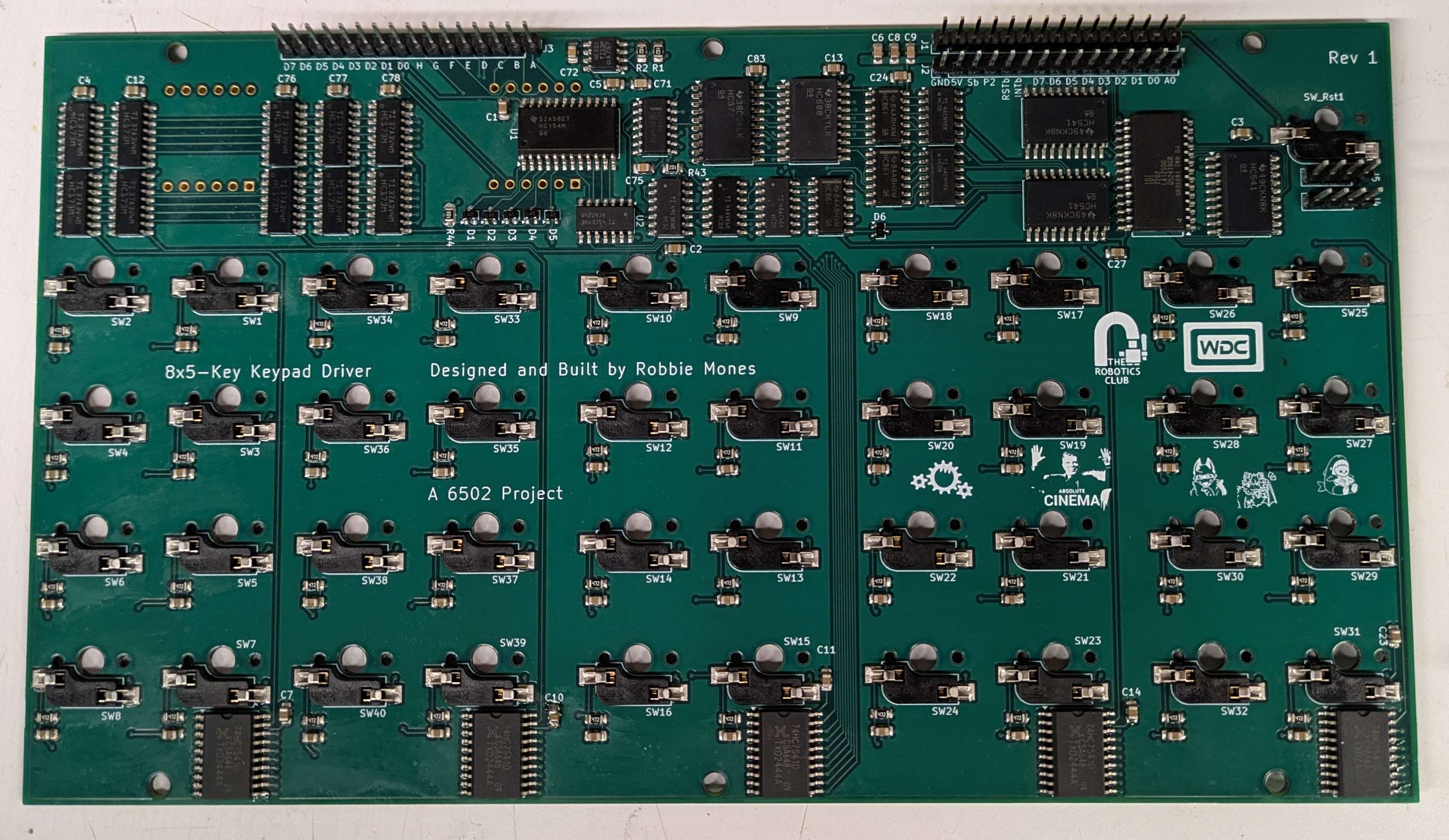
The back of the keypad, showing the logic chips and hot-swappable key sockets

Chassis

The chassis for the Claculator was manufactured by SendCutSend out of 1/8"-thick 304 stainless steel (except for the keypad plate which must be 0.06" thick to fit the keys). It has hinges at the top back to open the Claculator from the front to enable demonstrations and debugging more easily. It is very heavy (8lbs of sheet metal) and was very expensive but it's worth it for the bit.

Model of the assembled Claculator
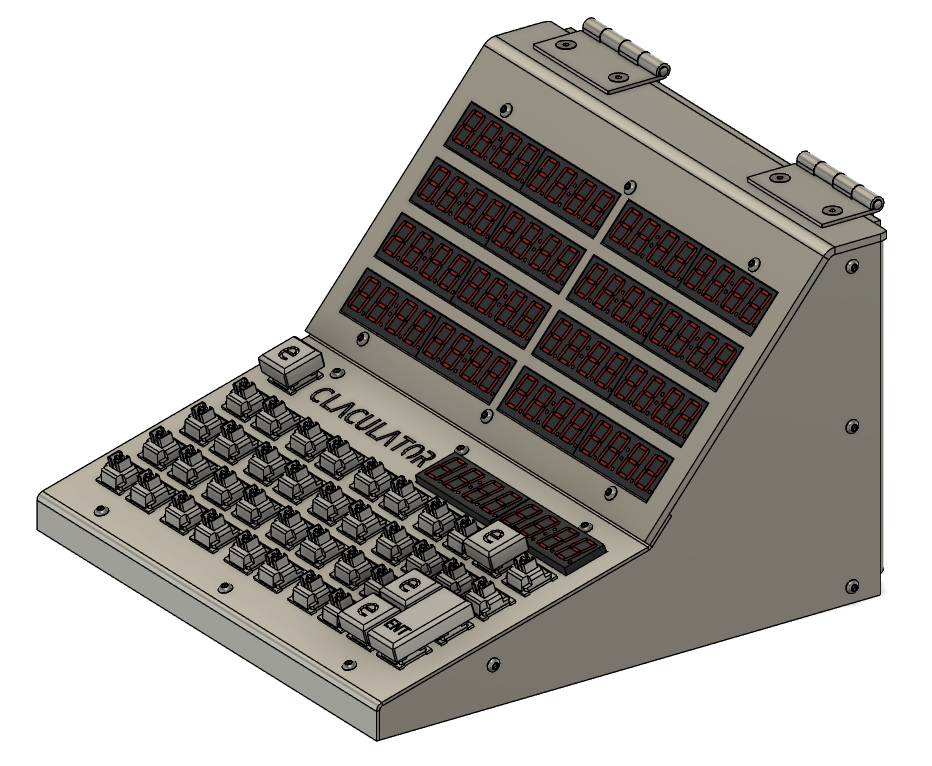
Model of the assembled Claculator

Code

I am currently working on some tests building up to a 32-bit integer mode to develop the RPN behavior and a feature-complete Clac implementation. After this, I will write a software 32-bit floating point implementation to support decimal arithmetic and comparisons. All of the code for this project will be written in 65C02 assembly.

Parts

36
QtyValueFootprintReferences
10470pFCapacitor_SMD:C_0805_2012Metric_Pad1.18x1.45mm_HandSolderC1, C2, C3, C4, C5, C6, C7, C8, C9, C10
10500kCustom:VariableResistor_Bourns_3006P_Horizontal_R1, R2, R3, R4, R5, R6, R7, R8, R9, R10
10APS2012SP1CLED_SMD:LED_0805_2012Metric_Pad1.15x1.40mm_HandSolderD1, D2, D3, D4, D5, D6, D7, D8, D9, D10
20.1uFCapacitor_SMD:C_0805_2012Metric_Pad1.18x1.45mm_HandSolderC11, C12
274HC14Package_SO:SOIC-14_3.9x8.7mm_P1.27mmU1, U2
1120ΩResistor_SMD:R_0805_2012Metric_Pad1.20x1.40mm_HandSolderR11
1LED_BACKLIGHTLED_THT:LED_D3.0mmD11

More from Robert-Mones/Claculator

3
  • 6 layers210 × 119 mmClaculator Keypad, the printed circuit board in 3D

    Claculator Keypad

    Robert-Mones/Claculator

    A reverse Polish notation calculator with added features such as comparisons, branching, and custom recursive operators taken from the Clac project from the 15-122 course at Carnegie Mellon University.

    202 parts5
  • 4 layers174 × 109 mmClaculator Display, the printed circuit board in 3D

    Claculator Display

    Robert-Mones/Claculator

    A reverse Polish notation calculator with added features such as comparisons, branching, and custom recursive operators taken from the Clac project from the 15-122 course at Carnegie Mellon University.

    170 parts5
  • 6 layers16.5 × 21.6 mmClock Addon, the printed circuit board in 3D

    Clock Addon

    Robert-Mones/Claculator

    A reverse Polish notation calculator with added features such as comparisons, branching, and custom recursive operators taken from the Clac project from the 15-122 course at Carnegie Mellon University.

    7 parts5

Similar boards

  • 2 layers89.2 × 82.6 mmDesktop 50 Pin TopConn, the printed circuit board in 3D

    Desktop 50 Pin TopConn

    BlueSCSI/BlueSCSI-v2

    BlueSCSI v2/Ultra - an open source, open hardware, SCSI emulator using the Pi Pico PR2040 and Pico 2 RP2350

    108 parts459GPL-3.0
  • 2 layers88.9 × 98.4 mmKickstart switcher-12up, the printed circuit board in 3D

    Kickstart switcher-12up

    keirf/pcb-projects

    The old Kickstart switcher documentation is here.

    197 parts108CC0-1.0
  • 2 layers100 × 100 mmExplorer, the printed circuit board in 3D

    Explorer

    anyshake/explorer

    🌏 Detecting seismic wave using 3 geophones and 3-axis accelerometer, pack & send data to AnyShake Observer over RS232 / RS485 serial.

    266 parts100
  • 2 layers160.1 × 101 mmPLC-14500, the printed circuit board in 3D

    PLC-14500

    nicolacimmino/PLC-14500

    Retro trainer board based on the MC14500 1-bit ICU. The project is OSHW certified and a ready to assemble kit is available on Tindie.

    173 parts70GPL-3.0
  • 4 layers69 × 74 mmShield, the printed circuit board in 3D

    Shield

    imihajlow/ethernet-to-spi

    An Ethernet to SPI converter using 7400-series ICs

    60 parts69
  • 2 layers154.9 × 139.7 mm68kBoard, the printed circuit board in 3D

    68kBoard

    transistorfet/computie

    A collection of 68k computer projects, including a unix-like operating system written in C that runs on them

    78 parts69GPL-3.0
  • 2 layers100 × 100 mmController, the printed circuit board in 3D

    Controller

    profdc9/ModularTuner

    A Modular Antenna Tuner for a Phased Array Antenna System

    180 parts59

Questions

How big is the Punchcard Reader PCB?

It measures 68.5 × 43.5 mm and has 4 copper layers, 1.6 mm thick.

What parts does the Punchcard Reader use?

36 parts, built around the 74HC14 and APS2012SP1C. The full list of its parts is on this page, with links to each part's symbol and footprint where PCBKit's library has them.

Where can I download the Punchcard Reader KiCad files?

From the Robert-Mones/Claculator repository on GitHub, at the commit this page was made from: the board is Punchcard_Reader/Punchcard_Reader.kicad_pcb and its schematic Claculator_Display/Claculator_Display.kicad_sch. PCBKit opens the board in the browser, with nothing to install.

Can I use the Punchcard Reader design in my own project?

Its repository states no licence, so its author keeps all rights: ask Robert-Mones before reusing the design.