4 layers69.8 × 35.2 mm
 rmingon/ScrapHawk1
An ultra-budget, high-performance drone flight controller powered by the RP2040. Featuring a full 9-axis navigation stack, GPS, dual-stage power filtering, and a dual-core FreeRTOS architecture. Proof that you don't need expensive silicon to rule the skies.
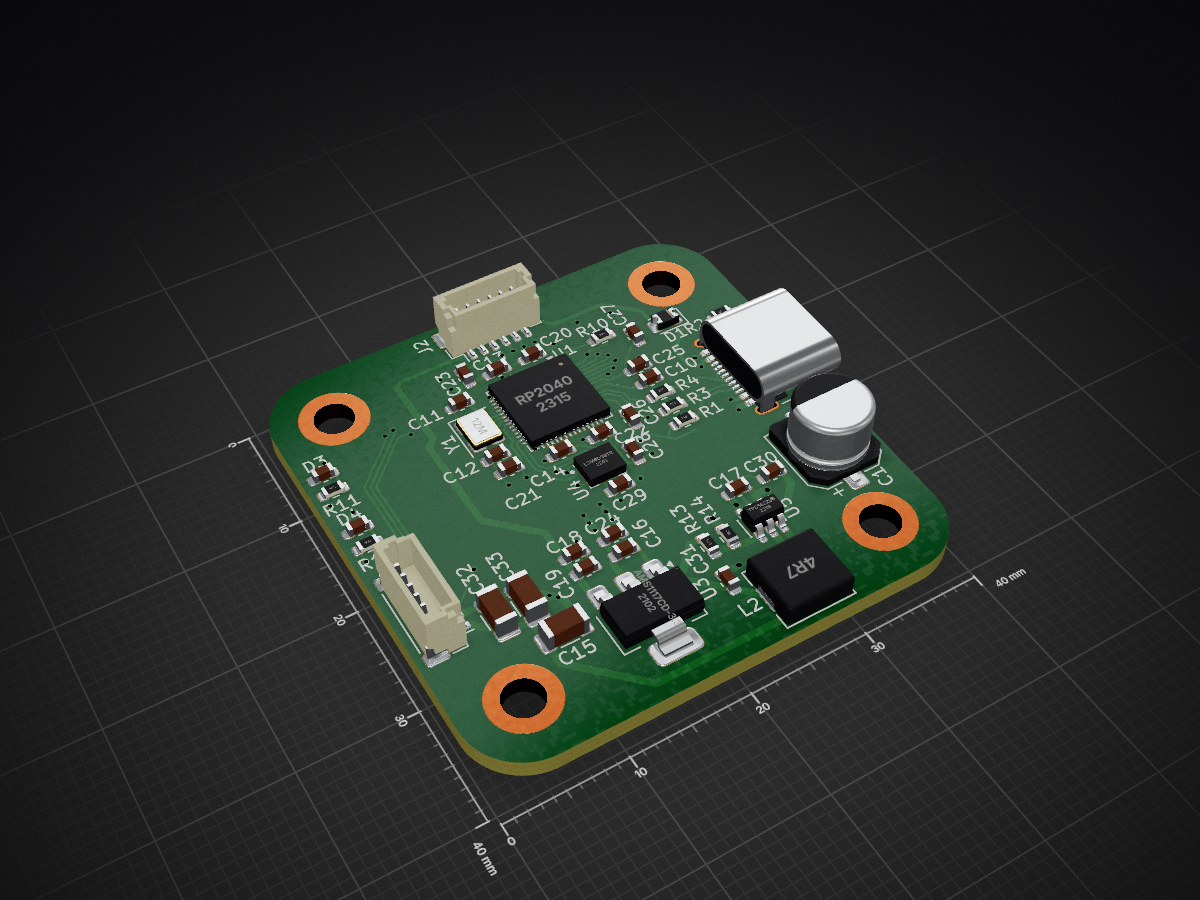
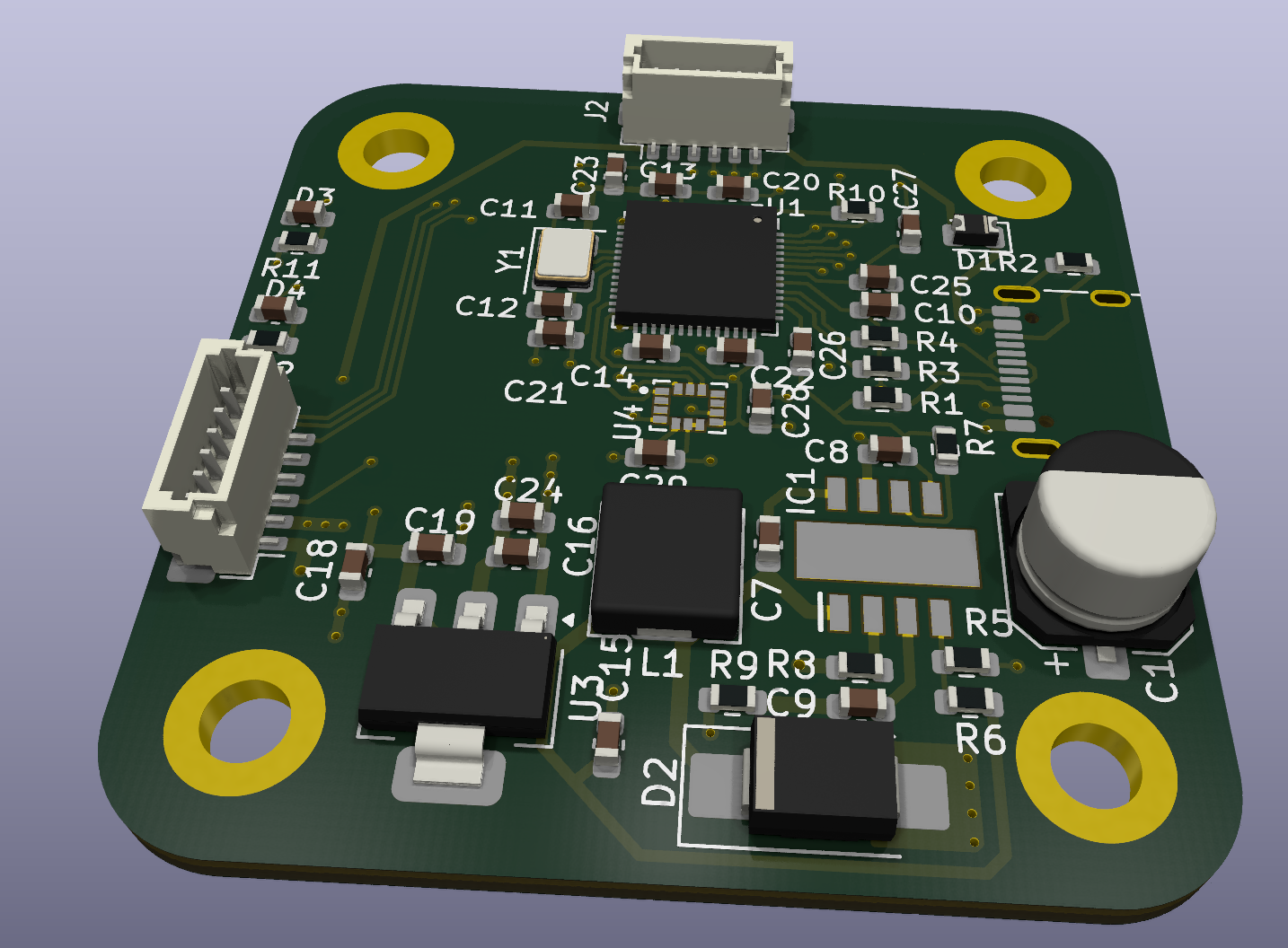
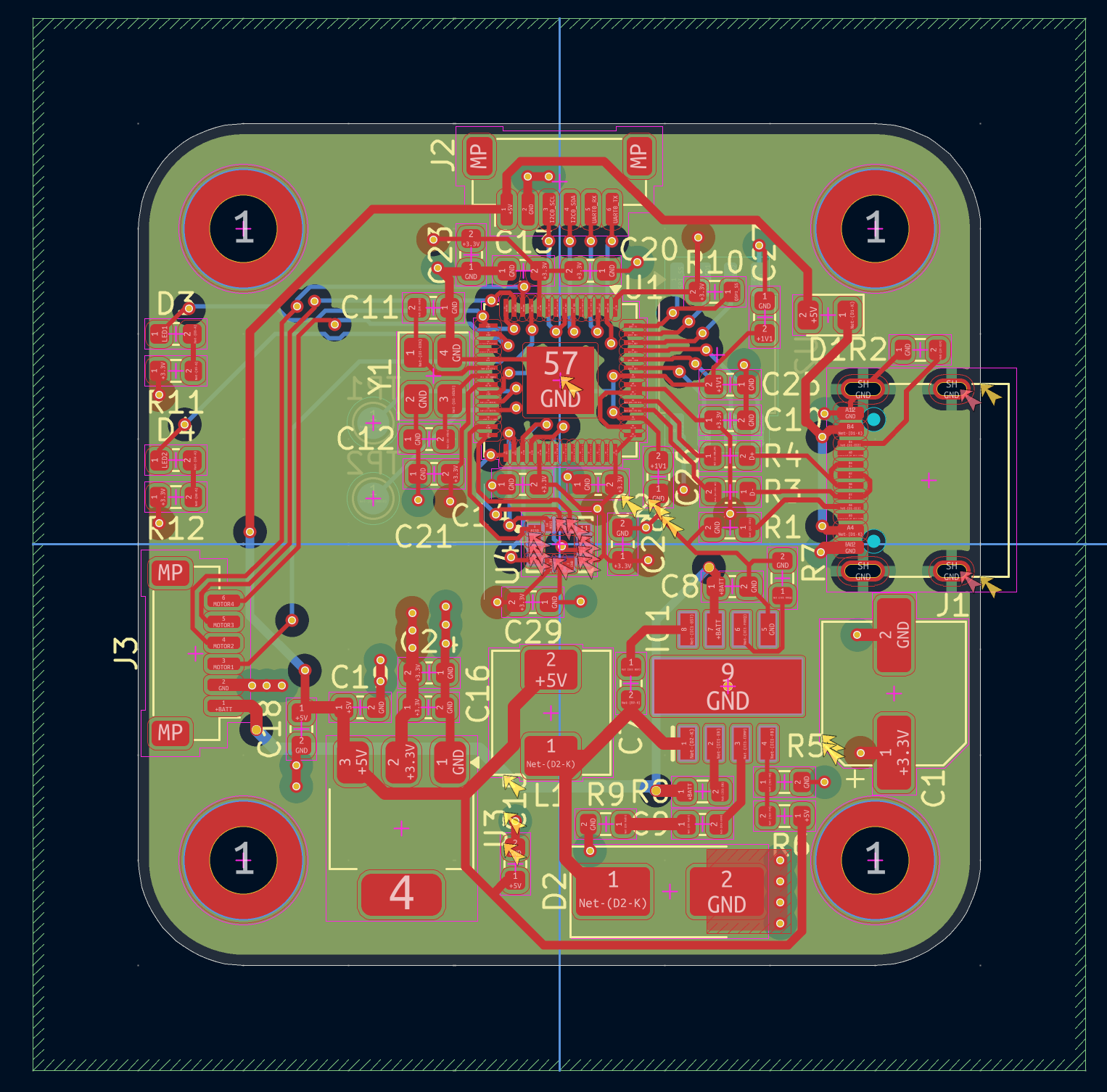
ScrapHawk FC Main is an open-source printed circuit board by rmingon, from the rmingon/ScrapHawk repository on GitHub. It is a 4-layer board of 40 × 40 mm with 53 parts on 63 nets, routed with 518 tracks and 80 vias.
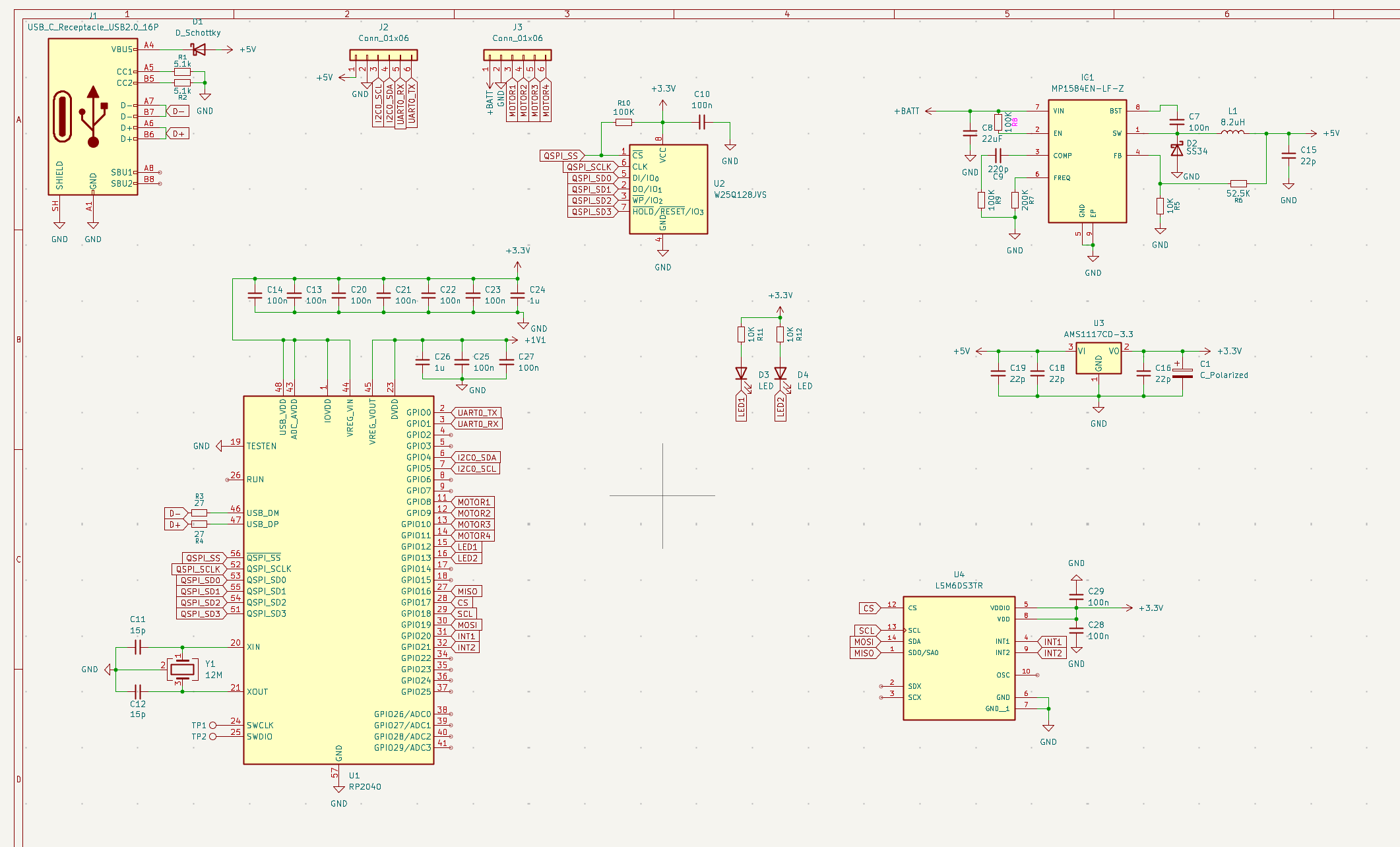
It is built around the RP2040, W25Q128JVSIQ and AMS1117CD-3.3, with the LSM6DS3TR-C and TPS562200DDC among its other parts. Its parts include 25 capacitors, 9 resistors, 5 ICs, 3 diodes and 3 connectors. It belongs with the robots and motor control boards and the RP2040 boards of this library.


Ultra-budget, high-performance RP2040 flight controller stack bypassing expensive legacy silicon.
For years, custom flight controllers have relied on expensive, legacy single-core silicon. ScrapHawk takes a radically different approach. By utilizing the ultra-affordable Raspberry Pi RP2040, modern FreeRTOS Symmetric Multiprocessing (SMP), and hardware-level Programmable I/O (PIO), ScrapHawk delivers a zero-latency, high-performance flight stack on a hacker's budget.
Beyond the silicon, ScrapHawk solves one of the most frustrating problems in drone engineering: Electromagnetic Interference (EMI) from high-current motor ESCs disrupting sensitive navigation sensors.
To combat this, the ScrapHawk architecture is physically decoupled into two separate printed circuit boards connected by a 6-pin JST-SH (1.0mm) umbilical cable.
The RP2040 features dual Cortex-M0+ cores. Instead of treating this as a generic processing pool, ScrapHawk leverages FreeRTOS SMP to rigidly enforce core affinity, completely decoupling the real-time flight dynamics from slower, blocking navigation tasks.
Traditionally, generating DSHOT signals for ESCs requires complex timer/DMA configurations that eat up CPU cycles. ScrapHawk completely bypasses the CPU for motor control. By mapping the motor output pins to the RP2040's hardware PIO state machines, the DSHOT timing is handled independently at the hardware level. Core 0 simply pushes throttle values into a FIFO buffer, and the PIO hardware seamlessly clocks out the precise DSHOT pulses.
This is the core flight management and power delivery board, situated in the center of the drone frame.

Designed to be mounted high on a mast, this board keeps the magnetometer and GPS completely isolated from the EMI generated by the motors and power leads.
ScrapHawk is designed for drone hardware hackers, custom flight controller developers, and FreeRTOS engineers who want to explore modern RTOS paradigms and PIO capabilities without being locked into expensive, proprietary, or legacy ecosystems. It proves that with clever software engineering and thoughtful hardware isolation, cheap silicon can fly just as well—if not better—than the expensive alternatives.
| Qty | Value | Footprint | References |
|---|---|---|---|
| 11 | 100n | Capacitor_SMD:C_0603_1608Metric | C10, C13, C14, C20, C21, C22, C23, C25, C27, C28, C29 |
| 3 | 100n | Capacitor_SMD:C_1206_3216Metric | C15, C32, C33 |
| 3 | 22p | Capacitor_SMD:C_0603_1608Metric | C16, C18, C19 |
| 2 | 10K | Resistor_SMD:R_0603_1608Metric | R11, R12 |
| 2 | 15p | Capacitor_SMD:C_0603_1608Metric | C11, C12 |
| 2 | 1u | Capacitor_SMD:C_0603_1608Metric | C24, C26 |
| 2 | 27 | Resistor_SMD:R_0603_1608Metric | R3, R4 |
| 2 | 5.1k | Resistor_SMD:R_0603_1608Metric | R1, R2 |
| 2 | 52.5K | Resistor_SMD:R_0603_1608Metric | R13, R14 |
| 2 | Conn_01x06 | Connector_JST:JST_SH_BM06B-SRSS-TB_1x06-1MP_P1.00mm_Vertical | J2, J3 |
| 2 | LED | Capacitor_SMD:C_0603_1608Metric | D3, D4 |
| 2 | TestPoint | TestPoint:TestPoint_Pad_D1.5mm | TP1, TP2 |
| 1 | 0.1u | Capacitor_SMD:C_0603_1608Metric | C30 |
| 1 | 100K | Resistor_SMD:R_0603_1608Metric | R10 |
| 1 | 12M | Crystal:Crystal_SMD_SeikoEpson_TSX3225-4Pin_3.2x2.5mm | Y1 |
| 1 | 22u | Capacitor_SMD:C_0603_1608Metric | C17 |
| 1 | 4.7uH | Inductor_SMD:L_Chilisin_BMRA00050520 | L2 |
| 1 | 47u | Capacitor_SMD:C_0603_1608Metric | C31 |
| 1 | AMS1117CD-3.3 | Package_TO_SOT_SMD:SOT-223 | U3 |
| 1 | C_Polarized | Capacitor_SMD:CP_Elec_6.3x5.2 | C1 |
| 1 | D_Schottky | Diode_SMD:D_0805_2012Metric | D1 |
| 1 | LSM6DS3TR | LSM6DS3TR:PQFN50P300X250X86-14N | U4 |
| 1 | RP2040 | Package_DFN_QFN:QFN-56-1EP_7x7mm_P0.4mm_EP3.2x3.2mm | U1 |
| 1 | TPS562200 | Package_TO_SOT_SMD:SOT-23-6 | U5 |
| 1 | USB_C_Receptacle_USB2.0_16P | Connector_USB:USB_C_Receptacle_G-Switch_GT-USB-7010ASV | J1 |
| 1 | W25Q128JVS | Package_SO:SOIC-8_5.3x5.3mm_P1.27mm | U2 |
The 49 most common of 53 parts.
It measures 40 × 40 mm and has 4 copper layers, 1.6 mm thick.
53 parts, built around the RP2040, W25Q128JVSIQ, AMS1117CD-3.3 and LSM6DS3TR-C. The full list of its parts is on this page, with links to each part's symbol and footprint where PCBKit's library has them.
From the rmingon/ScrapHawk repository on GitHub, at the commit this page was made from: the board is ScrapHawk_FC_Main/ScrapHawk_FC_Main.kicad_pcb and its schematic ScrapHawk_FC_Main/ScrapHawk_FC_Main.kicad_sch. PCBKit opens the board in the browser, with nothing to install.
Its repository states no licence, so its author keeps all rights: ask rmingon before reusing the design.

nyuad-space/dumpling
Modular payload for high-speed logging and benchmarking of COTS sensors, enabling real-world performance data and open sharing.

kabidey/someda-claude-plugin
This plugin puts the someda engine behind three slash commands. In a conversation, Claude writes the circuit as a small JSON plan: real parts with datasheet pinouts, nets, and intent such as "USB-C on the top edge".


Haxintosh/VFD-tool
A modular multitool designed for engineers with a VFD screen (WIP!!!!!!!)

everettpenne/PFMV4_Prelim_Files
PFM Controller V4 files for independent design review. For application controlling the Limiter, HVPS, and Transrex supplies.

GrandFatherPikhto/3CH-AWG-TIA
3 Channels AWG Tia Generator on 10CL006, AD9707, ADA4807-2
