
2 layers53.3 × 33 mm

 rjhsun/triumph2
Accurate and high-current analog function generator
Triumph main is an open-source printed circuit board by rjhsun, from the rjhsun/triumph repository on GitHub, published under the MIT licence. It is a 2-layer board of 99.1 × 86.4 mm with 87 parts on 43 nets, routed with 430 tracks and 21 vias.
It is built around the NE5532AP and LM211P. Its parts include 26 capacitors, 25 resistors, 10 connectors, 5 ICs and 4 diodes.




Analog function generator project for EE 90 at Caltech
The Triumph Analog Function Generator is an analog function generator constructed for the Analog Electronics Project Laboratory (EE 90) capstone course at Caltech. It provides a single output channel on a 50 Ω impedance matched BNC connector. It is capable of producing sine, square, and triangle waveforms that vary in frequency over at least the range 10 Hz to 20 kHz, in addition to DC. The frequency may be adjusted through the combination of a frequency range select switch and a fine-adjustment knob on the top of the device. The output amplitude may be varied from zero up to 10 V (single-sided) with a control knob. A second control knob allows the DC offset of the output to be varied.
Power is supplied via 9 – 18 VDC input through a barrel jack connector on the rear of the device. A rocker switch near the power connector allows the device to be switched on and off.
A blue indicator LED on the front of the device indicates if the function generator is powered.
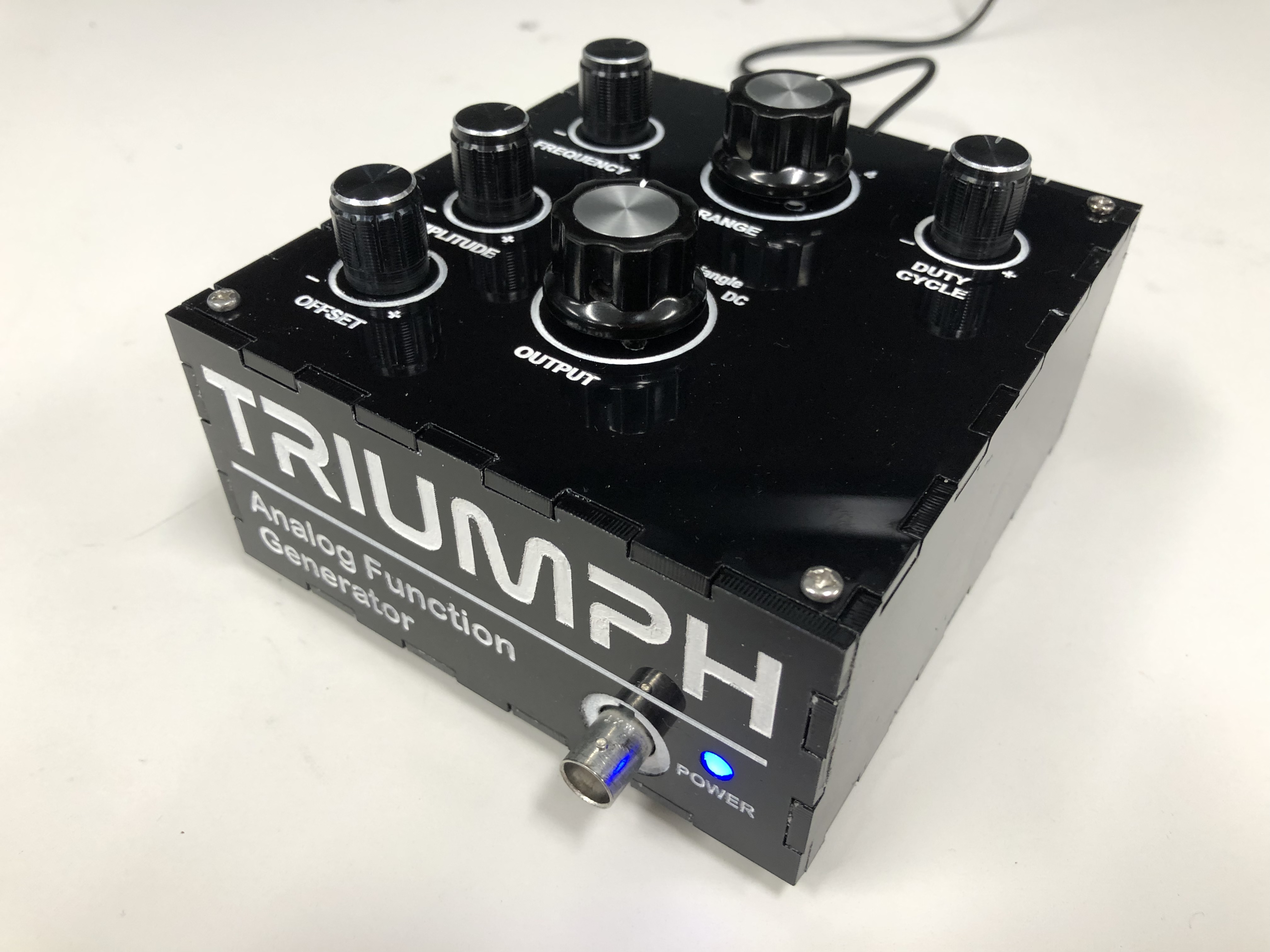
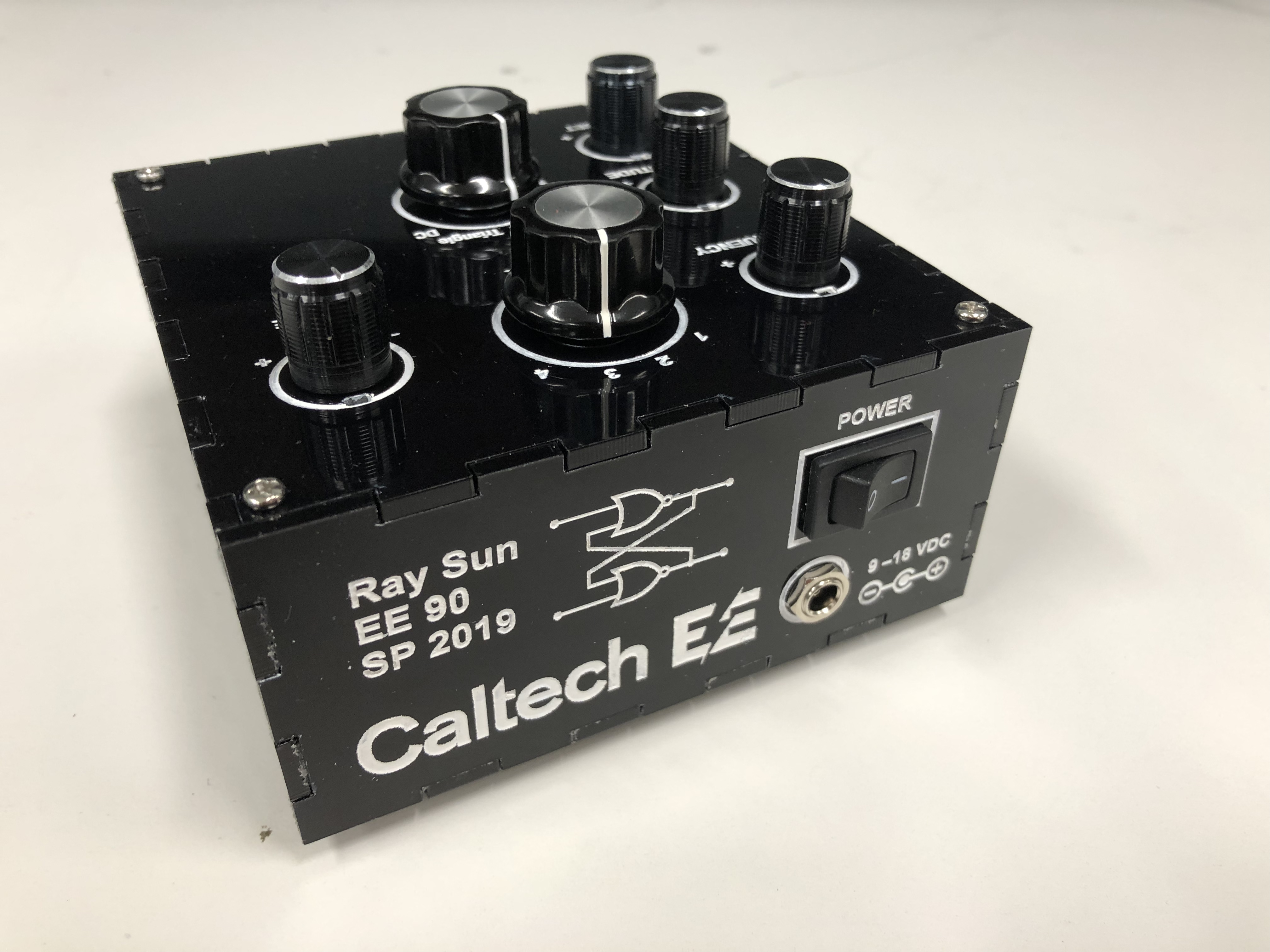
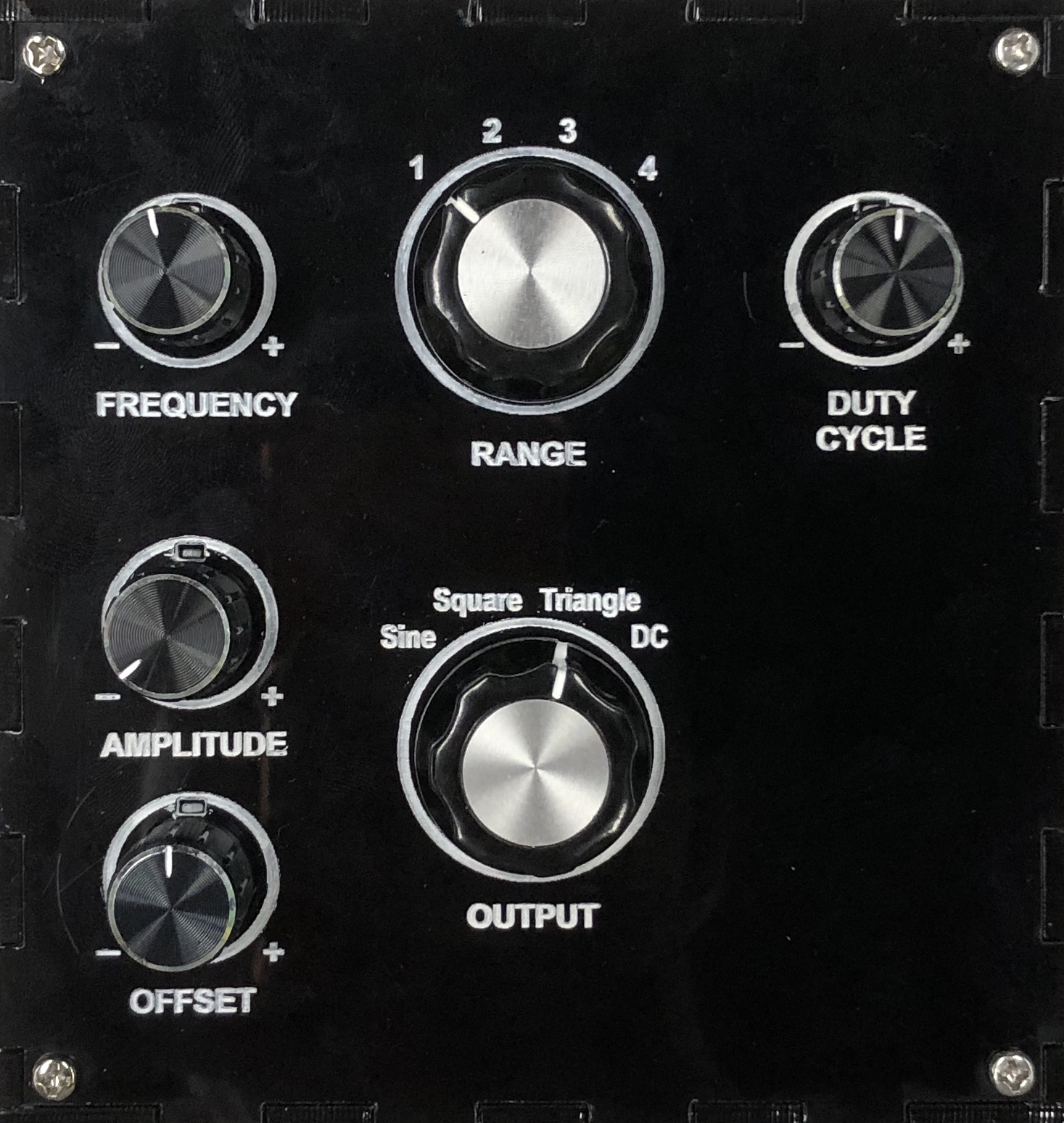
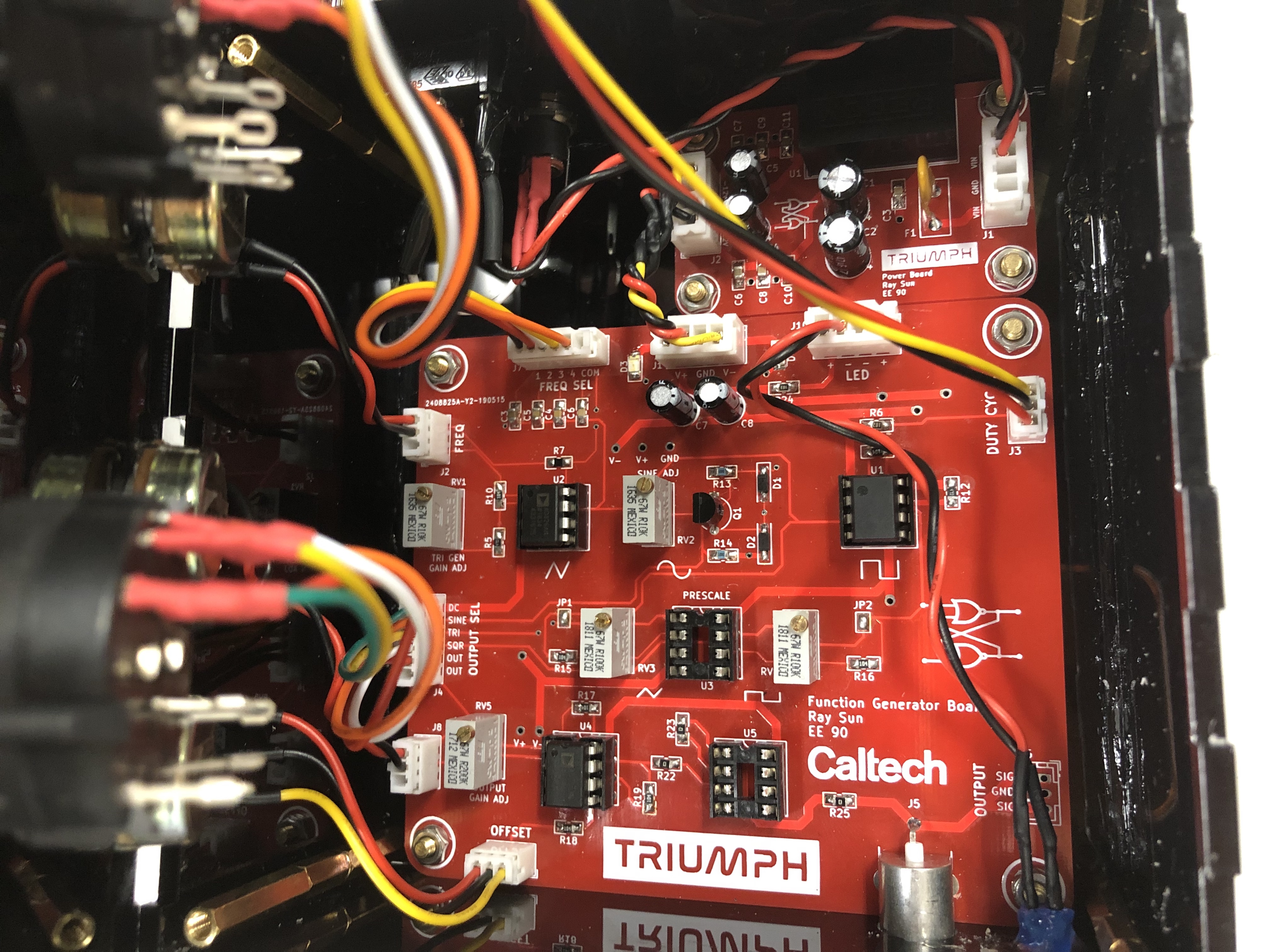
An integrator with Schmitt feedback is used to generate a base triangle wave, which is passed to a Middlebrook-Richer JFET converter to create a sine wave and also a comparator to create a square wave. A positive feedback circuit associated to the comparator provides square wave duty cycle control. A final output stage provides amplitude and offset control. This general architecture achieves a good balance among simplicity, reliability, and performance.
The electronics were split among two PCBs: a main board with the function generator circuitry, and a power board that functions as a DC-DC converter supplying the former with a dual polarity power supply.
The electronics were designed with KiCad EDA v. 5.1.2. The /triumph-main directory contains files, documentation, and fabrication output for the main board, while the /triumph-main-production directory contains files reflecting post-fabrication design changes. The /triumph-power directory contains files for the power board.
The enclosure was designed with SolidWorks 2018, CorelDraw X7, and the MakerCase box generator.
This project is released under the terms of the MIT License.
| Qty | Value | Footprint | References |
|---|---|---|---|
| 13 | 0.1uF | triumph:0805_C_HandSoldering | C1, C2, C4, C11, C12, C13, C14, C17, C18, C20, C21, C24, C25 |
| 6 | 0 | triumph:0805_R_HandSoldering | R1, R2, R3, R4, R22, R23 |
| 5 | 10K | triumph:0805_R_HandSoldering | R15, R16, R20, R21, R24 |
| 5 | 10K | Potentiometer_THT:Potentiometer_Bourns_3296W_Vertical | RV1, RV2, RV3, RV4, RV5 |
| 5 | 10uF | triumph:0805_C_HandSoldering | C3, C19, C22, C23, C26 |
| 5 | JST_PH_vert_01x03 | Connector_JST:JST_PH_B3B-PH-K_1x03_P2.00mm_Vertical | J2, J3, J6, J8, J9 |
| 4 | 100K | triumph:0805_R_HandSoldering | R8, R9, R10, R11 |
| 4 | 47K | triumph:0805_R_HandSoldering | R5, R17, R18, R19 |
| 4 | NE5532AP | Package_DIP:DIP-8_W7.62mm_Socket_LongPads | U2, U3, U4, U5 |
| 3 | 1uF | triumph:0805_C_HandSoldering | C5, C9, C10 |
| 2 | 0.01uF | triumph:0805_C_HandSoldering | C15, C16 |
| 2 | 10uF | Capacitor_THT:CP_Radial_D5.0mm_P2.00mm | C7, C8 |
| 2 | 1N4148 | triumph:D_SOD-123_HandSoldering | D1, D2 |
| 2 | 50 | triumph:0805_R_HandSoldering | R7, R25 |
| 2 | 68 | triumph:0805_R_HandSoldering | R13, R14 |
| 2 | BLUE | triumph:LED_1206_HandSoldering | D3, D4 |
| 2 | JST_PH_vert_01x06 | Connector_JST:JST_PH_B6B-PH-K_1x06_P2.00mm_Vertical | J4, J7 |
| 2 | JST_XH_vert_01x04 | Connector_JST:JST_XH_B4B-XH-A_1x04_P2.50mm_Vertical | J1, J10 |
| 2 | SJ_OPEN | Jumper:SolderJumper-2_P1.3mm_Open_TrianglePad1.0x1.5mm | JP1, JP2 |
| 1 | 10nF | triumph:0805_C_HandSoldering | C6 |
| 1 | 1K | triumph:0805_R_HandSoldering | R6 |
| 1 | 5K | triumph:0805_R_HandSoldering | R12 |
| 1 | Conn_BNC | triumph:Conn_BNC_73100-0154 | J5 |
| 1 | J310 | Package_TO_SOT_THT:TO-92_Inline_Wide | Q1 |
| 1 | LM211P | Package_DIP:DIP-8_W7.62mm_Socket_LongPads | U1 |
| 1 | LOGO | triumph-logos:ruddock-crest-l | G*** |
| 1 | LOGO | triumph-logos:triumph-logo-inv | G*** |
| 1 | LOGO | triumph-logos:rs | G*** |
| 1 | LOGO | triumph-logos:caltech | G*** |
| 1 | LOGO | triumph-logos:cit-ee-l | G*** |
The 83 most common of 87 parts.

josefadamcik/SofleKeyboard
A split keyboard based on Lily58, Crkbd and Helix keyboards

ataradov/usb-sniffer
Low-cost LS/FS/HS USB sniffer with Wireshark interface


sabogalc/KiCad-Arduino-Boards
A collection of Arduino boards recreated from scratch in KiCad. Legacy USB connectors have been replaced with USB-C where applicable.
It measures 99.1 × 86.4 mm and has 2 copper layers, 1.6 mm thick.
87 parts, built around the NE5532AP and LM211P. The full list of its parts is on this page, with links to each part's symbol and footprint where PCBKit's library has them.
From the rjhsun/triumph repository on GitHub, at the commit this page was made from: the board is triumph-main/triumph_main.kicad_pcb. PCBKit opens the board in the browser, with nothing to install.
Its repository publishes it under the MIT licence: you may reuse it on that licence's terms (keep the author's notice, and for a copyleft licence share your changes alike).