2 layers30 × 30 mm
0.96 OLED
rdhrobotics/RF-Hunter
A compact, standalone wireless security research device. Three tools in one — RF jammer, Wi-Fi deauther, and captive portal
64 parts

 rdhrobotics/RF-Hunter
A compact, standalone wireless security research device. Three tools in one — RF jammer, Wi-Fi deauther, and captive portal
RD Deauther is an open-source printed circuit board by rdhrobotics, from the rdhrobotics/RF-Hunter repository on GitHub. It is a 2-layer board of 45.8 × 60 mm with 55 parts on 73 nets, routed with 456 tracks and 39 vias.
It is built around the CH340C, ESP-12F and ME6211C33M5G-N, with the TP4057 and BC847 among its other parts. Its parts include 22 resistors, 9 switches, 6 ICs, 5 capacitors and 4 connectors. It belongs with the radio and wireless boards and the ESP8266 boards of this library.


ESP8266 + nRF24L01 · OLED Display · Open Source Hardware & Firmware

 [blocked]
 [blocked]
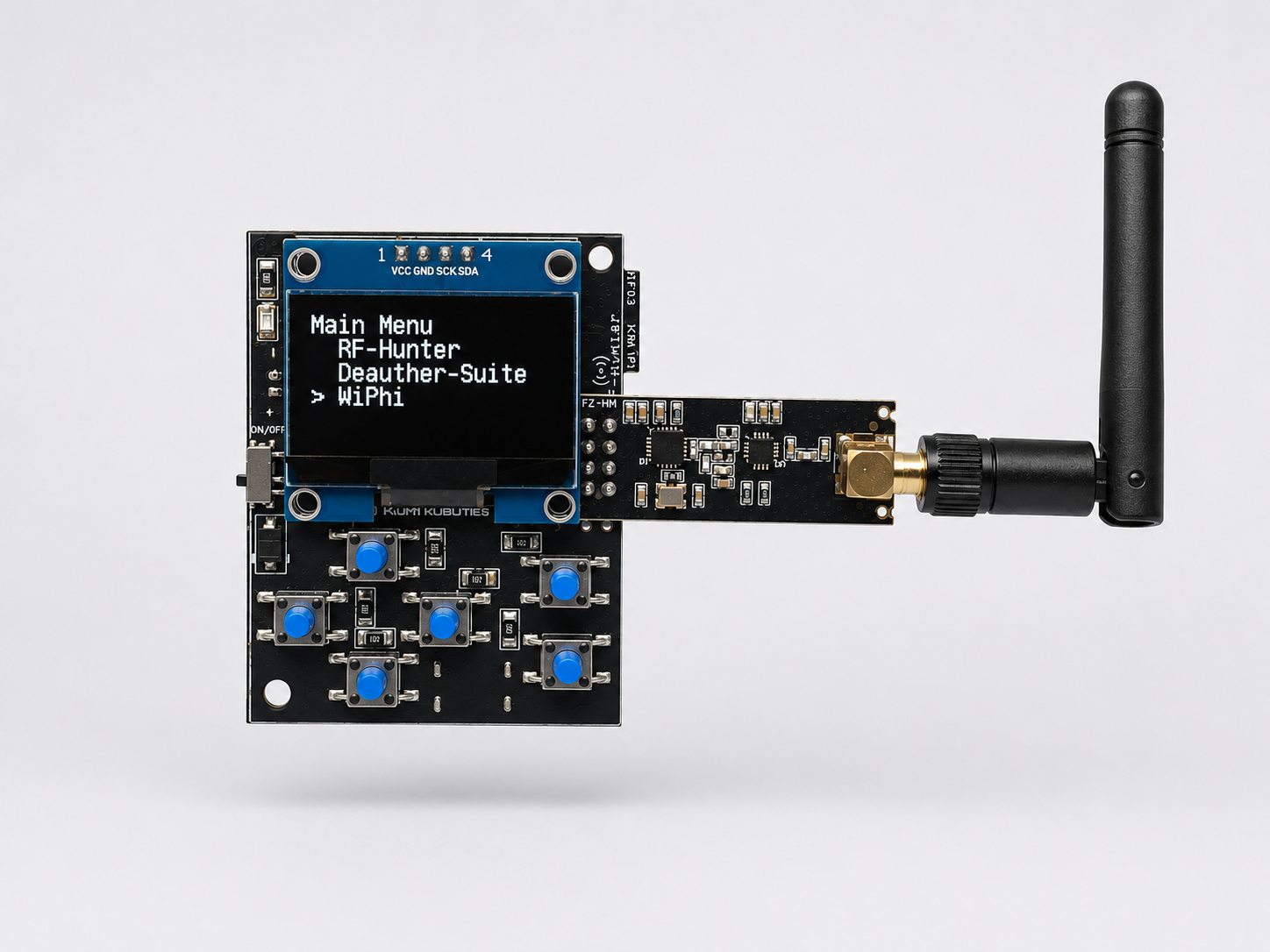
A compact, standalone wireless security research device. Three tools in one — RF jammer, Wi-Fi deauther, and captive portal testbed — controlled from a 128×64 OLED display and 6-button keypad. No laptop required.
If you want to skip the build and get straight to learning:
→ Buy RF-Hunter at rdhrobotics.in
Assembled, tested, and shipped. Includes quick-start card.
The RF-Hunter is a hardware platform for studying 2.4 GHz wireless security concepts hands-on. It runs three independent research modules from a unified launcher UI:
| Module | Description |
|---|---|
| RF-Hunter | nRF24 constant carrier jammer. BLE + all 2.4 GHz or Wi-Fi channels only.. |
| Deauther Suite | spacehuhn esp8266_deauther engine. Scan, select, deauth, beacon flood, probe attack. |
| WiPhi | Deauth + EvilTwin + captive portal credential harvester with EEPROM vault. |
| RF Chat | (bonus sketch) Point-to-point text chat over raw nRF24 radio. |
Everything is navigated from the OLED + keypad, or remotely via the built-in web admin panel at 192.168.4.1.
| Component | Part |
|---|---|
| MCU | ESP8266 (80/160 MHz, 2.4 GHz Wi-Fi) |
| RF module | nRF24L01+ PA+LNA |
| Display | SH1106 128×64 OLED (I²C) |
| Input | 6-button ADC keypad (voltage divider) |
| Storage | EEPROM — 5-slot credential vault, persists across reboots |
nRF24L01   CE  → GPIO16
           CSN → GPIO15

SH1106     SDA → GPIO4
SCL → GPIO5#define BTN_UP 135
#define BTN_DOWN 579
#define BTN_LEFT 426
#define BTN_RIGHT 634
#define BTN_ENTER 729
#define BTN_BACK 687Adjust values to match your resistor network.
RF24, ESP8266WiFi, DNSServer, ESP8266WebServer, SH1106Wire (ESP8266-OLED), ADCButton, ArduinoJson v5git clone https://github.com/rdhrobotics/RF-Hunter.gitOpen RFHunter/RFHunter.ino in Arduino IDE. Select Generic ESP8266 (Deauther) as the board. Flash at 115200 baud.
RF-Hunter/
├── RFHunter/
│   └── RFHunter.ino        ← main sketch (all three tools)
│
├── Hardware Source/
│   ├── RD_Deauther.pdf // schematic
│ └── RD_Deauther.kicad_pro // Kicad Project┌─────────────────┐
│ Main Menu │ ← Launcher
│ > RF-Hunter │
│ Deauther │
│ WiPhi │
└─────────────────┘
│
├── RF-Hunter → select mode → running (BACK to stop)
├── Deauther → full spacehuhn DisplayUI
└── WiPhi → scan → select AP → attack → captured PWHold BACK for 5 seconds from any mode to return to the launcher main menu.
The launcher uses a mode table — drop in a new attack without touching the state machine.
Step 1 — declare your functions:
void myMode_init();
void myMode_tick();
Step 2 — add a row to the table:
const NrfMode NRF_MODES[] = {
    { "BLE & All 2.4GHz", nrfAttackAllInit,  nrfAttackAllTick,  true },
    { "Just Wi-Fi",       nrfAttackWiFiInit, nrfAttackWiFiTick, true },
    { "My New Mode",      myMode_init,       myMode_tick,       false }, // ← add here
};
Step 3 — write the functions anywhere below. Done.
WiPhi saves captured credentials to EEPROM and survives power cycles.
Addr 0        Magic byte (0xAB) — detects first boot
Addr 1–485    5 slots × (1 valid flag + 32 SSID + 64 PW)

WiPhi vault (in Launcher, offset to avoid deauther collision):
Addr 2000     Magic byte (0xBC)
Addr 2001+    Same slot layout × 5
Browse and delete saved passwords from the OLED: Main Menu → Saved Passwords.
While WiPhi is running, connect to:
SSID:     WiPhi_34732
Password: d347h320
URL:      http://192.168.4.1/admin
The web UI and OLED run simultaneously — control from either.
This project is fully open source — firmware and hardware both.
| License | |
|---|---|
| Firmware | MIT |
| Hardware (schematic, BOM) | CERN OHL v2 Permissive |
The Deauther Suite module uses the spacehuhn/esp8266_deauther engine, which is also MIT licensed.
Pull requests welcome. See CONTRIBUTING.md for guidelines.
This device is built for authorized security research, CTF competitions, and educational use.
by @rdhrobotics — open hardware for security education.
| Qty | Value | Footprint | References |
|---|---|---|---|
| 8 | 10k | PCM_Resistor_SMD_AKL:R_1206_3216Metric_Pad1.30x1.75mm | R3, R4, R5, R6, R7, R8, R9, R15 |
| 6 | 2K | PCM_Resistor_SMD_AKL:R_1206_3216Metric_Pad1.30x1.75mm | R16, R17, R18, R19, R20, R21 |
| 6 | SW_Push | Button_Switch_SMD:SW_Push_1P1T_NO_E-Switch_TL3301NxxxxxG | SW1, SW2, SW3, SW4, SW5, SW6 |
| 3 | 100nF | PCM_Capacitor_SMD_AKL:C_1206_3216Metric_Pad1.33x1.80mm_HandSolder | C1, C4, C5 |
| 3 | LOGO | LOGO | G***, G***, G*** |
| 2 | 10uF | PCM_Capacitor_SMD_AKL:C_1206_3216Metric_Pad1.33x1.80mm_HandSolder | C2, C3 |
| 2 | 1K | PCM_Resistor_SMD_AKL:R_1206_3216Metric_Pad1.30x1.75mm | R12, R14 |
| 2 | 470E | PCM_Resistor_SMD_AKL:R_1206_3216Metric_Pad1.30x1.75mm | R1, R2 |
| 2 | 5.1k | PCM_Resistor_SMD_AKL:R_1206_3216Metric_Pad1.30x1.75mm | R10, R11 |
| 2 | BC847 | PCM_Package_TO_SOT_SMD_AKL:SOT-23 | Q1, Q2 |
| 2 | HH | MountingHole:MountingHole_3.2mm_M3 | H1, H2 |
| 2 | NRF24L01_Breakout | RF_Module:nRF24L01_Breakout | U4, U6 |
| 2 | SW_Push | Button_Switch_SMD:SW_SPST_TL3342 | SW8, SW9 |
| 1 | 10K | PCM_Resistor_SMD_AKL:R_1206_3216Metric_Pad1.30x1.75mm | R22 |
| 1 | 2.2K | PCM_Resistor_SMD_AKL:R_1206_3216Metric_Pad1.30x1.75mm | R13 |
| 1 | Battery | Connector_JST:JST_PH_B2B-PH-K_1x02_P2.00mm_Vertical | J4 |
| 1 | CH340C | Package_SO:SOIC-16_3.9x9.9mm_P1.27mm | U1 |
| 1 | ESP-12F | RF_Module:ESP-12E | U3 |
| 1 | GPIO's | Connector_PinSocket_2.54mm:PinSocket_2x06_P2.54mm_Vertical | J3 |
| 1 | HT7833 | Package_TO_SOT_SMD:SOT-23-5 | U2 |
| 1 | LED | LED_SMD:LED_1206_3216Metric_Pad1.42x1.75mm_HandSolder | D1 |
| 1 | M7 | PCM_Diode_SMD_AKL:D_SMA | D2 |
| 1 | OLE-Display | Library:OLED-1.3Inch | J2 |
| 1 | ON/OFF | Button_Switch_SMD:SW_SPDT_PCM12 | SW7 |
| 1 | TP4057 | Package_TO_SOT_SMD:TSOT-23-6 | U5 |
| 1 | USB-C-P16 | Connector_USB:USB_C_Receptacle_GCT_USB4105-xx-A_16P_TopMnt_Horizontal | J1 |
rdhrobotics/RF-Hunter
A compact, standalone wireless security research device. Three tools in one — RF jammer, Wi-Fi deauther, and captive portal


Phunkafizer/RFM-gateway
Hard- and software for the RFM-gateway, a universal platform for integrating sub-GHz radio into your WiFi network

17o2/bluetooth-minidisc
Adding built-in bluetooth connectivity to a 20-year-old Mindisc player


caterpy/Kicad-CheeseCake-SlimeTrackers-edit-
newslimes-cheesecake edit

rdhrobotics/BleBomB-Hardware
BleBomB is a compact embedded 2.4 GHz RF noise generator based on NRF24L01+ and MM32G0001A1T. Includes KiCad schematic, PCB, and Gerber files.

sean618/MakerTiles
Modular STM32 electronic-tile system: hardware, firmware, the MicroBus + Field Protocol stack, and a Python daemon.
It measures 45.8 × 60 mm and has 2 copper layers, 1.6 mm thick.
55 parts, built around the CH340C, ESP-12F, ME6211C33M5G-N and TP4057. The full list of its parts is on this page, with links to each part's symbol and footprint where PCBKit's library has them.
From the rdhrobotics/RF-Hunter repository on GitHub, at the commit this page was made from: the board is Hardware Source/RD_Deauther.kicad_pcb and its schematic Hardware Source/RD_Deauther.kicad_sch. PCBKit opens the board in the browser, with nothing to install.
Its repository states no licence, so its author keeps all rights: ask rdhrobotics before reusing the design.