
2 layers
MP Tracker
elektra42/freifunk-open-mppt
Open hard- and software solar maximum power point tracker
70 parts89
 q3k/hacklock5
An open source RFID lock for hackerspaces and more!
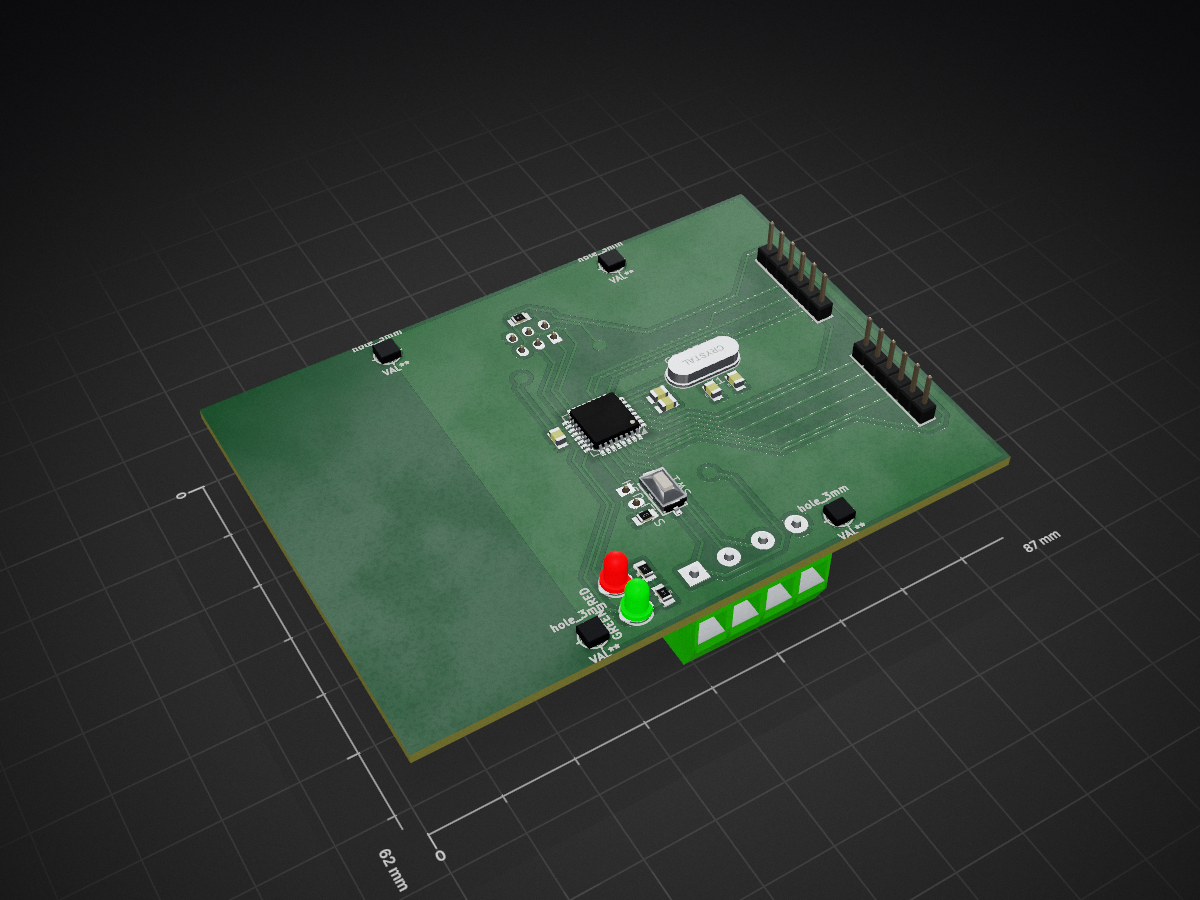
Keypad is an open-source printed circuit board by q3k, from the q3k/hacklock repository on GitHub. It is a 2-layer board of 87 × 62 mm with 23 parts on 34 nets, routed with 194 tracks and 5 vias.
It is built around the ATMEGA8A-AU. Its parts include 5 capacitors, 4 resistors, 4 connectors, 1 switch and 1 crystal. It belongs with the keyboards and input boards and the AVR (ATmega, ATtiny) boards of this library.
This is the Hackerspace Warsaw electronic lock mk2 project.
Work in progress! This is a prototype for a TP-Link WR703n based hardware solution - with a I2C bus on which there is a MAX7300 IO expander and a PN532 NFC tag reader. The I2C is software bit-banged by the kernel, drivers for both the IO expander and the PN532 are written in Lua.
The hacklock is mae out of two separate pieces of hardware:
Right now the project is in a prototype status. The keypad part is nearly identical to what will be in production, except that the PCB is home-etched.
The main lock part itself is however based on a TP-Link WR703N router with OpenWRT and a software I2C bus. In the future, it will probably be replaced woth a custom i.MX233-based 4-layer board.
Feel free to hack around. The whole project, however, is not anywhere near release, so things will change around and probably make no sense at the moment.
| Qty | Value | Footprint | References |
|---|---|---|---|
| 4 | VAL** | hole_3mm | hole_3mm, hole_3mm, hole_3mm, hole_3mm |
| 3 | 100n | c_0805 | C1, C2, C3 |
| 2 | 220 | r_0805 | R5, R6 |
| 2 | 22p | c_0805 | C4, C5 |
| 2 | 40k | r_0805 | R3, R4 |
| 2 | HEADER_6 | pin_strip_6 | J1, J2 |
| 1 | ATMEGA8 | lqfp32 | I1 |
| 1 | BUZZER | pin_strip_2 | BZ1 |
| 1 | CRYSTAL | crystal_hc-49s | X1 |
| 1 | GREEN | led_3mm_green | LD1 |
| 1 | I2C | mors_4p | J4 |
| 1 | ISP | pin_strip_3x2 | J3 |
| 1 | RED | led_3mm_red | LD2 |
| 1 | SW_PUSH | smd_push | SW1 |
It measures 87 × 62 mm and has 2 copper layers, 1.6 mm thick.
23 parts, built around the ATMEGA8A-AU. The full list of its parts is on this page, with links to each part's symbol and footprint where PCBKit's library has them.
From the q3k/hacklock repository on GitHub, at the commit this page was made from: the board is hardware/keypad/keypad.kicad_pcb. PCBKit opens the board in the browser, with nothing to install.
Its repository states no licence, so its author keeps all rights: ask q3k before reusing the design.
elektra42/freifunk-open-mppt
Open hard- and software solar maximum power point tracker


baranovskiykonstantin/aquarium
Control the lighting and the heating of the aquarium.

a-sakharov/LptToUsbAdapter
Solution for connecting old LPT device to modern PC via USB

HDR/XenoGC-Flex
Flashing is done over isp, a raspberry pi can be used for this, see https://github.com/HDR/RaspberryPiISP


