
2 layers207 × 52 mm

 profdc9/GuitarPico49
A guitar effects processor based on the Raspberry Pi Pico
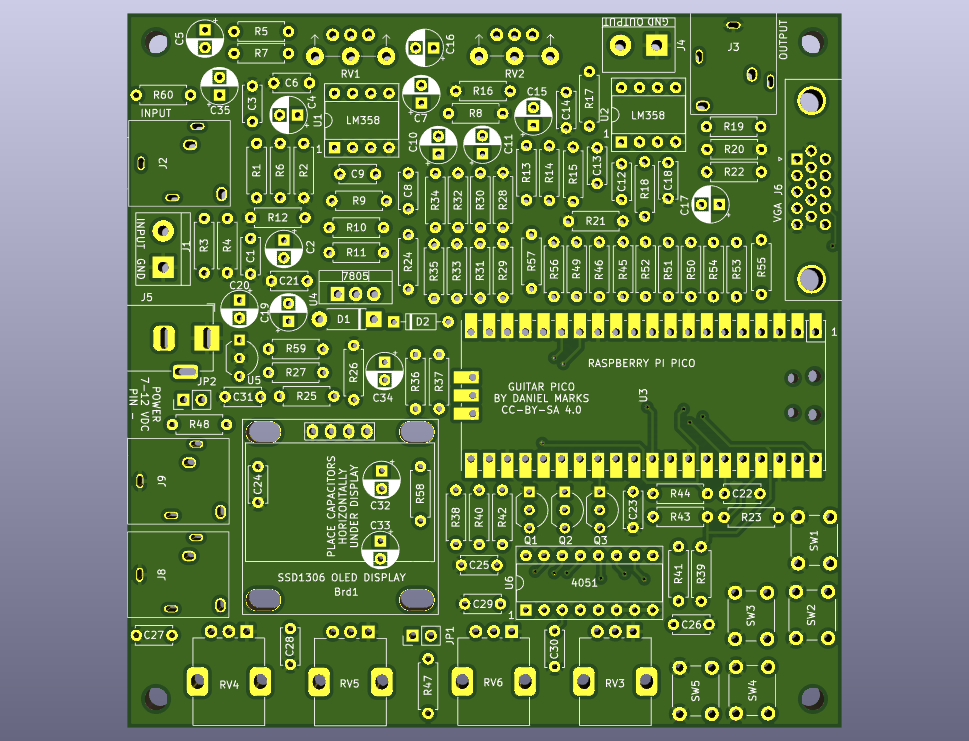
GuitarPico is an open-source printed circuit board by profdc9, from the profdc9/GuitarPico repository on GitHub. It is a 2-layer board of 100 × 100 mm with 132 parts on 105 nets, routed with 950 tracks and 14 vias.
It is built around the LM358. Its parts include 60 resistors, 35 capacitors, 8 connectors, 6 ICs and 5 switches. It belongs with the audio and music boards and the RP2040 boards of this library.
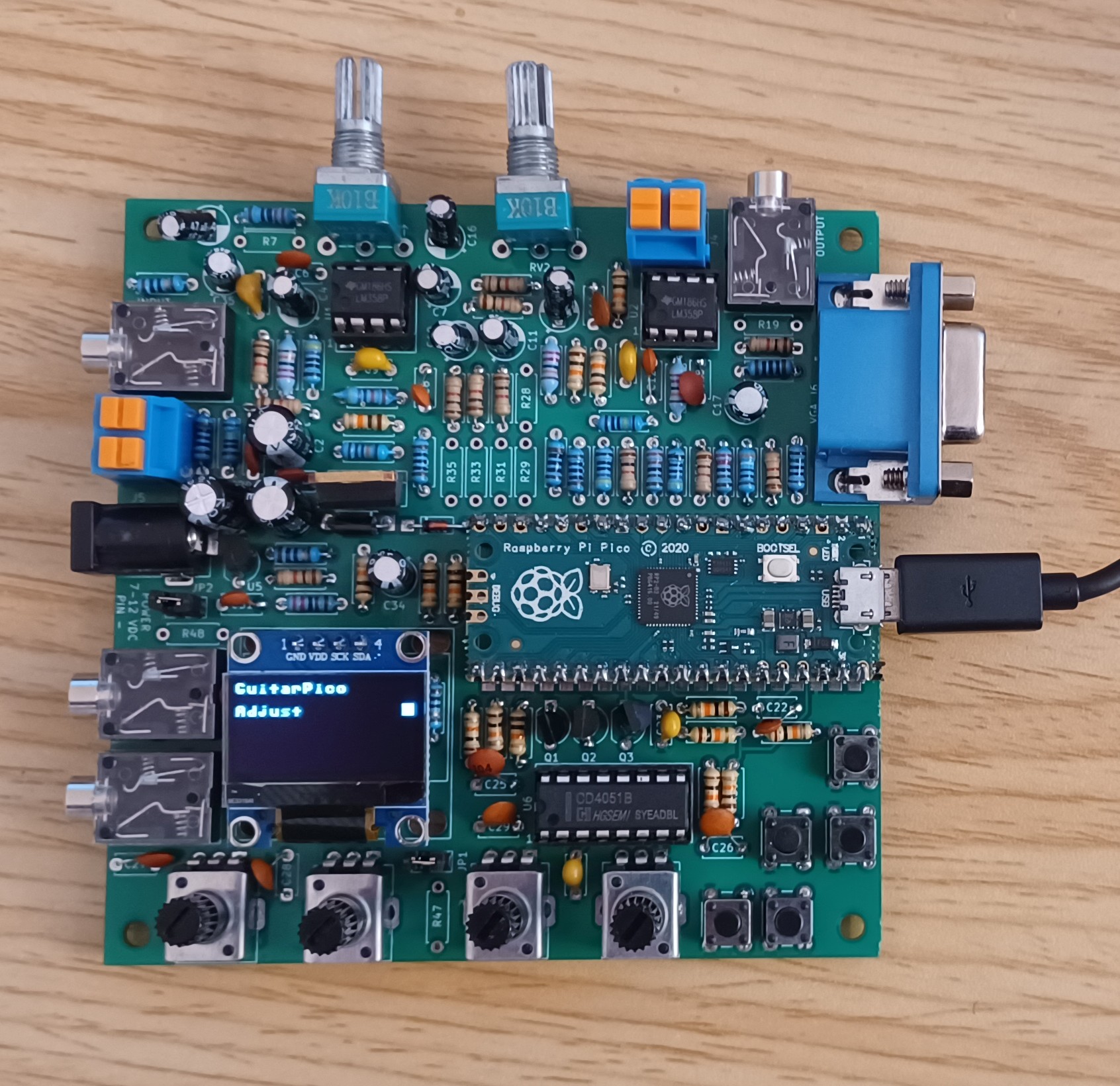
This is a guitar effects processor based on the Raspberry Pi Pico. A video of some of the effects is at
https://www.youtube.com/watch?v=15d9mEu2koQ
It includes the following effects:
The effects may be cascaded, to up to 16 in a sequence. The settings of a particular sequence of effects may be saved in flash memory. Because the effects are processed one sample at a time in real-time, the lag due to the processing is only 50 microseconds.
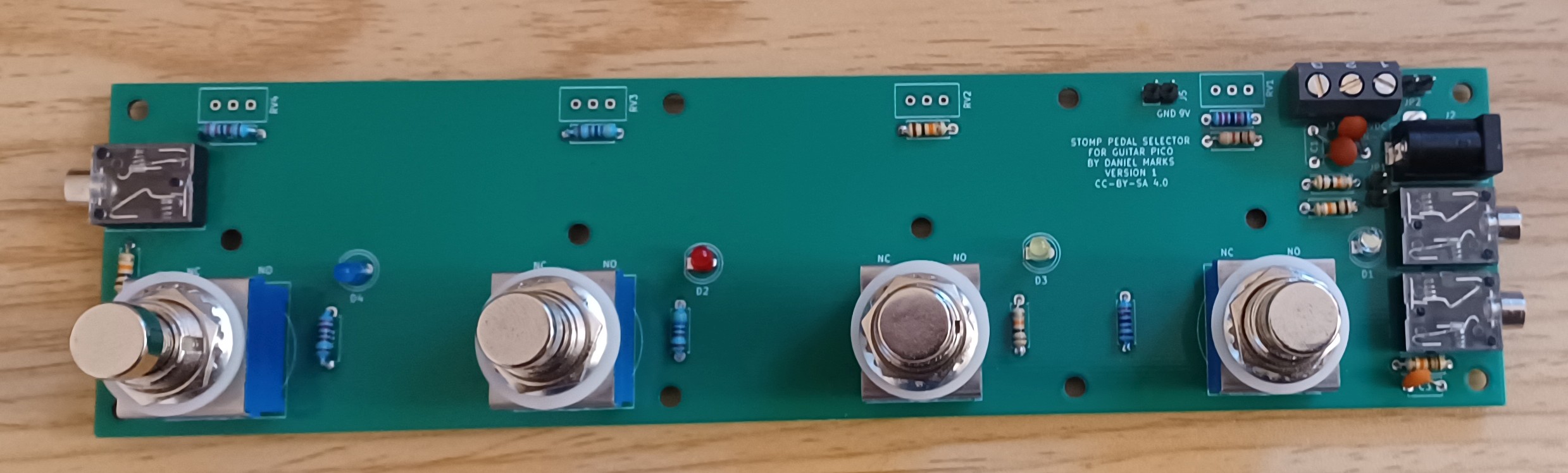
There is a stomp pedal which may be used to one of four saved settings, based on which of the four buttons is stomped on. It does not require power to operate.
The pedal has four potentiometers that may be assigned to control various aspects of effects operation. There are also two external inputs. These can be used with the stomp pedal, or with an expression pedal to control aspects of the effects.
There is also a feature to determine the frequency and note being played, to help with tuning a guitar. Also, if plugged into USB, notes played on the guitar are sent as MIDI events to the PC to turn the guitar into a MIDI instruments. However, this feature is imperfect (but this useful for tuning).
As well as a MIDI device, the guitar pedal appears as a COM port. The effect settings may be retrieved from the pedal or programmed into the pedal through this interface using text commands at a prompt. Type "HELP" for a list of the commands. For example, typing "CONF 0 0" lists all of the current effects configuration data. The data is output in the form of the commands used to reprogram the same state back into the device, so these may be directly copied into a text file and pasted back into a terminal to recreate the configuration.
There is also a VGA port that will be used to implement video effects.
The hardware is licensed under CC-BY-SA 4.0 and software under the zlib license (no warranty, yes commercial and noncommercial use), both open source licenses.
| Qty | Value | Footprint | References |
|---|---|---|---|
| 16 | 1k | Resistor_THT:R_Axial_DIN0207_L6.3mm_D2.5mm_P7.62mm_Horizontal | R1, R8, R10, R12, R14, R15, R16, R17, R20, R27, R30, R32, R34, R46, R51, R53 |
| 12 | 10k | Resistor_THT:R_Axial_DIN0207_L6.3mm_D2.5mm_P7.62mm_Horizontal | R11, R23, R26, R36, R37, R38, R39, R40, R41, R42, R43, R44 |
| 11 | 100 nF | Capacitor_THT:C_Disc_D5.0mm_W2.5mm_P5.00mm | C1, C6, C14, C18, C21, C24, C25, C26, C27, C28, C29 |
| 8 | 10 uF | Capacitor_THT:CP_Radial_D5.0mm_P2.50mm | C4, C5, C7, C10, C11, C15, C16, C17 |
| 5 | 100 uF | Capacitor_THT:CP_Radial_D5.0mm_P2.50mm | C2, C19, C20, C34, C35 |
| 5 | 100R | Resistor_THT:R_Axial_DIN0207_L6.3mm_D2.5mm_P7.62mm_Horizontal | R3, R22, R24, R56, R57 |
| 5 | 2k | Resistor_THT:R_Axial_DIN0207_L6.3mm_D2.5mm_P7.62mm_Horizontal | R28, R29, R31, R33, R35 |
| 5 | SW_Push | Button_Switch_THT:SW_PUSH_6mm | SW1, SW2, SW3, SW4, SW5 |
| 4 | 10k | Potentiometer_THT:Potentiometer_Alps_RK09K_Single_Vertical | RV3, RV4, RV5, RV6 |
| 4 | MountingHole | MountingHole:MountingHole_3.2mm_M3 | H1, H2, H3, H4 |
| 4 | NC | Resistor_THT:R_Axial_DIN0207_L6.3mm_D2.5mm_P7.62mm_Horizontal | R7, R19, R47, R48 |
| 3 | 10R | Resistor_THT:R_Axial_DIN0207_L6.3mm_D2.5mm_P7.62mm_Horizontal | R58, R59, R60 |
| 3 | 2N3904 | Package_TO_SOT_THT:TO-92_Inline_Wide | Q1, Q2, Q3 |
| 3 | 2k2 | Resistor_THT:R_Axial_DIN0207_L6.3mm_D2.5mm_P7.62mm_Horizontal | R25, R45, R50 |
| 3 | 470R | Resistor_THT:R_Axial_DIN0207_L6.3mm_D2.5mm_P7.62mm_Horizontal | R2, R49, R52 |
| 3 | INPUT | GuitarPico:PJ-3240-35mm-stereo | J2, J8, J9 |
| 2 | 10 nF | Capacitor_THT:C_Disc_D5.0mm_W2.5mm_P5.00mm | C22, C31 |
| 2 | 100 pF | Capacitor_THT:C_Disc_D5.0mm_W2.5mm_P5.00mm | C23, C30 |
| 2 | 10k | GuitarPico:Potentiometer_Big_Small_Combined | RV1, RV2 |
| 2 | 1M | Resistor_THT:R_Axial_DIN0207_L6.3mm_D2.5mm_P7.62mm_Horizontal | R4, R21 |
| 2 | 22 nF | Capacitor_THT:C_Disc_D5.0mm_W2.5mm_P5.00mm | C8, C12 |
| 2 | 220 uF | Capacitor_THT:CP_Radial_D5.0mm_P2.50mm | C32, C33 |
| 2 | 220k | Resistor_THT:R_Axial_DIN0207_L6.3mm_D2.5mm_P7.62mm_Horizontal | R6, R18 |
| 2 | LM358 | Package_DIP:DIP-8_W7.62mm_Socket | U1, U2 |
| 2 | POWER | Connector_PinHeader_2.54mm:PinHeader_1x02_P2.54mm_Vertical | JP1, JP2 |
| 1 | 1000 pF | Capacitor_THT:C_Disc_D5.0mm_W2.5mm_P5.00mm | C3 |
| 1 | 150R | Resistor_THT:R_Axial_DIN0207_L6.3mm_D2.5mm_P7.62mm_Horizontal | R55 |
| 1 | 1N4148 | Diode_THT:D_DO-35_SOD27_P7.62mm_Horizontal | D2 |
| 1 | 1N5819 | Diode_THT:D_DO-41_SOD81_P7.62mm_Horizontal | D1 |
| 1 | 2200 pF | Capacitor_THT:C_Disc_D5.0mm_W2.5mm_P5.00mm | C9 |
| 1 | 220R | Resistor_THT:R_Axial_DIN0207_L6.3mm_D2.5mm_P7.62mm_Horizontal | R5 |
| 1 | 22k | Resistor_THT:R_Axial_DIN0207_L6.3mm_D2.5mm_P7.62mm_Horizontal | R13 |
| 1 | 390R | Resistor_THT:R_Axial_DIN0207_L6.3mm_D2.5mm_P7.62mm_Horizontal | R54 |
| 1 | 4051 | Package_DIP:DIP-16_W7.62mm_Socket | U6 |
| 1 | 4700 pF | Capacitor_THT:C_Disc_D5.0mm_W2.5mm_P5.00mm | C13 |
| 1 | 4k7 | Resistor_THT:R_Axial_DIN0207_L6.3mm_D2.5mm_P7.62mm_Horizontal | R9 |
| 1 | Barrel_Jack_Switch | Connector_BarrelJack:BarrelJack_Horizontal | J5 |
| 1 | INPUT | TerminalBlock:TerminalBlock_bornier-2_P5.08mm | J1 |
| 1 | LM7805_TO220 | Package_TO_SOT_THT:TO-220-3_Vertical | U4 |
| 1 | OUTPUT | TerminalBlock:TerminalBlock_bornier-2_P5.08mm | J4 |
| 1 | OUTPUT | GuitarPico:PJ-3240-35mm-stereo | J3 |
| 1 | Pico | GuitarPico:RPi_Pico_SMD_TH | U3 |
| 1 | SSD1306 | GuitarPico:128x64OLED | Brd1 |
| 1 | TL431LP | Package_TO_SOT_THT:TO-92_Inline_Wide | U5 |
| 1 | VGA | Connector_Dsub:DSUB-15-HD_Female_Horizontal_P2.29x1.98mm_EdgePinOffset3.03mm_Housed_MountingHolesOffset4.94mm | J6 |

peterheinrich/InternetOverSpaghetti
Transmitting IP packages over a pair of spaghetti thus demonstrating how media independent IP really is.

zmaker/arduino_cookbook
gli sketch del nuovo progetto Arduino Cookbook e dei video di YouTube

profdc9/RFBitBanger
A QRP digital transceiver created from readily available parts for off-the-grid maintenance


tvlad1234/pillScopePlus
Oscilloscope based around the STM32F401 Black Pill and a color LCD screen


starlightk7/OpenSFC
OSHW Reproduction Parts related to the Super Famicom / Super Nintendo game console

It measures 100 × 100 mm and has 2 copper layers, 1.6 mm thick.
132 parts, built around the LM358. The full list of its parts is on this page, with links to each part's symbol and footprint where PCBKit's library has them.
From the profdc9/GuitarPico repository on GitHub, at the commit this page was made from: the board is GuitarPico/GuitarPico.kicad_pcb and its schematic GuitarPico/GuitarPico.kicad_sch. PCBKit opens the board in the browser, with nothing to install.
Its repository states no licence, so its author keeps all rights: ask profdc9 before reusing the design.