


2 layers72.5 × 27.5 mm

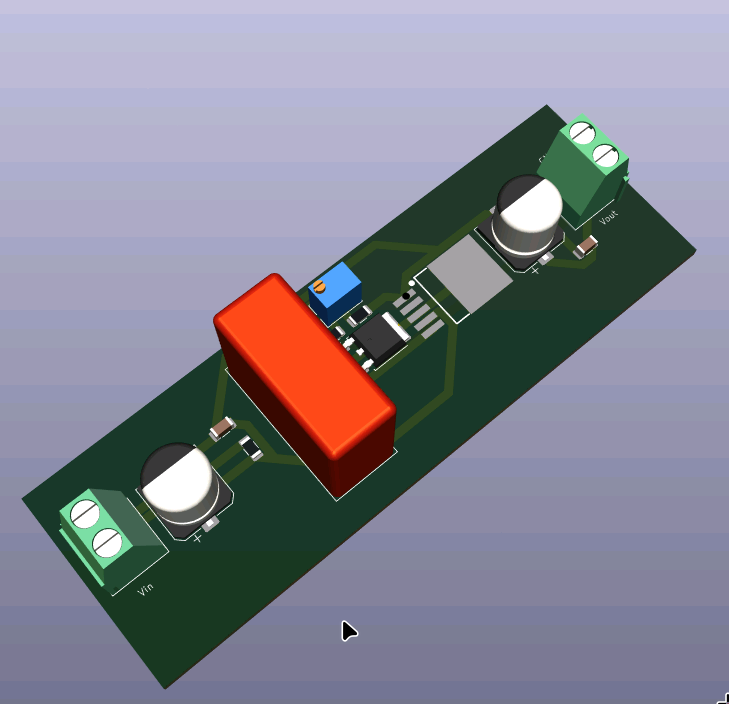
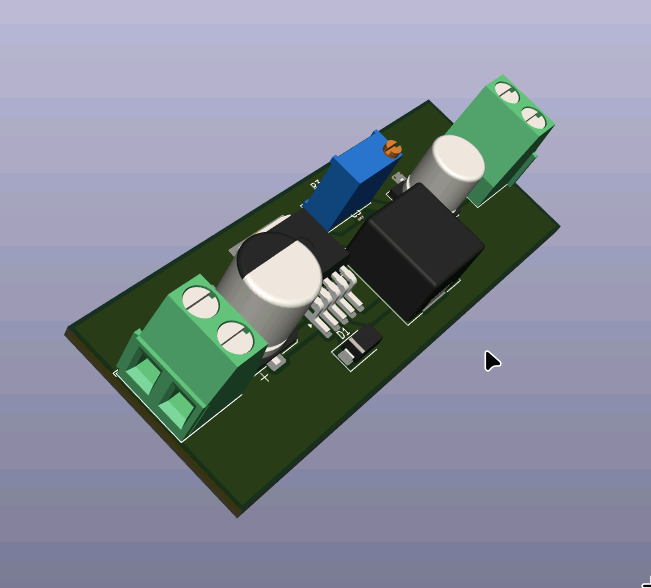
Boost is an open-source printed circuit board by Pegoku, from the Pegoku/dc-dc-converters repository on GitHub. It is a 2-layer board of 105 × 35 mm with 13 parts on 8 nets, routed with 84 tracks and 13 vias.
It is built around the XL6019E1 and MBRD1045. Its parts include 4 capacitors, 3 resistors, 2 connectors, 1 IC and 1 diode.
| Qty | Value | Footprint | References |
|---|---|---|---|
| 2 | 1uF | Capacitor_SMD:C_1206_3216Metric | C2, C3 |
| 2 | 220uF/60V | Capacitor_SMD:CP_Elec_10x10.5 | C1, C4 |
| 2 | Screw_Terminal_01x02 | TerminalBlock_Phoenix:TerminalBlock_Phoenix_MKDS-1,5-2-5.08_1x02_P5.08mm_Horizontal | J1, J2 |
| 1 | 100k | Potentiometer_THT:Potentiometer_Bourns_3266Y_Vertical | R3 |
| 1 | 3k | Resistor_SMD:R_1206_3216Metric | R2 |
| 1 | 41k | Resistor_SMD:R_1206_3216Metric | R1 |
| 1 | 47uH/6A | Capacitor_THT:C_Rect_L26.5mm_W11.5mm_P22.50mm_MKS4 | L1 |
| 1 | 5A | Fuse:Fuse_1206_3216Metric | F1 |
| 1 | MBRD1045 | Package_TO_SOT_SMD:TO-252-2 | D1 |
| 1 | XL6019E1 | easyeda2kicad:TO-263-5_L10.2-W9.9-P1.70-LS14.4-TL | U1 |

Froggy111/RBC-soccer-2025
software and hardware for team BotByWire, Robocup Junior Soccer Lightweight 2025

justinlindh/digits
Encrypted retro phone network — private VoIP over vintage desk phones

Boardoza/Boardoza_XL6019E1_DC_DC_Boost_Breakout_Board
High-efficiency DC-DC boost converter board with selectable high-voltage outputs based on the XL6019E1.


kwiecinski/BMS-and-offgrid-photovoltaic-management-system
Project contains BMS for lead-acid batteries and ESP-based board used to pull information from EASUN offgrid inverter, energy meters and sensors.

class-ab/open-soccer
Mindstormers' open soccer repo. contains code, pcbs, elec, diagrams, etc...

It measures 105 × 35 mm and has 2 copper layers, 1.6 mm thick.
13 parts, built around the XL6019E1 and MBRD1045. The full list of its parts is on this page, with links to each part's symbol and footprint where PCBKit's library has them.
From the Pegoku/dc-dc-converters repository on GitHub, at the commit this page was made from: the board is boost/boost.kicad_pcb and its schematic boost/boost.kicad_sch. PCBKit opens the board in the browser, with nothing to install.
Its repository states no licence, so its author keeps all rights: ask Pegoku before reusing the design.