

2 layers72 × 42 mm
NRF24 jammer
W0rthlessS0ul/nRF24_jammer
The nRF24 jammer is a powerful tool that requires an ESP32 and configurable numbers of NRF24 modules to assemble.
51 parts1kMIT

 orkanm/HARem3
This project implements a "Thin Client" smart home remote using ESPHome on an ESP32-C3. It features a 5-line OLED display with scrolling text and a rotary encoder to navigate Home Assistant Areas dynamically.
HARem is an open-source printed circuit board by orkanm, from the orkanm/HARem repository on GitHub, published under the MIT licence. It is a 2-layer board of 70 × 38 mm with 14 parts on 24 nets, routed with 124 tracks and 3 vias.
It is built around the BC817. Its parts include 6 resistors, 2 capacitors, 2 ICs, 1 transistor and 1 connector. It belongs with the home automation and IoT and lEDs and displays boards and the ESP32 and RISC-V boards of this library.
HARem is a high-performance, minimalist "Thin Client" remote controller designed for the modern smart home. Built on the ESPHome ecosystem and powered by the ESP32-C3, it provides a boutique-quality physical interface that prioritizes speed, aesthetics, and zero-maintenance operation.
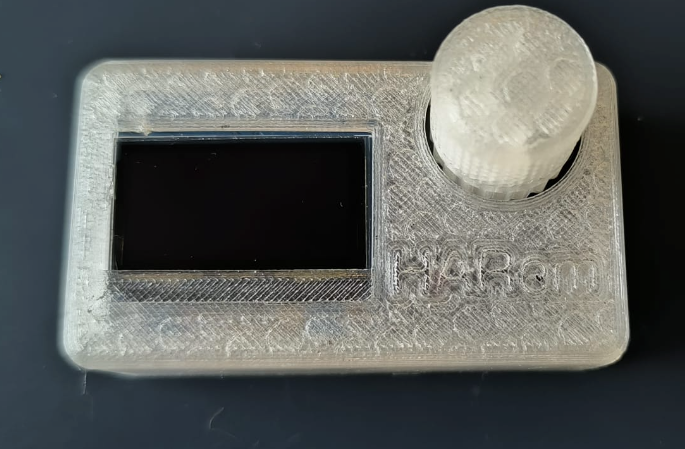
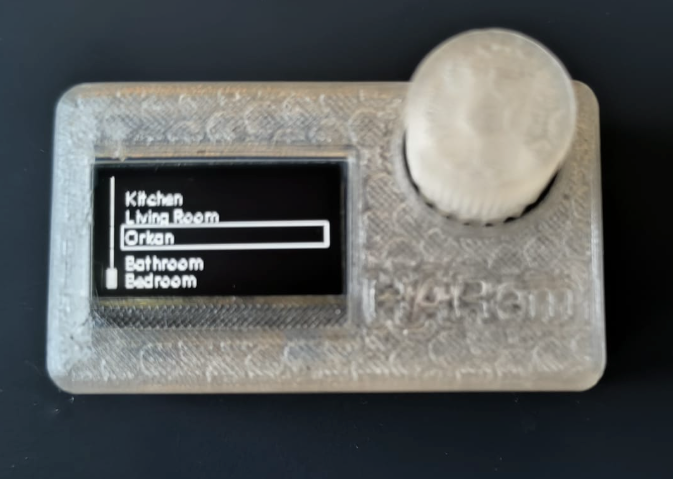
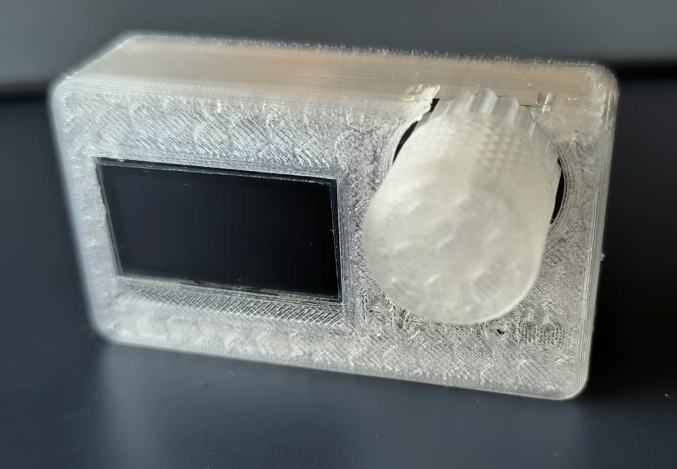
Unlike traditional smart remotes that require manual configuration of every button, HARem operates as a dynamic viewport into your Home Assistant instance. Complex logic is handled by Home Assistant Blueprints and Automations, keeping the hardware lightweight and responsive.
.factory.bin from Releases and flash it to offset 0x0.esphome run remote_controller.yaml.
7knRB3/EL4Fq8Foul7Yhv+pcABzyLXHSQxa9bTzzQqg=
[!WARNING] This key is publicly known. For security, you should change it in your own configuration and perform an OTA update as soon as possible.
Building your own HARem is straightforward. The project includes custom PCB files and 3D printable case models.
Explore the design files directly in your browser:
.FCStd), print-ready .stl files for the case, lid, and knob, along with a high-resolution .step model. ESP32-C3 Super Mini Peripherals
┌───────────────────────┐ ┌───────────────┐
│ │ Q1(NPN) │ 1.3" OLED │
│ 5V / 3.3V ───┼────▶[C] │ │
│ GPIO1 (OLED PWR) ────┼────▶[B] │ │
│ │ [E]────┼─▶ [VCC] │
│ GND ───┼────────────┼─▶ [GND] │
│ GPIO5 (SDA)───┼────────────┼─▶ [SDA] │
│ GPIO6 (SCL)───┼────────────┼─▶ [SCL] │
│ │ └───────────────┘
│ │
│ │ ┌───────────────┐
│ │ │ ROTARY (EC11) │
│ GPIO8 (CLK) ◀─┼───[100Ω]───┼─ [CLK] │
│ GPIO9 (DT) ◀─┼───[100Ω]───┼─ [DT] │
│ GPIO4 (SW) ◀─┼───[100Ω]───┼─ [SW] │
│ GND ◀─┼────────────┼─ [GND] │
│ │ └───────────────┘
│ │ ┌───────────────┐
│ │ │ BAT MONITOR │
│ │ │ [+] BATTERY │
│ │ │ │ │
│ │ │ [1MΩ] │
│ GPIO0 (ADC) ◀─┼────────────┼───┤ │| Component | ESP32-C3 Pin | Type | Notes |
|---|---|---|---|
| OLED VCC | GPIO1 | Output | Active Power Management (via Q1 NPN) |
| OLED SDA/SCL | GPIO5 / GPIO6 | I2C | SSD1306/SH1106 |
| Encoder CLK/DT | GPIO8 / GPIO9 | Input | Navigation |
| Encoder SW | GPIO4 | Input | Wakeup Trigger |
| Battery ADC | GPIO0 | Analog | 1M/1M Divider + 0.1µF Cap |
The name HARem is a clever portmanteau of Home Assistant and Remote, but its inspiration runs deeper into Turkish history and culture.
In Turkish and Ottoman history, the Harem represented the most private, sacred, and protected part of the household. By adopting this name, the project acknowledges the smart home as the modern individual's "inner sanctum." Just as the historical Harem was the heart of the home, this remote serves as the private, primary interface to control and protect the sanctity of your living space.
If you find this project helpful and would like to support its development, you can buy me a coffee! Your support helps fund new prototypes and keeps the project open-source and free for everyone.
| Qty | Value | Footprint | References |
|---|---|---|---|
| 3 | 100 | Resistor_SMD:R_0805_2012Metric | R2, R3, R4 |
| 2 | 1M | Resistor_SMD:R_0805_2012Metric | R5, R6 |
| 1 | 0.1uF | Capacitor_SMD:C_0805_2012Metric | C2 |
| 1 | 100nF | Capacitor_SMD:C_0805_2012Metric | C1 |
| 1 | 10K | Resistor_SMD:R_0805_2012Metric | R1 |
| 1 | BC817 | Package_TO_SOT_SMD:SOT-23 | Q1 |
| 1 | ESP32-C3_SUPERMINI_TH | ESP32-C3_SUPERMINI_TH:MODULE_ESP32-C3_SUPERMINI_TH | U1 |
| 1 | OLED_128X64_1.3_I2C | OLED_128X64_1.3_I2C:LCD_OLED_128X64_1.3_I2C | DS1 |
| 1 | RotaryEncoder_Switch | Rotary_Encoder:RotaryEncoder_Alps_EC11E-Switch_Vertical_H20mm_MountingHoles | SW1 |
| 1 | S2B-PH-K-S_LF__SN_ | S2B-PH-K-S_LF__SN_:JST_S2B-PH-K-S_LF__SN_ | J1 |
| 1 | ~ | TP4056:TP4056-Module | U2 |
It measures 70 × 38 mm and has 2 copper layers, 1.6 mm thick.
14 parts, built around the BC817. The full list of its parts is on this page, with links to each part's symbol and footprint where PCBKit's library has them.
From the orkanm/HARem repository on GitHub, at the commit this page was made from: the board is PCB/HARem/HArem.kicad_pcb and its schematic PCB/HARem/HArem.kicad_sch. PCBKit opens the board in the browser, with nothing to install.
Its repository publishes it under the MIT licence: you may reuse it on that licence's terms (keep the author's notice, and for a copyleft licence share your changes alike).
W0rthlessS0ul/nRF24_jammer
The nRF24 jammer is a powerful tool that requires an ESP32 and configurable numbers of NRF24 modules to assemble.

Ardumower/ardumower
Develop an open source robotic lawn mower (HW+SW reference platform)

qbancoffee/imac_g3_ivad_board_init
iMac G3 IVAD board initialization with an arduino


BitDogLab/BitDogLab
Open-source educational hardware for embedded systems, programming, electronics, and physical computing.


