2 layers95 × 85 mm
NUC980
TreeNewbeer/Coonix
Coonix is a funny project about building a application platform in Allwinner-v3s processor.
172 parts4

 MDCservice/EsPiFF223
An ESP32 in the Raspberry Pi form factor
Espiff v3 1 is an open-source printed circuit board by MDCservice, from the MDCservice/EsPiFF repository on GitHub, published under the GPL-3.0 licence. It is a 6-layer board of 83.5 × 56 mm with 172 parts on 198 nets, routed with 3,384 tracks and 305 vias.
It is built around the CH340T, ESP32-WROVER-E(4MB) and IP101GR, with the MT9700, FM25CL64B-G and PCA9557PW among its other parts. Its parts include 56 capacitors, 53 resistors, 17 ICs, 13 diodes and 10 connectors. It belongs with the radio and wireless boards and the ESP32, RP2040 and RISC-V boards of this library.


An ESP32 in the Raspberry Pi form factor
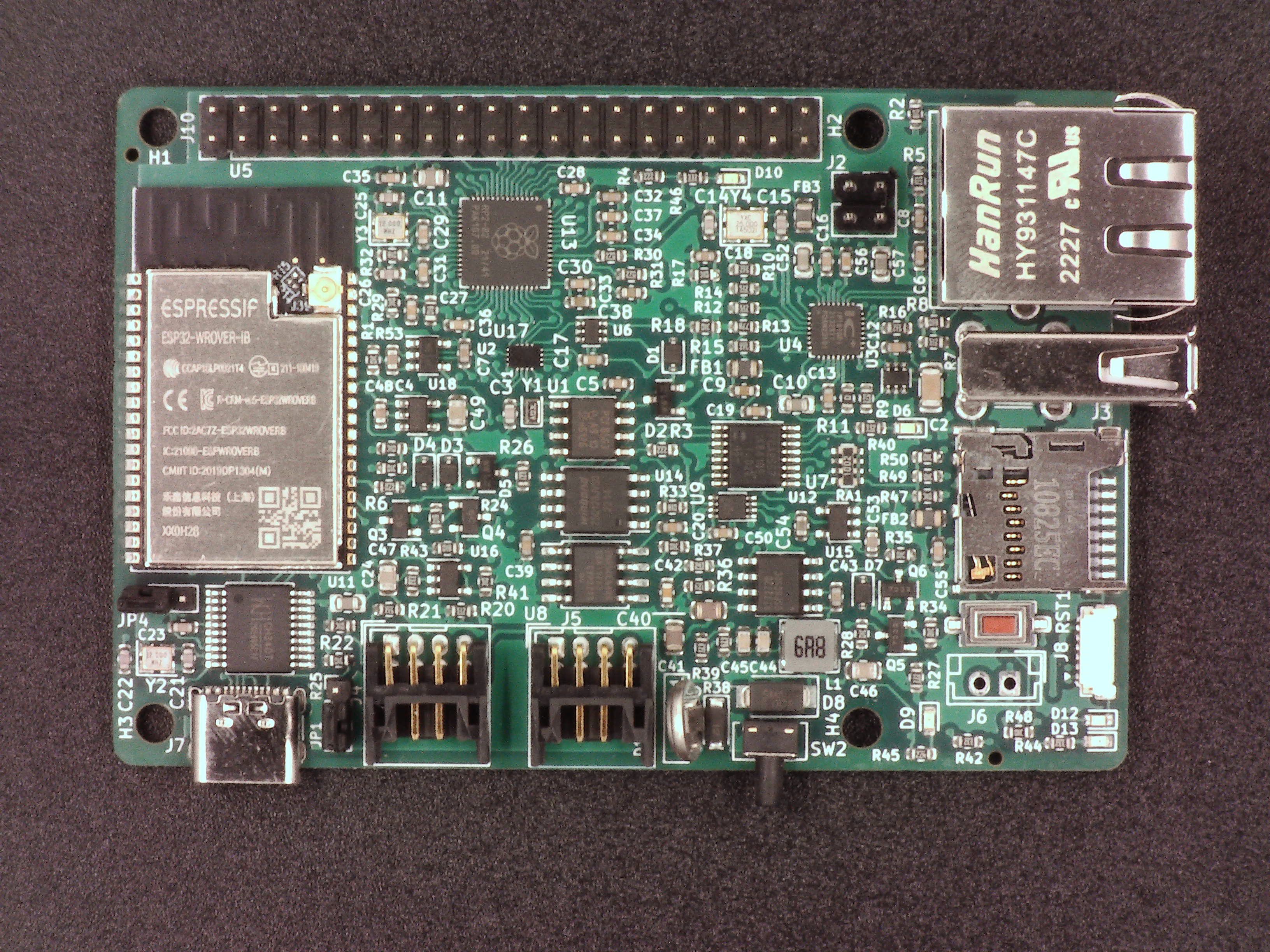
For applications, where the Raspberry Pi 4 is not robust enough, or take too much power, you can consider the EsPiFF as an option. The EsPiFF (V2) brings
The EsPiFF V3 will bring the following
 EsPiFF-PLC
We decided to build an alternative to the Raspberry Pi for our projects and products. As many others we were using the Raspberry Pi in our products, adding electronic payment to existing vending machines and coffee machines, in RFID solutions to read RFID tags in laundry and other application. While it was easy to get a solution up and running in a short time, over time we got a lot of problems resulting from using the Pi. A key problem of the Pi's design is, to rely on an SD-card. The SD-cards are made for digital cameras, to write on them a few times. A Linux system like the Pi on the other hand, is writing permanent its log files and swap partition or to the SD-card. As a result, after some months the SD-card broke and the application crashed. High-end industrial SD-card lasted longer, but finally still broke. An industrial controller simply can not base on a SD-card. The PI Operating system is also great for fast bring-up of a solution, but its more and more focused on media streaming then real-time tasks. It gets more and more overloaded with each new version. So we made the decision, to build a replacement, which is focused on high-reliability, but still enable the use of Raspberry Pi universum of add-ons, like HATs and enclosures. We choose the ESP32 dual core, 2x240MHz WROVER module with 8MB PSRAM and 16MB Flash. The EsPiFF, the Esp32 in Raspberry Pi Form Factor was born.
The first version of the EsPiFF was born in a time, where all Ethernet Phy chips was unavailable. Our first prototype used a Waveshare LAN8720 module. Chip crysis! Interestingly, even no LAN8720 chips could be bought anywhere, but the modules was still available. Because the Waveshare module did not route the enable signal to the pin header, but left one pin unconnected on the pin header, we had to solder a wire from the oscillator to that unused pin on the header. After these, the board run well, and do so till now. We added 4 high side switches, and digital inputs to operate 4 door locks. These are the 4 white connectors opposite the RJ45 connectors. The Version 1 had the WROOM module of the ESP32.
Picture: the Version 1 of the EsPiFF
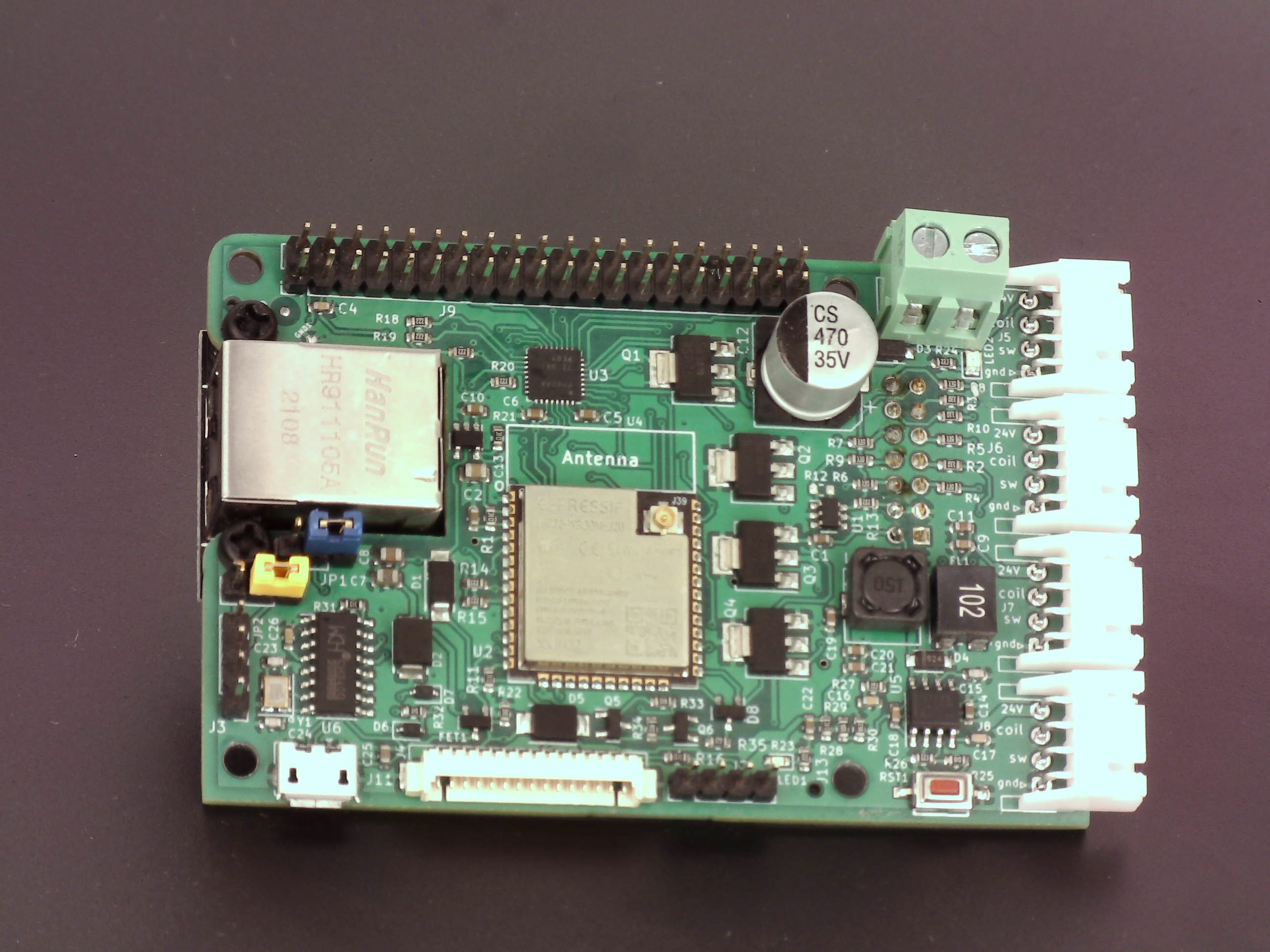
We ported the PostgreSQL client libray, based on SimplePgPSQL to the EsPiFF, what worked very well, even with the limited RAM and Flash. Not only SELECT, INSERT and UPDATE work, but also the brilliant PostgreSQL feature NOTIFY. As a result, the EsPiFF dont need to poll the PostgreSQL server, but get notified instead. We could define a trigger in PostgreSQL, and notify other EsPiFF board. Thats very cool.
Because of the ongoing chip crysis, we only select parts, what are available.
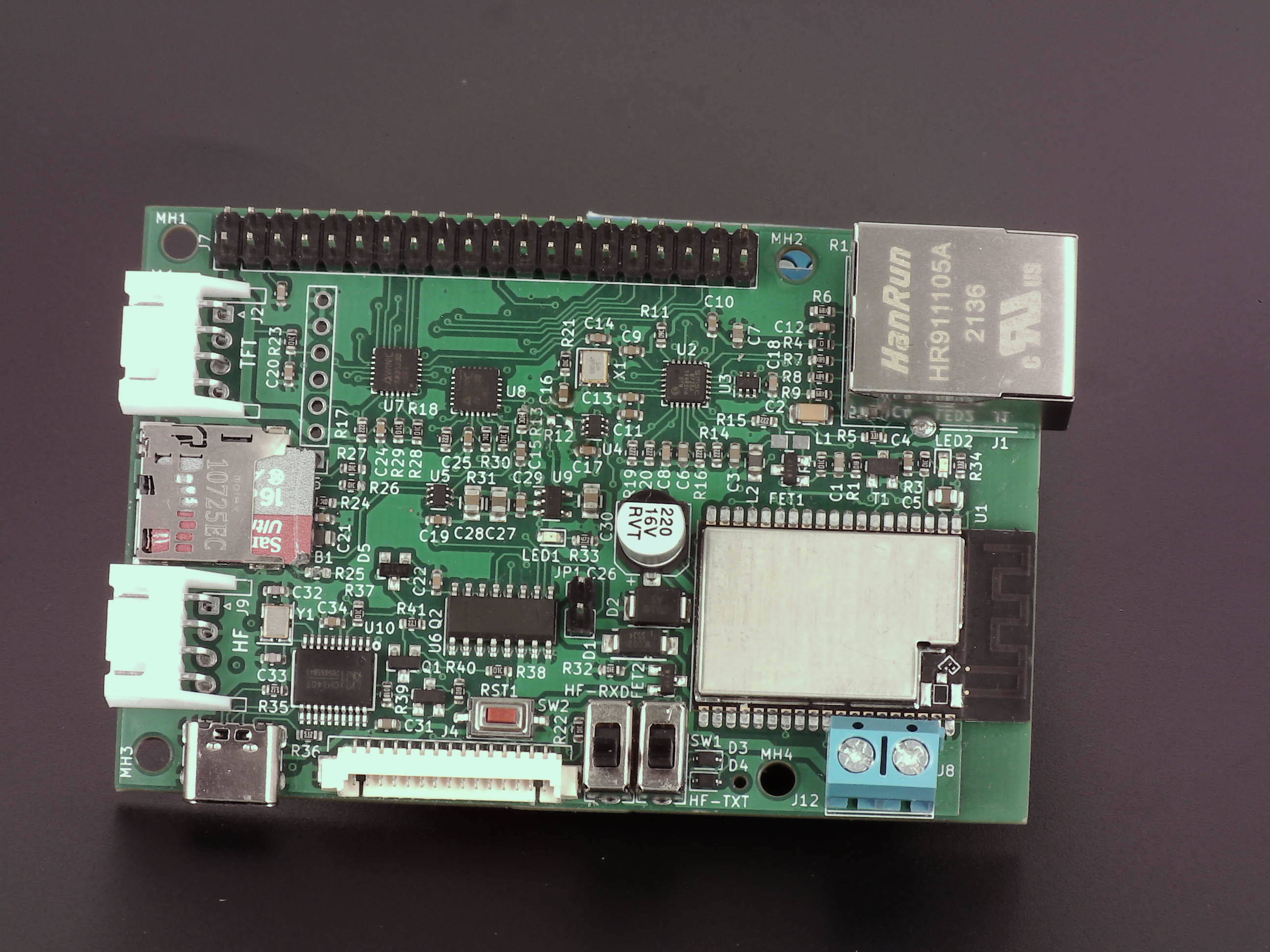 After the LAN8720 chips got available again, we decided to make a new board revision. These are the current boards. We used the ESP32-WROVER module, for additional 8MB PSRAM and 16MB Flash. We also added an SD-card. Unfortunately, we used the wrong pinout, make it very difficult to change the SD-card. An other issue was a missing pull-up resistor on the LAN8720.
We changed the USB connector to a Type-C connector, and configured it so, that 5V and up to 3A can be taken. Thats a big improvement, raising the available power from 0.5W to 15W. We removed the 4 door lock connectors, and put them on a HAT.
Since version 1 we have a "Chafon-Connector", next to the USB connector. It is to connect the Chafon RFID Rain(UHF) modules. Additional, we replaced the UART pin headers with more robust JST connectors, left and right of the SD-card.
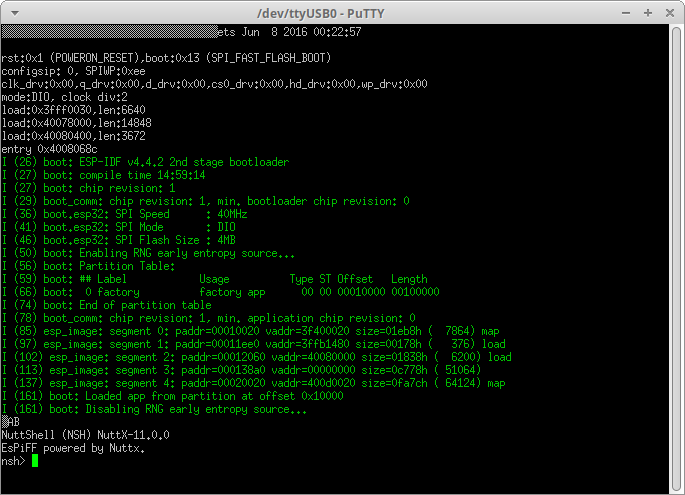
We could also compile and flash the Apache Nuttx operating system on the new board. A growing number of people are using ESP32-WROVER boards together with Nuttx as OS. This offers an somehow easy path of porting Linux and Raspberry Pi software on ESP32+Nuttx.
This is the planned final version. Additional to the fix of the 2 known issues, we plan the following:
This is the current progress. We managed, to bring all the functionality on the board. We selected a 6 layer PCB, for best signal integrity.
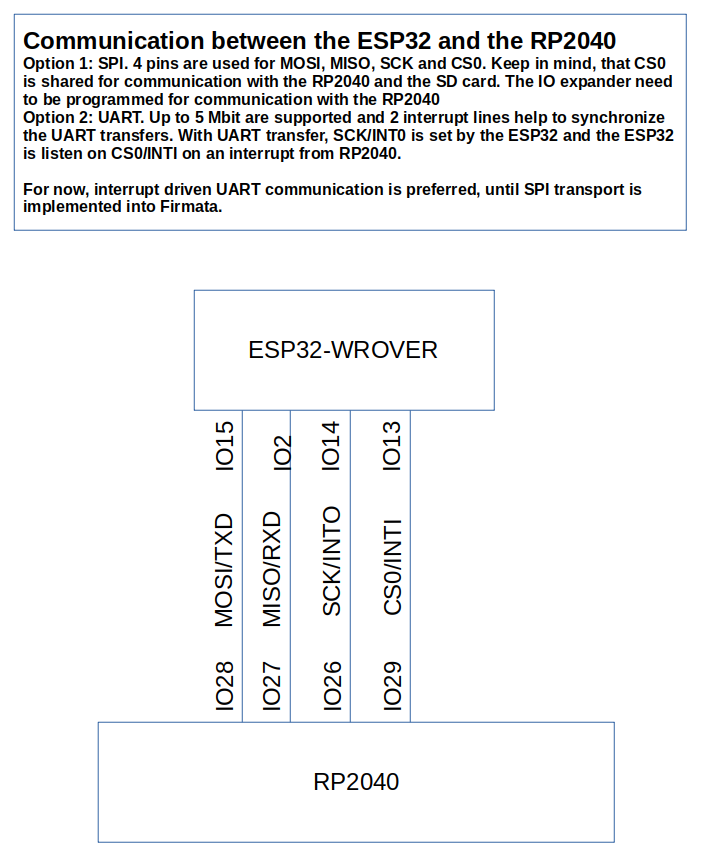
The ESP32 can communicate with the RP2040 via SPI, where the ESP32 is the SPI master. Depend on the requirements, the communication protocol can be implemented application specific, with ether the Espressif IDF or Arduino IDE. Or an existing SPI driver from, for example NuttX, could be used on the ESP side, and the RP2040 emulating for example an SD card or a SPI Flash.
One more option is to run Firmata on the RP2040. This is a popular way for Arduino developers, to remote control and Arduino/RP2040 from a host computer, here the ESP32. For now, Firmata only supports UART communication, whats is also possible on the EsPiFF.
Because all pins on both the ESP32 and the RP2040 are used already, there are no decidated interupt pins between ESP32 and RP2040. The software should implement software interupts, when i.e. the receiving buffer reaches a certain level.
We finally replaced the LAN8720 Ethernet PHY by an IP101, as used in the Espressif Ethernet reference design. The LAN8720 showed stability problems, in combination with the ESP32-WROVER (it is working well with the ESP32-WROOM). Other projects with the ESP32-WROVER - LAN8720 combination (wESP, Olimex) seem to had the same problems, and also switched away from the LAN8720. On this point, a big "Thank you" to Ondrej from Espressif for all of his support in this field.
We also ordered customized cables, for the DF11 and display connectors, what offer DuPont on the opposite side. With these cables, breadbord or Nextion displays, or other 2.54mm headers can easily connected.
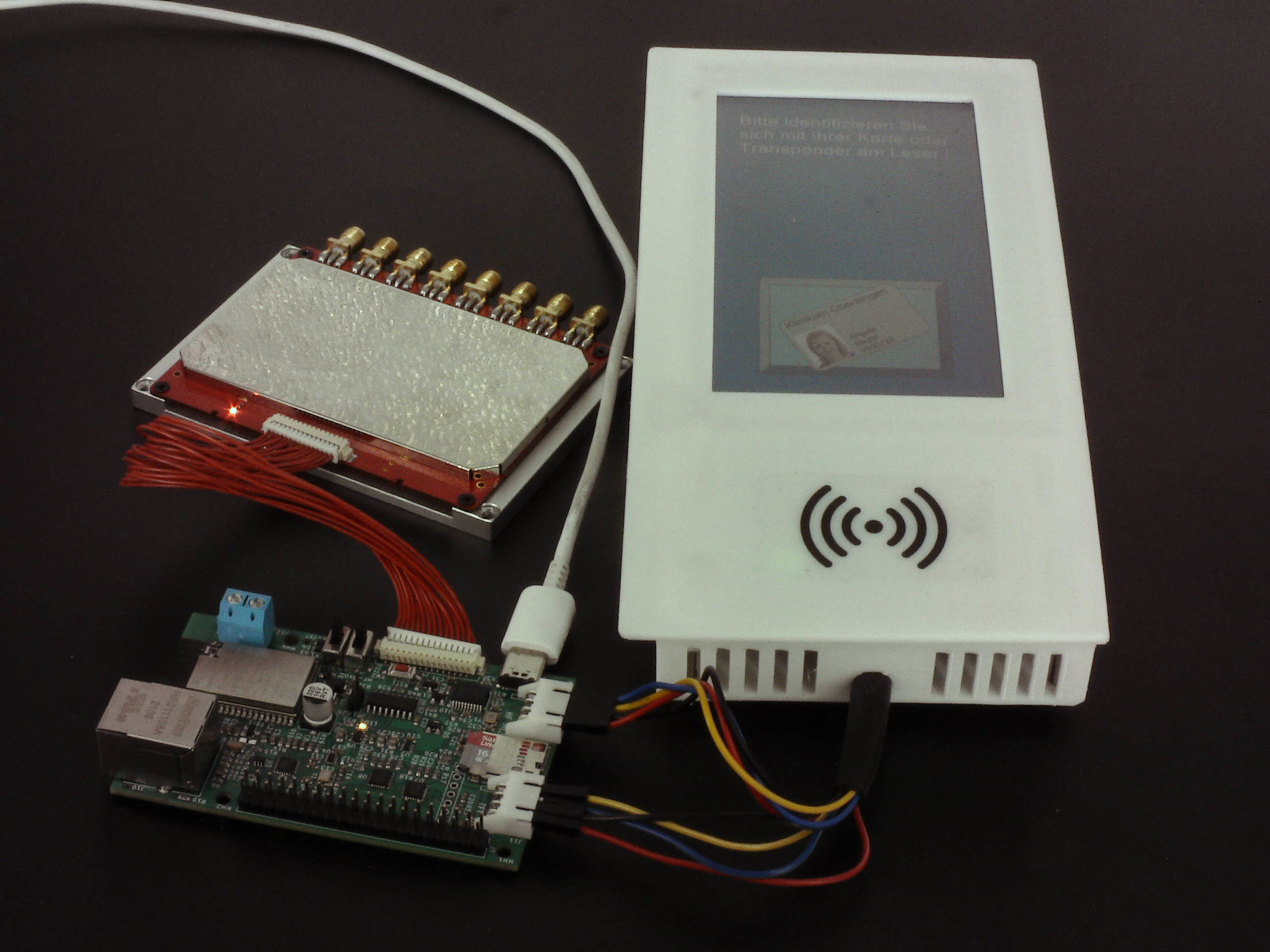
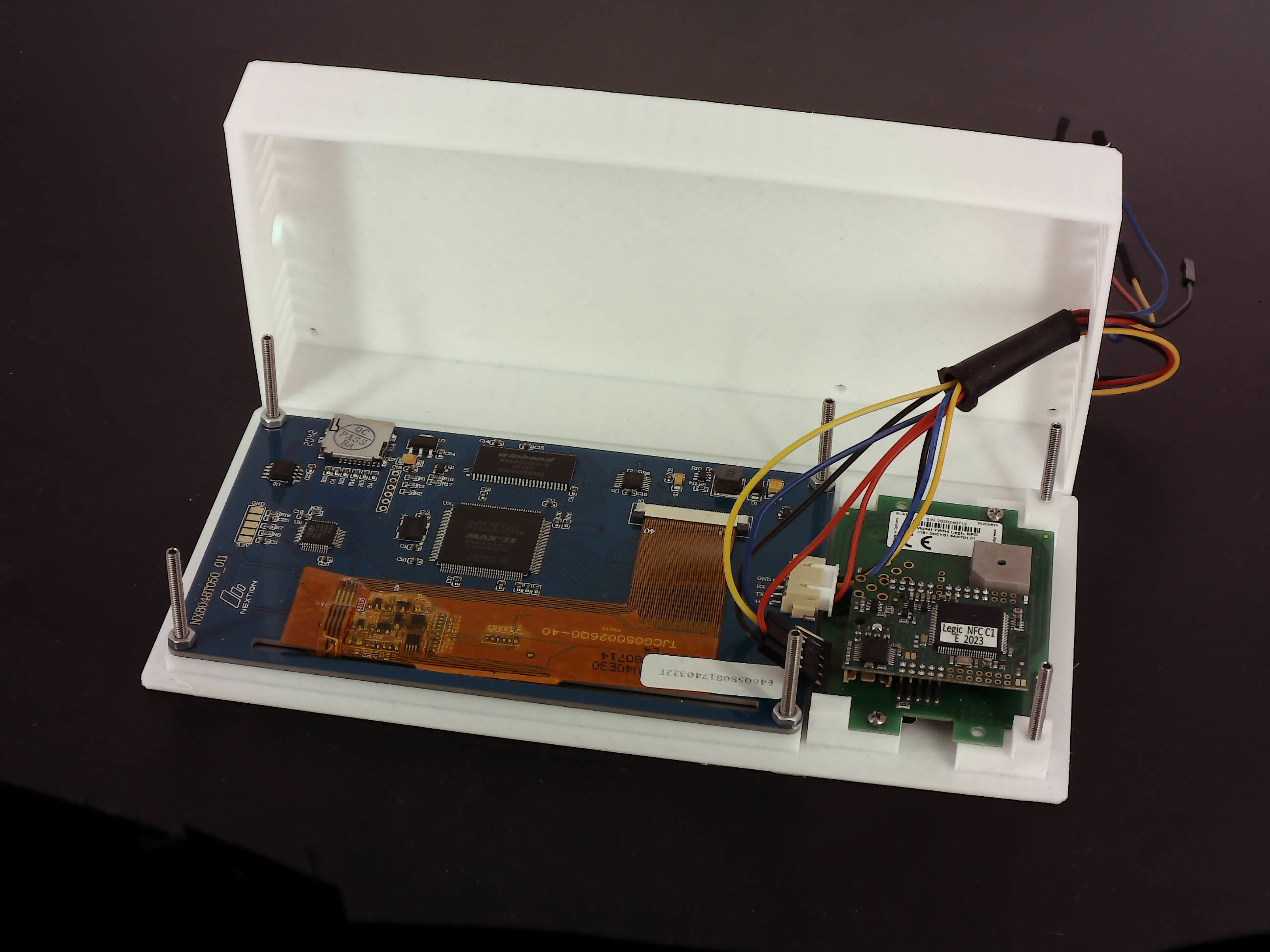
This example show, how a Nextion 5 inch TFT, a HF RFID reader from Elatec (TWN4), a Chafon 8 channel RAIN UHF-RFID reader and a 3D printed enclosure can form an electronic identification system. We put the source code and the 3D design files into the example folder. Smaller or bigger Nextion TFTs can be used, when you adapt the 3D design.
The HMI interact with the user, ask him/her to put the HF-RFID card on the card reader. The TWN4 from Elatec is able to read near any LF or HF card, inclding the LEGIC chips used in many high secure access control applications. The TWN4 is inside the 3D printed enclosure, as well as the Nextion TFT.
With the 8 port RAIN UHF reader/writer from Chafon, we can monitor a whole area with up to 8 antennas. We use it to monitor 4 cabinets, other use cases could be the monitoring a whole room/warehouse, or the entrance of buiildings,etc. Chafon offer 1, 4, 8 and 16 port devices, and they are all compatible with the software.
In our application, we read/write direct to a PostgreSQL database, connected by wired ethernet, thats why we have ported the LibPQ (the PostgreSQL client library) to the ESP32. The use of other techniques, like MQTT, is also possible.
Picture: the open 3D printed enclsure, showing the Nextion 5'' TFT, and the TWN4 HF RFID reader
After the EsPiFF is now mature enough, we we are preparing a campaign at Crowd Supply. After the Pre-launch page will be available, we will update the info here. Hope you support us on our Crowd Supply campaign!
Please notice, that the ESP32-module PCB antenna can not be used, an external wifi antenna is required. This is because of space restrictions, the RasPi form factor not allow us to make the board larger, and there is simply no space left for the required keepout area for the PCB antenna. Most people will use a metal enclosure, what renders a PCB antenna useless anyway. We still have to use an ESP32-WROVER module containing a PCB antenna, because only these modules have 16 MB Flash, 8 MB PSRAM, and all the features we build in. Other modules, for example the ESP32-S3, does not have Ethernet MII.
Apache Nuttx can run on the EsPiFF! Next the wellknown FreeRTOS, there is an other, not so wellknown operating system supporting ESP32 and friends: Apache Nuttx (https://nuttx.apache.org). It has a very cool feature: runtime loading of ELF files (for example, from SDcard) into RAM, and then execute it in RAM. Very much like Windows/Linux/MacOS are doing it. Imagine, you can send a SDcard to your customer for software-update. Bye bye over the air(OTA) updates in enviroments, where OTA is not allowed.
ESP32 <> RP2040 interconnection
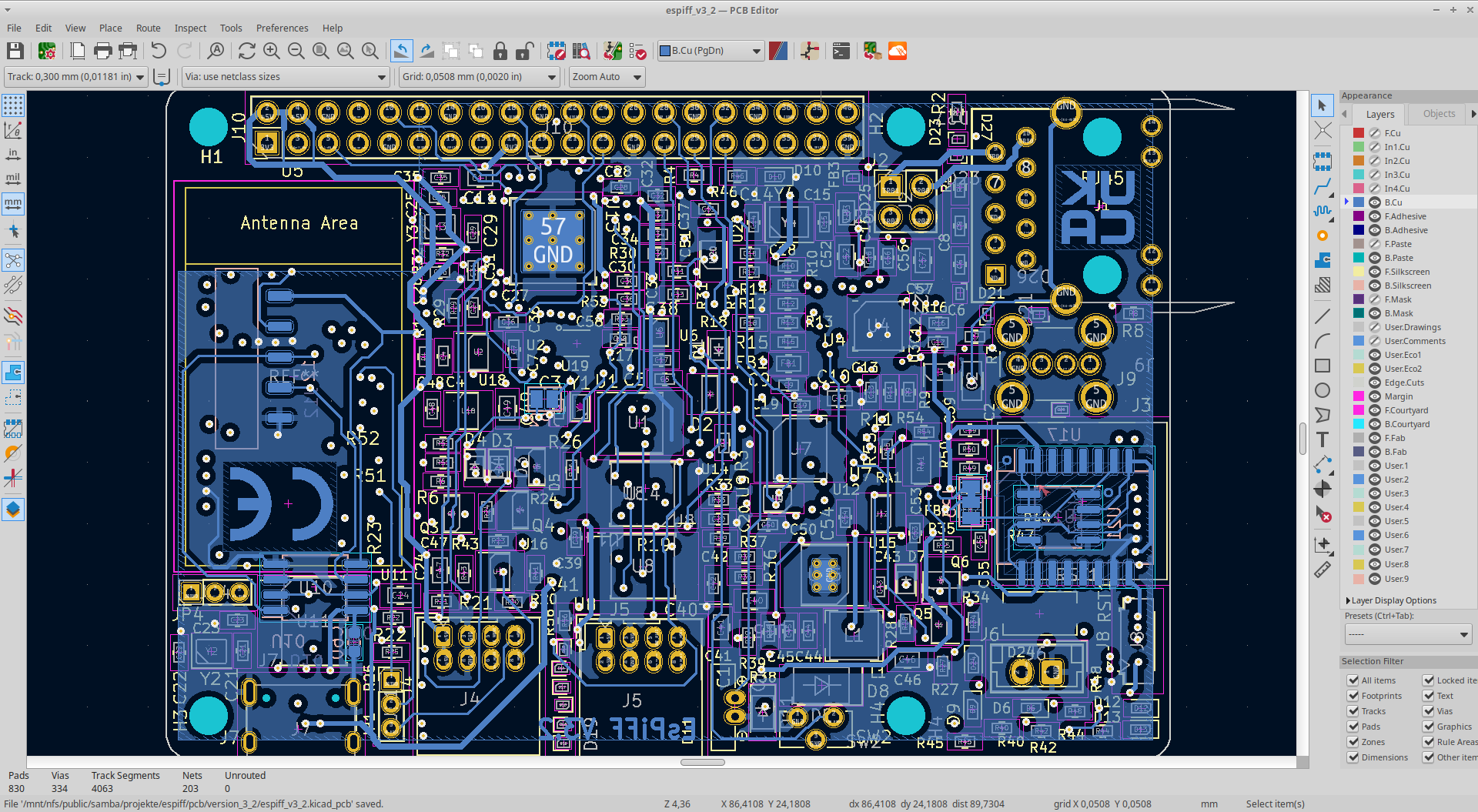
Latest news: We just finish the layout of the version 3.2, the version the crowd supply backer will get. Few interesting things:
Because several people mention the integrated PCB antenna, the version 3.2 offer at least a basic use of the PCB antenna. Still, the external PCB antenna is the prefered way to use Wifi with the EsPiFF, now to use the integrated PCB antenna as well.
Keep in mind, that the ESP32-WROVER-IB module requires a solder jumper modification before the PCB antenna can be used.
Team MDC
| Qty | Value | Footprint | References |
|---|---|---|---|
| 27 | 100n | Capacitor_SMD:C_0603_1608Metric | C12, C13, C16, C17, C18, C19, C20, C23, C27, C28, C29, C30, C31, C32, C34, C35 +11 |
| 17 | 10k | Resistor_SMD:R_0603_1608Metric | R1, R17, R18, R19, R22, R25, R28, R29, R34, R35, R41, R47, R48, R49, R50, R51 +1 |
| 9 | 5k1 | Resistor_SMD:R_0603_1608Metric | R5, R7, R10, R12, R14, R15, R16, R20, R21 |
| 7 | 1k | Resistor_SMD:R_0603_1608Metric | R2, R8, R23, R24, R32, R33, R53 |
| 6 | 3k3 | Resistor_SMD:R_0603_1608Metric | R27, R40, R42, R43, R44, R46 |
| 5 | 1u | Capacitor_SMD:C_0603_1608Metric | C4, C9, C33, C38, C48 |
| 4 | 22u/6.3V | Capacitor_SMD:C_0805_2012Metric | C10, C24, C52, C57 |
| 4 | 27R | Resistor_SMD:R_0603_1608Metric | R6, R9, R30, R31 |
| 4 | 27p | Capacitor_SMD:C_0603_1608Metric | C21, C22, C25, C26 |
| 4 | 47u/6.3V | Capacitor_SMD:C_0805_2012Metric | C11, C46, C47, C49 |
| 4 | MH | mdc_footprints:MountingHole_M3_3.2mm | H1, H2, H3, H4 |
| 3 | 1N5819WS | Diode_SMD:D_SOD-323 | D1, D3, D4 |
| 2 | 10u/10V | Capacitor_SMD:C_0603_1608Metric | C53, C54 |
| 2 | 10u/50V | Capacitor_SMD:C_0805_2012Metric | C40, C41 |
| 2 | 12MHz | Crystal:Crystal_SMD_2520-4Pin_2.5x2.0mm | Y2, Y3 |
| 2 | 2.2k | Resistor_SMD:R_0603_1608Metric | R3, R4 |
| 2 | 20p | Capacitor_SMD:C_0603_1608Metric | C14, C15 |
| 2 | 22u/10V | Capacitor_SMD:C_0603_1608Metric | C44, C45 |
| 2 | 2N7002 | Package_TO_SOT_SMD:SOT-23 | Q5, Q6 |
| 2 | 741G3157 | Package_TO_SOT_SMD:SOT-363_SC-70-6 | U3, U6 |
| 2 | BAT54C | Package_TO_SOT_SMD:SOT-23 | D2, D5 |
| 2 | BC817 | Package_TO_SOT_SMD:SOT-23 | Q3, Q4 |
| 2 | ConDF11_2x4 | mdc_footprints:DF11-8DP-2DS(52) | J4, J5 |
| 2 | FB0805 | Resistor_SMD:R_0805_2012Metric | FB1, FB3 |
| 2 | LEDyellow | LED_SMD:LED_0603_1608Metric | D9, D13 |
| 2 | MT9700 | Package_TO_SOT_SMD:SOT-23-5 | U12, U16 |
| 1 | 0R | Resistor_SMD:R_0603_1608Metric | R11 |
| 1 | 10k | Resistor_SMD:R_Array_Convex_4x0603 | RA1 |
| 1 | 120k | Resistor_SMD:R_0603_1608Metric | R36 |
| 1 | 12k | Resistor_SMD:R_0603_1608Metric | R39 |
| 1 | 1N5819 | Diode_SMD:D_SOD-323 | D7 |
| 1 | 1n/2kV | Capacitor_SMD:C_1206_3216Metric | C2 |
| 1 | 220R | Resistor_SMD:R_0603_1608Metric | R26 |
| 1 | 220mF/4V | mdc_footprints:supercap_DMS3R3224R | C1 |
| 1 | 22p | Capacitor_SMD:C_0603_1608Metric | C3 |
| 1 | 24k | Resistor_SMD:R_0603_1608Metric | R37 |
| 1 | 25MHz | Crystal:Crystal_SMD_3225-4Pin_3.2x2.5mm | Y4 |
| 1 | 2n7 | Capacitor_SMD:C_0603_1608Metric | C42 |
| 1 | 32kHz | Crystal:Crystal_SMD_2012-2Pin_2.0x1.2mm | Y1 |
| 1 | 4k7 | Resistor_SMD:R_0603_1608Metric | R45 |
| 1 | 62k | Resistor_SMD:R_0603_1608Metric | R38 |
| 1 | 6k19 | Resistor_SMD:R_0603_1608Metric | R13 |
| 1 | 6uH8 | Inductor_SMD:L_Bourns-SRN4018 | L1 |
| 1 | 74xx2G32 | Package_SO:VSSOP-8_2.3x2mm_P0.5mm | U9 |
| 1 | APX823 | Package_TO_SOT_SMD:SOT-23-5 | U2 |
| 1 | CH340T | Package_SO:SSOP-20_5.3x7.2mm_P0.65mm | U11 |
| 1 | ConPoE_2x2 | Connector_PinHeader_2.54mm:PinHeader_2x02_P2.54mm_Vertical | J2 |
| 1 | Con_24Vin | Connector_JST:JST_EH_B2B-EH-A_1x02_P2.50mm_Vertical | J6 |
| 1 | ESP32-WROVER-E | Espressif:ESP32-WROVER-E | U5 |
| 1 | FB_800mA | Resistor_SMD:R_0805_2012Metric | FB2 |
| 1 | FM25CL64B | mdc_footprints:SOIC8_W+N_combi | U8 |
| 1 | HMI_ESP32c3_hostSide | Connector_JST:JST_SUR_SM06B-SURS-TF_1x06-1MP_P0.80mm_Horizontal | J8 |
| 1 | HY931147C_PoE | mdc_footprints:HY931147C | J1 |
| 1 | IP101GR | Package_DFN_QFN:QFN-32-1EP_4x4mm_P0.4mm_EP2.65x2.65mm | U4 |
| 1 | JP_HF_USB_MISO | Connector_PinHeader_2.00mm:PinHeader_1x03_P2.00mm_Vertical | JP4 |
| 1 | JP_HF_USB_MOSI | Connector_PinHeader_2.00mm:PinHeader_1x03_P2.00mm_Vertical | JP1 |
| 1 | JP_ResetSel | Jumper:SolderJumper-3_P1.3mm_Bridged12_RoundedPad1.0x1.5mm | JP3 |
| 1 | JP_WTI | Jumper:SolderJumper-2_P1.3mm_Open_Pad1.0x1.5mm | JP2 |
| 1 | LEDblue | LED_SMD:LED_0603_1608Metric | D6 |
| 1 | LEDemerald | LED_SMD:LED_0603_1608Metric | D12 |
| 1 | LEDgreen | LED_SMD:LED_0603_1608Metric | D10 |
| 1 | ME6211 | Package_TO_SOT_SMD:SOT-23-5 | U18 |
| 1 | PCA9557PW | Package_SO:TSSOP-16_4.4x5mm_P0.65mm | U7 |
| 1 | PCF8563T | Package_SO:SOIC-8_3.9x4.9mm_P1.27mm | U1 |
| 1 | RP2040_alternateFuncs | mdc_footprints:QFN56_ThermalVias_0.3 | U13 |
| 1 | RT7272 | mdc_footprints:SOIC8-1EP_3.9x4.9mm_P1.27_ThermalVias | U15 |
| 1 | Raspberry_Pi_2_3 | Connector_PinHeader_2.54mm:PinHeader_2x20_P2.54mm_Vertical | J10 |
| 1 | Reset | mdc_footprints:Btn_KEY-SMD_JCLPCB_C698192 | RST1 |
| 1 | SDcard_molex | molex_sdcard:MOLEX_503398-1892 | J3 |
| 1 | SK4001 | Diode_SMD:D_SOD-123 | D11 |
| 1 | SMAJ6.0 | Diode_SMD:D_SMA | D8 |
| 1 | TS3A5018 | mdc_footprints:UQFN-16_1.8x2.6_P0.4mm | U17 |
| 1 | USB_A | mdc_footprints:USB_A_C26235 | J9 |
| 1 | USB_BOOT | mdc_footprints:Btn_TC-1109DE-C-F | SW2 |
| 1 | USB_C_Receptacle_USB2.0 | mdc_footprints:USB_C_XKB_U262-16XN-4BVC11 | J7 |
| 1 | W25Q128 | mdc_footprints:SOIC8_5.23x5.23mm_P1.27mm_mdc | U14 |
It measures 83.5 × 56 mm and has 6 copper layers, 2.66 mm thick.
172 parts, built around the CH340T, ESP32-WROVER-E(4MB), IP101GR and MT9700. The full list of its parts is on this page, with links to each part's symbol and footprint where PCBKit's library has them.
From the MDCservice/EsPiFF repository on GitHub, at the commit this page was made from: the board is hardware/espiff_v3_1.kicad_pcb and its schematic hardware/espiff_v3_1.kicad_sch. PCBKit opens the board in the browser, with nothing to install.
Its repository publishes it under the GPL-3.0 licence: you may reuse it on that licence's terms (keep the author's notice, and for a copyleft licence share your changes alike).
TreeNewbeer/Coonix
Coonix is a funny project about building a application platform in Allwinner-v3s processor.

Jochen0x90h/RoomControl
Smart home room controller based on nRF52840 with MQTT and and IEEE 802.15.4 radio support. Buttons and relays for lights and roller shutters can also be connected with a local bus using LIN physical layer

jayis1/hacker-devices
Full-cycle hardware designs for security research devices — each device is a subfolder with its own README, schematics, PCB layout, and software stack


SuperPower/Artemis
All hardware designs and products you can find in this repository is licensed under CERN Open Hardware Licence Version 2 - Weakly Reciprocal


kenyattaejones32-boop/AQM
Open-source hardware design for OpenHAP, an ESP32-based air quality monitor with CO sensing, thermistor temperature input, USB-C charging, and cellular data upload.
