4 layers150 × 150 mm
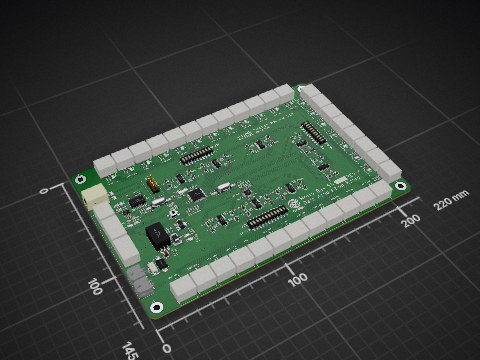
Ecp5u85-bse usb io tester
open-ephys/ECP5U85-BSE-USB
USB development board featuring USB3.0, Lattice ECP5U85 FPGA, and Samtec BSE GPIO Headers
96 parts10

 open-ephys/ECP5U85-BSE-USB-IO-Tester1
IO Test board for ECP5U85-BSE-USB
ECP5U85-BSE USB IO Tester is an open-source printed circuit board by open-ephys, from the open-ephys/ECP5U85-BSE-USB-IO-Tester repository on GitHub. It is a 4-layer board of 150 × 150 mm with 96 parts on 230 nets, routed with 2,051 tracks and 414 vias.
It is built around the ATXMEGA32A4U-AU, FT232RL and 745X101103JP, with the LTST-C191KGKT, BTE-040-02-L-D-A-K and 67996-420HLF among its other parts. Its parts include 25 capacitors, 22 resistors, 13 ICs, 5 diodes and 5 connectors. It belongs with the AVR (ATmega, ATtiny) and FPGA and CPLD boards of this library.


| Qty | Value | Footprint | References |
|---|---|---|---|
| 21 | 1k | Resistor_SMD:R_0402_1005Metric | R1, R2, R3, R4, R10, R12, R13, R14, R15, R16, R17, R18, R20, R21, R22, R23 +5 |
| 16 | 745X101103JP | jonnew:CTS_745X101 | RN1, RN2, RN3, RN4, RN5, RN6, RN7, RN8, RN9, RN10, RN11, RN12, RN13, RN14, RN15, RN16 |
| 9 | 0.1uF | Capacitor_SMD:C_0402_1005Metric | C1, C2, C6, C7, C9, C10, C11, C12, C13 |
| 9 | 0.1uF | Capacitor_SMD:C_0603_1608Metric | C4, C8, C14, C17, C18, C19, C23, C24, C25 |
| 9 | 74HCT4067PW,118 | Package_SO:TSSOP-24_4.4x7.8mm_P0.65mm | U1, U2, U4, U5, U7, U8, U9, U10, U11 |
| 5 | LTST-C191KGKT | LED_SMD:LED_0603_1608Metric | D1, D2, D3, D5, D6 |
| 4 | MountingHole_Pad | MountingHole:MountingHole_3.5mm_Pad | H1, H2, H3, H4 |
| 2 | 10uF | Capacitor_SMD:C_1210_3225Metric | C3, C5 |
| 2 | 47pF | Capacitor_SMD:C_0603_1608Metric | C20, C21 |
| 2 | BTE-040-02-L-D-A | jonnew:SAMTEC_BTE-040-01-L-D-A-K-TR | J1, J3 |
| 2 | TestPoint | TestPoint:TestPoint_THTPad_3.0x3.0mm_Drill1.5mm | TP1, TP2 |
| 1 | jonnew-eagle:OE-LOGO-14X10 | ||
| 1 | 100 | Resistor_SMD:R_0402_1005Metric | R19 |
| 1 | 4.7nF | Capacitor_SMD:C_0603_1608Metric | C22 |
| 1 | 4.7uF | Capacitor_SMD:C_0805_2012Metric | C16 |
| 1 | 65100516121 | Connector_USB:USB_Mini-B_Lumberg_2486_01_Horizontal | J2 |
| 1 | 67996-420HLF | Connector_PinHeader_2.54mm:PinHeader_2x10_P2.54mm_Vertical | J5 |
| 1 | ATxmega32A4U-A | Package_QFP:TQFP-44_10x10mm_P0.8mm | U6 |
| 1 | B3F-1002 | Button_Switch_THT:SW_PUSH_6mm_H8mm | SW1 |
| 1 | FBMH3216HM221NTV | Inductor_SMD:L_1206_3216Metric | FB2 |
| 1 | FT232RL | Package_SO:SSOP-28_5.3x10.2mm_P0.65mm | U12 |
| 1 | MH1608-601Y | Inductor_SMD:L_0603_1608Metric | FB1 |
| 1 | NCV4274ADT33RKG | Package_TO_SOT_SMD:TO-252-2 | U3 |
| 1 | O 32,0-JT32C-A-K-3,3-LF | Oscillator:Oscillator_SMD_Abracon_ASE-4Pin_3.2x2.5mm | U13 |
| 1 | PR20203VBDN | Connector_PinHeader_2.54mm:PinHeader_2x03_P2.54mm_Vertical | J4 |
| 1 | T498X107K016ATE075 | Capacitor_Tantalum_SMD:CP_EIA-7343-20_Kemet-V | C15 |
open-ephys/ECP5U85-BSE-USB
USB development board featuring USB3.0, Lattice ECP5U85 FPGA, and Samtec BSE GPIO Headers

harp-tech/device.faststepper
A fast moving stepper motor controller device, with acceleration, jerk control, and end stop support
ParadigmHyperloop/testing-hardware
PCBs and other electrical things for Paradigm's post-competition 4 testing efforts


oresat/oresat-proto-card
Prototype card for the OreSat bus. Requires the OreSat Backplane.

arlethmichellopez/Curso-de-KiCad
En esta sección integraré el diseño de las PCB's que cree durante el transcurso de mi curso en KiCad

MbFredys/PCB-designs-for-PLATZI-course
PCB design exercises completed during a structured training course, documenting schematic capture, layout, and manufacturing outputs.
It measures 150 × 150 mm and has 4 copper layers, 4.69 mm thick.
96 parts, built around the ATXMEGA32A4U-AU, FT232RL, 745X101103JP and LTST-C191KGKT. The full list of its parts is on this page, with links to each part's symbol and footprint where PCBKit's library has them.
From the open-ephys/ECP5U85-BSE-USB-IO-Tester repository on GitHub, at the commit this page was made from: the board is pcb/ecp5u85-bse-usb_io-tester.kicad_pcb and its schematic pcb/ecp5u85-bse-usb_io-tester.kicad_sch. PCBKit opens the board in the browser, with nothing to install.
Its repository states no licence, so its author keeps all rights: ask open-ephys before reusing the design.