2 layers
Small-9
NVlabs/Cypress
Cypress is a scalable, GPU-accelerated PCB placement method inspired by VLSI. It incorporates tailored cost functions, constraint handling, and optimized techniques adapted for PCB layouts.
476 parts56Apache-2.0

 NVlabs/Cypress56
Cypress is a scalable, GPU-accelerated PCB placement method inspired by VLSI. It incorporates tailored cost functions, constraint handling, and optimized techniques adapted for PCB layouts.
Small-2 is an open-source printed circuit board by NVlabs, from the NVlabs/Cypress repository on GitHub, published under the Apache-2.0 licence. It is a 2-layer board with 240 parts on 183 nets, routed with 981 tracks and 65 vias.
Cypress is a scalable, GPU-accelerated PCB placement method inspired by VLSI. It incorporates tailored cost functions, constraint handling, and optimized techniques adapted for PCB layouts.
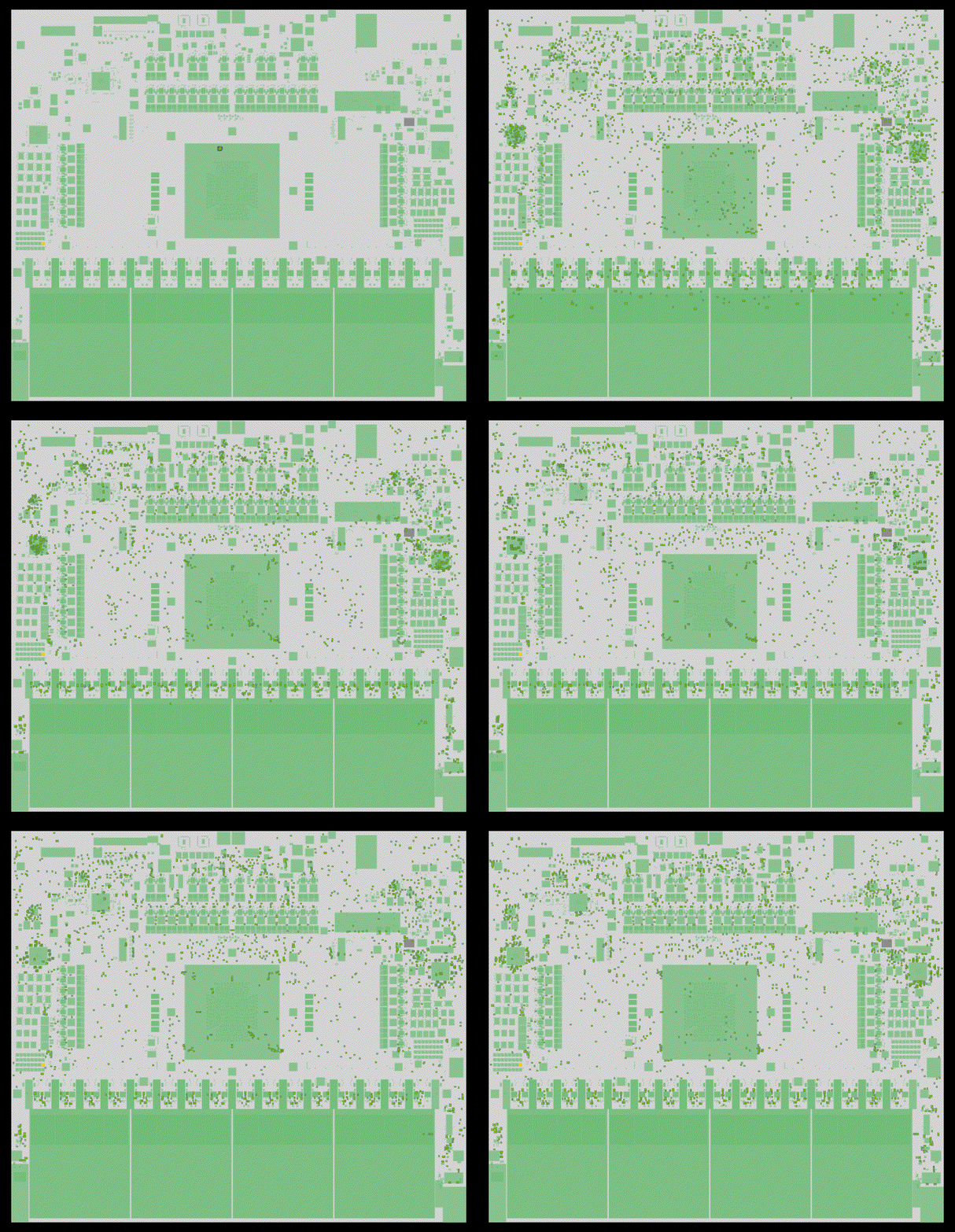
You can build in two ways:
cd /Cypress
python dreamplace/Placer.py path/to/your/config.json./tuner/run_tuner.sh 1 1 test/tune/pcb-configspace.json /path/to/aux_file test/tuner/tuner-ppa.json "" 100 4 0 0 10 ./tuner ./results/result_pathCypress builds upon and extends the following open-source projects:
DREAMPlace: A deep learning toolkit-enabled VLSI placement framework that provides the foundation for our GPU-accelerated placement engine.
AutoDMP: An automated design methodology platform that inspired aspects of our hyperparameter tuning approach.
We thank the authors and contributors of these projects for their valuable work that made Cypress possible.
If you find this work useful, please cite the following paper:
@inproceedings{zhang2025cypress,
  title={Cypress: VLSI-Inspired PCB Placement with GPU Acceleration},
  author={Zhang, Niansong and Agnesina, Anthony and Shbat, Noor and Leader, Yuval and Zhang, Zhiru and Ren, Haoxing},
  booktitle={Proceedings of the 2025 International Symposium on Physical Design},
  pages={xx--xx},
  year={2025}
}| Qty | Value | Footprint | References |
|---|---|---|---|
| 1 | C10_10_4 | C10_10_4 | C10_10_4 |
| 1 | C10_11_4 | C10_11_4 | C10_11_4 |
| 1 | C10_12_4 | C10_12_4 | C10_12_4 |
| 1 | C10_1_4 | C10_1_4 | C10_1_4 |
| 1 | C10_2_4 | C10_2_4 | C10_2_4 |
| 1 | C10_3_4 | C10_3_4 | C10_3_4 |
| 1 | C10_4_4 | C10_4_4 | C10_4_4 |
| 1 | C10_5_4 | C10_5_4 | C10_5_4 |
| 1 | C10_6_4 | C10_6_4 | C10_6_4 |
| 1 | C10_7_4 | C10_7_4 | C10_7_4 |
| 1 | C10_8_4 | C10_8_4 | C10_8_4 |
| 1 | C10_9_4 | C10_9_4 | C10_9_4 |
| 1 | C11_10_4 | C11_10_4 | C11_10_4 |
| 1 | C11_11_4 | C11_11_4 | C11_11_4 |
| 1 | C11_12_4 | C11_12_4 | C11_12_4 |
| 1 | C11_1_4 | C11_1_4 | C11_1_4 |
| 1 | C11_2_4 | C11_2_4 | C11_2_4 |
| 1 | C11_3_4 | C11_3_4 | C11_3_4 |
| 1 | C11_4_4 | C11_4_4 | C11_4_4 |
| 1 | C11_5_4 | C11_5_4 | C11_5_4 |
| 1 | C11_6_4 | C11_6_4 | C11_6_4 |
| 1 | C11_7_4 | C11_7_4 | C11_7_4 |
| 1 | C11_8_4 | C11_8_4 | C11_8_4 |
| 1 | C11_9_4 | C11_9_4 | C11_9_4 |
| 1 | C12_10_4 | C12_10_4 | C12_10_4 |
| 1 | C12_11_4 | C12_11_4 | C12_11_4 |
| 1 | C12_12_4 | C12_12_4 | C12_12_4 |
| 1 | C12_1_4 | C12_1_4 | C12_1_4 |
| 1 | C12_2_4 | C12_2_4 | C12_2_4 |
| 1 | C12_3_4 | C12_3_4 | C12_3_4 |
| 1 | C12_4_4 | C12_4_4 | C12_4_4 |
| 1 | C12_5_4 | C12_5_4 | C12_5_4 |
| 1 | C12_6_4 | C12_6_4 | C12_6_4 |
| 1 | C12_7_4 | C12_7_4 | C12_7_4 |
| 1 | C12_8_4 | C12_8_4 | C12_8_4 |
| 1 | C12_9_4 | C12_9_4 | C12_9_4 |
| 1 | C13_10_4 | C13_10_4 | C13_10_4 |
| 1 | C13_11_4 | C13_11_4 | C13_11_4 |
| 1 | C13_12_4 | C13_12_4 | C13_12_4 |
| 1 | C13_1_4 | C13_1_4 | C13_1_4 |
| 1 | C13_2_4 | C13_2_4 | C13_2_4 |
| 1 | C13_3_4 | C13_3_4 | C13_3_4 |
| 1 | C13_4_4 | C13_4_4 | C13_4_4 |
| 1 | C13_5_4 | C13_5_4 | C13_5_4 |
| 1 | C13_6_4 | C13_6_4 | C13_6_4 |
| 1 | C13_7_4 | C13_7_4 | C13_7_4 |
| 1 | C13_8_4 | C13_8_4 | C13_8_4 |
| 1 | C13_9_4 | C13_9_4 | C13_9_4 |
| 1 | C14_10_4 | C14_10_4 | C14_10_4 |
| 1 | C14_11_4 | C14_11_4 | C14_11_4 |
| 1 | C14_12_4 | C14_12_4 | C14_12_4 |
| 1 | C14_1_4 | C14_1_4 | C14_1_4 |
| 1 | C14_2_4 | C14_2_4 | C14_2_4 |
| 1 | C14_3_4 | C14_3_4 | C14_3_4 |
| 1 | C14_4_4 | C14_4_4 | C14_4_4 |
| 1 | C14_5_4 | C14_5_4 | C14_5_4 |
| 1 | C14_6_4 | C14_6_4 | C14_6_4 |
| 1 | C14_7_4 | C14_7_4 | C14_7_4 |
| 1 | C14_8_4 | C14_8_4 | C14_8_4 |
| 1 | C14_9_4 | C14_9_4 | C14_9_4 |
| 1 | C15_10_4 | C15_10_4 | C15_10_4 |
| 1 | C15_11_4 | C15_11_4 | C15_11_4 |
| 1 | C15_12_4 | C15_12_4 | C15_12_4 |
| 1 | C15_1_4 | C15_1_4 | C15_1_4 |
| 1 | C15_2_4 | C15_2_4 | C15_2_4 |
| 1 | C15_3_4 | C15_3_4 | C15_3_4 |
| 1 | C15_4_4 | C15_4_4 | C15_4_4 |
| 1 | C15_5_4 | C15_5_4 | C15_5_4 |
| 1 | C15_6_4 | C15_6_4 | C15_6_4 |
| 1 | C15_7_4 | C15_7_4 | C15_7_4 |
| 1 | C15_8_4 | C15_8_4 | C15_8_4 |
| 1 | C15_9_4 | C15_9_4 | C15_9_4 |
| 1 | C1_10_4 | C1_10_4 | C1_10_4 |
| 1 | C1_11_4 | C1_11_4 | C1_11_4 |
| 1 | C1_12_4 | C1_12_4 | C1_12_4 |
| 1 | C1_1_4 | C1_1_4 | C1_1_4 |
| 1 | C1_2_4 | C1_2_4 | C1_2_4 |
| 1 | C1_3_4 | C1_3_4 | C1_3_4 |
| 1 | C1_4_4 | C1_4_4 | C1_4_4 |
| 1 | C1_5_4 | C1_5_4 | C1_5_4 |
The 80 most common of 240 parts.
NVlabs/Cypress
Cypress is a scalable, GPU-accelerated PCB placement method inspired by VLSI. It incorporates tailored cost functions, constraint handling, and optimized techniques adapted for PCB layouts.

NVlabs/Cypress
Cypress is a scalable, GPU-accelerated PCB placement method inspired by VLSI. It incorporates tailored cost functions, constraint handling, and optimized techniques adapted for PCB layouts.

NVlabs/Cypress
Cypress is a scalable, GPU-accelerated PCB placement method inspired by VLSI. It incorporates tailored cost functions, constraint handling, and optimized techniques adapted for PCB layouts.

NVlabs/Cypress
Cypress is a scalable, GPU-accelerated PCB placement method inspired by VLSI. It incorporates tailored cost functions, constraint handling, and optimized techniques adapted for PCB layouts.

NVlabs/Cypress
Cypress is a scalable, GPU-accelerated PCB placement method inspired by VLSI. It incorporates tailored cost functions, constraint handling, and optimized techniques adapted for PCB layouts.

NVlabs/Cypress
Cypress is a scalable, GPU-accelerated PCB placement method inspired by VLSI. It incorporates tailored cost functions, constraint handling, and optimized techniques adapted for PCB layouts.

NVlabs/Cypress
Cypress is a scalable, GPU-accelerated PCB placement method inspired by VLSI. It incorporates tailored cost functions, constraint handling, and optimized techniques adapted for PCB layouts.

NVlabs/Cypress
Cypress is a scalable, GPU-accelerated PCB placement method inspired by VLSI. It incorporates tailored cost functions, constraint handling, and optimized techniques adapted for PCB layouts.

NVlabs/Cypress
Cypress is a scalable, GPU-accelerated PCB placement method inspired by VLSI. It incorporates tailored cost functions, constraint handling, and optimized techniques adapted for PCB layouts.

NVlabs/Cypress
Cypress is a scalable, GPU-accelerated PCB placement method inspired by VLSI. It incorporates tailored cost functions, constraint handling, and optimized techniques adapted for PCB layouts.

NVlabs/Cypress
Cypress is a scalable, GPU-accelerated PCB placement method inspired by VLSI. It incorporates tailored cost functions, constraint handling, and optimized techniques adapted for PCB layouts.

1upkeyboards/PCBs
Repository containing production files and schematics for 1upkeyboards pcbs


EmadBahra/open-source-IGBT-gate-driver
This is a beta version and it's not tested yet, so use it at your own risk under GPL v3

madcatse/Delta-S-M
A recreation of soviet Delta-S personal computer using semi-modern parts and original case


NEOgHacking/SCORPION-MAX-V1
4x Power Mosfets for controlling heated beds, heaters, ext.

TrojanPinata/Model-B
A 75% keyboard based on the RP2040 - with hotswappable switches, OLED display and rotary encoder

milindmadhukar/keygen
One-off wireless split keyboard: 2 knobs, OLED, trackpad, per-key RGB, ZMK
240 parts. The full list of its parts is on this page, with links to each part's symbol and footprint where PCBKit's library has them.
From the NVlabs/Cypress repository on GitHub, at the commit this page was made from: the board is artifacts/kicad/small-2.kicad_pcb. PCBKit opens the board in the browser, with nothing to install.
Its repository publishes it under the Apache-2.0 licence: you may reuse it on that licence's terms (keep the author's notice, and for a copyleft licence share your changes alike).