
2 layers
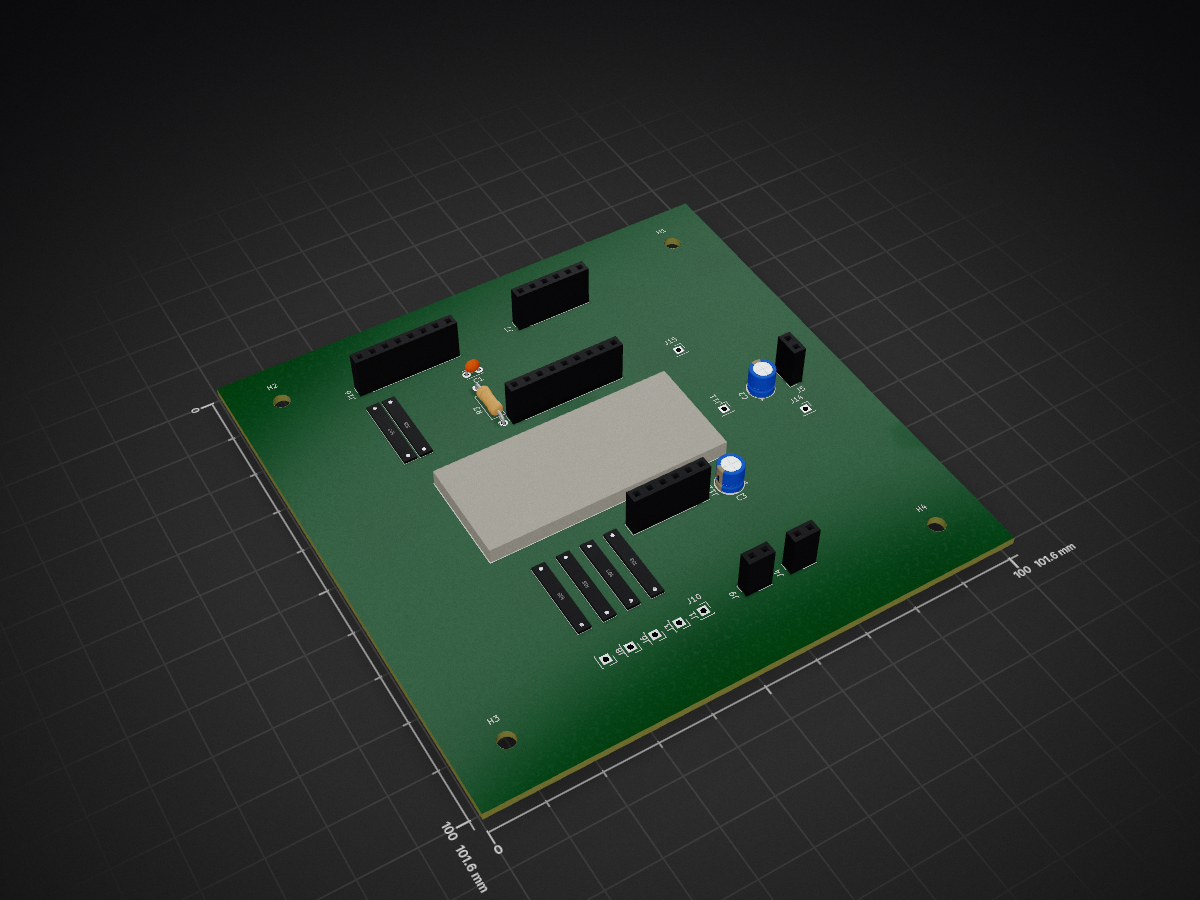
 nutzende/Senso3
Senso V4 is an open-source printed circuit board by nutzende, from the nutzende/Senso repository on GitHub, published under the GPL-3.0 licence. It is a 2-layer board of 101.6 × 101.6 mm with 30 parts on 36 nets, routed with 142 tracks and 0 vias.
It is built around the ESP32-PICO-V3. Its parts include 15 connectors, 7 resistors and 3 capacitors. It belongs with the ESP32 and RISC-V boards of this library.
| Qty | Value | Footprint | References |
|---|---|---|---|
| 8 | PINHD_1x1_Female | Connector_PinSocket_2.54mm:PinSocket_1x01_P2.54mm_Vertical | J1, J3, J6, J8, J10, J11, J14, J15 |
| 6 | 10kΩ | senso_lib:Resistore | R1, R2, R5, R6, R7, R8 |
| 4 | MountingHole | MountingHole:MountingHole_3.2mm_M3 | H1, H2, H3, H4 |
| 2 | Capacitor_PO | Capacitor_THT:CP_Radial_D5.0mm_P2.50mm | C2, C3 |
| 2 | PINHD_1x6_Female | Connector_PinSocket_2.54mm:PinSocket_1x06_P2.54mm_Vertical | J7, J12 |
| 1 | 80Ω | Resistor_THT:R_Axial_DIN0207_L6.3mm_D2.5mm_P10.16mm_Horizontal | R3 |
| 1 | Capacitor_NP | Capacitor_THT:C_Disc_D3.0mm_W2.0mm_P2.50mm | C1 |
| 1 | ESP32-PICO-V3 | senso_lib:ESP32 pico v1 | ESP32-PICO-V1 |
| 1 | PINHD_1x2_Female | Connector_PinSocket_2.54mm:PinSocket_1x02_P2.54mm_Vertical | J5 |
| 1 | PINHD_1x8_Female | Connector_PinSocket_2.54mm:PinSocket_1x08_P2.54mm_Vertical | J16 |
| 1 | PINHD_1x9_Female | Connector_PinSocket_2.54mm:PinSocket_1x09_P2.54mm_Vertical | J2 |
| 1 | Power LED | Connector_PinSocket_2.54mm:PinSocket_1x02_P2.54mm_Vertical | J4 |
| 1 | Power Speaker | Connector_PinSocket_2.54mm:PinSocket_1x02_P2.54mm_Vertical | J9 |

jkirsons/stealth-controller
With 8A driver, Magnetic Sensor, Microcontroller, Two-Wire Automotive Interface

AnyLeaf/elrs-hardware
This repo contains open source hardware information for AnyLeaf ELRS receivers

demik/quack
Bluetooth and ADB Mouse Converter for Macintosh 128/512/Plus, Apple Lisa and Apple IIc


OpenDrone-hw/OpenAIO-Whoop
Open-source 1S whoop AIO: flight controller, 4-channel brushless ESC, ExpressLRS receiver and analog VTX, 25.5x25.5 mm. Planned.

GewoonMaarten/soil-sensor
Schematic and PCB for a capacitive soil moisture sensor 🌱.

DevKiDCosmo/SATELLITE-EDGE-MODULE
A satellite edge module ready for competition

yvolodym/esp32-clock
Low-power round-display ESP32 desk clock built with Arduino/PlatformIO, with a companion KiCad PCB design
It measures 101.6 × 101.6 mm and has 2 copper layers, 1.6 mm thick.
30 parts, built around the ESP32-PICO-V3. The full list of its parts is on this page, with links to each part's symbol and footprint where PCBKit's library has them.
From the nutzende/Senso repository on GitHub, at the commit this page was made from: the board is KiCad/senso v4/Senso V4.kicad_pcb and its schematic KiCad/Senso V1/Senso V1.kicad_sch. PCBKit opens the board in the browser, with nothing to install.
Its repository publishes it under the GPL-3.0 licence: you may reuse it on that licence's terms (keep the author's notice, and for a copyleft licence share your changes alike).
