
4 layers45 × 41 mm
Osw
Open-Smartwatch/open-smartwatch-gps
Hardware design files for the GPS version of the open-smartwatch
70 parts243GPL-3.0

 noriokun4649/Wi-SUN-Module-Serial-Board1
MB-RL7023-11をUSBシリアルに変換する基板です
Wi SUN Board is an open-source printed circuit board by noriokun4649, from the noriokun4649/Wi-SUN-Module-Serial-Board repository on GitHub, published under the MIT licence. It is a 2-layer board of 42.5 × 30 mm with 17 parts on 31 nets, routed with 119 tracks and 109 vias.
It is built around the CH340E. Its parts include 5 capacitors, 3 resistors, 2 ICs, 2 connectors and 1 diode.
秋月電子の謎SoCに内蔵されている Wi-SUN モジュール MB-RL7023-11 をUSBシリアルに変換する基板です。
| Qty | Value | Footprint | References |
|---|---|---|---|
| 2 | 0.1uf | Capacitor_SMD:C_0402_1005Metric_Pad0.74x0.62mm_HandSolder | C3, C5 |
| 2 | 1uf | Capacitor_SMD:C_0402_1005Metric_Pad0.74x0.62mm_HandSolder | C2, C4 |
| 2 | 5.1k | Resistor_SMD:R_0402_1005Metric_Pad0.72x0.64mm_HandSolder | R2, R3 |
| 1 | 10uf | Capacitor_SMD:C_0603_1608Metric_Pad1.08x0.95mm_HandSolder | C1 |
| 1 | 350mA | Capacitor_SMD:C_0603_1608Metric_Pad1.08x0.95mm_HandSolder | F1 |
| 1 | 470 | Resistor_SMD:R_0402_1005Metric_Pad0.72x0.64mm_HandSolder | R1 |
| 1 | AP7333_33SAG_SOT23 | Package_TO_SOT_SMD:SOT-23 | U1 |
| 1 | CH340E | Package_SO:MSOP-10_3x3mm_P0.5mm | U2 |
| 1 | DF12NB_3.0_-20DS-0.5V_51_ | Connector:HRS_DF12NB_3.0_-20DS-0.5V_51_ | J1 |
| 1 | LED | LED_SMD:LED_0603_1608Metric_Pad1.05x0.95mm_HandSolder | D1 |
| 1 | LOGO | Logos:logo_silk | ©nkun.dev |
| 1 | MountingHole_2.2mm_M2 | MountingHole:MountingHole_2.2mm_M2 | |
| 1 | SW_Push | Button_Switch_SMD:TS-1187A-B-A-B | SW1 |
| 1 | USB_C_Receptacle_USB2.0_12402012E212A | Connector_USB:USB_C_Receptacle_Amphenol_12402012E212A | J2 |
Open-Smartwatch/open-smartwatch-gps
Hardware design files for the GPS version of the open-smartwatch
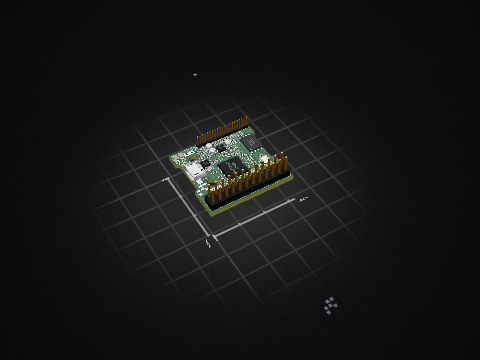

teapotlaboratories/feather-rak3172
Teapotlabs Feather RAK3172: Low-cost Low-power LoRaWAN Development Board

azerimaker/Penguino-STM32WL-LoRa-E5
This repo contains all the necessary design and fabrication files for the Seeed Studio LoRa-E5 based Penguino Feather breakout board.


hb020/batterymeter
Handheld Battery AC and Time Domain characterization tool on Attiny series 2

It measures 42.5 × 30 mm and has 2 copper layers, 1.6 mm thick.
17 parts, built around the CH340E. The full list of its parts is on this page, with links to each part's symbol and footprint where PCBKit's library has them.
From the noriokun4649/Wi-SUN-Module-Serial-Board repository on GitHub, at the commit this page was made from: the board is Wi-SUN_Board/Wi-SUN_Board.kicad_pcb and its schematic Wi-SUN_Board/Wi-SUN_Board.kicad_sch. PCBKit opens the board in the browser, with nothing to install.
Its repository publishes it under the MIT licence: you may reuse it on that licence's terms (keep the author's notice, and for a copyleft licence share your changes alike).