

2 layers110 × 110 mm

 nochkin/esp-line-follower3
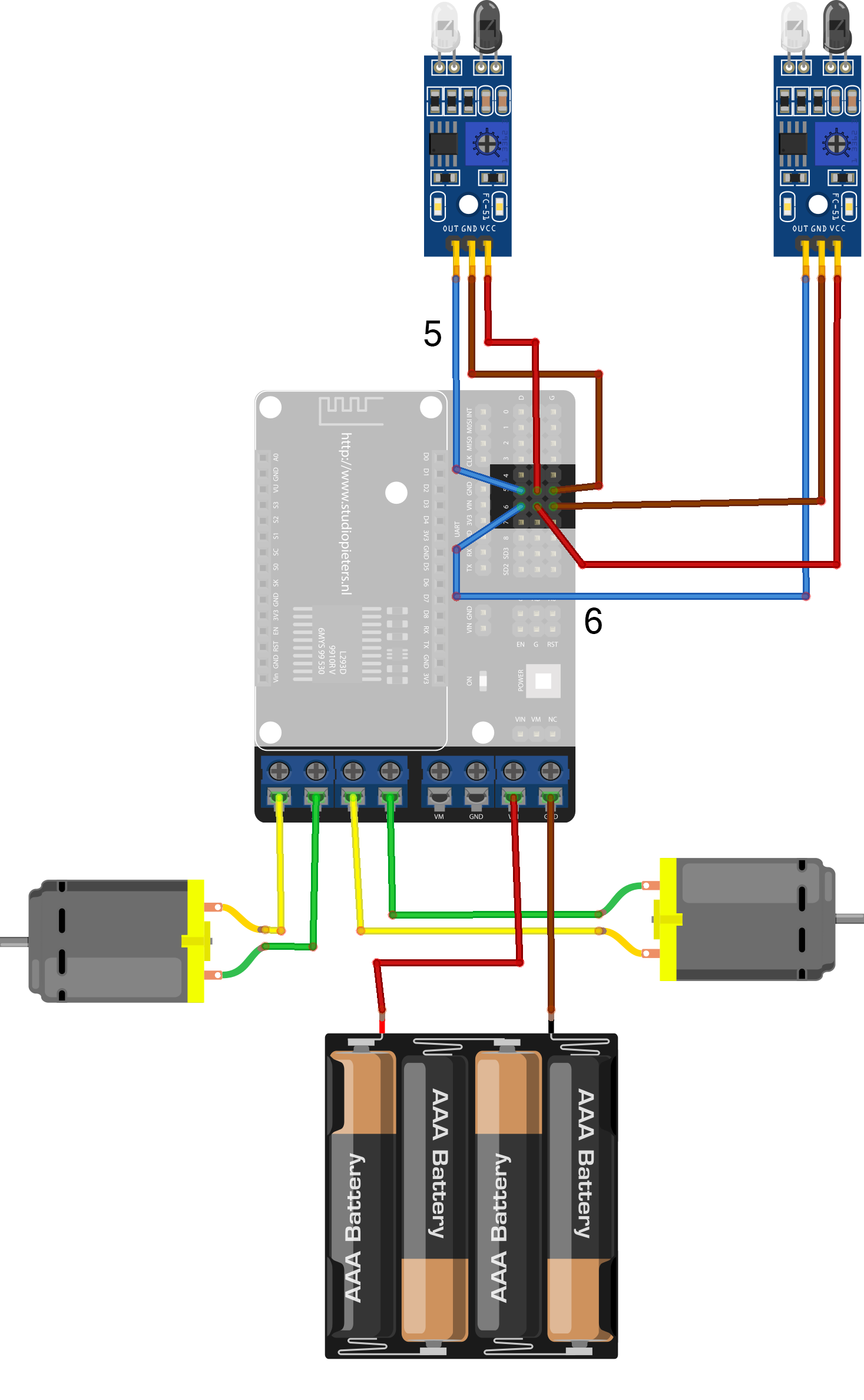
A simple educational project to build a line following 2WD robot
Esp32-2wd is an open-source printed circuit board by nochkin, from the nochkin/esp-line-follower repository on GitHub, published under the MIT licence. It is a 2-layer board of 71.5 × 48.3 mm with 13 parts on 32 nets, routed with 253 tracks and 3 vias.
It is built around the DRV8833PW and IRF9540NS. Its parts include 1 capacitor, 1 IC and 1 transistor. It belongs with the robots and motor control boards and the ESP32 and ESP8266 boards of this library.
The goal of the project is to teach beginners into robotics without fearing and over-complicated or expensive parts. It's indended to be open enough for future experiments and improvements.
This is the minimum list of required parts. Basically, these are the parts which are being used in this project. The list should not limit you in case if you wish to add some additional functionality or make other experiments based on that.
All prices are approximate and depend on the source where you purchase it. My recommended sources are eBay and AliExpress. You can also find it on Amazon, but it tends to be slightly more expensive. All prices are in USD.
| Qnty | Part | Cost | Buy |
|---|---|---|---|
| 1 | ESP8266 NodeMCU (CP2102) | $5.00 | eBay, AliExpress, Amazon |
| 1 | L293DD Motor Shield for ESP8266 NodeMCU | $2.50 | eBay, AliExpress, Amazon |
| 2 | Infrared sensors | $1.50 | eBay, AliExpress, Amazon |
| 1 | 2WD Robot Chassis | $8.00 | eBay, AliExpress, Amazon |
| 6 | 20cm Dupont Wires F-F to connect Infrared boards | $2.00 | eBay |
| 1 | Various M3 spacers/standoffs/screws | $12.00 | eBay, AliExpress, Amazon |
| 1 | Black Cloth Tape, 32mm x 15m | $2.00 | AliExpress |
Total: about $20
| Qty | Value | Footprint | References |
|---|---|---|---|
| 3 | Conn_1x18_254 | custom:Conn_1x18_254 | CONN1, CONN2, CONN3 |
| 3 | Screw_Conn_2p_508 | custom:Screw_Conn_2p_508 | Bat1, Motor1, Motor2 |
| 1 | CP | Capacitor_THT:CP_Radial_D4.0mm_P2.00mm | C1 |
| 1 | DRV8833 | custom:DRV8833-12 | DRV2 |
| 1 | ESP32-Devkitc-V4 | custom:ESP32-DevKitC-V4-b | U1 |
| 1 | IRF9540N | Package_TO_SOT_THT:TO-220-3_Vertical | Q1 |
| 1 | TB6612 | custom:TB6612-board | DRV1 |
The 11 most common of 13 parts.

RoboticsBrno/Robutek
Robůtek je robotická platforma založená na čipu ESP32-S3. Je velice rozšitiřelný, ale ze základu umí jezdit, kreslit fixou, jezdit po čáře, pohybovat se bludištěm. Programování je přes Jaculus.


CWRUbotix/Micromouse-2023-24
A fully autonomous maze-solving not-quite-mouse-sized robot.

FIPATECH/CDFR26_PAMI
Open source firmware and PCB for a differential mobile robot (PAMI) based on ESP32-S3 - Coupe de France de Robotique

empriselab/mote
A low cost, high confidence mobile robot optimized for education.

interspecifics/ComunicacionesEspeculativas
Es un proyecto basado en una máquina que es capaz de observar y aprender de microorganismos para crear un score audiovisual a partir de los patrones que encuentre en su comportamiento.

It measures 71.5 × 48.3 mm and has 2 copper layers, 1.6 mm thick.
13 parts, built around the DRV8833PW and IRF9540NS. The full list of its parts is on this page, with links to each part's symbol and footprint where PCBKit's library has them.
From the nochkin/esp-line-follower repository on GitHub, at the commit this page was made from: the board is kicad/esp32-2wd.kicad_pcb. PCBKit opens the board in the browser, with nothing to install.
Its repository publishes it under the MIT licence: you may reuse it on that licence's terms (keep the author's notice, and for a copyleft licence share your changes alike).