

4 layers84.5 × 32.5 mm

 niklasekstrom/clockport_pi_interface61
Amiga clock port to Raspberry Pi interface
Cp pi if fit shield is an open-source printed circuit board by niklasekstrom, from the niklasekstrom/clockport_pi_interface repository on GitHub, published under the GPL-3.0 licence. It is a 4-layer board of 59 × 32 mm with 15 parts on 79 nets, routed with 484 tracks and 39 vias.
It is built around the SN74LVC573APWRE4 and IS63WV1288DBLL-10TLI. Its parts include 8 capacitors, 4 ICs and 2 connectors. It belongs with the retro computing and games and lEDs and displays boards and the FPGA and CPLD boards of this library.
This interface has a small 64 kB SRAM memory that is shared between an Amiga and a Raspberry Pi. The Amiga connects to the interface through the clock port.
The A314 software has been adapted to this interface so that it is possible to run services such as a314fs and the SANA-II network driver. This board has later become referenced to as A314-cp. The software for all variants of A314 is available in the main branch of the a314 repository. The instructions for how to install the software is in the Software/README.md file.
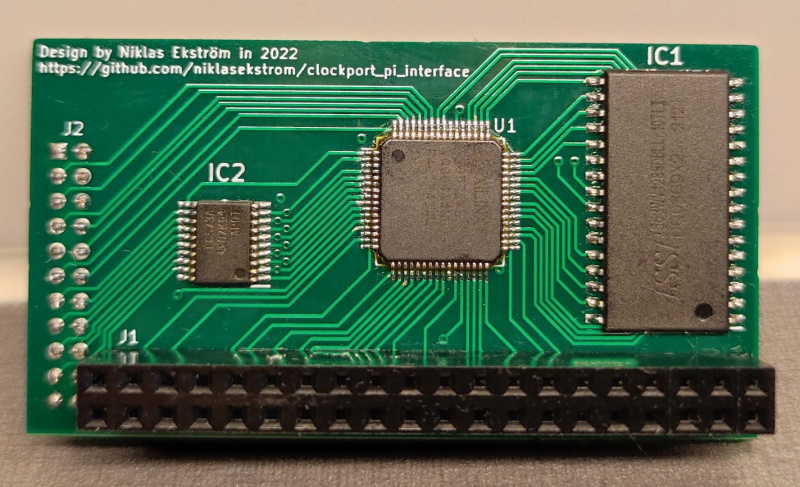 | 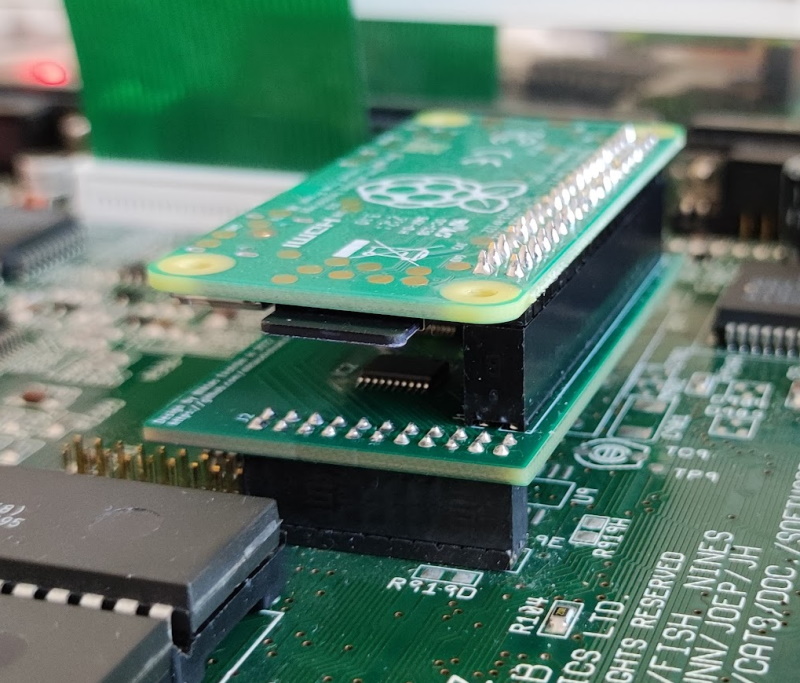 |
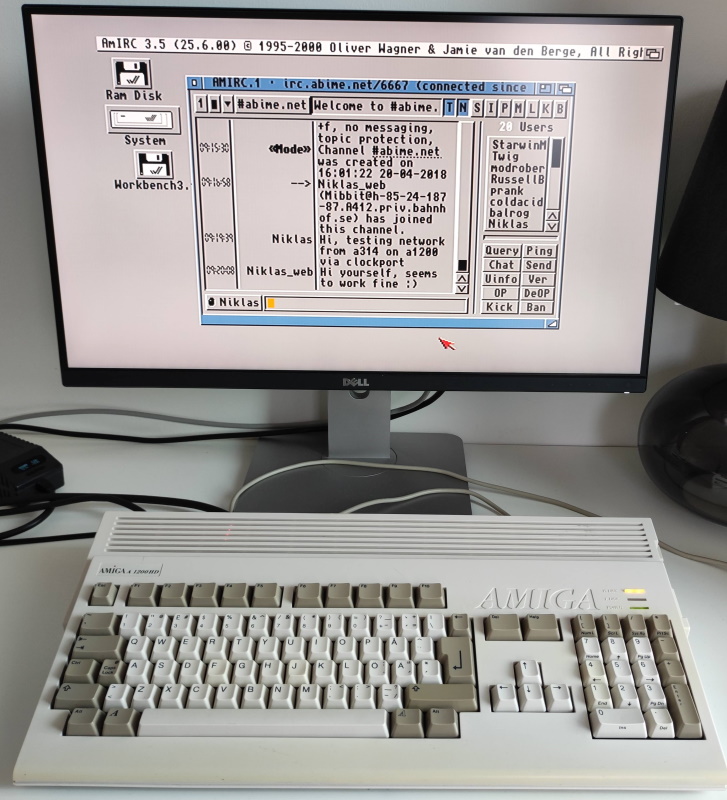 |
Either side, the Amiga or the Pi, can read from and write to the SRAM. The interface is 8 bits wide, meaning that each access reads or writes one byte. The interface is symmetric between the sides, so in this description we describe how the Amiga is communicating with the interface, but the communicating between the Pi and the interface works in the same way.
The Amiga can perform two commands towards the interface:
The interface exposes four registers:
The interface has the following state variables:
The actions that the Amiga can do, and their effects:
So in order to read and write to the SRAM, either side must set the address pointer, and then repeatedly read (or write) REG_SRAM in order to read (or write) subsequent positions in the memory.
| References | Value | Footprint | Quantity |
|---|---|---|---|
| C1, C2, C3, C4, C5, C6, C7, C8 | 0.1u | C_0603_1608Metric | 8 |
| U1 | XC9572XL-VQ64 | TQFP-64_10x10mm_P0.5mm | 1 |
| IC2, IC3 | SN74LVC573APWRE4 (alt: 74LVC573APW,118) | SOP65P640X120-20N | 2 |
| IC1 | IS63WV1288DBLL-10TLI (alt: IS61WV1288EEBLL-10TLI) | SOIC127P1176X120-32N | 1 |
| J1 | Raspberry_Pi_2_3 | PinSocket_2x20_P2.54mm_Vertical | 1 |
| J2 | Conn_02x11_Odd_Even | PinSocket_2x11_P2.00mm_Vertical | 1 |
| Qty | Value | Footprint | References |
|---|---|---|---|
| 8 | 0.1u | Capacitor_SMD:C_0603_1608Metric | C1, C2, C3, C4, C5, C6, C7, C8 |
| 2 | SN74LVC573APWRE4 | SamacSys_Parts:SOP65P640X120-20N | IC2, IC3 |
| 1 | Conn_02x11_Odd_Even | Connector_PinSocket_2.00mm:PinSocket_2x11_P2.00mm_Vertical | J2 |
| 1 | IS63WV1288DBLL-10TLI | SamacSys_Parts:SOIC127P1176X120-32N | IC1 |
| 1 | Raspberry_Pi_2_3 | Connector_PinSocket_2.54mm:PinSocket_2x20_P2.54mm_Vertical | J1 |
| 1 | XC9572XL-VQ64 | Package_QFP:TQFP-64_10x10mm_P0.5mm | U1 |
The 14 most common of 15 parts.
It measures 59 × 32 mm and has 4 copper layers, 1.59 mm thick.
15 parts, built around the SN74LVC573APWRE4 and IS63WV1288DBLL-10TLI. The full list of its parts is on this page, with links to each part's symbol and footprint where PCBKit's library has them.
From the niklasekstrom/clockport_pi_interface repository on GitHub, at the commit this page was made from: the board is Hardware/cp_pi_if_fit_shield.kicad_pcb and its schematic Hardware/cp_pi_if.kicad_sch. PCBKit opens the board in the browser, with nothing to install.
Its repository publishes it under the GPL-3.0 licence: you may reuse it on that licence's terms (keep the author's notice, and for a copyleft licence share your changes alike).

JanM321/esphome-lg-controller
Wired controller for LG HVAC units using ESPHome and ESP32


RoboticsBrno/RB0005-UniversalStepDown
Universal step-down module

OpenDevicePartnership/pico-de-gallo
A tool for testing Embedded Rust drivers for discrete I2C/SPI components.
