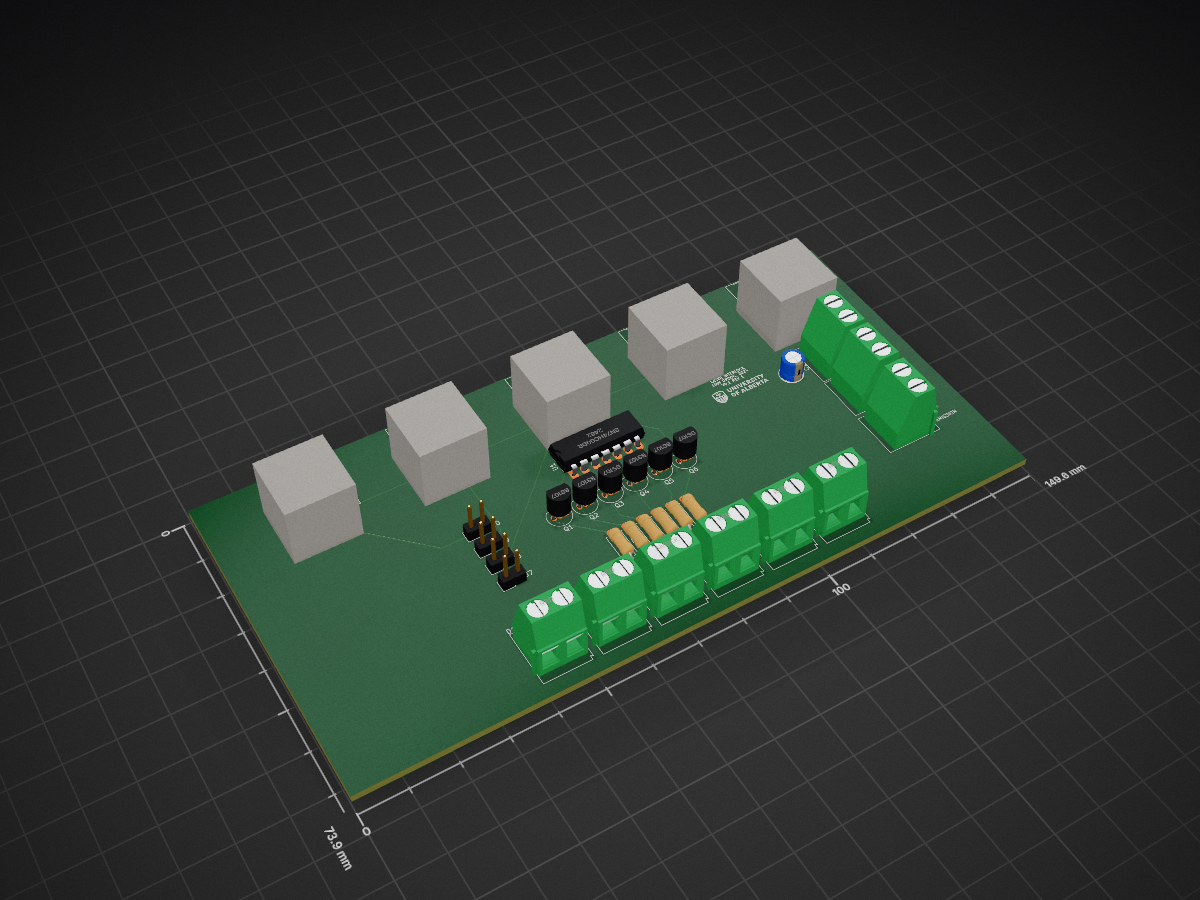
Github repository for hardware and software interfacing of the smart system used by the Hussein Ultrafast Plasma Science group at the University of Alberta for experiments LIBS and high-repetition-rate, femtosecond…
PortableLIBS is an open-source printed circuit board by nfbeier, from the nfbeier/HusseinLab_UltrafastPlasmaScience repository on GitHub. It is a 2-layer board of 149.6 × 73.9 mm with 33 parts on 25 nets, routed with 82 tracks and 0 vias.
It is built around the SN74HC00DR(LX). Its parts include 12 connectors, 6 resistors, 6 diodes, 6 transistors and 1 capacitor.
Repository Description: 'Last Edited: July 29, 2025'
Overview
Github repository for hardware and software interfacing of the smart system used by the Hussein Ultrafast Plasma Science group at the University of Alberta for experiments LIBS and high-repetition-rate, femtosecond laser experiments.
The smart system aims to interface a collection of hardware components necessary to perform high intensity laser-plasma interactions including FLIR Blackfly CCD, Newport XPS-D8 Motion Controller,
Agilent XGS-600 Vacuum Controller, Andor iKon-M Vacuum X-ray CCD, and more. The various equipment will be controlled using Python code, and be designed in a modular structure to allow for quick
changes in experimental setups.
Python Version
We are standardized on Python 3.10 for all software in this repo. However, usage of the LIBS code with Stellarnet spectrometers requires Python 3.8
Importing Driver Code
This project aims to provide a consistent and reliable way to handle relative imports across various modules. By including a default pathing block at the top of the main programs, we ensure that all relative imports are correctly resolved, preventing potential import errors.
Default Pathing Block
To maintain consistent relative imports, we include the following default pathing block at the top of our main programs:
text
import os
import sys

cwd = os.getcwd()
if "HusseinLab_UltrafastPlasmaScience" not in cwd.split(os.path.sep):
    raise ValueError("The directory does not contain 'HusseinLab_UltrafastPlasmaScience' folder.")
# Rebuild the directory string up to and including 'HusseinLab_UltrafastPlasmaScience', prevent import errors
cwd = os.path.sep.join(
    cwd.split(os.path.sep)[: cwd.split(os.path.sep).index("HusseinLab_UltrafastPlasmaScience") + 1]
)
sys.path.insert(0, cwd)
Contributing
Branches
Branches must change or implement one feature
Branches created from branches must be merged in the order they are created
Branch Naming
Branches are named as follows: <name_of_author>/<branch_type>/<description_of_branch>
Branch types may be one of the following: {hotfix,bugfix,experimental,feature}
Commit Messages
Do not assume your code is self explanatory
Do not assume everyone else knows what you are working on
Use the imperative mood in the subject line
When in doubt, use the KISS method: Keep It Simple, Silly
Converting PyQt5 Designer Files
To convert PyQt5 Designer .ui files to Python .py files that can be imported into your software, you can use the pyuic5 tool. This tool is part of the PyQt5 package and allows you to generate Python code from the .ui files created using the Qt Designer.
Command
The basic command to convert a .ui file to a .py file is:
A simple, original Game Boy (DMG) / ModRetro Chromatic homebrew development cartridge. 512 KB of rewritable NOR flash, 8 KB of battery-free F-RAM, and an MBC5-subset mapper built from discrete 74HC logic.
This directory retains the rejected #38 nine-board-era schematic, PCB and route receipts at base commit 1fc6e5347308fe5e8166d5828ba3ba6fa8e101c7. It is excluded from the current ten-board manifest.
MNT VA2000, an Open Source Amiga 2/3/4000 Graphics Card (Zorro II/III), written in Verilog
33 parts1k
Questions
How big is the PortableLIBS PCB?
It measures 149.6 × 73.9 mm and has 2 copper layers, 1.6 mm thick.
What parts does the PortableLIBS use?
33 parts, built around the SN74HC00DR(LX). The full list of its parts is on this page, with links to each part's symbol and footprint where PCBKit's library has them.
Where can I download the PortableLIBS KiCad files?
From the nfbeier/HusseinLab_UltrafastPlasmaScience repository on GitHub, at the commit this page was made from: the board is Hardware/portableLIBS/pcb/portableLIBS/portableLIBS.kicad_pcb and its schematic Hardware/portableLIBS/pcb/portableLIBS/demo.kicad_sch. PCBKit opens the board in the browser, with nothing to install.
Can I use the PortableLIBS design in my own project?
Its repository states no licence, so its author keeps all rights: ask nfbeier before reusing the design.