
2 layers75 × 100 mm
Phased
Neumi/open_echo
Open Source echo sounder / depth sounder / SONAR for bathymetry and research. Arduino based and compatible.
77 parts530

 Neumi/open_echo530
Open Source echo sounder / depth sounder / SONAR for bathymetry and research. Arduino based and compatible.
TUSS4470 shield is an open-source printed circuit board by Neumi, from the Neumi/open_echo repository on GitHub. It is a 2-layer board with 51 parts on 84 nets, routed with 206 tracks and 24 vias.
It is built around the CP2102N-A01-GQFN28R, AMS1117-3.3 and R1M. Its parts include 20 capacitors, 10 resistors, 4 ICs, 4 diodes and 2 crystals. It belongs with the sensors and measurement boards and the STM32 boards of this library.



An ongoing open-source hardware and software project for building sonar systems for testing, boating, bathymetry, and research.
Discord | Getting Started Guide | Hardware Files
Open Echo makes SONAR technology accessible for developers, researchers, and hobbyists. It supports a wide variety of commercial and DIY ultrasonic transducers in both water and air, covering frequencies from 40 kHz up to 1000 kHz.
Use cases range from reverse-engineering car parking sensors and reading depth data on a yacht, to operating a Lowrance Tripleshot side-scan transducer or streaming data to a Pixhawk on a custom boat.
The primary development platform is the TUSS4470 Arduino Shield. It stacks directly on top of an Arduino Uno to drive the TUSS4470 ultrasonic driver.
Upcoming Board: A new development version is in the works and will hopefully be released in the coming weeks. It features an on-board boost converter and slightly improved signal routing.
openechoes@gmail.com.Note: All profits go directly toward supporting the project. Please understand that I can only provide support if you order the boards directly from me or Elecrow.
The Python Interface Software connects to boards running the RAW Data Firmware. It serves as a simple backend to view live echograms and output TCP depth data streams. (Configuration tweaking directly from the UI will be added later).
Live echogram in water (6x speed):
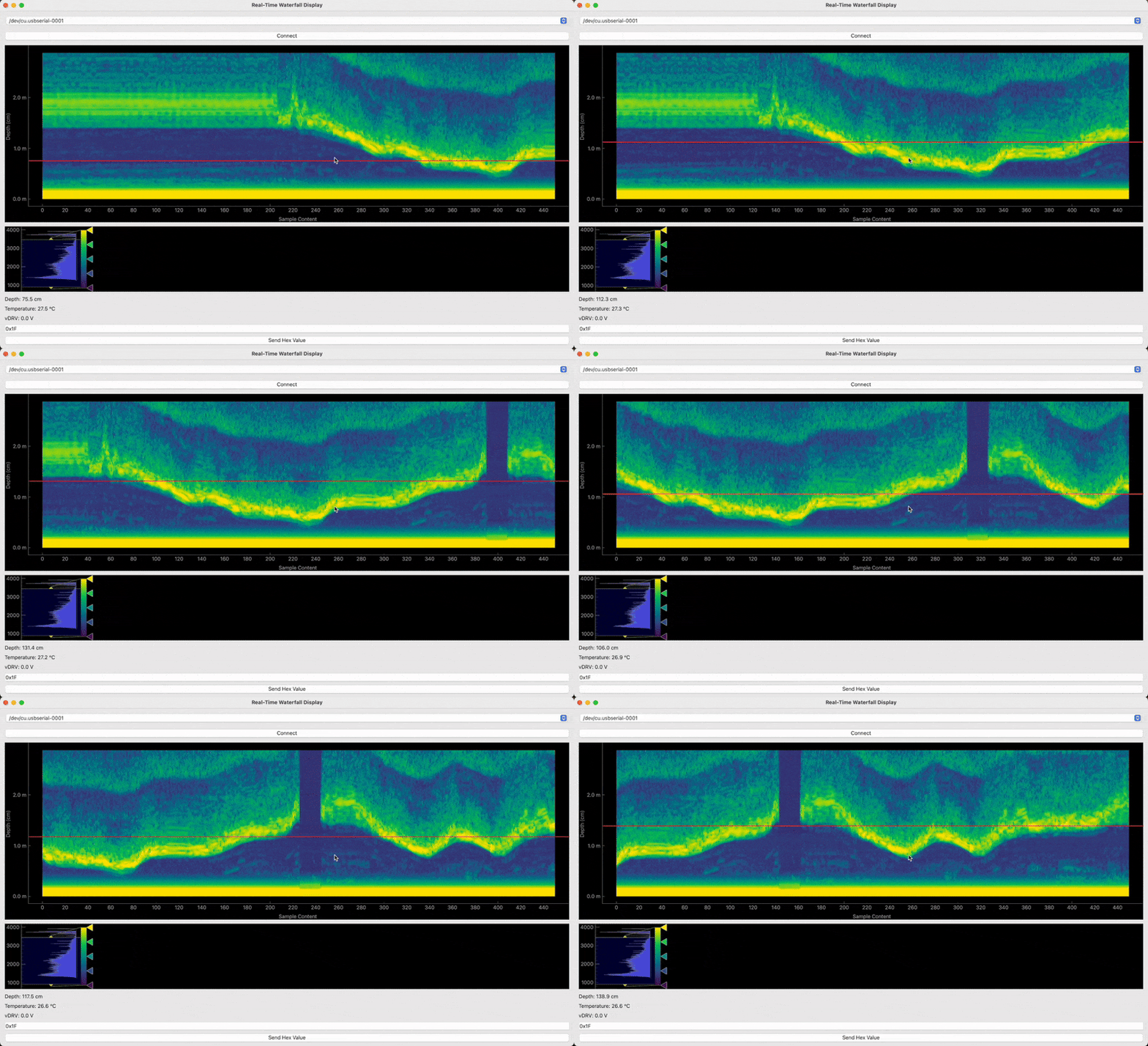
(Static raw data waterfall chart available here)
Tested using a built-in 150 kHz SEAFARER transducer, powered at 15-20 V via an MT3608 boost converter from USB. Data capture in the plots begins at the bottom.
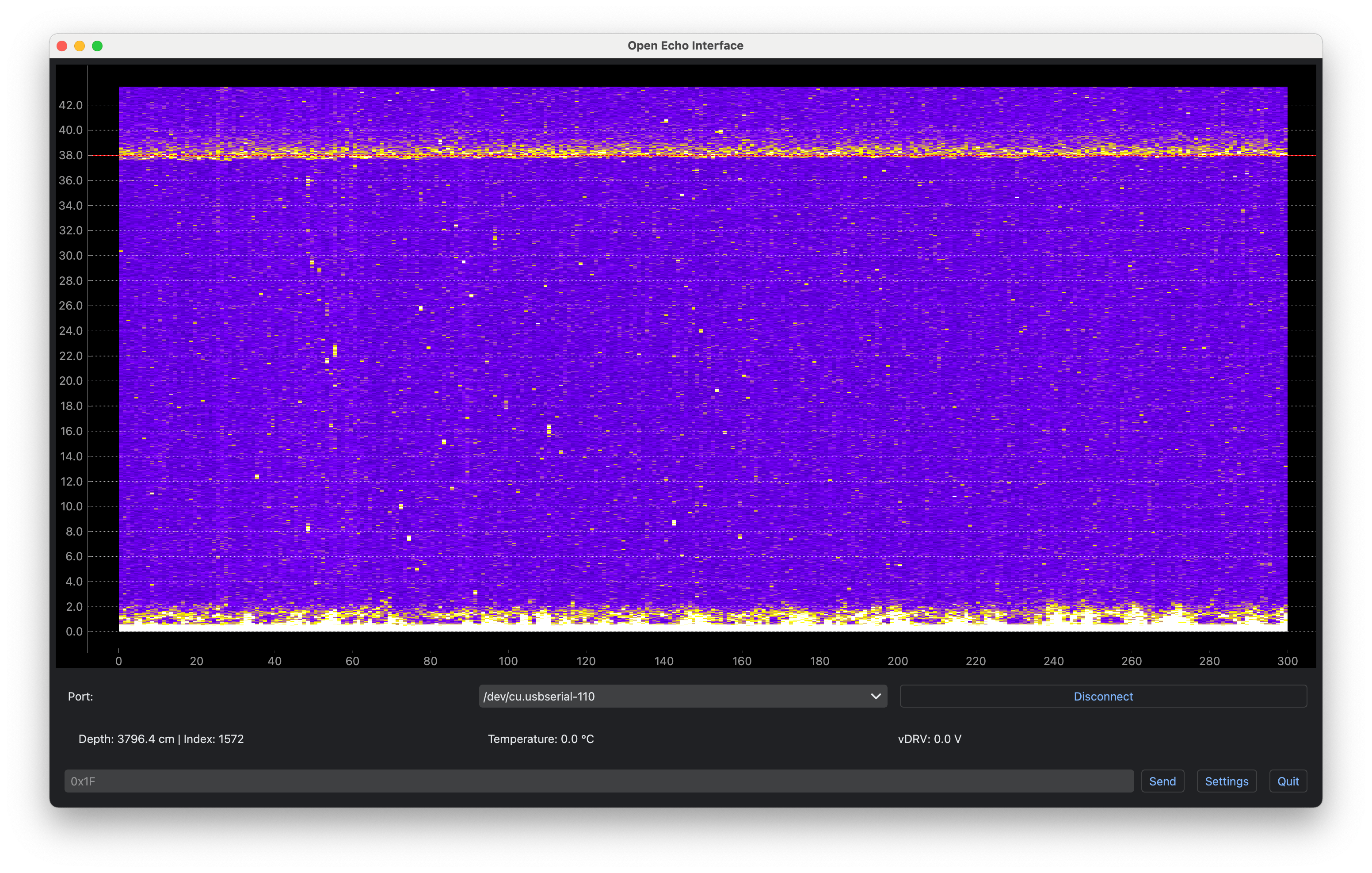 38 m range test |
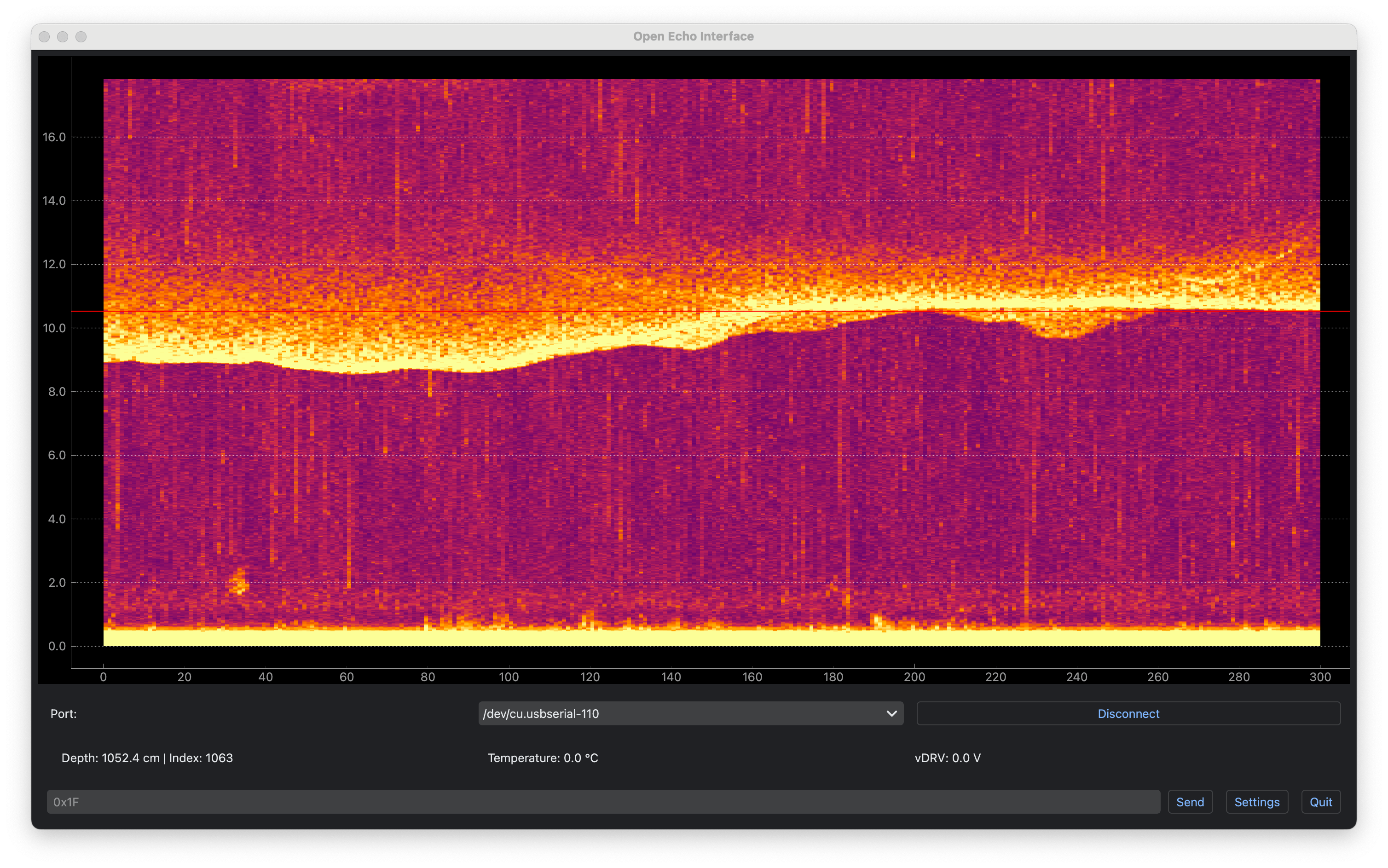 Kiel Channel sand and mud |
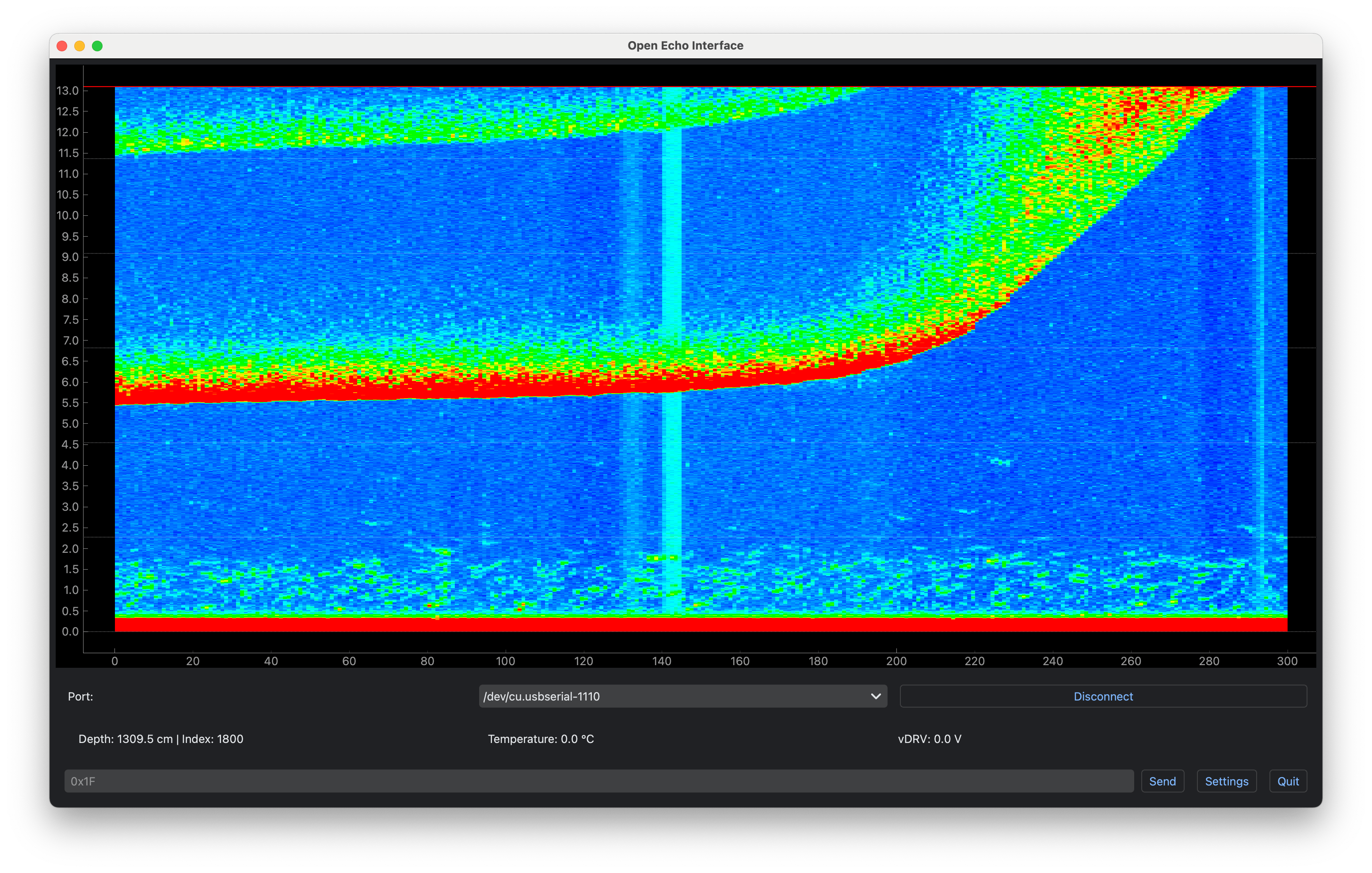 Slope near Stollergrund |
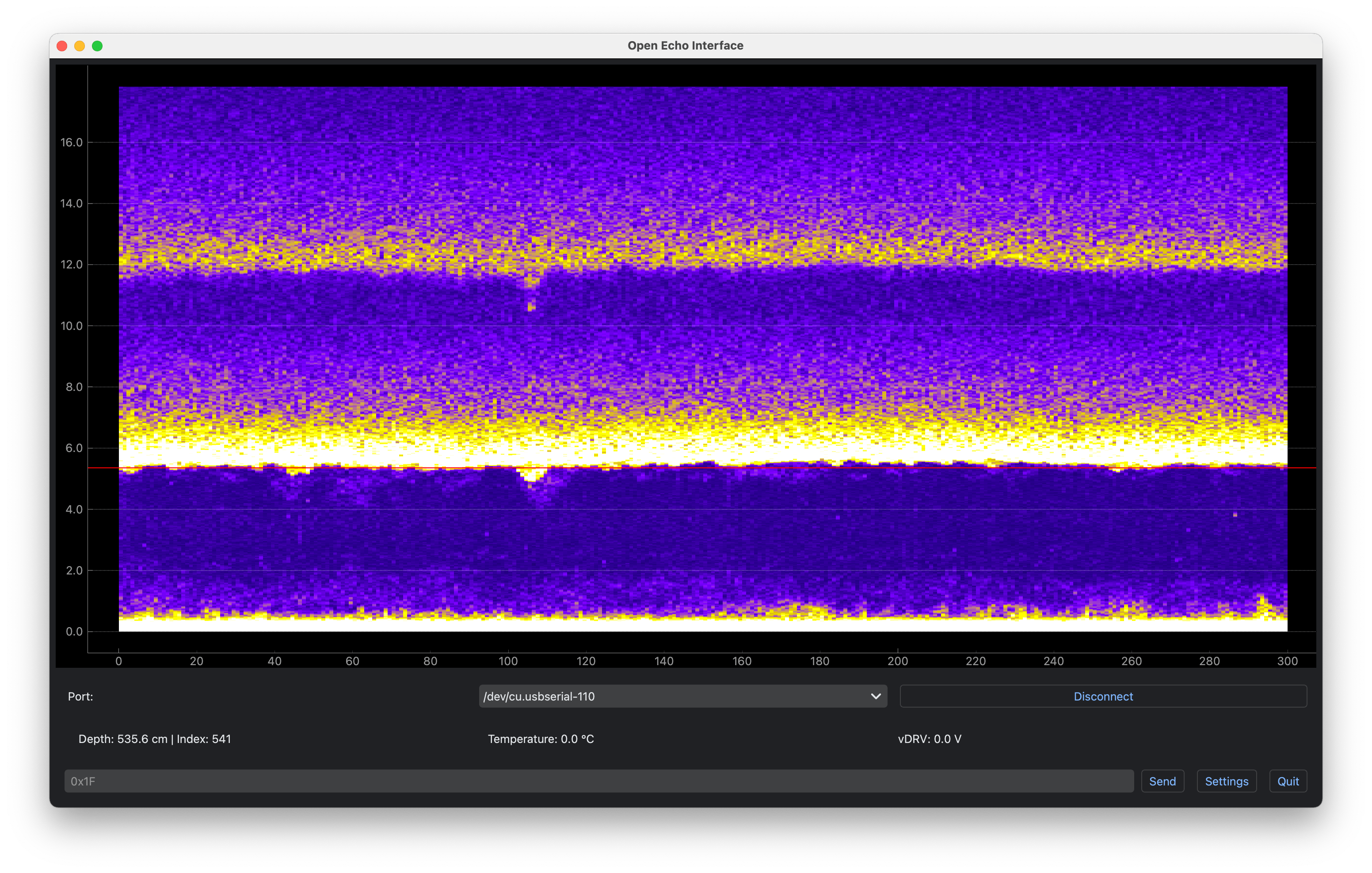 Stones and sandy seabed |
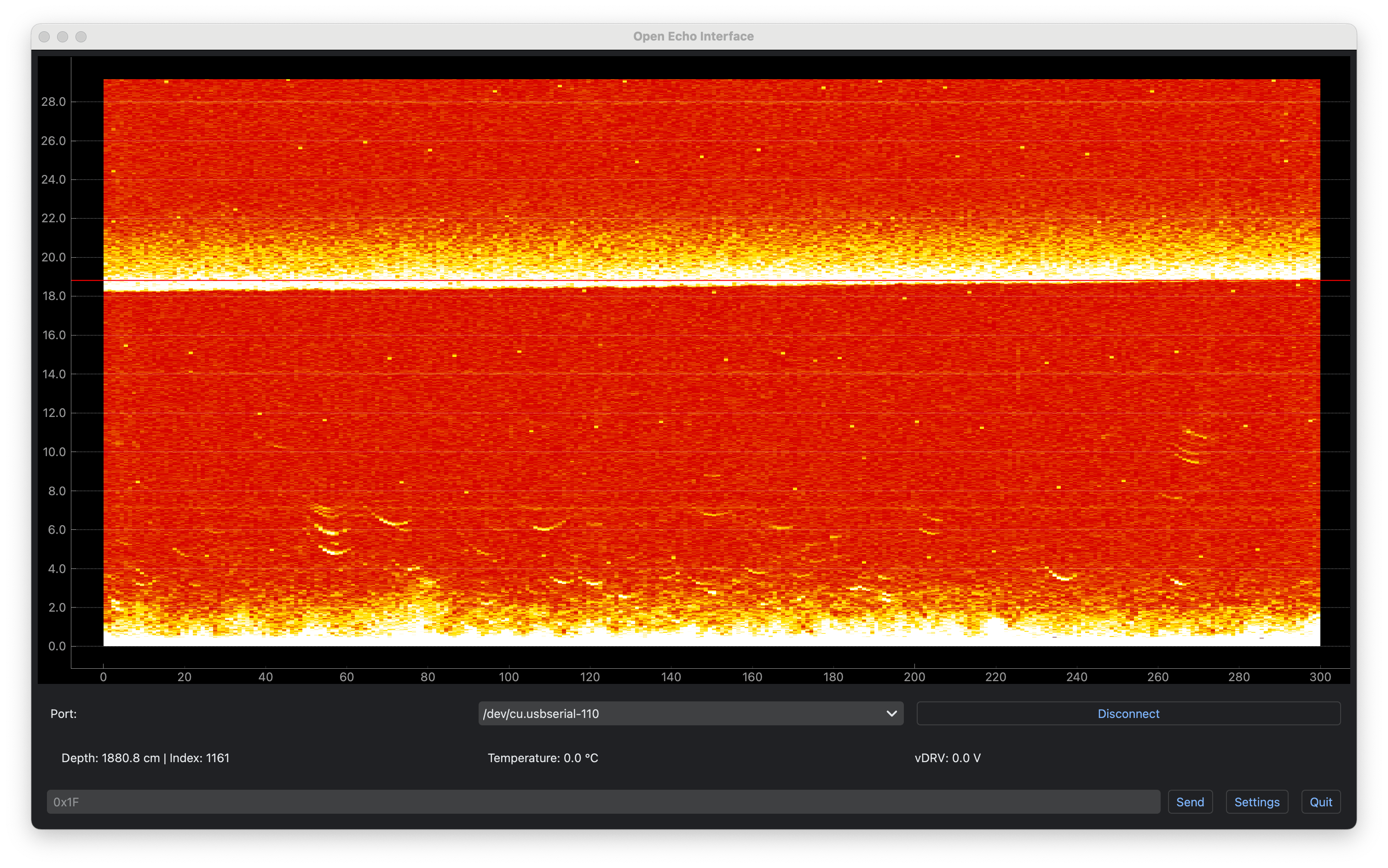 Fish detection |
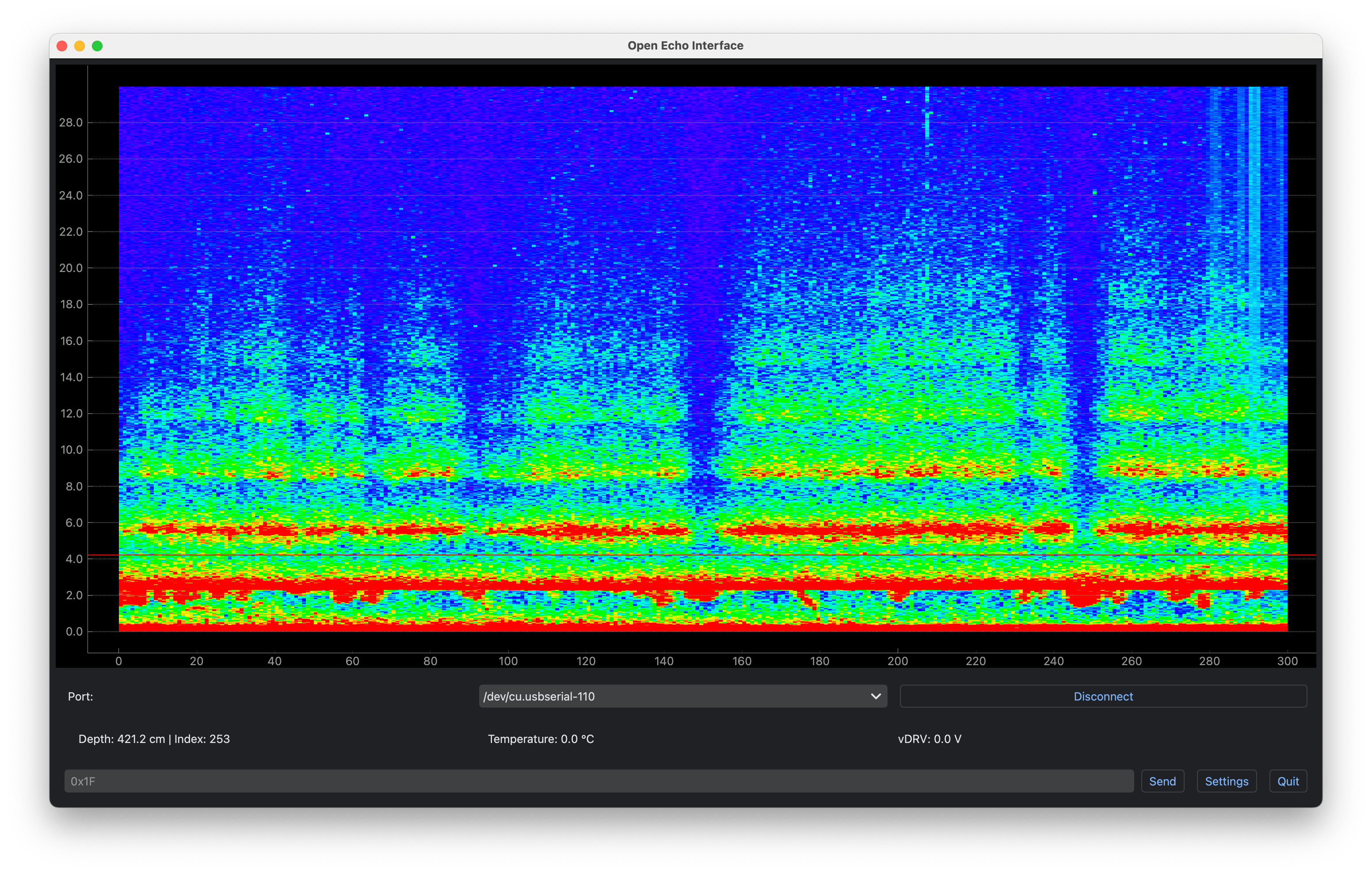 Multiple reflections and seaweed |
Open Echo has been tested with multiple transducers. Here is a curated list of tested hardware:
| Transducer Name | Rating | Description | Freq. | Range Air/Water | Price | Link |
|---|---|---|---|---|---|---|
| NASA / Seafarer 150kHz | ⭐⭐⭐ | NASA in-hull boat transducer for echo sounding / fish-finding | 150kHz | >2m / >50m | 50-100€ | Link |
| Raymarine CPT-S | ⭐⭐⭐ | High-quality in-hull transducer with two frequencies | 50/200kHz | 2m / >50m | 200€ | Link |
| Lowrance Tripleshot | ⭐⭐⭐ | Sidescan transducer (three FANS + temp + down-scan) | 200/455/600kHz | 0m / >20m | 200€ | Link |
| Cheap Bathymetry | ⭐⭐⭐ | Good range and price/performance (can be hard to order) | 200kHz | 2m / >30m | 25€ | Link |
| Car Parking Sensor | ⭐⭐ | Great for air, works in water (not recommended for marine) | 40kHz | >7m / >30m | 5€ | Link |
| Water Flow Sensor | ⭐⭐ | Cheap (Air & Water). Very narrow beam in water (~5°)! | 1000kHz | 0.25m / >10m | 16€ (5pcs) | Link |
| Sinter Glass (Air Only) | ⭐ | Sinter glass matching layer, strictly for air use | 200kHz | 0.8m / (>8m) | 10€ | Link |
| Encapsulated Transducers | ⭐ | Good for short-range testing at higher frequencies | 200-400kHz | ?m / ?m | 9-18€ | Link |
| Small PZT Only | ⭐ | Bare component, only for raw experimentation | 200kHz | 0.2m / ?m | 10€ | Link |
Note: The range values were measured using the TUSS4470 shield on an Arduino Uno with an MT3608 boost converter set to 20V for
vDRV. Consider them approximate.
Tip: Lower frequencies propagate farther, while higher frequencies produce narrower beams and more detailed echoes. For bathymetry, the first four options work best. Most commercial marine-grade transducers are suitable as long as they operate between 40 and 1000 kHz.
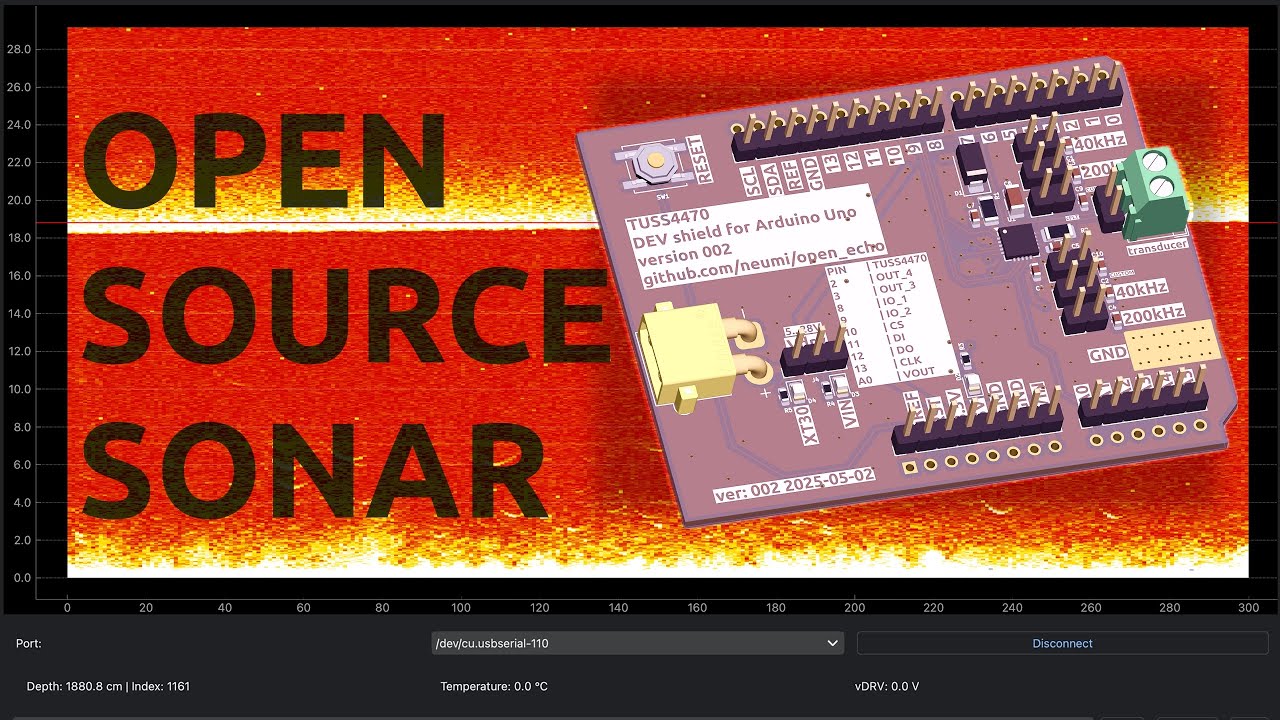
https://www.youtube.com/watch?v=R3_NO2F7PsI
https://www.youtube.com/watch?v=msbLVsY8xhQ
https://www.youtube.com/watch?v=eJ8jVEQSx_Y
https://www.youtube.com/watch?v=Bxh3rWd5RZk
https://www.youtube.com/watch?v=UDYWQIizN7A
A big thanks to www.kogger.tech for their continued support!
Thanks to our contributors:
If you use open_echo in your work or research, please cite the project:
 0009-0003-9829-8959
BibTeX:
@misc{open_echo,
  author       = {Jan Neumann},
  title        = {open\_echo},
  year         = {2026},
  publisher    = {GitHub},
  journal      = {GitHub Repository},
  howpublished = {\url{[https://github.com/Neumi/open_echo](https://github.com/Neumi/open_echo)}},
  note         = {ORCID: [https://orcid.org/0009-0003-9829-8959](https://orcid.org/0009-0003-9829-8959)}
}| Qty | Value | Footprint | References |
|---|---|---|---|
| 4 | C100nF | Capacitor_SMD:C_0402_1005Metric | C25, C28, C29, C30 |
| 4 | C100nF | Capacitor_SMD:C_0603_1608Metric | C21, C22, C23, C24 |
| 3 | R1k | Resistor_SMD:R_0603_1608Metric | R7, R8, R9 |
| 2 | C100nF | Capacitor_SMD:C_1206_3216Metric | C11, C16 |
| 2 | C22pF | Capacitor_SMD:C_0402_1005Metric | C26, C27 |
| 2 | C47uF | Capacitor_SMD:C_1206_3216Metric | C12, C17 |
| 2 | GND | TestPoint:TestPoint_Pad_D2.0mm | TP1, TP5 |
| 2 | R10k | Resistor_SMD:R_0603_1608Metric | R13, R14 |
| 2 | R330 | Resistor_SMD:R_0603_1608Metric | R10, R12 |
| 1 | 10nF | Capacitor_SMD:C_0603_1608Metric | C8 |
| 1 | 1N4001 | Diode_SMD:D_SMA | D1 |
| 1 | 3.3V | TestPoint:TestPoint_Pad_D2.0mm | TP6 |
| 1 | 40V, 2µF | Capacitor_SMD:C_1206_3216Metric | C6 |
| 1 | 40V, 330pF | Capacitor_SMD:C_0603_1608Metric | C5 |
| 1 | 50V, 100nF | Capacitor_SMD:C_0603_1608Metric | C7 |
| 1 | 5V | TestPoint:TestPoint_Pad_D2.0mm | TP2 |
| 1 | AMS1117-3.3 | Package_TO_SOT_SMD:SOT-223-3_TabPin2 | U2 |
| 1 | C21.2nF | Capacitor_SMD:C_0603_1608Metric | C4 |
| 1 | C3.2nF | Capacitor_SMD:C_0603_1608Metric | C3 |
| 1 | CP2102N-A01-GQFN28 | Package_DFN_QFN:QFN-28-1EP_5x5mm_P0.5mm_EP3.35x3.35mm | U3 |
| 1 | Crystal | Crystal:Crystal_SMD_5032-2Pin_5.0x3.2mm | Y2 |
| 1 | Crystal | Resistor_SMD:R_1206_3216Metric | Y1 |
| 1 | D+ | TestPoint:TestPoint_Pad_D2.0mm | TP7 |
| 1 | D- | TestPoint:TestPoint_Pad_D2.0mm | TP8 |
| 1 | LED_PC13 | LED_SMD:LED_0805_2012Metric | D5 |
| 1 | R10 | Resistor_SMD:R_1206_3216Metric | R1 |
| 1 | R1M | Resistor_SMD:R_0402_1005Metric | R15 |
| 1 | R200 | Resistor_SMD:R_1206_3216Metric | R2 |
| 1 | RST | Button_Switch_SMD:SW_Push_1P1T_NO_CK_KSC7xxJ | SW2 |
| 1 | RX | LED_SMD:LED_0805_2012Metric | D8 |
| 1 | RX | TestPoint:TestPoint_Pad_D2.0mm | TP3 |
| 1 | STM32F103C8Tx | Package_QFP:LQFP-48_7x7mm_P0.5mm | U4 |
| 1 | TUSS4470TRTJR | Package_DFN_QFN:QFN-20-1EP_4x4mm_P0.5mm_EP2.5x2.5mm_ThermalVias | U1 |
| 1 | TX | TestPoint:TestPoint_Pad_D2.0mm | TP4 |
| 1 | TX | LED_SMD:LED_0805_2012Metric | D6 |
| 1 | Transformer_1P_SS | Transformer_SMD:UltrasonicTransformer7.8,8 | T1 |
| 1 | termination_jumper | Jumper:SolderJumper-2_P1.3mm_Open_RoundedPad1.0x1.5mm | JP7 |
Neumi/open_echo
Open Source echo sounder / depth sounder / SONAR for bathymetry and research. Arduino based and compatible.

Neumi/open_echo
Open Source echo sounder / depth sounder / SONAR for bathymetry and research. Arduino based and compatible.

Neumi/open_echo
Open Source echo sounder / depth sounder / SONAR for bathymetry and research. Arduino based and compatible.

Neumi/open_echo
Open Source echo sounder / depth sounder / SONAR for bathymetry and research. Arduino based and compatible.

Neumi/fastLOGIC
An affordable Arduino-based board designed for straightforward (industrial) logic control, ideal for building small-scale automation and control solutions.

Neumi/ethersweep
Open Source, easy to use Ethernet connected stepper motor controller. Built in FreeCAD, KiCAD and Arduino.

AlisonTristao/KynoWave
Dispositivo IoT para monitoramento do nivel de ruído em ambientes (2º lugar na maratona de inovação 2026/1 - Arena Ação Junior)

TheUnproductive/FrameworkHDMICaptureCard
This Project aims to bring a native HDMI Capture Card to the Framework architecture.

Asapgiri/kbb-keyboard
Keep in mind, that first the Atmega32u4 will need a bootloader, witch is programmed trough the bootloader pins. We had to program it with an Esp32-C3-mini, witches Arduino ISA codes I will upload here under the folder…


augustinzaininger/photocatalysisManagement
PCB Layouts, firmware and software for management of photocatalysis experimental system consisting of MFCs, Solenoid Valves etc

51 parts, built around the CP2102N-A01-GQFN28R, AMS1117-3.3 and R1M. The full list of its parts is on this page, with links to each part's symbol and footprint where PCBKit's library has them.
From the Neumi/open_echo repository on GitHub, at the commit this page was made from: the board is development/TUSS4470_PCB_ECHO/TUSS4470_shield/TUSS4470_shield.kicad_pcb and its schematic TUSS4470_shield_002/TUSS4470_shield_hardware/TUSS4470_shield/TUSS4470_shield.kicad_sch. PCBKit opens the board in the browser, with nothing to install.
Its repository states no licence, so its author keeps all rights: ask Neumi before reusing the design.