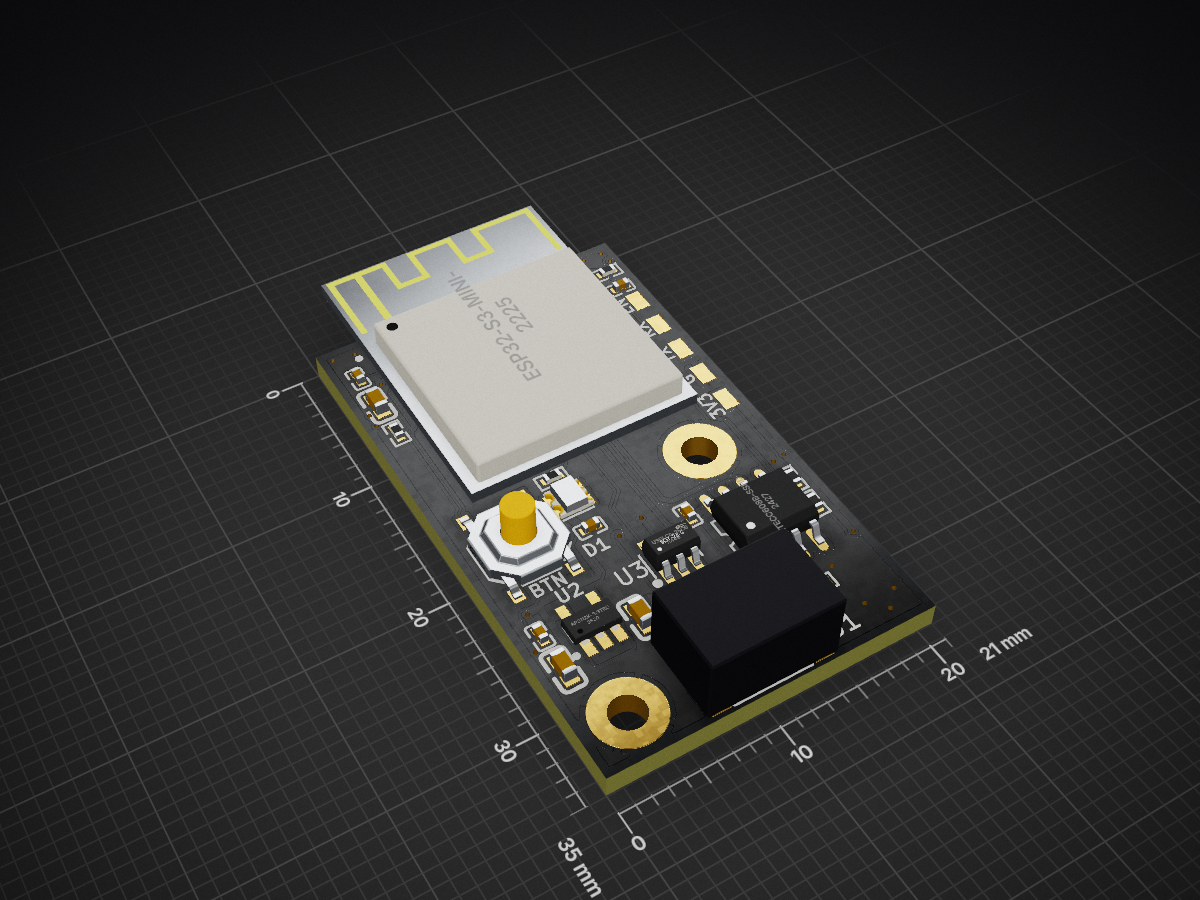
Tinycrypt key is an open-source printed circuit board by nakomis, from the nakomis/tinycrypt repository on GitHub, published under the CC0-1.0 licence. It is a 2-layer board of 21 × 35 mm with 25 parts on 14 nets, routed with 119 tracks and 42 vias.
It is built around the ESP32-S3-MINI-1-N8, AP2112K-3.3TRG1 and ATECC608B-SSHDA-T, with the USBLC6-2SC6, TS-1187A-B-A-B and WS2812B-2020-V6 among its other parts. Its parts include 8 capacitors, 6 resistors, 4 ICs, 1 diode and 1 connector. It belongs with the ESP32 boards of this library.
tinycrypt — a DIY FIDO2 security key you approve from your Apple Watch
Support
If you find this useful, please consider buying me a coffee:
Table of Contents
Overview
A YubiKey-style FIDO2/WebAuthn USB security key built on an ESP32-S3, where the "touch the key"
step happens on your wrist instead: the key sends a push notification to an Apple Watch, you tap
Approve, and the watch proves it over Bluetooth before the key signs you in.
The first target is signing into AWS IAM Identity Center with the "Security key" MFA option.
Hardware:
ESP32-S3 (target board: Waveshare ESP32-S3-Zero) — native USB, Wi-Fi, BLE
Microchip ATECC608 — ECC P-256 secure element (I²C) for key storage, added after the software prototype
Apple Watch — user-presence approval
Status: feasibility spikes. Spike A passed: an ESP32-S3 running the
SoloKeys solo1 CTAP2 core, with an insecure software key and a
BOOT-button presence check, registered and signed into IAM Identity Center from Chrome. The earlier
ATtiny85 / U2F experiments live on the spike branch.
How it fits together
The browser asks the key (USB HID, CTAP2) for a WebAuthn assertion.
The key sends an approval request: AWS IoT Core → SNS → APNs → actionable watch notification (about 2 s).
You tap Approve; the watch connects to the key over BLE and signs a fresh nonce with its Secure Enclave key.
The watch must be in Bluetooth range: a remote approval is impossible. On a real watch the Bluetooth exchange takes about 1.4 s after you tap.
The key verifies the watch's signature, then signs the WebAuthn assertion and returns it to the browser.
The firmware is split into a portable CTAP2 core with swappable transport, crypto, presence and
notifier back ends, so most of it also runs as a simulator on macOS.
Testing builds can use a software key instead of the ATECC608. That build is deliberately
insecure, is for testing only, and must only ever be registered against a read-only test user.
Building and testing
All the firmware lives in embedded/, and the commands below run from there. The CTAP2 core is
SoloKeys solo1 (Apache-2.0 OR MIT), pinned as a submodule in
embedded/third_party/solo1 under its own licence. Fetch it and the libraries it builds:
Portable code: the secure-element interface and solo1's crypto routed through it, presence, the soft element (TINYCRYPT_INSECURE_SOFT_KEY, refused in release builds)
sim/
Mac simulator: CTAPHID over UDP, state in a directory
esp32s3/
ESP-IDF firmware: TinyUSB FIDO HID, the ATECC608B (or the soft element in NVS), presence, the provisioner
tests/
python-fido2 tests against the sim, plus hw_smoke.py for a real key
Mac sim (needs brew install libsodium):
bash
cmake -S . -B build -DTINYCRYPT_INSECURE_SOFT_KEY=ON && cmake --build build
python3 -m venv tests/.venv && tests/.venv/bin/pip install -r tests/requirements.txt
tests/.venv/bin/python -m pytest tests
build/tinycrypt-sim --presence prompt     # run it by hand; press Enter to approve
ESP32-S3 (ESP-IDF 5.5 in ~/esp/v5.5/esp-idf):
bash
esp32s3/build.sh                                    # build (KEYSTORE=atecc for the ATECC608B; soft by default)
esp32s3/build.sh -p /dev/cu.usbmodemXXXX flash      # flash over the UART port
esp32s3/flash-manual.sh /dev/cu.usbmodemXXXX        # if auto-reset fails: hold BOOT, tap RST, release BOOT first
tests/.venv/bin/python tests/hw_smoke.py            # register + authenticate; press BOOT when asked
The key enumerates on the S3's native USB port (not the UART one) as
"tinycrypt INSECURE TEST KEY", USB ID 303a:4004.
ATECC608B (CRYPT-22). Wire a breakout to the dev board: VCC to 3V3, GND, SDA to GPIO38, SCL to
GPIO21 (the PCB's pins; change them under esp-cryptoauthlib in esp32s3/build.sh menuconfig). The
breakouts have their own pull-ups. A blank chip answers at 0xC0 (8-bit); the M5Stack Trust&GO unit
(0x6A) is factory-locked and can't take tinycrypt's configuration. Locking is permanent: do a
sacrificial chip first. The provisioner's console is the native USB port (USB-Serial-JTAG), so
connect that one; flashing it and the key image straight after needs no BOOT+RST.
bash
KEYSTORE=atecc esp32s3/build.sh provisioner                 # the provisioner image
ESPTOOL_BEFORE=default_reset esp32s3/flash-manual.sh --provisioner /dev/cu.usbmodemXXXX  # else BOOT+RST first
esp32s3/tools/atecc_provision.py /dev/cu.usbmodemXXXX info
esp32s3/tools/atecc_provision.py /dev/cu.usbmodemXXXX lock  # PERMANENT; asks for the serial
esp32s3/tools/atecc_provision.py /dev/cu.usbmodemXXXX csr tinycrypt-sandbox-key-1 /tmp/key-1.csr
infra/scripts/provision-key.sh key-1 --csr /tmp/key-1.csr   # certificate from the chip's own key
KEYSTORE=atecc esp32s3/build.sh && ESPTOOL_BEFORE=default_reset esp32s3/flash-manual.sh /dev/cu.usbmodemXXXX   # the key again
The same steps with the default soft keystore move a key's IoT private key out of prov into its
(INSECURE) soft element, with no chip.
Architecture Diagram
docs/architecture/tinycrypt.drawio will be the source for the architecture diagram; the SVG is
auto-regenerated on commit by the pre-commit hook in .githooks/pre-commit.
To activate the hook after cloning:
bash
git config core.hooksPath .githooks
Support
If you find this useful, please consider buying me a coffee:
It measures 21 × 35 mm and has 2 copper layers, 1.6 mm thick.
What parts does the Tinycrypt key use?
25 parts, built around the ESP32-S3-MINI-1-N8, AP2112K-3.3TRG1, ATECC608B-SSHDA-T and USBLC6-2SC6. The full list of its parts is on this page, with links to each part's symbol and footprint where PCBKit's library has them.
Where can I download the Tinycrypt key KiCad files?
From the nakomis/tinycrypt repository on GitHub, at the commit this page was made from: the board is hardware/key-board/out/key/tinycrypt-key.kicad_pcb. PCBKit opens the board in the browser, with nothing to install.
Can I use the Tinycrypt key design in my own project?
Its repository publishes it under the CC0-1.0 licence: you may reuse it on that licence's terms (keep the author's notice, and for a copyleft licence share your changes alike).
A small ESP32-S3 board that drives the wired DMX512 input of a Neewer PL60C panel light so the light can be ramped up slowly in the morning (sunrise alarm). Rev A, 2026-09-02.
3D-printed, tilted test shelf for 16 dev boards: sliding drawers, per-bay ESP32-S3 running Zephyr (USB/IP, power switching, metering), KiCad PCBs, OpenSCAD parts, BOM and an interactive 3D viewer
Dual-MCU baremetal embedded development board featuring high-speed QSPI storage, hardware USB hub, and flexible power management. Open for PCB trace routing collaboration