4 layers90 × 66.3 mm
Lighthouse base
mwuerms/lighthouse_hardware
+ lighthouse + buoy: hand sender, ble advertising
75 partsMIT

 mwuerms/lighthouse_hardware
+ lighthouse + buoy: hand sender, ble advertising
Lighthouse display is an open-source printed circuit board by mwuerms, from the mwuerms/lighthouse_hardware repository on GitHub, published under the MIT licence. It is a 2-layer board of 132 × 66.4 mm with 137 parts on 84 nets, routed with 1,051 tracks and 226 vias.
It is built around the IS31FL3731-SALS2, OPT3004DNPR and SHTC3, with the IN-S126AT5UW and PMEG4010CEJ among its other parts. Its parts include 106 diodes, 12 resistors, 11 capacitors, 4 ICs and 1 connector. It belongs with the lEDs and displays boards of this library.


buoy will be soldered together using wire only, no pcb for this.
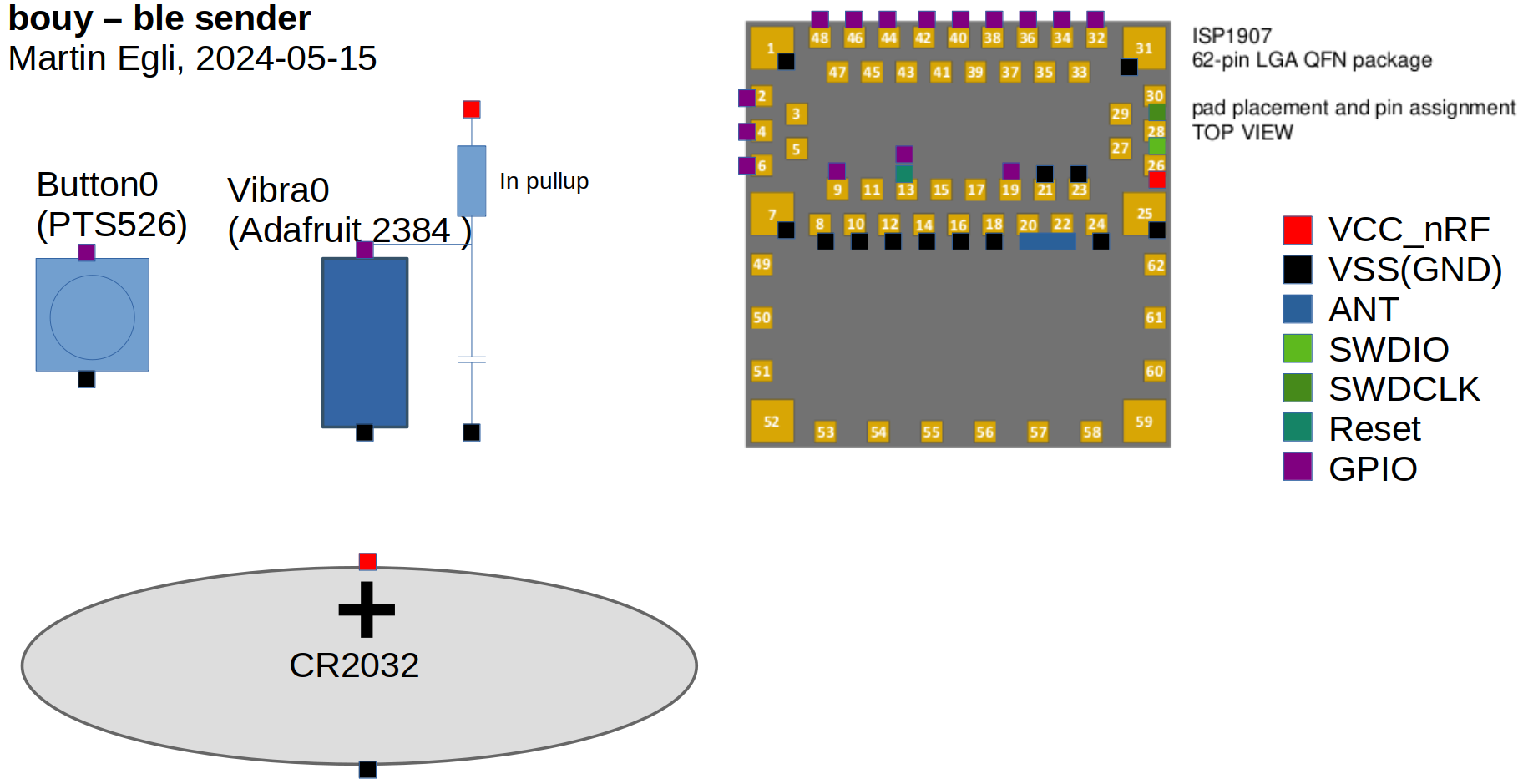
just a collection of (maybe) useful links
| Qty | Value | Footprint | References |
|---|---|---|---|
| 42 | IN-S126AT5UW | LED_SMD:LED_1206_3216Metric_Pad1.42x1.75mm_HandSolder | D64, D65, D66, D67, D68, D69, D70, D71, D72, D73, D101, D102, D103, D104, D105, D106 +26 |
| 34 | 1206MIL | LED_SMD:LED_1206_3216Metric_Pad1.42x1.75mm_HandSolder | D1, D2, D3, D10, D11, D14, D15, D18, D19, D20, D23, D24, D27, D28, D31, D32 +18 |
| 29 | 599-0210-007F | LED_SMD:LED_1206_3216Metric_Pad1.42x1.75mm_HandSolder | D12, D13, D16, D17, D21, D22, D25, D26, D29, D30, D33, D34, D38, D39, D42, D43 +13 |
| 6 | 1M | Resistor_SMD:R_0603_1608Metric_Pad0.98x0.95mm_HandSolder | R3, R5, R8, R9, R10, R11 |
| 5 | 100nF | Capacitor_SMD:C_0603_1608Metric_Pad1.08x0.95mm_HandSolder | C1, C6, C8, C9, C10 |
| 3 | 10uF | Capacitor_SMD:C_0805_2012Metric_Pad1.18x1.45mm_HandSolder | C2, C5, C7 |
| 2 | 1uF | Capacitor_SMD:C_0805_2012Metric_Pad1.18x1.45mm_HandSolder | C4, C11 |
| 2 | 4k7 | Resistor_SMD:R_0603_1608Metric_Pad0.98x0.95mm_HandSolder | R6, R7 |
| 2 | Jumper_3_Bridged12 | Jumper:SolderJumper-3_P1.3mm_Bridged12_RoundedPad1.0x1.5mm | JP1, JP2 |
| 1 | 1M3 | Resistor_SMD:R_0603_1608Metric_Pad0.98x0.95mm_HandSolder | R1 |
| 1 | 20k | Resistor_SMD:R_0603_1608Metric_Pad0.98x0.95mm_HandSolder | R12 |
| 1 | 4.7uH | Inductor_SMD:L_Taiyo-Yuden_NR-60xx_HandSoldering | L1 |
| 1 | 470nF | Capacitor_SMD:C_0603_1608Metric_Pad1.08x0.95mm_HandSolder | C3 |
| 1 | 51k | Resistor_SMD:R_0603_1608Metric_Pad0.98x0.95mm_HandSolder | R2 |
| 1 | 68k | Resistor_SMD:R_0603_1608Metric_Pad0.98x0.95mm_HandSolder | R4 |
| 1 | Conn_01x12_Pin | lighthouse:con_1x12_1.27mm_long_pads | J1 |
| 1 | IS31FL3731-SA | Package_SO:SSOP-28_5.3x10.2mm_P0.65mm | U1 |
| 1 | OPT3004DNPR | lighthouse:SON65P200X200X65-7N-D | IC1 |
| 1 | PMEG4010CEJ | Diode_SMD:D_SOD-323F | D100 |
| 1 | SHTC3 | Sensor_Humidity:Sensirion_DFN-4-1EP_2x2mm_P1mm_EP0.7x1.6mm | U3 |
| 1 | TPS61176RTER | Package_DFN_QFN:Texas_RTE0016D_WQFN-16-1EP_3x3mm_P0.5mm_EP0.8x0.8mm | U2 |
mwuerms/lighthouse_hardware
+ lighthouse + buoy: hand sender, ble advertising

mwuerms/lighthouse_hardware
+ lighthouse + buoy: hand sender, ble advertising

ldab/SARA-Rx-application-board
SARA-R4 NB-IoT + Cat-M1 + GNSS application board - NINA-B3 with Secure MQTT

TUDSSL/FreeBie
To compile FreeBie runtime we used the GNU Arm Embedded Toolchain (9.3.1) and CMake (3.19.1) to build the project. To program the MCU we used the J-Link debug probe with the accompanying J-Link software.

ben5049/Smart-Watch
This project aims to take a cheap, common smart watch and upgrade it by replacing the screen and all internal electronics with custom hardware.


Tuskar-Marine/hardware
All tools for the Mermaid's Rest open sailing tools


joymonkey/animatrix
open-source hardware, firmware, and software toolkit for custom LED matrix displays
It measures 132 × 66.4 mm and has 2 copper layers, 1.6 mm thick.
137 parts, built around the IS31FL3731-SALS2, OPT3004DNPR, SHTC3 and IN-S126AT5UW. The full list of its parts is on this page, with links to each part's symbol and footprint where PCBKit's library has them.
From the mwuerms/lighthouse_hardware repository on GitHub, at the commit this page was made from: the board is kicad/lighthouse_display/rev1/lighthouse_display.kicad_pcb and its schematic kicad/lighthouse_base/lighthouse_base.kicad_sch. PCBKit opens the board in the browser, with nothing to install.
Its repository publishes it under the MIT licence: you may reuse it on that licence's terms (keep the author's notice, and for a copyleft licence share your changes alike).