2 layers187.2 × 26.6 mm

 MrQuiet7/Lemon
A stereo 20-LED VU meter built around two LM3915N-1 ICs, designed for 15–25V DC operation with adjustable audio sensitivity.
Lemon is an open-source printed circuit board by MrQuiet7, from the MrQuiet7/Lemon repository on GitHub, published under the GPL-3.0 licence. It is a 2-layer board of 66 × 58.4 mm with 50 parts on 39 nets, routed with 242 tracks and 0 vias.
Its parts include 20 diodes, 10 resistors, 4 capacitors and 2 ICs.

When life gives you a lemon, plug your music into it.
Lemon is based on the LED VU meter circuit published by Elliott Sound Products.
The original circuit uses an LM3915 to drive ten LEDs according to the level of an incoming audio signal. Lemon uses two identical sections for the left and right channels.
Each channel has its own sensitivity adjustment, allowing the two VU meters to be calibrated independently.
Lemon is designed for a 15–25 V DC supply.
The PCB uses a single positive supply and ground connection. The LED supply path and LM3915 supply path are separated on the board according to the original circuit.
The EARTH connection is kept separate from the main GND plane through the original 10 Ω connection, allowing the board to be integrated into a larger amplifier system without unnecessarily tying the two together.
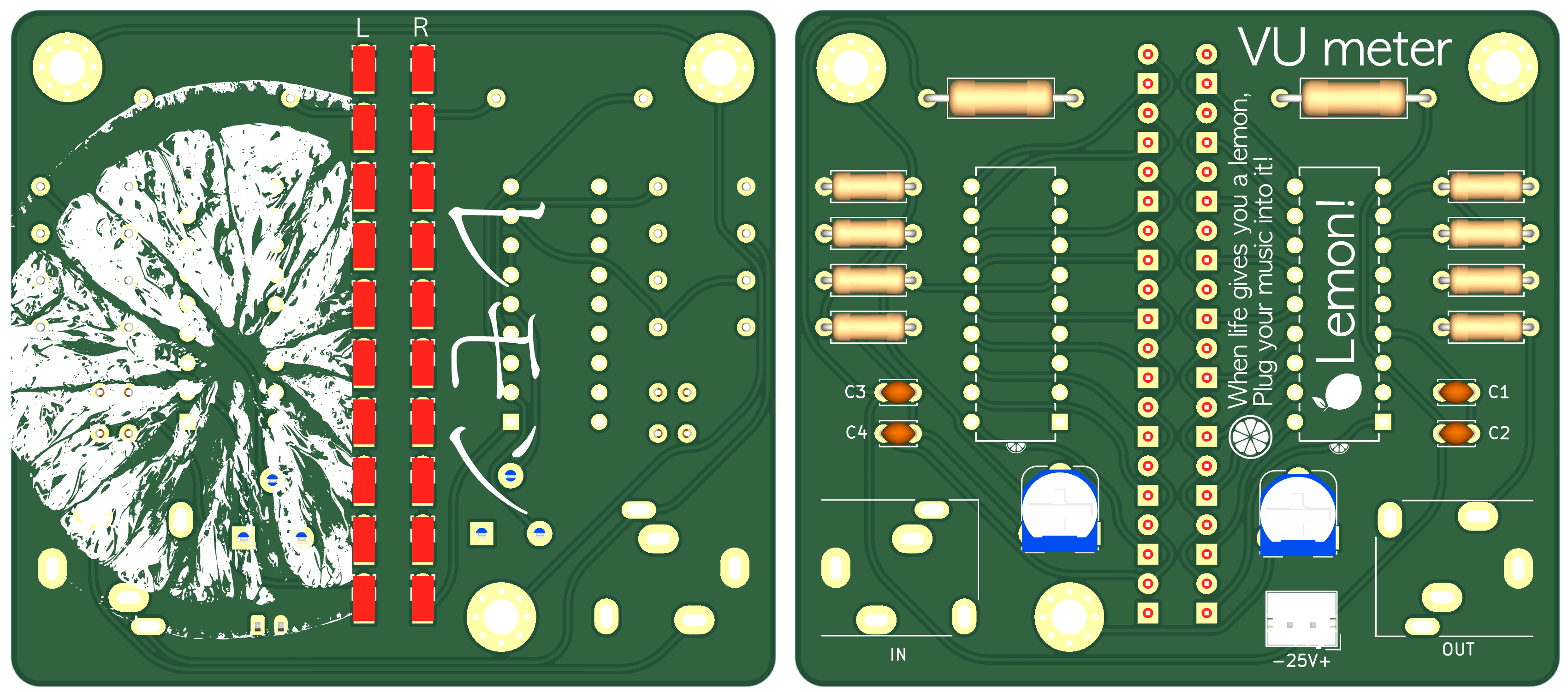
The VU meter circuit is based on the design published by Elliott Sound Products.
Lemon is an independent PCB implementation and stereo adaptation of the circuit, with a custom PCB layout, mechanical arrangement, and visual design.
| Qty | Value | Footprint | References |
|---|---|---|---|
| 20 | LED | LED_THT:LED_Rectangular_W3.9mm_H1.9mm | D1, D2, D3, D4, D5, D10, D11, D12, D13, D14, D15, D16, D17, D18, D19, D20 +4 |
| 6 | LOGO | LOGO | G***, G***, G***, G***, G***, G*** |
| 4 | 100n | Capacitor_THT:C_Disc_D3.0mm_W2.0mm_P2.50mm | C1, C2, C3, C4 |
| 4 | 10k | Resistor_THT:R_Axial_DIN0207_L6.3mm_D2.5mm_P7.62mm_Horizontal | R1, R2, R6, R7 |
| 2 | 1.2k | Resistor_THT:R_Axial_DIN0207_L6.3mm_D2.5mm_P7.62mm_Horizontal | R3, R8 |
| 2 | 2.2k | Resistor_THT:R_Axial_DIN0207_L6.3mm_D2.5mm_P7.62mm_Horizontal | R4, R9 |
| 2 | 50k | PCM_SL_Devices:Potentiometer_RM065 | VR, VR |
| 2 | 82R0.5W | Resistor_THT:R_Axial_DIN0309_L9.0mm_D3.2mm_P12.70mm_Horizontal | R5, R10 |
| 2 | AudioJack3_SwitchTR | Connector_Audio:Jack_3.5mm_CUI_SJ1-3515N_Horizontal | IN, OUT |
| 2 | LM3915N-1 | LM3915:NA18A_TEX | U1, U2 |
| 1 | 25v | Connector_JST:JST_PH_B2B-PH-K_1x02_P2.00mm_Vertical | -25V+ |
The 47 most common of 50 parts.
It measures 66 × 58.4 mm and has 2 copper layers, 1.6 mm thick.
50 parts. The full list of its parts is on this page, with links to each part's symbol and footprint where PCBKit's library has them.
From the MrQuiet7/Lemon repository on GitHub, at the commit this page was made from: the board is hardware/Lemon.kicad_pcb and its schematic hardware/Lemon.kicad_sch. PCBKit opens the board in the browser, with nothing to install.
Its repository publishes it under the GPL-3.0 licence: you may reuse it on that licence's terms (keep the author's notice, and for a copyleft licence share your changes alike).


hackclub/OnBoard
💡 Join 1,000 teenagers and make your first PCB with a $100 grant!

dmcke5/NucDeck
The Open Source DIY Handheld Gaming PC!


roarfred/AmsToMqttBridge
Minimalistic system to read AMS/HAN data from electrical meter