Skip to the content
2 layers60 × 60 mmAnalog mux, the printed circuit board in 3D

Controllers for MIDI, USB, Software Synths, VST Plugins.

Size
60 × 60 mm
Copper layers
2
Thickness
1.6 mm
Parts
11
Nets
24
Pads
112
Tracks, vias
398, 18
Routed
Yes
KiCad
KiCad 8.0 (file 20240108)
Created
30 Sep 2025
Updated
22 Sep 2026

Overview

Analog mux is an open-source printed circuit board by Mo-MoS, from the Mo-MoS/controllers repository on GitHub. It is a 2-layer board of 60 × 60 mm with 11 parts on 24 nets, routed with 398 tracks and 18 vias.

It is built around the 74HCT125PW and 74LVC125AD. Its parts include 5 connectors, 3 capacitors and 3 ICs. It belongs with the audio and music boards of this library.

Main components

2

README

README.md

Controllers

Description

Controllers for MIDI, USB, Software Synths, VST Plugins.

Pictures

PCB boards for the 14 knobs of S2-OSC:
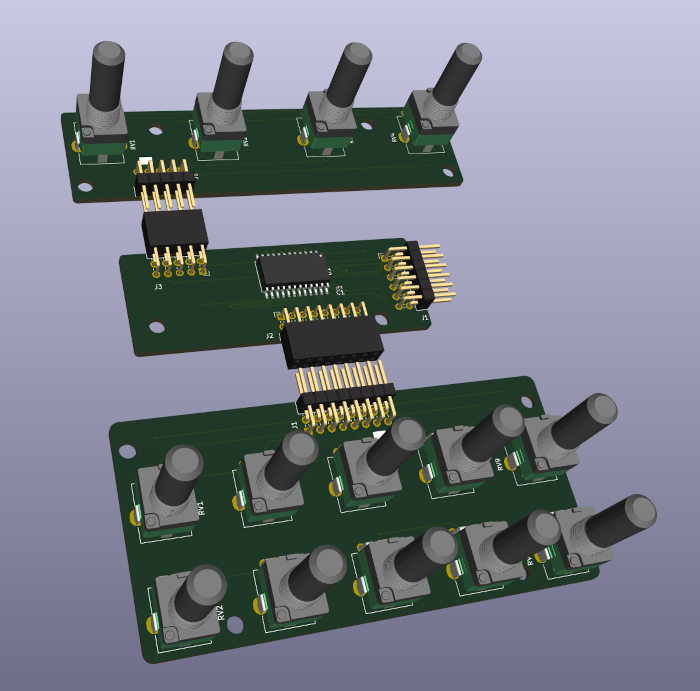
PCBs for S2-OSC

Functional prototype of S2-OSC in a livestream:
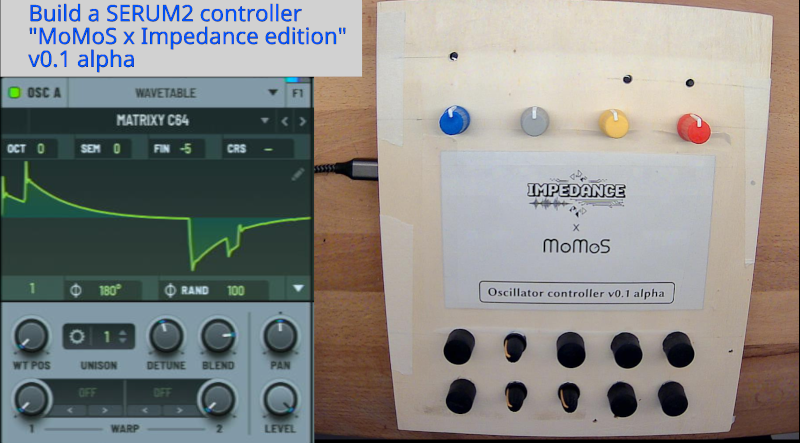
S2-OSC livestream screenshot

Paper scribble for the S2-OSC frontplate:
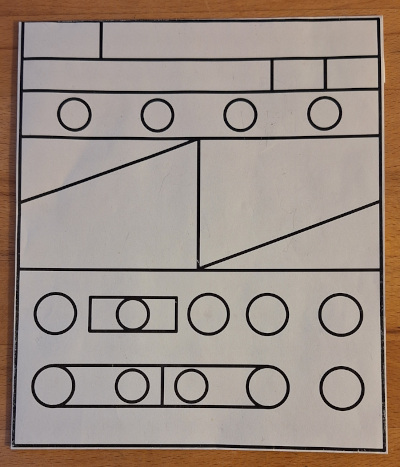
S2-OSC paper front

Prototype in handmade PCB boards for S2-OSC:
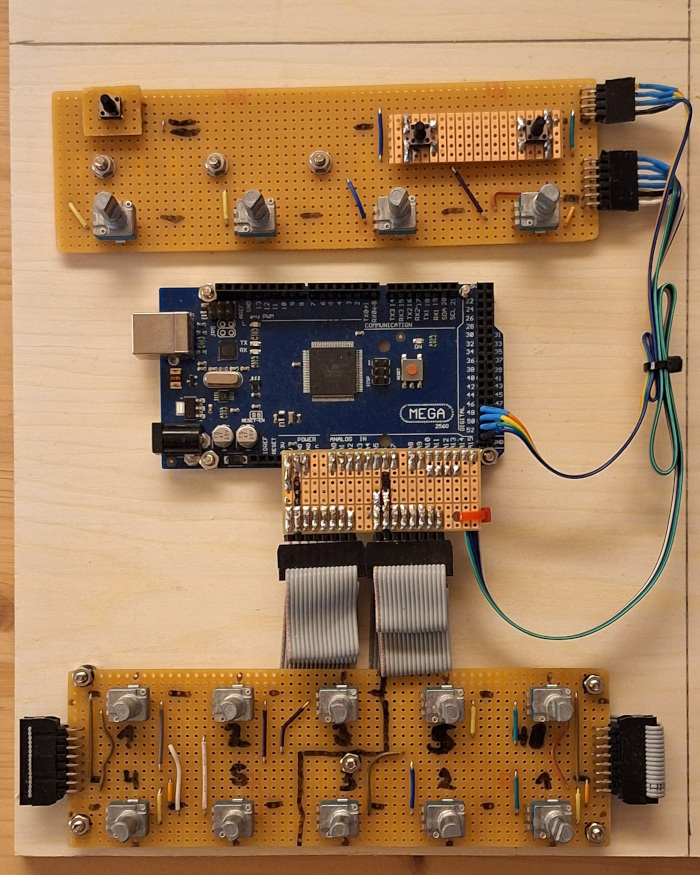
S2-OSC pcbs

Parts

11
QtyValueFootprintReferences
3100nCapacitor_SMD:C_0402_1005MetricC1, C2, C3
14051Package_DIP:DIP-16_W7.62mm_Socket_LongPadsU3
174HCT125Package_SO:SO-14_5.3x10.2mm_P1.27mmU1
174LVC125Package_SO:SO-14_5.3x10.2mm_P1.27mmU2
1to_knobs_mux_1Connector_PinHeader_2.54mm:PinHeader_2x06_P2.54mm_HorizontalJ1
1to_knobs_mux_2Connector_PinHeader_2.54mm:PinHeader_2x06_P2.54mm_HorizontalJ2
1to_knobs_mux_3Connector_PinHeader_2.54mm:PinHeader_2x06_P2.54mm_HorizontalJ3
1to_knobs_mux_4Connector_PinHeader_2.54mm:PinHeader_2x06_P2.54mm_HorizontalJ4
1to_rpiConnector_PinHeader_2.54mm:PinHeader_2x07_P2.54mm_HorizontalJ5

More from Mo-MoS/controllers

12
  • 2 layers100 × 80 mmButtons matrix, the printed circuit board in 3D

    Buttons matrix

    Mo-MoS/controllers

    Controllers for MIDI, USB, Software Synths, VST Plugins.

    94 parts1
  • 2 layers45 × 100 mmVoice spinalSynth, the printed circuit board in 3D

    Voice spinalSynth

    Mo-MoS/controllers

    Controllers for MIDI, USB, Software Synths, VST Plugins.

    15 parts1
  • 2 layers100 × 55 mmKnobs 8 mux, the printed circuit board in 3D

    Knobs 8 mux

    Mo-MoS/controllers

    Controllers for MIDI, USB, Software Synths, VST Plugins.

    12 parts1
  • 2 layers95 × 46 mmKnobs 2x5, the printed circuit board in 3D

    Knobs 2x5

    Mo-MoS/controllers

    Controllers for MIDI, USB, Software Synths, VST Plugins.

    11 parts1
  • 2 layers80 × 80 mmKnobs 7 mux, the printed circuit board in 3D

    Knobs 7 mux

    Mo-MoS/controllers

    Controllers for MIDI, USB, Software Synths, VST Plugins.

    11 parts1
  • 2 layers100 × 50 mmKnobs 8, the printed circuit board in 3D

    Knobs 8

    Mo-MoS/controllers

    Controllers for MIDI, USB, Software Synths, VST Plugins.

    9 parts1
  • 2 layers80 × 50 mmButtons 1x5 filter, the printed circuit board in 3D

    Buttons 1x5 filter

    Mo-MoS/controllers

    Controllers for MIDI, USB, Software Synths, VST Plugins.

    8 parts1
  • 2 layers95 × 23.6 mmKnobs 1x4, the printed circuit board in 3D

    Knobs 1x4

    Mo-MoS/controllers

    Controllers for MIDI, USB, Software Synths, VST Plugins.

    5 parts1
  • 2 layers67 × 23.5 mmKnobs mux, the printed circuit board in 3D

    Knobs mux

    Mo-MoS/controllers

    Controllers for MIDI, USB, Software Synths, VST Plugins.

    5 parts1
  • 2 layers95 × 10 mmButtons 1x3 osc, the printed circuit board in 3D

    Buttons 1x3 osc

    Mo-MoS/controllers

    Controllers for MIDI, USB, Software Synths, VST Plugins.

    4 parts1
  • 2 layers50 × 55 mmController mcu, the printed circuit board in 3D

    Controller mcu

    Mo-MoS/controllers

    Controllers for MIDI, USB, Software Synths, VST Plugins.

    4 parts1

Similar boards

  • 2 layers100 × 100 mmPi Board, the printed circuit board in 3D

    Pi Board

    ab0tj/MiniSys

    Homebrew computer with an ISA-like bus

    47 parts7
  • 2 layers181 × 97 mmOpenDeck r3.1.2, the printed circuit board in 3D

    OpenDeck r3.1.2

    shanteacontrols/OpenDeck

    A platform for building interactive control and sensing devices using MIDI and OSC built with Zephyr RTOS.

    262 parts960Apache-2.0
  • 2 layers106.4 × 95 mmIsavideo, the printed circuit board in 3D

    Isavideo

    schlae/graphics-gremlin

    Open source retro ISA video card

    99 parts582CC-BY-SA-4.0
  • 2 layersLM80C R6, the printed circuit board in 3D

    LM80C R6

    leomil72/LM80C

    A Z80-based homebrew computer withTMS9918, AY-3-8910, Z80 CTC, Z80 PIO, and Z80 SIO

    153 parts123GPL-3.0
  • 2 layers171.5 × 106.7 mmSequencer, the printed circuit board in 3D

    Sequencer

    westlicht/performer-hardware

    PER|FORMER Eurorack Sequencer - Hardware Design Files

    435 parts110
  • 4 layers39.4 × 110.3 mmBetula Main, the printed circuit board in 3D

    Betula Main

    Cs4System/Eurorack

    Blattwerk Eurorack modules. Designed by Lorenz Neumann

    176 parts83
  • 4 layers292.1 × 88.3 mmSnark barker mca, the printed circuit board in 3D

    Snark barker mca

    schlae/snark-barker-mca

    A Sound Blaster compatible sound card for Micro Channel bus computers

    177 parts69
  • 2 layers100 × 50 mmRc2014-ds1302-rtc, the printed circuit board in 3D

    Rc2014-ds1302-rtc

    electrified/rc2014-ds1302-rtc

    DS1302 Real Time Clock for the RC2014 computer

    34 parts25

Questions

How big is the Analog mux PCB?

It measures 60 × 60 mm and has 2 copper layers, 1.6 mm thick.

What parts does the Analog mux use?

11 parts, built around the 74HCT125PW and 74LVC125AD. The full list of its parts is on this page, with links to each part's symbol and footprint where PCBKit's library has them.

Where can I download the Analog mux KiCad files?

From the Mo-MoS/controllers repository on GitHub, at the commit this page was made from: the board is s2/kicad/analog_mux/analog_mux/analog_mux.kicad_pcb and its schematic s2/kicad/analog_mux/analog_mux/analog_mux.kicad_sch. PCBKit opens the board in the browser, with nothing to install.

Can I use the Analog mux design in my own project?

Its repository states no licence, so its author keeps all rights: ask Mo-MoS before reusing the design.