2 layers135.1 × 111.3 mm

 mjfortier/zmk-shields1
Collection of custom keyboard shields
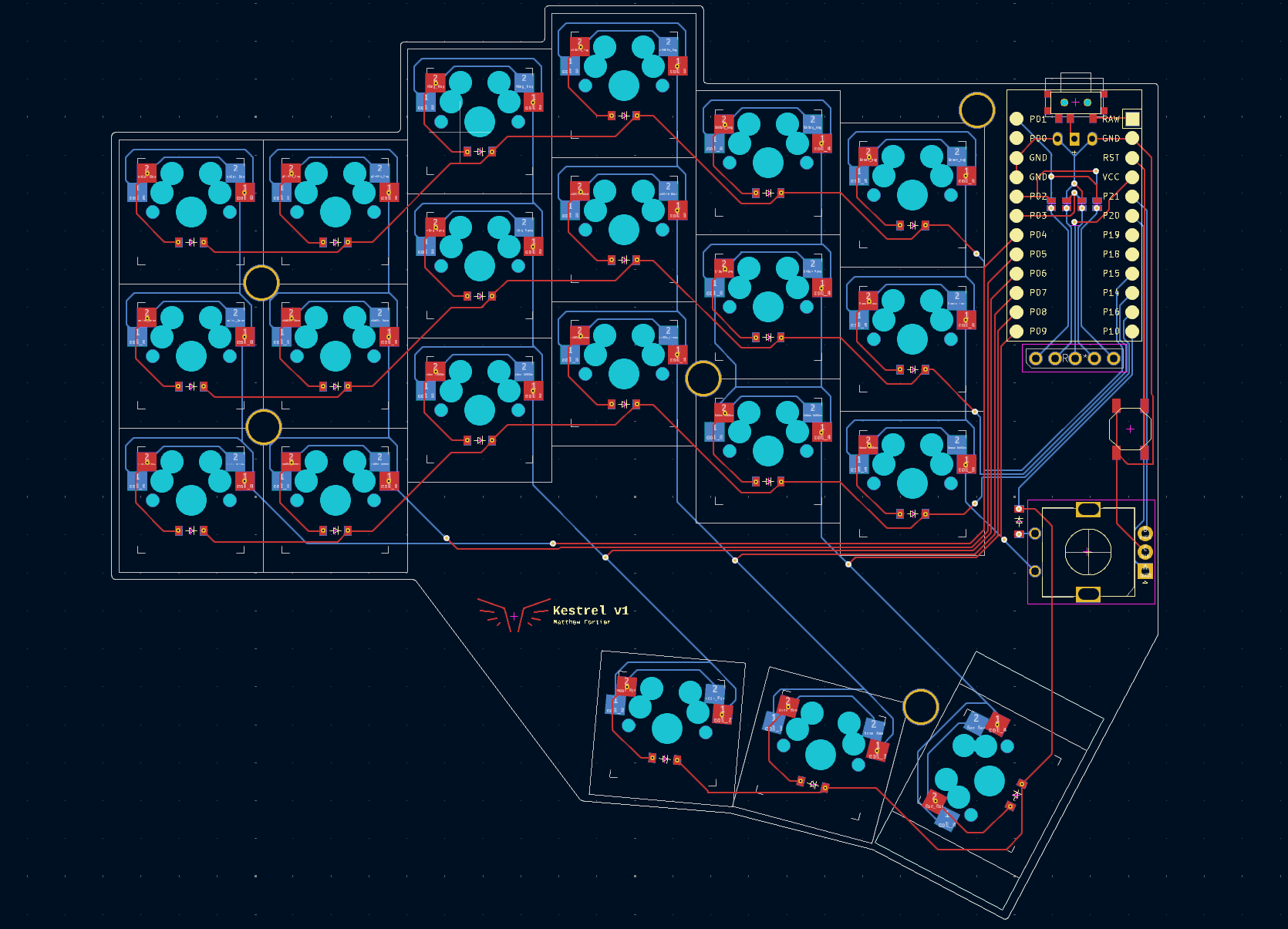
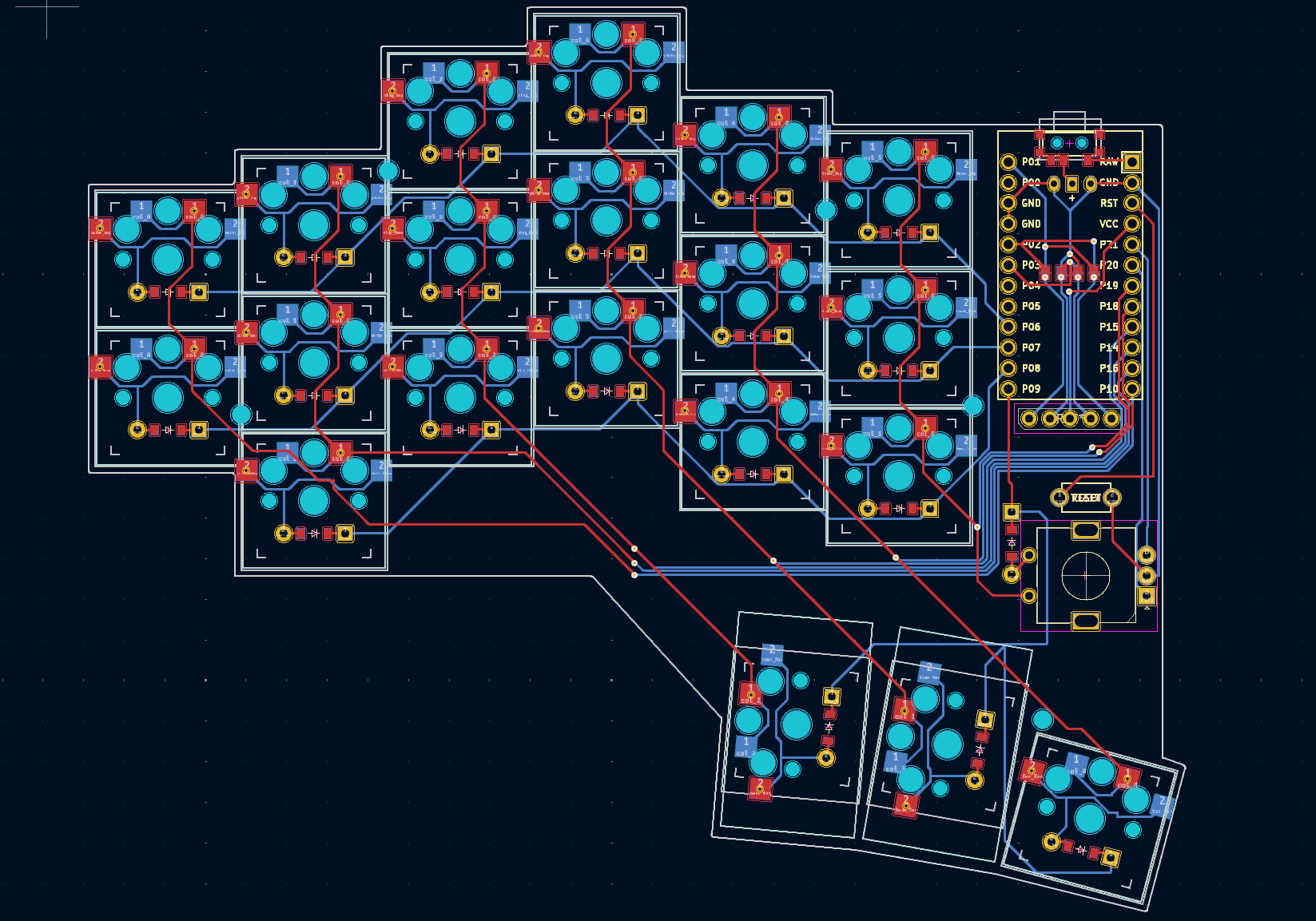
Kestrel is an open-source printed circuit board by mjfortier, from the mjfortier/zmk-shields repository on GitHub. It is a 2-layer board of 137.7 × 120.3 mm with 147 parts on 49 nets, routed with 594 tracks and 20 vias.
Its parts include 22 diodes, 21 switches and 8 connectors. It belongs with the keyboards and input boards and the nRF52 and nRF5x boards of this library.
This project contains the design and firmware files for custom wireless split ergonomic keyboards I have designed.
kicad/: Contains all KiCad design files, including:
boards/: Contains the ZMK firmware plugin files.
The kicad directory includes all necessary files to modify and fabricate the keyboard's PCB and plates. Open these files in KiCad to view or edit the design.
The firmware for the keyboard is managed using ZMK, a flexible firmware specifically designed for custom keyboards. The firmware compilation is handled using Zephyr and automated through GitHub Actions. Simply push a commit and GHA will produce the files which can be flashed as per ZMK's flashing instructions.
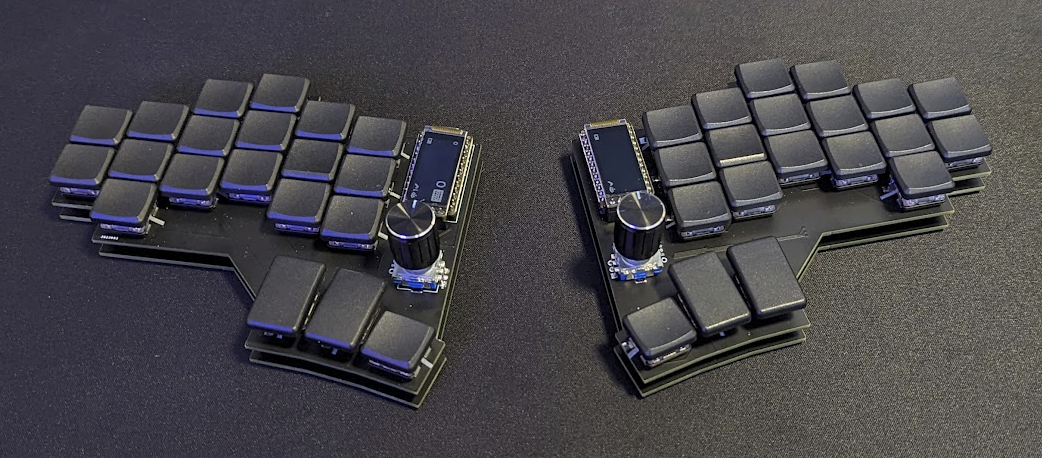
The Kestrel (V1) is an ortholinear wireless split keyboard with 21 keys + rotary encoder per side.
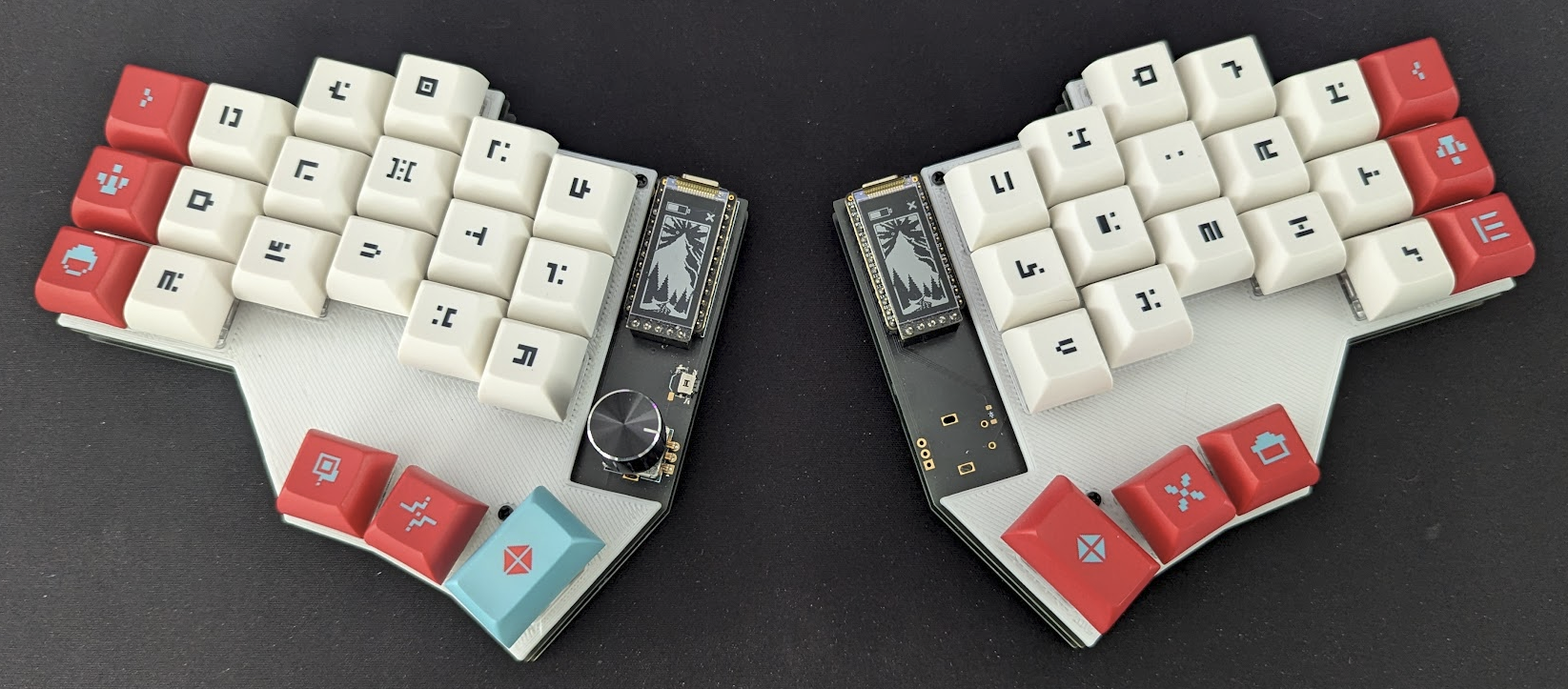
The Nightingale is an ortholinear wireless split keyboard with 20 keys + rotary encoder per side. It uses low-profile choc switches and is designed to be portable with an extensive battery life.
| Qty | Value | Footprint | References |
|---|---|---|---|
| 22 | ComboDiode | D1, D2, D3, D10, D11, D12, D13, D14, D15, D16, D17, D18, D19, D20, D21, D22 +6 | |
| 21 | MX | S1, S2, S3, S4, S10, S11, S12, S13, S14, S15, S16, S17, S18, S19, S20, S21 +5 | |
| 8 | Jumper | lib:Jumper | J1, J2, J3, J4, J5, J6, J7, J8 |
| 5 | HOLE | SofleKeyboard-footprint:HOLE_M2_TH | TH3, TH3, TH3, TH3, TH3 |
| 1 | rotary_encoder | ROT1 | |
| 1 | E73:SPDT_C128955 | T1 | |
| 1 | E73:SW_TACT_ALPS_SKQGABE010 | B1 | |
| 1 | ProMicro | MCU1 | |
| 1 | I2C_Breakout_nice_nano | Keebio-Parts:I2C_Breakout_nice_nano | REF* |
| 1 | JST | JST_PH_S2B-PH-K_02x2.00mm_Angled | JST REV1 |
The 62 most common of 147 parts.

baldengineer/bit-preserve
Project for capturing vintage, classic, aka old computer schematics in KiCad.

TweetyDaBird/Lotus-58-Classic
A split ergo linear keyboard derived from the Lily58 family


fl4p/Fugu2
Links: git | kicanvas | cadlab | docs | pdf schematics | IBOM (TODO) | firmware | additional docs & resources

junglejim8/opensolar
Maximum Power Point Tracking Solar Charge Controller 100V input, 65amp

PCBench/PCBench
resolution = [0.5, 0.5] pcbfolder = '../PCBs/' pcbnames = ["1Bitsy1bitsy"] iters = 30 env = PCBRoutingEnv(resolution=resolution, pcbfolder=pcbfolder, pcbnames=pcbnames) obs, info = env.reset() for in range(iters): act =…

It measures 137.7 × 120.3 mm and has 2 copper layers, 1.6 mm thick.
147 parts. The full list of its parts is on this page, with links to each part's symbol and footprint where PCBKit's library has them.
From the mjfortier/zmk-shields repository on GitHub, at the commit this page was made from: the board is kicad/kestrel/kestrel.kicad_pcb. PCBKit opens the board in the browser, with nothing to install.
Its repository states no licence, so its author keeps all rights: ask mjfortier before reusing the design.