

2 layers27.9 × 45.7 mm
 mithat/Arduino_Minimal_PTH1
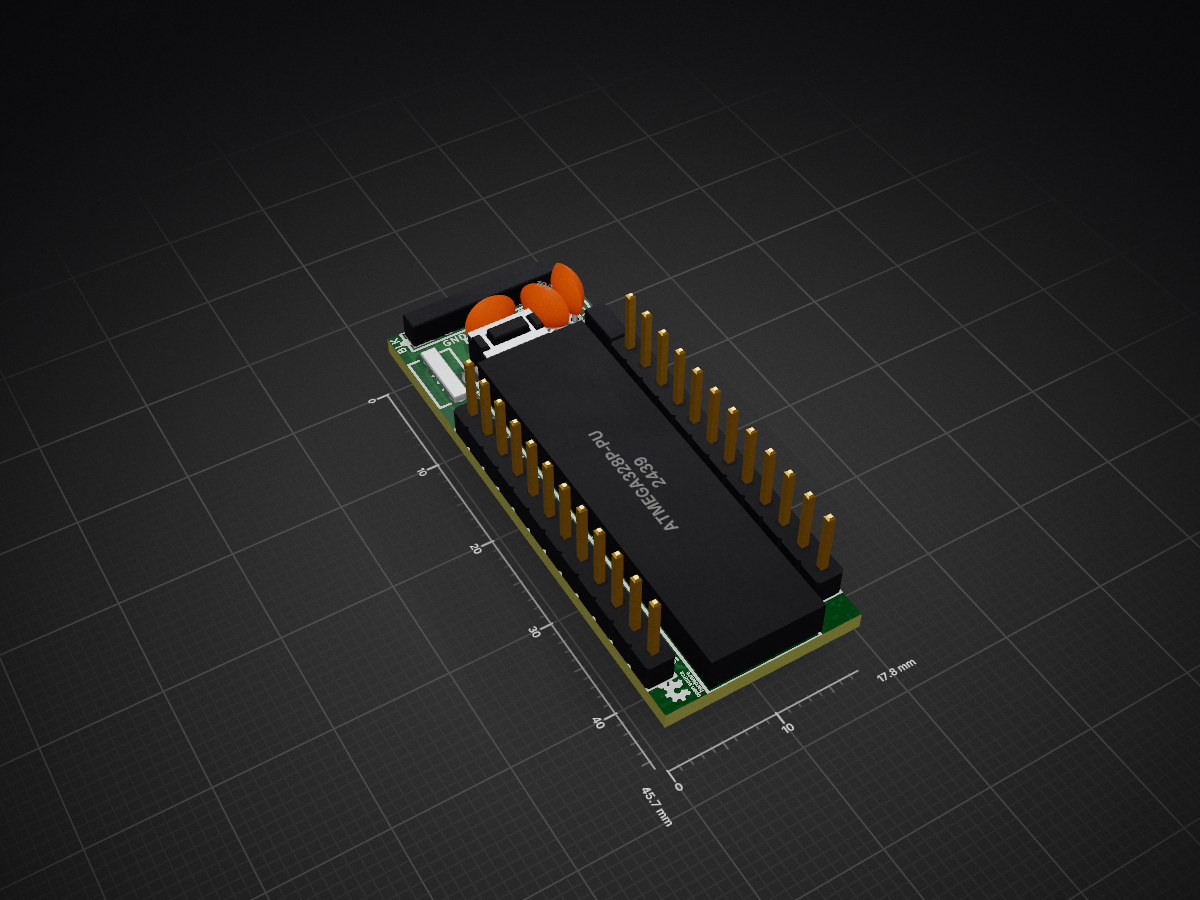
Crazy stupid experiment to see how small you can make an Arduino-compatible board using through-hole parts.
Arduino Minimal PTH is an open-source printed circuit board by mithat, from the mithat/Arduino_Minimal_PTH repository on GitHub. It is a 2-layer board of 17.8 × 45.7 mm with 13 parts on 27 nets, routed with 150 tracks and 0 vias.
It is built around the ATMEGA328P-PU and CSTLS16M0X53-B0. Its parts include 4 capacitors, 4 connectors, 1 resistor, 1 IC and 1 switch. It belongs with the AVR (ATmega, ATtiny) boards of this library.
Crazy stupid experiment to see how small you can make an Arduino-compatible board using through-hole parts.
The design is based on the Arduino Pro Mini, and it tries to follow that board's I/O conventions. Everything that can be considered optional has been eliminated.
Made with KiCad, which is free and open source software. No raptors were touched in the making of this board.


No, I haven't built it (yet?).
| Qty | Value | Footprint | References |
|---|---|---|---|
| 3 | 100n | mfk-C_4.0_2.5_2.5_0.5 | C4, C7, C8 |
| 1 | 10K | mfk-R_0.25W_RN55_vert | R2 |
| 1 | 10u | mfk-CRP_4.0_2.5_0.5 | C2 |
| 1 | A4 A5 | mfk-SIL-2 | P3 |
| 1 | ATMEGA328P-PU | mfk-DIP-28_300_rnd | IC1 |
| 1 | CSTLS16M0X53-B0 | mfk-Murata-CSTLS_X | X1 |
| 1 | FTDI Basic | mfk-SIL-6 | P2 |
| 1 | I/O hi | mfk-SIL-12 | P4 |
| 1 | I/O lo | mfk-SIL-12 | P1 |
| 1 | REF | oshw-logo-100mil-FSilk | VAL |
| 1 | Reset | mfk-SW_PUSH_6x3.5mm | SW1 |

zmaker/arduino_cookbook
gli sketch del nuovo progetto Arduino Cookbook e dei video di YouTube

coseyfannitutti/discipad
17-key numpad assembled with only through hole components, including usb type-c

matthewcieplak/super-sixteen
Code and schematics for the Super Sixteen Eurorack sequencer

coseyfannitutti/romeo
Staggered 40% keyboard pcb that can be assembled with only through hole components, including USB Type-C

mattybrad/drumkid
Version 4 was the first successful working design, with full code, schematics, Gerbers, etc available on GitHub.


leomil72/LM80C
A Z80-based homebrew computer withTMS9918, AY-3-8910, Z80 CTC, Z80 PIO, and Z80 SIO
It measures 17.8 × 45.7 mm and has 2 copper layers, 1.6 mm thick.
13 parts, built around the ATMEGA328P-PU and CSTLS16M0X53-B0. The full list of its parts is on this page, with links to each part's symbol and footprint where PCBKit's library has them.
From the mithat/Arduino_Minimal_PTH repository on GitHub, at the commit this page was made from: the board is Arduino_Minimal_PTH.kicad_pcb. PCBKit opens the board in the browser, with nothing to install.
Its repository states no licence, so its author keeps all rights: ask mithat before reusing the design.