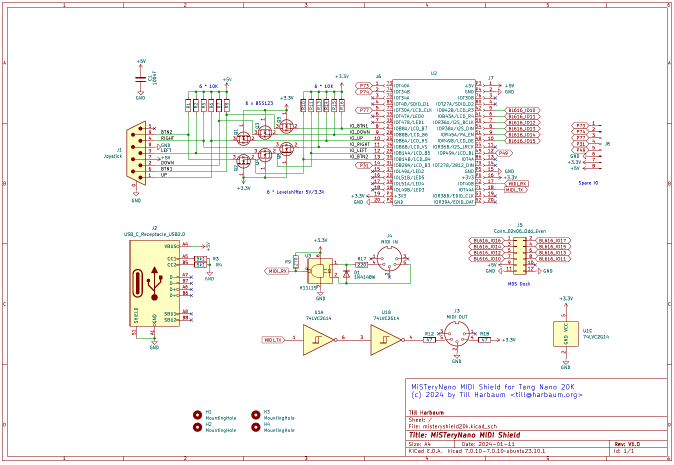
2 layers90 × 67 mm

 MiSTle-Dev/Boards23
Custom board designs for MiSTle projects
Pico pmod is an open-source printed circuit board by MiSTle-Dev, from the MiSTle-Dev/Boards repository on GitHub. It is a 2-layer board of 61.4 × 23 mm with 25 parts on 50 nets, routed with 185 tracks and 19 vias.
It is built around the EA2208T6R, USBLC6-2SC6 and SS34. Its parts include 8 resistors, 5 diodes, 5 connectors, 2 capacitors and 2 ICs. It belongs with the RP2040 boards of this library.


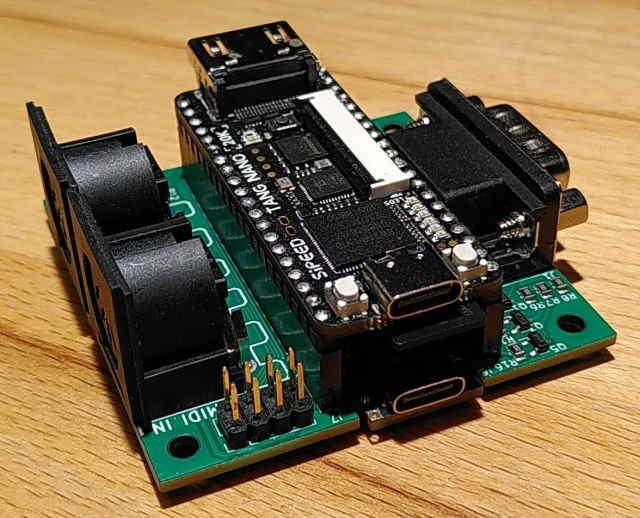
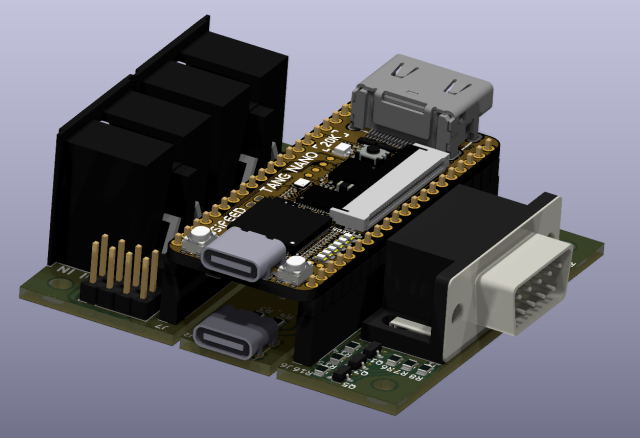
This is a base board for the Tang Nano 20K and optionally the M0S Dock. It features:
PCBA production files for JLCPCB are availble here.
There are now two variants of the board:
The original variant including a small PCB breakout with a USB-C connector. This variant could theoretically be used without M0S Dock. But in fact the M0S Dock is currently needed by many cores and the USB-C part needs to be cut off to make space for the M0S Dock. However, it turned out that some people damage the PCB in the process of cutting this part off. That's why the second M0S variant now exists.
The M0S variant does not include the USB-C part and can only be used in conjunction with a M0S Dock. This is the preferred version as nothing has to be cut to use it. However, this variant has not been tested, yet. No problems are expected, but please report back if you successfully order and use one of these.
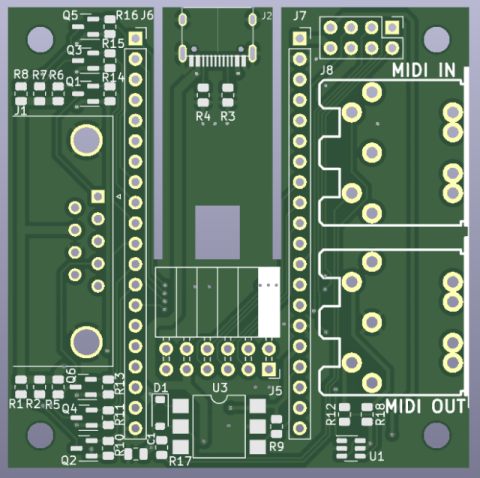
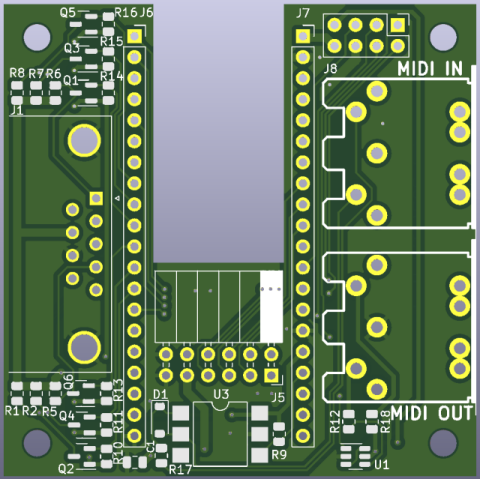
The part carrying the USB connector can be cut away making room for a M0S Dock which will then also be used to provide power to the Tang Nano 20K.
| Qty | Value | Footprint | References |
|---|---|---|---|
| 4 | 1k2 | Resistor_SMD:R_0805_2012Metric | R3, R4, R7, R8 |
| 4 | green | LED_SMD:LED_0805_2012Metric | D1, D2, D3, D5 |
| 2 | 22uF | Capacitor_SMD:C_1206_3216Metric | C1, C2 |
| 2 | 5k1 | Resistor_SMD:R_0402_1005Metric | R1, R2 |
| 2 | Conn_01x20_Pin | Connector_PinSocket_2.54mm:PinSocket_1x20_P2.54mm_Vertical | J3, J4 |
| 2 | TestPoint | TestPoint:TestPoint_Pad_D1.5mm | TP1, TP2 |
| 1 | 220k | Resistor_SMD:R_0805_2012Metric | R5 |
| 1 | 30k | Resistor_SMD:R_0805_2012Metric | R6 |
| 1 | 4.7uH | Inductor_SMD:L_6.3x6.3_H3 | L1 |
| 1 | Conn_01x03_Pin | Connector_PinHeader_2.54mm:PinHeader_1x03_P2.54mm_Vertical | J5 |
| 1 | EA2208 | Package_TO_SOT_SMD:SOT-23-6 | U2 |
| 1 | PMOD | Connector_PinHeader_2.54mm:PinHeader_2x06_P2.54mm_Horizontal | J2 |
| 1 | SS34 | Diode_SMD:D_SMA | D4 |
| 1 | USBLC6-2SC6 | Package_TO_SOT_SMD:SOT-23-6 | U1 |
| 1 | USB_C_Receptacle_USB2.0 | Connector_USB:USB_C_Receptacle_HRO_TYPE-C-31-M-12 | J1 |


MiSTle-Dev/Boards
Custom board designs for MiSTle projects


lhm0/rotating_display_color
56 LED rotating color display with RP2040 and ESP32 microcontrollers


hoeken/frothfet
Yarrboard load controller board with current sense, volt sense, fuses, and sender support.

thebenedict/seattletransit-hardware
Schematic and PCB for a circuit board map of Seattle area public transit.


GuzziFlipFlops/ESP32-Walkie-Talkie
An open source ESPNOW based walkie talkie with a 600 meter tested distance, with an OLED and multiple buttons to interact with
It measures 61.4 × 23 mm and has 2 copper layers, 1.6 mm thick.
25 parts, built around the EA2208T6R, USBLC6-2SC6 and SS34. The full list of its parts is on this page, with links to each part's symbol and footprint where PCBKit's library has them.
From the MiSTle-Dev/Boards repository on GitHub, at the commit this page was made from: the board is pipico_pmod/pico_pmod.kicad_pcb and its schematic atarist_keyboard/pcb/keyboard.kicad_sch. PCBKit opens the board in the browser, with nothing to install.
Its repository states no licence, so its author keeps all rights: ask MiSTle-Dev before reusing the design.