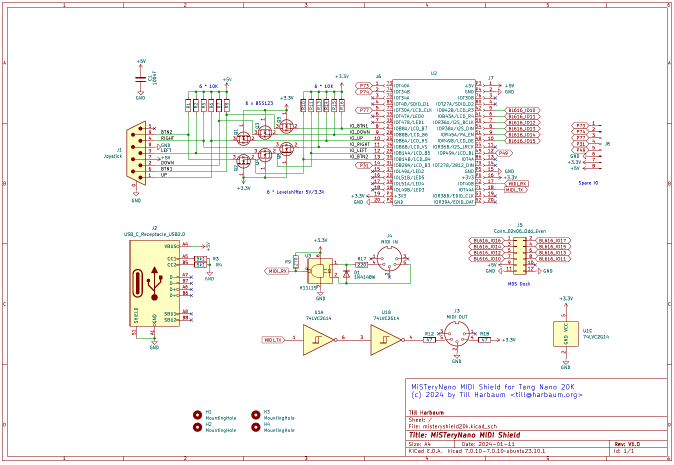
2 layers90 × 67 mm

 MiSTle-Dev/Boards23
Custom board designs for MiSTle projects
Misteryshield20k is an open-source printed circuit board by MiSTle-Dev, from the MiSTle-Dev/Boards repository on GitHub. It is a 2-layer board of 57 × 57 mm with 40 parts on 68 nets, routed with 418 tracks and 44 vias.
It is built around the 74LVC2G14GW, H11L1S and BSS123, with the 1N4148W among its other parts. Its parts include 18 resistors, 8 connectors, 6 transistors, 2 ICs and 1 capacitor.


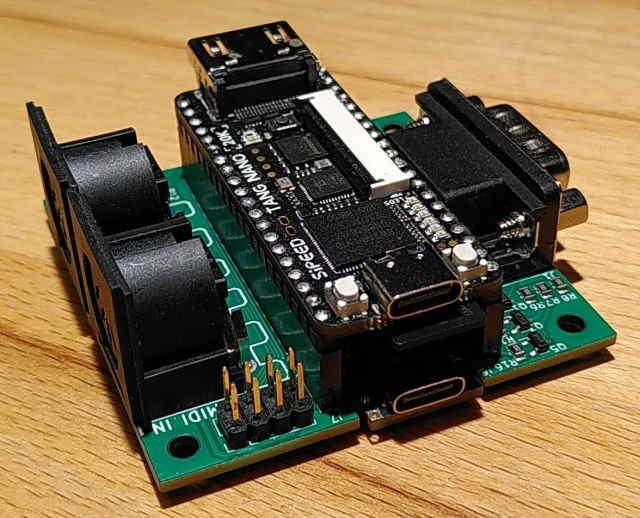
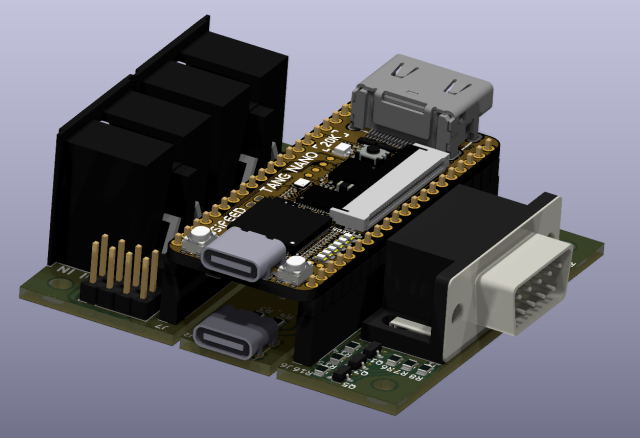
This is a base board for the Tang Nano 20K and optionally the M0S Dock. It features:
PCBA production files for JLCPCB are availble here.
There are now two variants of the board:
The original variant including a small PCB breakout with a USB-C connector. This variant could theoretically be used without M0S Dock. But in fact the M0S Dock is currently needed by many cores and the USB-C part needs to be cut off to make space for the M0S Dock. However, it turned out that some people damage the PCB in the process of cutting this part off. That's why the second M0S variant now exists.
The M0S variant does not include the USB-C part and can only be used in conjunction with a M0S Dock. This is the preferred version as nothing has to be cut to use it. However, this variant has not been tested, yet. No problems are expected, but please report back if you successfully order and use one of these.
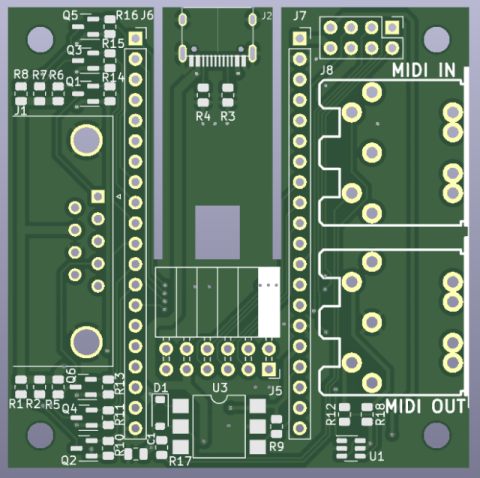
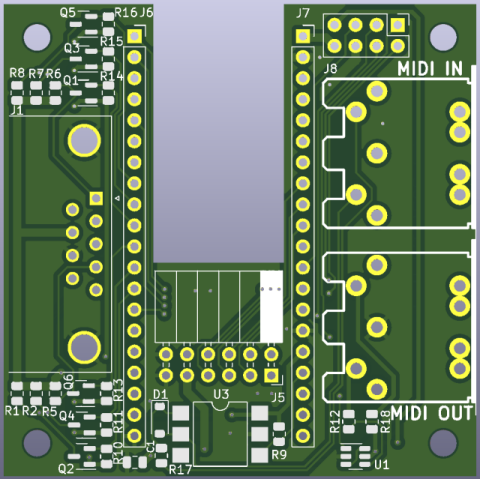
The part carrying the USB connector can be cut away making room for a M0S Dock which will then also be used to provide power to the Tang Nano 20K.
| Qty | Value | Footprint | References |
|---|---|---|---|
| 12 | 10k | Resistor_SMD:R_0805_2012Metric | R1, R2, R5, R6, R7, R8, R10, R11, R13, R14, R15, R16 |
| 6 | BSS123 | Package_TO_SOT_SMD:SOT-23 | Q1, Q2, Q3, Q4, Q5, Q6 |
| 4 | MountingHole | MountingHole:MountingHole_3.2mm_M3 | H1, H2, H3, H4 |
| 2 | 47 | Resistor_SMD:R_0805_2012Metric | R12, R18 |
| 2 | 5k1 | Resistor_SMD:R_0805_2012Metric | R3, R4 |
| 2 | Conn_01x20_Socket | Connector_PinSocket_2.54mm:PinSocket_1x20_P2.54mm_Vertical | J6, J7 |
| 1 | 100nF | Capacitor_SMD:C_0805_2012Metric | C1 |
| 1 | 1N4148W | Diode_SMD:D_SOD-123 | D1 |
| 1 | 220 | Resistor_SMD:R_0805_2012Metric | R17 |
| 1 | 270 | Resistor_SMD:R_0805_2012Metric | R9 |
| 1 | 74LVC2G14 | Package_TO_SOT_SMD:SOT-23-6 | U1 |
| 1 | Conn_02x04_Pin | Connector_PinHeader_2.54mm:PinHeader_2x04_P2.54mm_Vertical | J8 |
| 1 | Conn_02x06_Odd_Even | Connector_PinSocket_2.54mm:PinSocket_2x06_P2.54mm_Horizontal | J5 |
| 1 | H11L1S | Package_DIP:SMDIP-6_W9.53mm | U3 |
| 1 | Joystick | Connector_Dsub:DSUB-9_Male_Horizontal_P2.77x2.84mm_EdgePinOffset7.70mm_Housed_MountingHolesOffset9.12mm | J1 |
| 1 | MIDI IN | tangnano:din-5 | J4 |
| 1 | MIDI OUT | tangnano:din-5 | J3 |
| 1 | USB_C_Receptacle_USB2.0 | usb-c:TYPE-C-31-M-12 | J2 |


MiSTle-Dev/Boards
Custom board designs for MiSTle projects


GliderWinchItems/bmsmot
The contactor function measures the high voltage using a STM32L431RCT6, ground isolated and communicates readings to the main processor via uart with opto-isolator.


sam-banks/power-supply-load-switch
Bench power supply add-on board to switch power on/off


Filip-Kin/frc-radio-kiosk
Bench box that powers and configures FRC radios: dual-mode PoE (802.3at via LTC4279, passive 12 V via TPS26600), USB-C PD or DC in, 15.6 V out for the Toughbook, 4x CR123A backup, STM32F072 firmware.
It measures 57 × 57 mm and has 2 copper layers, 1.6 mm thick.
40 parts, built around the 74LVC2G14GW, H11L1S, BSS123 and 1N4148W. The full list of its parts is on this page, with links to each part's symbol and footprint where PCBKit's library has them.
From the MiSTle-Dev/Boards repository on GitHub, at the commit this page was made from: the board is misteryshield20k/misteryshield20k.kicad_pcb and its schematic atarist_keyboard/pcb/keyboard.kicad_sch. PCBKit opens the board in the browser, with nothing to install.
Its repository states no licence, so its author keeps all rights: ask MiSTle-Dev before reusing the design.