2 layers97.2 × 58.9 mm
 MinosCodes/cdjay
Pioneer CDJ-850 USB-MIDI Bridge for Raspberry Pi Pico
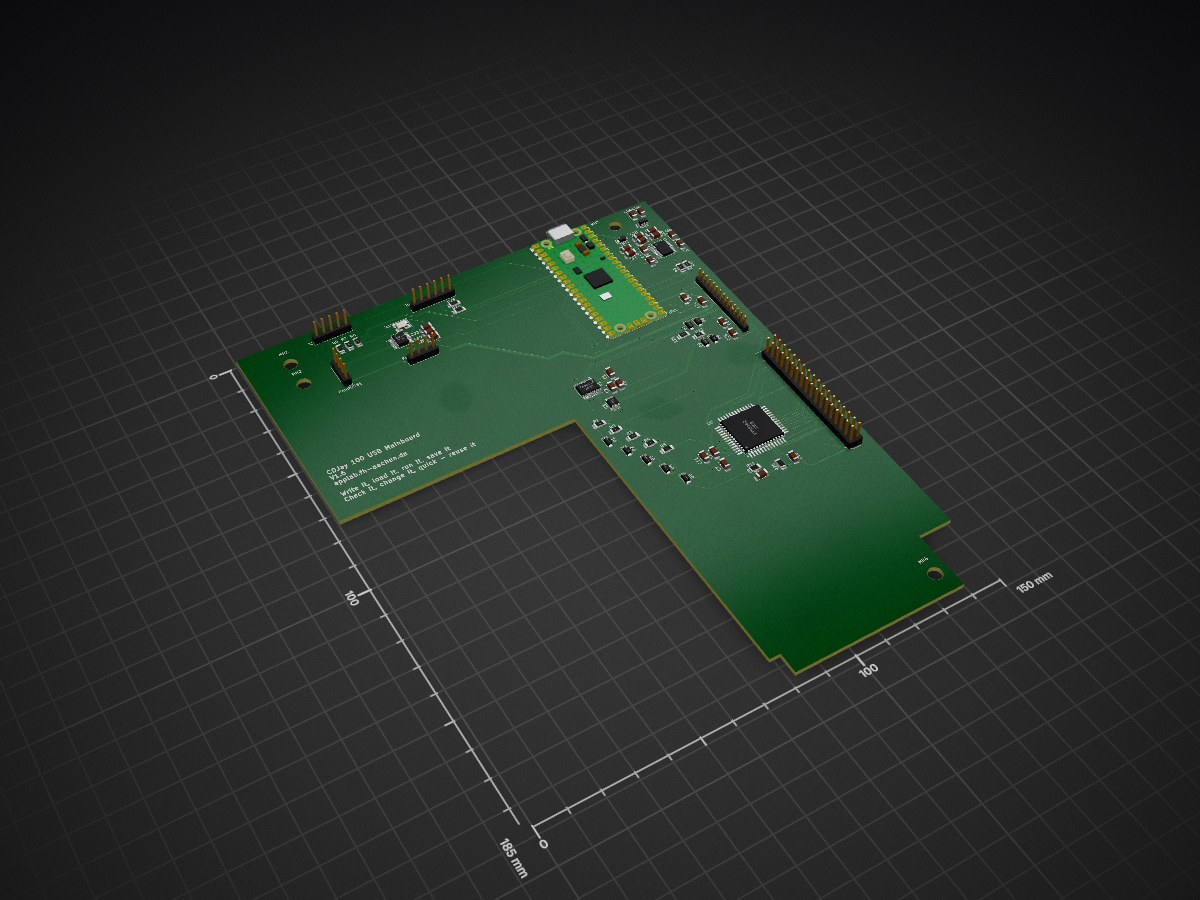
CDJAY100S is an open-source printed circuit board by MinosCodes, from the MinosCodes/cdjay repository on GitHub. It is a 2-layer board of 150 × 185 mm with 72 parts on 127 nets, routed with 973 tracks and 90 vias.
It is built around the ADS1115IDGS, CH334R and TXS0108EPW, with the MBR120VLSFT1G-TP and PCM5102PW among its other parts. Its parts include 27 capacitors, 16 resistors, 9 diodes, 5 ICs and 3 connectors. It belongs with the RP2040 boards of this library.


The success of Pioneer's CDJ-Players is based on their usability and performance-oriented controls. And while the technology has evolved from CDs over SD-Cards to USB-Keys or direct interaction with a laptop, the control interface itself hasn't changed much. Modern CDJs, such as the CDJ-850, CDJ-900, CDJ-2000, and newer offer the possibility to directly connect to a host software, such as Algoriddim DJay, Native Instruments' Traktor, Serato Scratch, in order to be used as controller. The goal of this project is to bring this capability to older CDJ-Models in order to keep their control interface.
A number of other projects have looked at the same idea. Some turning the CDJ into a MIDI-based controller, others integrating a RaspberryPi and running Mixxx, and open source DJ-Software on it, essentially turning them into full-blown, standalone, media-players.
The goal is to provide drop-in replacement mainboards that communicate with the original hardware and bridge to a USB connection. All boards start from a Raspberry Pi Pico 2, but depending on the model, more or less additional hardware is required. See the individual files in the docs folder.
Since we want to focus on interfacing the old CDJs with the modern world (USB-C, Software, etc.), we use iPad mini running Algoriddim's djay in single deck mode, which gives us all the benefits such as touch interaction, integration to streaming services, etc.. Any iPad being able to run djay is fine, although interfacing is easier with the usb-c models.
Install djay from the App-Store on your iPad. Technically, it is possible to run djay from an iPhone, however, it doesn't support single-deck mode on smaller devices.
If you have an iPad with a lightning-connector, you need a lightning to usb-converter that supports USB OTG. This will make the iPad the host of your USB connection, and the CDJay the client. For the USB-Models, just connect the USB-C connection to your iPad.
This project was supported by...
This work is part of a University project with its main focus is on teaching. The repository under https://git.fh-aachen.de/applab/projects/cdjay is the internal repo. The repository under https://github.com/applab-fhaachen/cdjay is a mirror to facilitate development with a larger community.
Original contributors are
MIT License
All trademarks are property of their respective owners. This project is part of the education at FH Aachen University of Applied Sciences and not affiliated to any of the brand names.
| Qty | Value | Footprint | References |
|---|---|---|---|
| 10 | 100 n | Capacitor_SMD:C_1206_3216Metric_Pad1.33x1.80mm_HandSolder | C1, C2, C5, C7, C9, C10, C11, C14, C16, C17 |
| 9 | 10k | Resistor_SMD:R_1206_3216Metric_Pad1.30x1.75mm_HandSolder | R1, R2, R3, R4, R5, R6, R7, R8, R10 |
| 9 | 1SS355VM | Diode_SMD:Nexperia_CFP3_SOD-123W | D1, D2, D3, D4, D5, D6, D7, D8, D9 |
| 6 | 10 u | Capacitor_SMD:C_1206_3216Metric_Pad1.33x1.80mm_HandSolder | C8, C15, C18, C20, C21, C22 |
| 4 | MountingHole:MountingHole_4.5mm | MH1, MH2, MH3, MH4 | |
| 2 | 100 u | Capacitor_SMD:C_1206_3216Metric_Pad1.33x1.80mm_HandSolder | C28, C29 |
| 2 | 10u | Capacitor_SMD:C_1206_3216Metric_Pad1.33x1.80mm_HandSolder | C23, C25 |
| 2 | 1200 p | Capacitor_SMD:C_1206_3216Metric_Pad1.33x1.80mm_HandSolder | C24, C26 |
| 2 | 2.2 u | Capacitor_SMD:C_1206_3216Metric_Pad1.33x1.80mm_HandSolder | C12, C13 |
| 2 | 2k | Resistor_SMD:R_1206_3216Metric_Pad1.30x1.75mm_HandSolder | R21, R22 |
| 2 | 5.1 k | Resistor_SMD:R_1206_3216Metric_Pad1.30x1.75mm_HandSolder | R25, R26 |
| 2 | Conn_01x04_Pin | Connector_PinHeader_2.54mm:PinHeader_1x04_P2.54mm_Vertical | FrontUSB1, PicoUSB1 |
| 1 | 1 k | Resistor_SMD:R_1206_3216Metric_Pad1.30x1.75mm_HandSolder | R11 |
| 1 | 100 p | Capacitor_SMD:C_1206_3216Metric_Pad1.33x1.80mm_HandSolder | C6 |
| 1 | 110 n | Capacitor_SMD:C_1206_3216Metric_Pad1.33x1.80mm_HandSolder | C19 |
| 1 | 12MHz | Crystal:Crystal_SMD_3225-4Pin_3.2x2.5mm_HandSoldering | X1 |
| 1 | 1u | Capacitor_SMD:C_1206_3216Metric_Pad1.33x1.80mm_HandSolder | C27 |
| 1 | 20k | Resistor_SMD:R_1206_3216Metric_Pad1.30x1.75mm_HandSolder | R9 |
| 1 | 52151-1410 | Connector_PinHeader_2.00mm:PinHeader_1x14_P2.00mm_Vertical | CN2 |
| 1 | 52492-3620 | 52045-3645:ConnectorFPC&FFC_MOL52045-3645-36P_1 | CN1 |
| 1 | 82 k | Resistor_SMD:R_1206_3216Metric_Pad1.30x1.75mm_HandSolder | R20 |
| 1 | ADS1115IDGS | Package_SO:TSSOP-10_3x3mm_P0.5mm | U3 |
| 1 | AP2127K-3.3 | Package_TO_SOT_SMD:SOT-23-5 | U4 |
| 1 | CH334R | Package_SO:QSOP-16_3.9x4.9mm_P0.635mm | U6 |
| 1 | Conn_01x06_Pin | Connector_PinHeader_2.54mm:PinHeader_1x06_P2.54mm_Vertical | Upstream1 |
| 1 | MBR120VLSFT1G | Diode_SMD:Nexperia_CFP3_SOD-123W | CNT1 |
| 1 | PCM5102 | Package_SO:TSSOP-20_4.4x6.5mm_P0.65mm | i2S_Audio1 |
| 1 | PT6324Q | Package_QFP:QFP-52_14x14mm_P1mm_1 | U5 |
| 1 | RaspberryPi_Pico | Module:RaspberryPi_Pico_Common_Unspecified | rPi1 |
| 1 | Rotary Encoder | Connector_PinHeader_2.54mm:PinHeader_1x05_P2.54mm_Vertical | J1 |
| 1 | SolderJumper_2_Open | Jumper:SolderJumper-2_P1.3mm_Open_Pad1.0x1.5mm | JP1 |
| 1 | TXS0108 | Package_SO:TSSOP-20_4.4x6.5mm_P0.65mm | U1 |
It measures 150 × 185 mm and has 2 copper layers, 1.58 mm thick.
72 parts, built around the ADS1115IDGS, CH334R, TXS0108EPW and MBR120VLSFT1G-TP. The full list of its parts is on this page, with links to each part's symbol and footprint where PCBKit's library has them.
From the MinosCodes/cdjay repository on GitHub, at the commit this page was made from: the board is Boards/CDJAY100S/CDJAY100S.kicad_pcb and its schematic Boards/CDJ-800/CDJ-800.kicad_sch. PCBKit opens the board in the browser, with nothing to install.
Its repository states no licence, so its author keeps all rights: ask MinosCodes before reusing the design.


Cybdo/CybdoDuino
I have so many old Arduino-based projects, including a CNC plotter I made with old CD drives (see here), that could do with a refresh.

NuttyShell/NuttyBadge
NuttyBadge: A NuttyShell crafted multi-tool. Opensourced Hardawre and Software


Nicolai-Electronics/tanmatsu-hardware
Hardware design of the Tanmatsu mainboard