2 layers90 × 140 mm
Drumkid
mattybrad/drumkid
Version 4 was the first successful working design, with full code, schematics, Gerbers, etc available on GitHub.
70 parts137

 mattybrad/drumkid137
Version 4 was the first successful working design, with full code, schematics, Gerbers, etc available on GitHub.
Drumkid is an open-source printed circuit board by mattybrad, from the mattybrad/drumkid repository on GitHub. It is a 2-layer board of 90 × 140 mm with 69 parts on 90 nets, routed with 477 tracks and 18 vias.
Its parts include 15 connectors, 14 resistors, 8 diodes, 8 switches and 4 capacitors. It belongs with the AVR (ATmega, ATtiny) boards of this library.
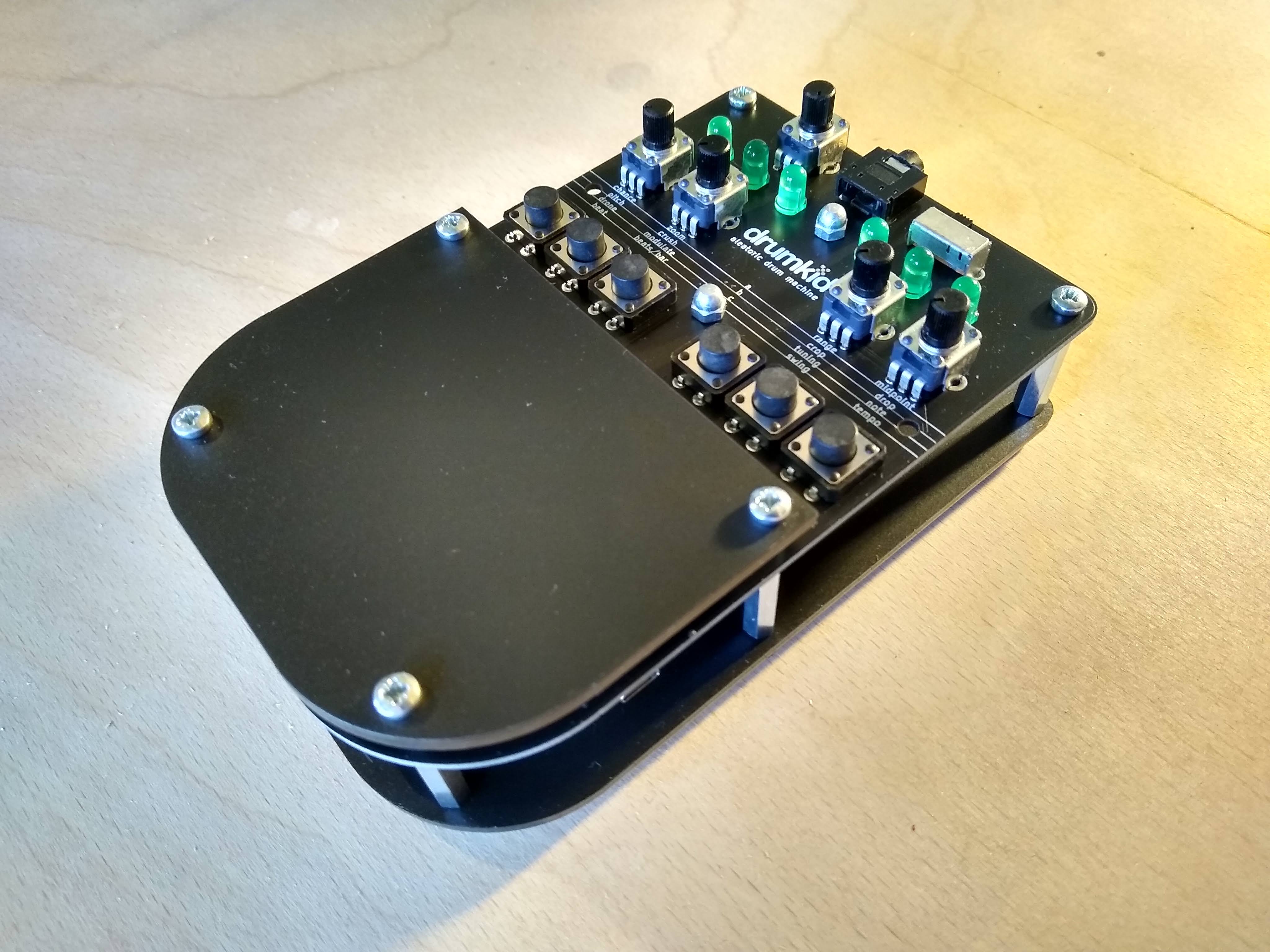
A drum machine which generates rhythms using probability. Imagine a traditional step-based drum machine, but where various dice are rolled for each step, with the resulting numbers used to determine the behaviour of the beat.
You can buy Drumkid fully assembled or as a kit from <mattbradshawdesign.com>
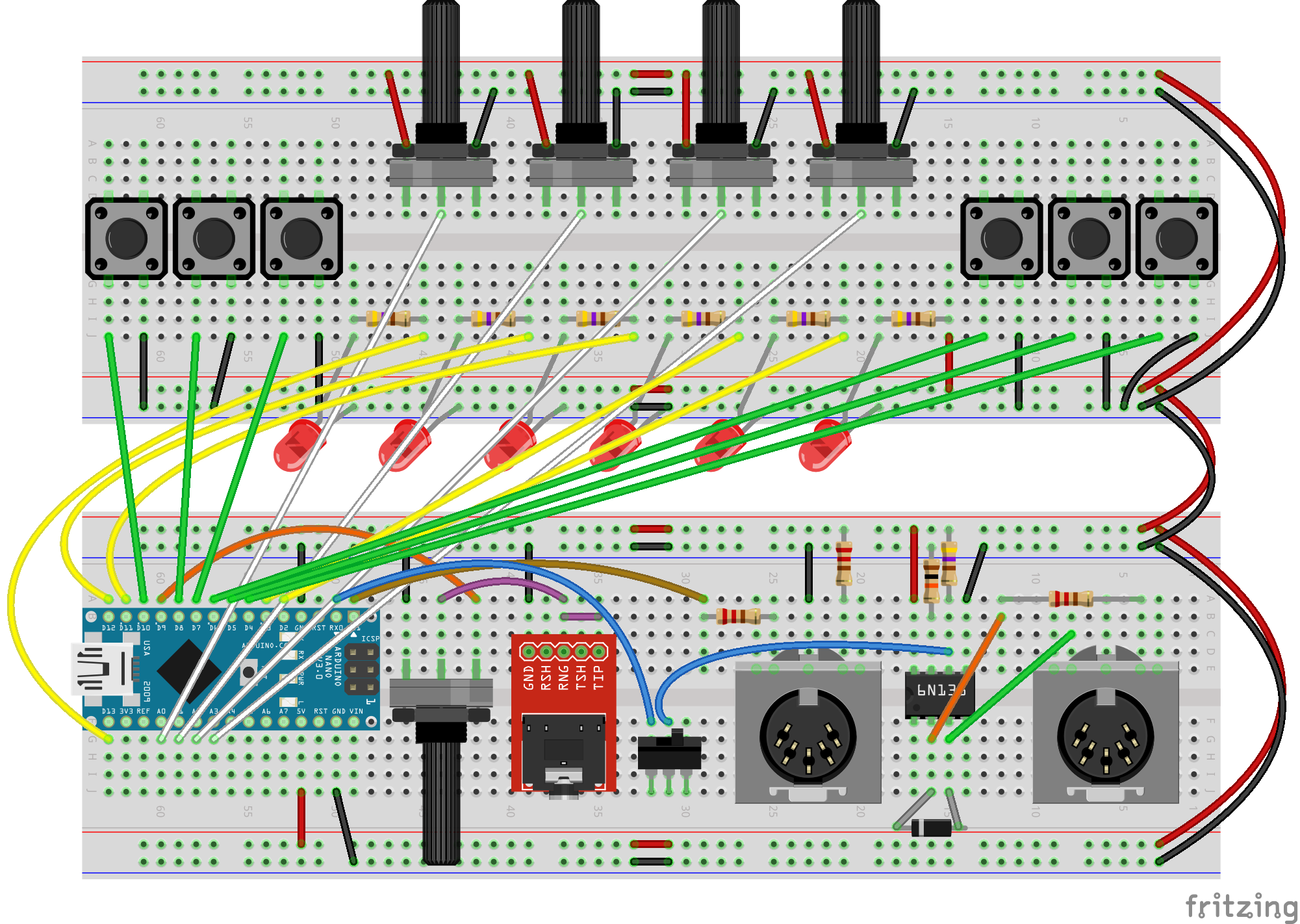
DrumKid is based around an Arduino Nano, and coded using the Arduino IDE. Audio is produced by the Mozzi library. You can build a version of DrumKid using an Arduino, a breadboard, and standard electronic components, or you can build/buy the "full" version described below.
DrumKid is a portable, handheld, battery-powered instrument with a minimalist design. It consists of a PCB (printed circuit board) for the front panel, featuring knobs, buttons, LEDs, a power switch and a headphone/line output. The electronics are protected/enclosed by two laser-cut acrylic pieces and six metal standoffs.
This project is almost entirely open source. The code, breadboard layout, schematics, Gerber (PCB) files, and laser-cutter files are all included in the repository, with the aim of making this project easy to duplicate and adapt. Please note that the project depends on the Mozzi library, which is released under a Creative Commons non-commercial licence. I have used it here with kind permission from its creator, but please be aware that if you create a commercial product using this code, you will need to request permission from him. Go to https://sensorium.github.io/Mozzi/ for more details.
Versions 1-3 were early prototypes.
Version 4 was the first successful working design, with full code, schematics, Gerbers, etc available on GitHub.
Version 5 contained various PCB errors and has been superseded.
Versions 6 onwards were used in the final product, with version 10 being the latest at the time of writing.
| Qty | Value | Footprint | References |
|---|---|---|---|
| 10 | MountingHole | drumkidcustom:MountingHole_3.2mm_M3 | H1, H2, H3, H4, H5, H6, H7, H8, H9, H10 |
| 6 | 680 | Resistor_SMD:R_0805_2012Metric | R1, R2, R3, R4, R5, R6 |
| 6 | LED | drumkidcustom:LED_D5.0mm | D1, D2, D3, D4, D5, D6 |
| 6 | SW_Push | drumkidcustom:SW_PUSH-12mm_Wuerth-430476085716 | SW1, SW2, SW3, SW4, SW5, SW6 |
| 5 | 220 | Resistor_SMD:R_0805_2012Metric | R7, R10, R11, R12, R13 |
| 4 | R_POT | drumkidcustom:Potentiometer_Alps_RK09K_Single_Vertical | RV1, RV2, RV3, RV4 |
| 3 | AudioJack3_Ground_Switch | drumkidcustom:Tayda_3.5mm_stereo_TRS_jack_A-853 | J9, J13, J15 |
| 2 | 470uF | Capacitor_THT:CP_Radial_D6.3mm_P2.50mm | C1, C3 |
| 2 | Conn_01x05 | Connector_PinSocket_2.54mm:PinSocket_1x05_P2.54mm_Vertical | J12, J14 |
| 2 | Conn_01x10 | Connector_PinSocket_2.54mm:PinSocket_1x10_P2.54mm_Vertical | J5, J8 |
| 2 | Conn_01x10 | Connector_PinHeader_2.54mm:PinHeader_1x10_P2.54mm_Vertical | J6, J7 |
| 2 | Conn_01x15 | Connector_PinSocket_2.54mm:PinSocket_1x15_P2.54mm_Vertical | J3, J4 |
| 2 | Conn_01x15 | Connector_PinHeader_2.54mm:PinHeader_1x15_P2.54mm_Vertical | J10, J11 |
| 2 | DIN-5_180degree | drumkidcustom:MIDI_DIN5 | J1, J2 |
| 2 | SW_SPDT | drumkidcustom:EG1206 | SW7, SW8 |
| 2 | drumkid_logo | drumkidcustom:drumkid_logo | U2, U3 |
| 1 | 100nF | Capacitor_SMD:C_0402_1005Metric | C2 |
| 1 | 10k | Resistor_SMD:R_0805_2012Metric | R8 |
| 1 | 10k | drumkidcustom:Potentiometer_Alps_RK09K_Single_Vertical | RV5 |
| 1 | 1N4148 | Diode_SMD:D_SOD-123 | D7 |
| 1 | 1N5817 | Diode_SMD:D_SOD-123 | D8 |
| 1 | 22uF | Capacitor_SMD:C_0603_1608Metric | C5 |
| 1 | 270 | Resistor_SMD:R_0805_2012Metric | R14 |
| 1 | 470 | Resistor_SMD:R_0805_2012Metric | R9 |
| 1 | 6N138 | Package_DIP:PowerIntegrations_SMD-8 | U1 |
| 1 | Arduino_Nano_v3.x | Module:Arduino_Nano_WithMountingHoles | A1 |
| 1 | Battery | Connector_Wire:SolderWirePad_1x02_P5.08mm_Drill1.5mm | BT1 |
mattybrad/drumkid
Version 4 was the first successful working design, with full code, schematics, Gerbers, etc available on GitHub.

mattybrad/drumkid
Version 4 was the first successful working design, with full code, schematics, Gerbers, etc available on GitHub.

mattybrad/drumkid
Version 4 was the first successful working design, with full code, schematics, Gerbers, etc available on GitHub.

mattybrad/drumkid
Version 4 was the first successful working design, with full code, schematics, Gerbers, etc available on GitHub.

mattybrad/drumkid
Version 4 was the first successful working design, with full code, schematics, Gerbers, etc available on GitHub.

mattybrad/drumkid
Version 4 was the first successful working design, with full code, schematics, Gerbers, etc available on GitHub.


jackw01/scanlight
A better light source for scanning color negative film

Biacco42/Ergo42
7x4 ortho linear split keyboard - The Answer to the Ultimate Question of Life, the Universe, and at least Keyboards

eigenco/frankenpi
This is an experimental project to connect Raspberry Pi with the help of cheap Cyclone IV FPGA board to 8-bit ISA bus to act as multiple different devices.

KaiPereira/Overglade-Badges
NFC hackathon badges for the Overglade game jam in Singapore!

BerkeleyHCI/PolymorphicBlocks
A Python-based hardware description language for PCBs for higher-level (block-diagram / system-architecture level) PCB design through libraries of directly reusable subcircuit generators.


It measures 90 × 140 mm and has 2 copper layers, 1.6 mm thick.
69 parts. The full list of its parts is on this page, with links to each part's symbol and footprint where PCBKit's library has them.
From the mattybrad/drumkid repository on GitHub, at the commit this page was made from: the board is pcb/v14/drumkid.kicad_pcb. PCBKit opens the board in the browser, with nothing to install.
Its repository states no licence, so its author keeps all rights: ask mattybrad before reusing the design.