4 layers77.1 × 49.6 mm
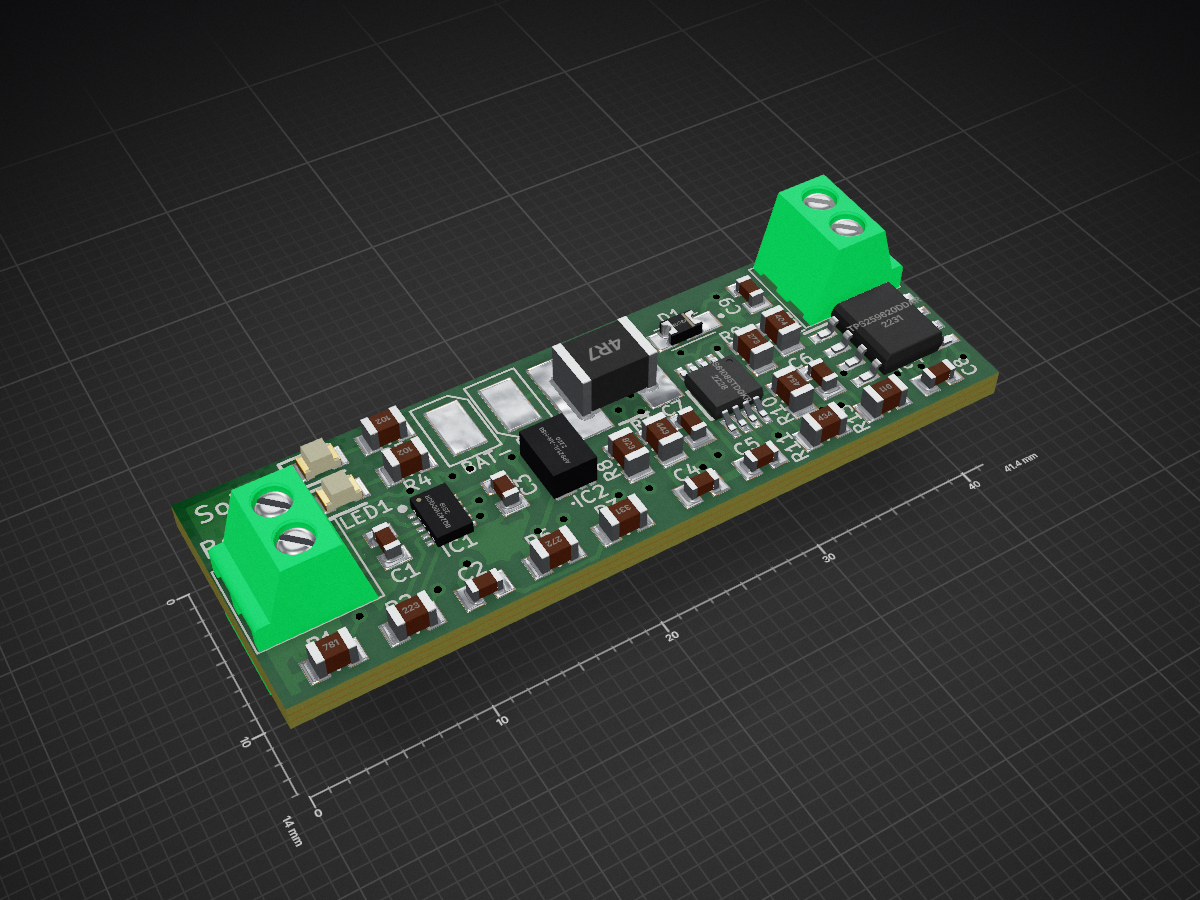
 makingdevices/SolarCharger10
Small PCB that charges a Li-Ion battery from a solar panel and gives an output of 5V - 0.6A
SolarCharger is an open-source printed circuit board by makingdevices, from the makingdevices/SolarCharger repository on GitHub. It is a 4-layer board of 41.4 × 14 mm with 38 parts on 28 nets, routed with 285 tracks and 40 vias.
It is built around the BQ24210DQCR, TPS259620DDAR and FSV360FP. Its parts include 14 resistors, 9 capacitors, 4 ICs, 3 diodes and 2 connectors. It belongs with the power boards of this library.


[blocked]






Open Source projects where we struggle with engineering, electronics, coding and who knows what else... The solar charger uses the energy from a solar panel (using MPPT) to charge a Li-Ion rechargeable battery and provide an stable 5V - 0.6A output.

The solar charger uses the energy from a solar panel (using MPPT) to charge a Li-Ion rechargeable battery and provide an stable 5V - 0.6A output. The project was created to test a small circuit before using it with other projects.


Documentation is updated.
As soon as you connect a battery, the output voltage will be activated.
Protections:
Solar Panel
Battery
Output
See the open issues for a full list of proposed features (and known issues).
State: Project FINISHED - 12/09/2023
Priority: High
Distributed under three licenses:

Making Devices - @MakingDevices
Project Link: https://github.com/makingdevices/SolarCharger
Other Links: LinkTree
PCBWAY is the most professional PCB manufacturer for prototyping and low-volume production to work with in the world. With more than a decade in the field, They are committed to meeting the needs of their customers from different industries in terms of quality, delivery, cost-effectiveness and any other demanding requests. As Sponsor of Making Devices, they will be in charge of all the PCBs for MDV, allowing both of us to grow together in a long term partnership. We hope you take them into account for your both personal and professional prototypes or products.

| Qty | Value | Footprint | References |
|---|---|---|---|
| 3 | 1uF | Library_Loader:CAPC2012X140N | C1, C2, C3 |
| 2 | 1k | Library_Loader:RESC2012X75N | R4, R5 |
| 1 | 100nF | Library_Loader:CAPC2012X140N | C7 |
| 1 | 100uF | Library_Loader:CAPC2012X140N | C8 |
| 1 | 2.2nF | Library_Loader:CAPC2012X140N | C6 |
| 1 | 2.7k | Library_Loader:RESC2012X75N | R6 |
| 1 | 21.5K | Library_Loader:RESC2012X75N | R2 |
| 1 | 22uF | Library_Loader:CAPC2012X140N | C5 |
| 1 | 27k | Library_Loader:RESC2012X75N | R9 |
| 1 | 330 | Library_Loader:RESC2012X75N | R3 |
| 1 | 4.7uH | Library_Loader:SRN6045_1 | L1 |
| 1 | 400k | Library_Loader:RESC2012X75N | R12 |
| 1 | 432k | Library_Loader:RESC2012X75N | R11 |
| 1 | 44.2k | Library_Loader:RESC2012X75N | R7 |
| 1 | 450K | Library_Loader:RESC2012X75N | R10 |
| 1 | 47uF | Library_Loader:CAPC2012X140N | C9 |
| 1 | 780 | Library_Loader:RESC2012X75N | R1 |
| 1 | 820pF | Library_Loader:CAPC2012X140N | C4 |
| 1 | 82k | Library_Loader:RESC2012X75N | R8 |
| 1 | 909 | Library_Loader:RESC2012X75N | R13 |
| 1 | AP9214L-AN-HSBR-7 | Library_Loader:AP9214LANHSBR7 | IC2 |
| 1 | BQ24210DQCR | Library_Loader:SON50P200X300X80-11N | IC1 |
| 1 | FSV360FP | Library_Loader:SS12FP | D1 |
| 1 | Green | Library_Loader:LEDC2012X90N | LED2 |
| 1 | IN | Library_Loader:282834-2_1 | J1 |
| 1 | Jumper | Library Loader:RESC2012X75N | R14 |
| 1 | LOGO | MDV:logo_MDV_3 | G*** |
| 1 | NTC 10K | Library_Loader:THRMC2012X95N | RT1 |
| 1 | OUT | Library_Loader:282834-2_1 | J2 |
| 1 | Orange | Library_Loader:LEDC2012X90N | LED1 |
| 1 | TPS259620DDAR | Library_Loader:SOIC127P600X170-9N | IC4 |
| 1 | TPS61085TDGKR | Library_Loader:SOP65P490X110-8N | IC3 |
| 1 | bat+ | Library_Loader:mountinghole_battery | H1 |
| 1 | bat- | Library_Loader:mountinghole_battery | H2 |
The 37 most common of 38 parts.
It measures 41.4 × 14 mm and has 4 copper layers, 1.6 mm thick.
38 parts, built around the BQ24210DQCR, TPS259620DDAR and FSV360FP. The full list of its parts is on this page, with links to each part's symbol and footprint where PCBKit's library has them.
From the makingdevices/SolarCharger repository on GitHub, at the commit this page was made from: the board is Kicad/SolarCharger/SolarCharger.kicad_pcb and its schematic Kicad/SolarCharger/SolarCharger.kicad_sch. PCBKit opens the board in the browser, with nothing to install.
Its repository states no licence, so its author keeps all rights: ask makingdevices before reusing the design.

barkinvar/sugerCANe
A compact interface for three NPN, PNP or logic sensors on an FRC robot. Each port has a removable 5 V / 12 V power jumper; input type is configured in software.

martinrybka2000/openacme-pfm
An open-source power quality meter for AC installations. It measures voltage, current, power (active / reactive / apparent), frequency, power factors and THD, and exposes the results over Ethernet and Modbus, with PQDIF…


jlab-sensing/ENTS-node-hardware
Schematics and design for soil MFC voltage and current sensing


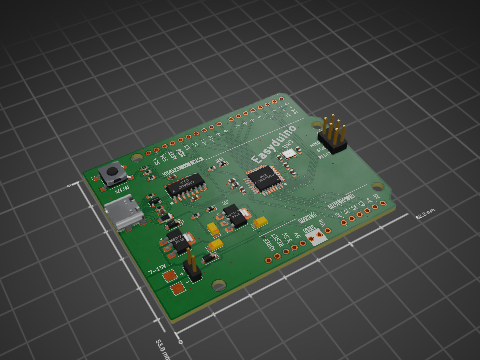
Hanqaqa/Easyduino
Easily dive into different PCB KiCad designs of the most popular microcontroller devboards