

4 layers234 × 84 mm
Main panel
google/mozc-devices
Circuit diagrams and firmware source code for Gboard DIY keyboards
234 parts3kApache-2.0
An open source framework for creating a bipedal modular companion robot.
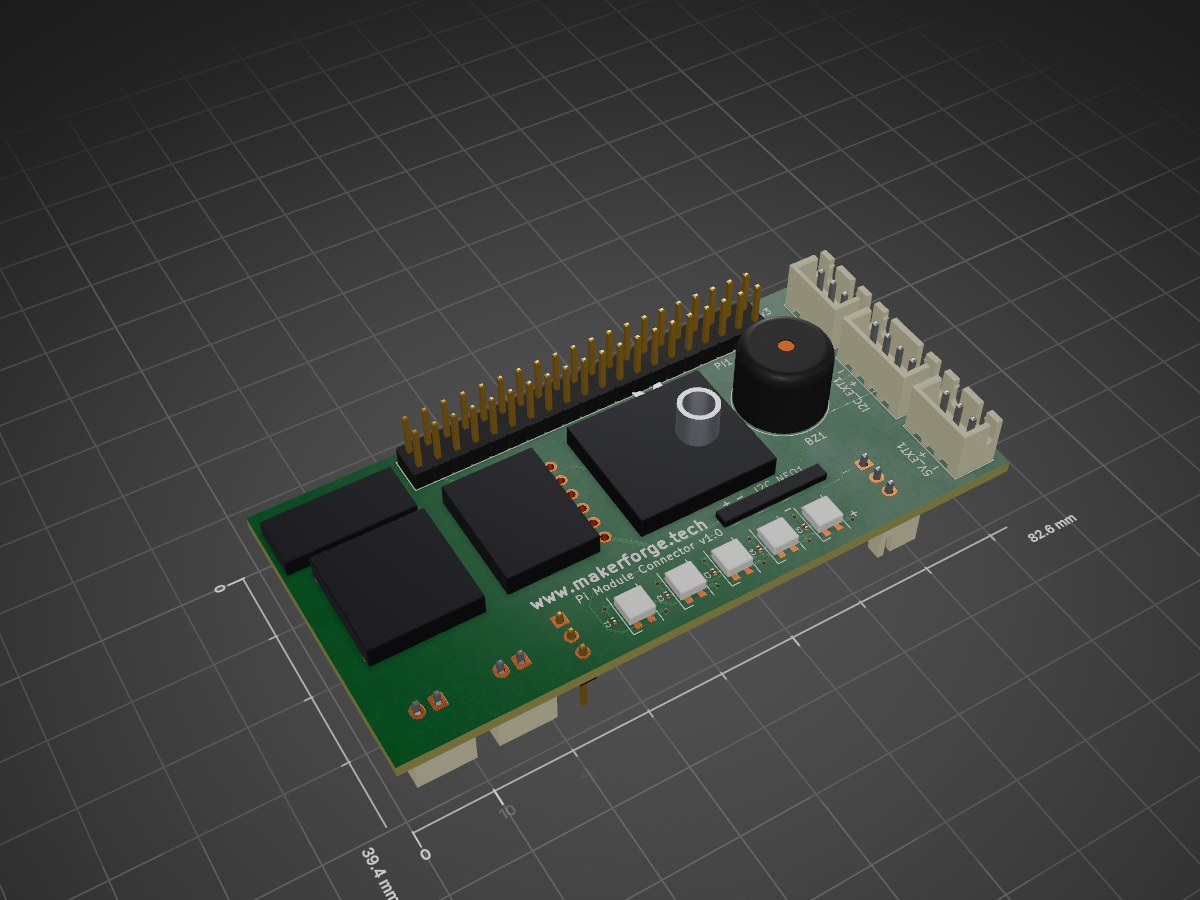
V4head is an open-source printed circuit board by makerforgetech, from the makerforgetech/modular-biped repository on GitHub, published under the GPL-3.0 licence. It is a 4-layer board of 82.5 × 39.4 mm with 26 parts on 43 nets, routed with 207 tracks and 10 vias.
It is built around the SK6812MINI-E. Its parts include 5 capacitors and 5 diodes. It belongs with the robots and motor control boards of this library.
The Modular Bipedal Robot project aims to educate and inspire individuals interested in robotics and electronics. This open-source initiative focuses on creating a fully autonomous companion robot with a variety of advanced features.
The Modular Biped Robot Project is designed to provide a flexible and modular framework for robotics development using Python and C++ on the Raspberry Pi and Arduino platforms. It aims to enable developers, robotics enthusiasts, and curious individuals to experiment, create, and customize their own biped robots. With a range of features and functionalities and the option to add your own easily, the Modular Biped Robot Project offers an exciting opportunity to explore the world of robotics.
The open source framework is designed for flexibility, allowing users to easily add or remove components to suit their specific needs. Comprehensive guides are provided for integrating new modules seamlessly.
| Qty | Value | Footprint | References |
|---|---|---|---|
| 5 | C_Small | Capacitor_SMD:C_0201_0603Metric | C1, C2, C3, C4, C5 |
| 5 | SK6812MINI | LED_SMD:LED_SK6812MINI_PLCC4_3.5x3.5mm_P1.75mm | D1, D2, D3, D4, D5 |
| 3 | Conn_01x03 | Connector_JST:JST_XH_B3B-XH-A_1x03_P2.50mm_Vertical | 3V_EXT1, 5V_EXT1, NEO1 |
| 2 | Conn_01x02 | Connector_JST:JST_XH_B2B-XH-A_1x02_P2.50mm_Vertical | PWR1, SERIAL1 |
| 2 | ~ | MakerForgeComponents:SPH0645LM4H | MIC1, MIC2 |
| 1 | Banana_Jack_1Pin | Connector:Banana_Jack_1Pin | HOLE |
| 1 | Buzzer | Buzzer_Beeper:Buzzer_12x9.5RM7.6 | BZ1 |
| 1 | Conn_01x03 | Connector_PinHeader_2.54mm:PinHeader_1x03_P2.54mm_Vertical | SRV1 |
| 1 | Conn_01x04 | Connector_JST:JST_XH_B4B-XH-A_1x04_P2.50mm_Vertical | I2C_EXT1 |
| 1 | I2C_NEOPIXEL | MakerForgeComponents:I2C_NEOPIXEL | I2C_NEO1 |
| 1 | Raspberry_Pi_2_3 | Connector_PinHeader_2.54mm:PinHeader_2x20_P2.54mm_Vertical | PI1 |
| 1 | ~ | MakerForgeComponents:MAX98357 | AMP1 |
| 1 | ~ | MakerForgeComponents:RCWL-0516_MIN | RCWL-516 |
| 1 | ~ | MakerForgeComponents:LCC_BIDIRECTIONAL | LLC1 |
It measures 82.5 × 39.4 mm and has 4 copper layers, 1.6 mm thick.
26 parts, built around the SK6812MINI-E. The full list of its parts is on this page, with links to each part's symbol and footprint where PCBKit's library has them.
From the makerforgetech/modular-biped repository on GitHub, at the commit this page was made from: the board is circuits/v4/Head/v4head/v4head.kicad_pcb and its schematic circuits/v4/Head/v4head/v4head.kicad_sch. PCBKit opens the board in the browser, with nothing to install.
Its repository publishes it under the GPL-3.0 licence: you may reuse it on that licence's terms (keep the author's notice, and for a copyleft licence share your changes alike).
google/mozc-devices
Circuit diagrams and firmware source code for Gboard DIY keyboards

Bastardkb/Dilemma
The Dilemma is a vertical stagger low-profile keyboard with mods.

Pwnsat/FlatSat
Flatsat v1.0 is a hardware based platform for aerospace cybersecurity research

adamws/kicad-kbplacer
KiCad plugin for automatic keyboard's key placement and routing

imchipwood/dumbpad
Simple 4x4 numpad with rotary encoder. Powered by QMK via ATmega32u4 Pro Micro


Envious-Data/Env-KB
A custom mechanical keyboard inspired by the CFTKB Mysterium utilizing the Raspberry Pi Pico