


2 layers116.5 × 60.3 mm
TalDoor
akaStanley/TalDoor
GatekeeperV2- POE powered NFC Door lock system using the PocketBeagle
67 parts14GPL-3.0

 luxonis/oak-hardware560
Open Source OAK Hardware designs in Altium
DepthABC is an open-source printed circuit board by luxonis, from the luxonis/oak-hardware repository on GitHub, published under the MIT licence. It is a 4-layer board of 152 × 65.2 mm with 117 parts on 163 nets, routed with 5,199 tracks and 450 vias.
It is built around the PTN5150HXMP, CBTL02043ABQ and RK7002BM. Its parts include 41 resistors, 12 capacitors, 9 connectors, 5 diodes and 5 transistors.


This repository contains OAK Open Source Hardware designs, including Altium design files, documentation, and pictures. This repository is for anyone interested in developing with the OAK SoM or anyone interested in understanding more about the embedded hardware that powers OAK devices. An open source, community KiCad folder is also available for sharing KiCad based designs and components.
The designs are Dual Licensed under MIT or KiCad Libraries License
OAK 4 FFC (OAK-4-FFC) is an OAK 4 SOM (OAK-4-SOM) carrier design with five FFC camera interfaces, a separate BK6970 PoE power board, and Altium libraries for the three SOM connectors. See the OAK 4 FFC README for design resources, interface mapping, and current release limitations.
This board is the basis for the OAK-D-POE. And it is the equivalent of the BW1098OBC/BW1098OAK, but with POE instead of USB. So 3 onboard cameras (1x onboard IMX378 12MP autofocus color camera, 2x global shutter grayscale for stereo depth), with the stereo baseline being 7.5cm (just like BW1098OBC/BW1098OAK/OAK-D).

This design is in progress. When complete it will support the DepthAI API over Ethernet, and some additional features like direct RTSP streaming.
This is the basis for OAK-1-POE. It is the equivalent of the BK1096_OAK, with with POE instead of USB. So 1x onboard IMX378 12MP autofocus color camera.

This design is in progress. When complete it will support the DepthAI API over Ethernet, and some additional features like direct RTSP streaming.
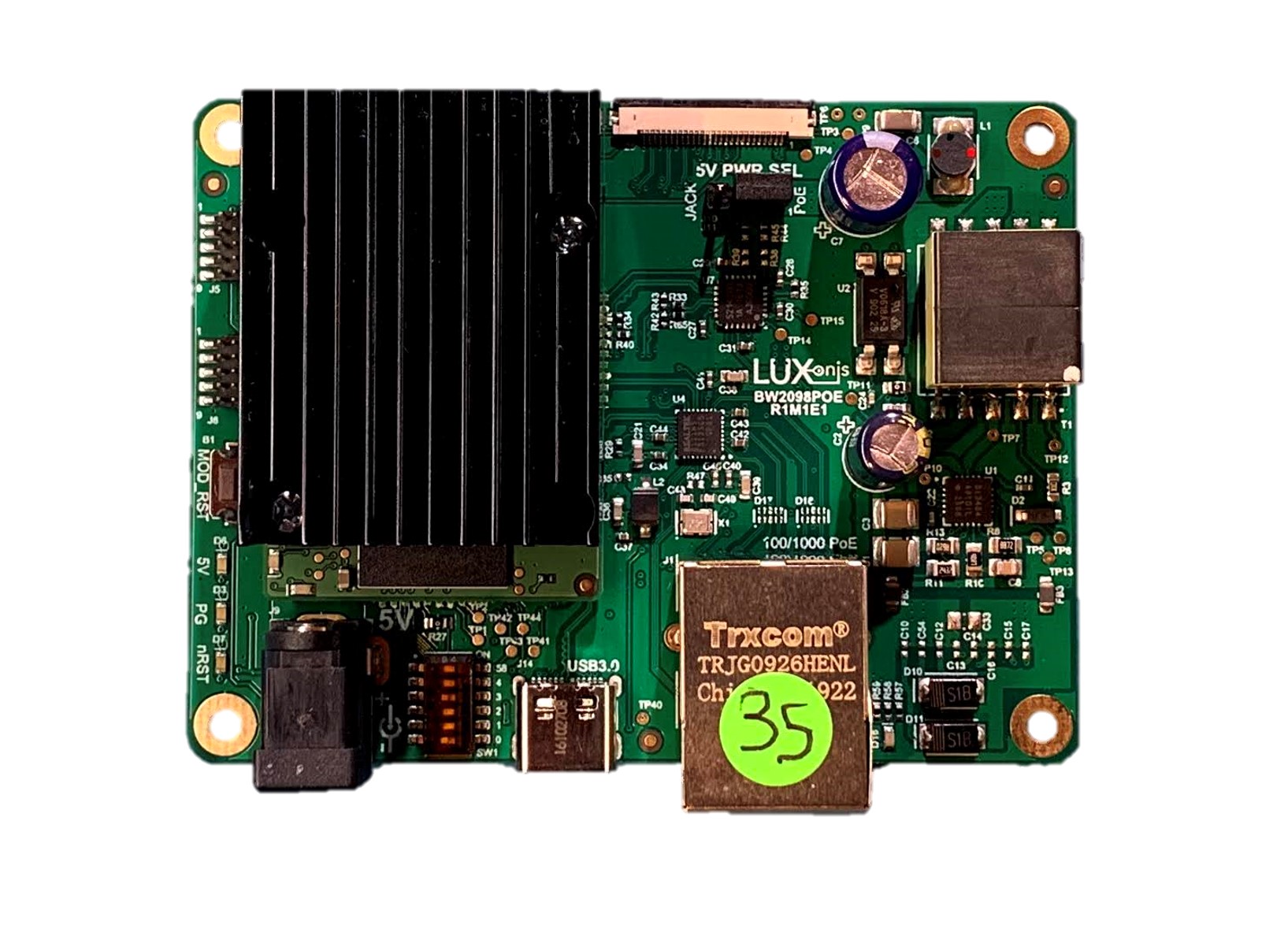
The BW2098POE repository contains open hardware designed by Luxonis, and meant to be used as a baseboard for the Luxonis BW2099 OAK SoM. The BW2098POE baseboard offers full 802.3af, Class 3 PoE compliance with 1000BASE-T speeds, along with user-selectable external power from a 5V barrel jack. The Luxonis BW0249 12MP RGB camera module can be connected via the 26-pin FFC interface, which exposes a 4-lane MIPI CSI-2 channel directly into the Myriad X on the BW2099 module for processing. Data can also be streamed to a host via USB 3.1 Gen1 (Type-C). Finally, the BW2098POE board exposes boot selection switches, allowing the end user to boot the BW2099 module from USB or the on-board eMMC or NOR flash.
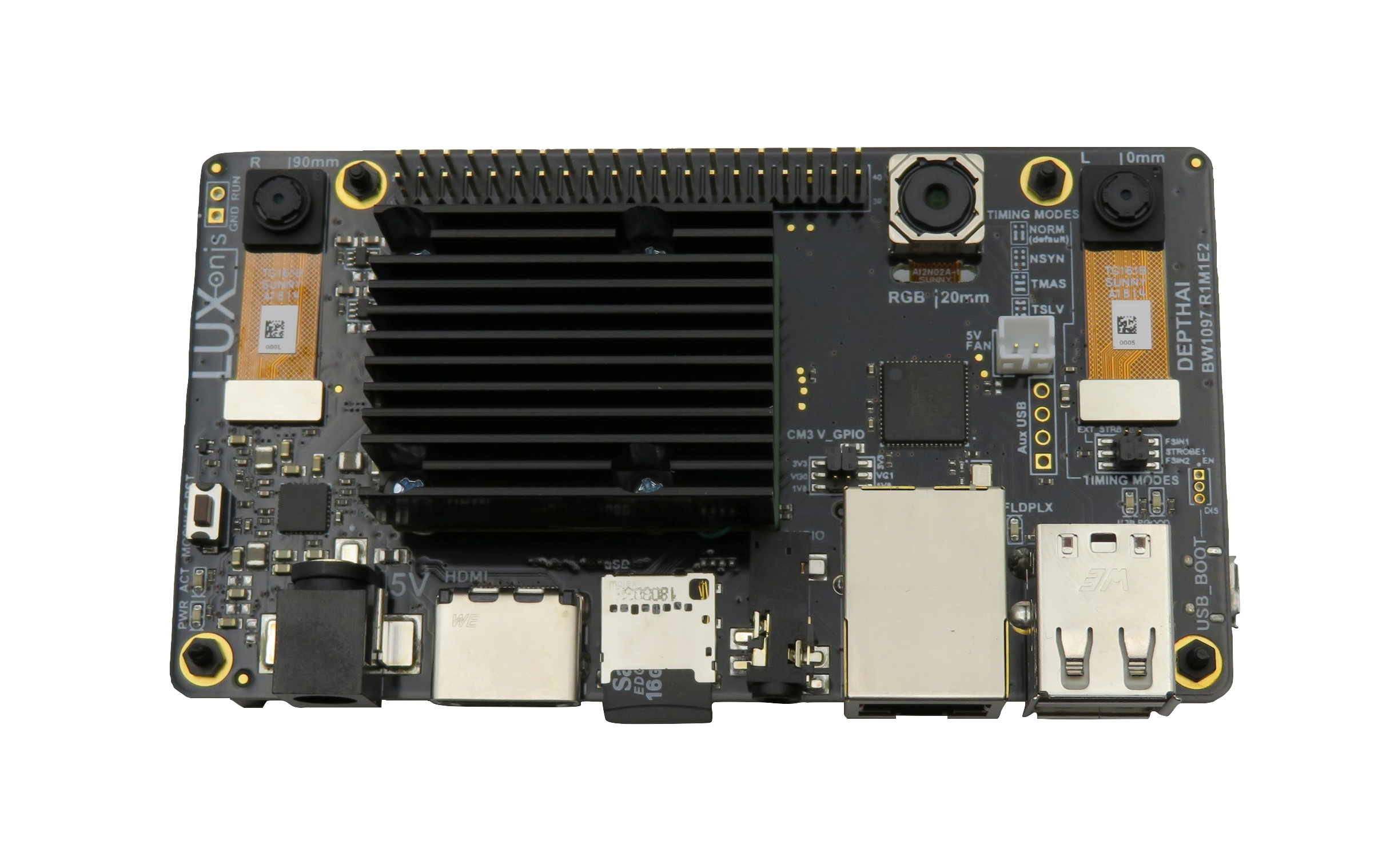
The DM1097 contains the design files for DepthAI with an integrated/onboard Raspberry Pi Compute Module 4. The DM1097 combines a host and the Luxonis OAK SoM to allow for fully integrated solution for real-time spatial AI. It is effectively the same as the BW1097, below, but with a Pi 4 computer module instead of a Pi 3 compute module.

The BW1097 repository contains open hardware designed by Luxonis, and meant to be used as a baseboard for the Luxonis BW1099 OAK SoM and the Raspberry Pi Compute Module 3+. Based on the Raspberry PI CMIO board, the BW1097 combines a host and the Luxonis OAK SoM to allow for fully integrated solution for real-time spatial AI.
This board is used in the depthai product known as the OpenCV AI Kit with Depth, OAK-D:

The BW1098OBC repository contains open hardware designed by Luxonis, and meant to be used as a baseboard for the Luxonis BW1099 OAK SoM. The BW1098OBC baseboard has three on-board cameras which implement stereo and RGB vision, piped directly into the OAK SoM for depth and AI processing. The data is then output to a host via USB 3.1 Gen1 (Type-C).

The 1090 is our updated version from the common issues customers have had with BW1098FFC. (We will keep selling the 1098FFC, for folks who have that connector type.) Improvements/changes:
Below is a flow-chart showing the evolution of this design over time based on customer feedback/needs.
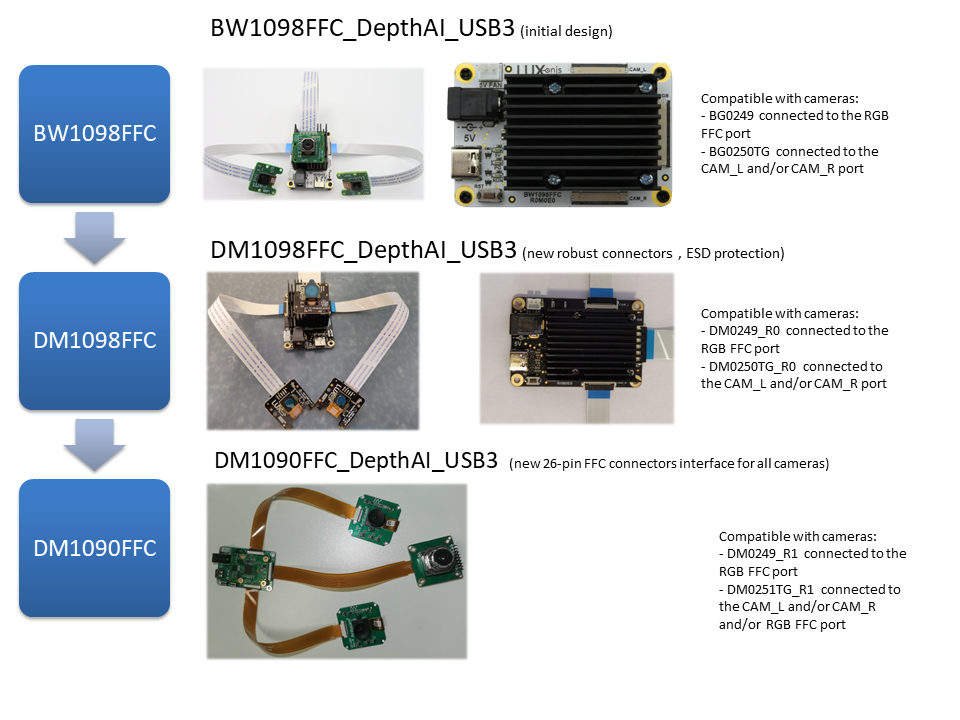
More information about each design can be found in corresponding repositories.
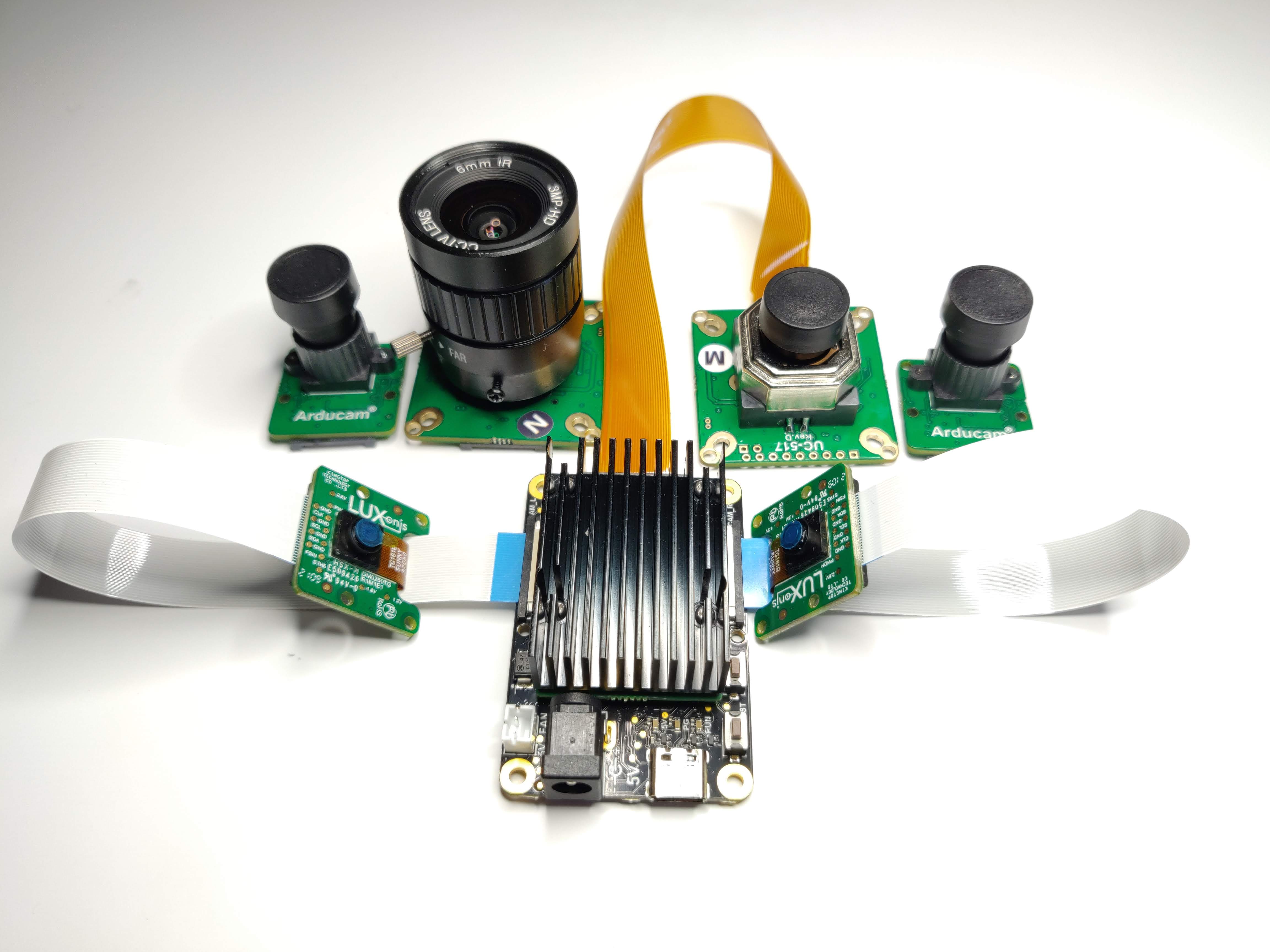
The DM1090FFC repository contains open hardware designed by Luxonis, and meant to be used as a baseboard for the Luxonis BW1099 OAK SoM. The DM1090FFC baseboard has three FFC interfaces which allow for two DM0250TG camera modules (stereo pair) and one DM0249 RGB camera module. Besides Luxonis camera modules, several Arducam CCMs can be connected to DM1090FFC. Please note that only revision R1 and above (R1M1E1) (DM0250TG and DM0249) cameras with 26-pin FFC connectors can be connected to DM1090FFC.
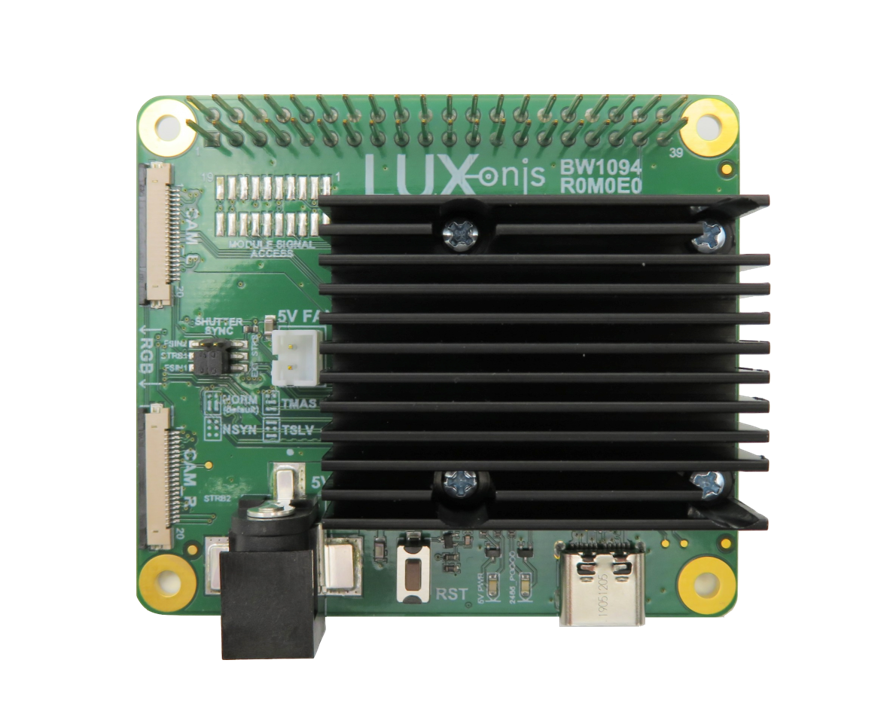
The BW1094 repository contains open hardware designed by Luxonis, and meant to be used as a baseboard for the Luxonis BW1099 OAK SoM and as a HAT for the RPi "B" models. The BW1094 baseboard has three FFC interfaces which allow for two BG0250TG camera modules (stereo pair) and one BG0249 RGB camera module. The GPIO interface from the Raspberry Pi Model B variants is passed through the BW1094 with the exception of the 5V pins, GND pins, and BCM GPIO26 (pin 37), which is used as a way for the Raspberry Pi to reset the OAK SoM, parallel to the RST button.
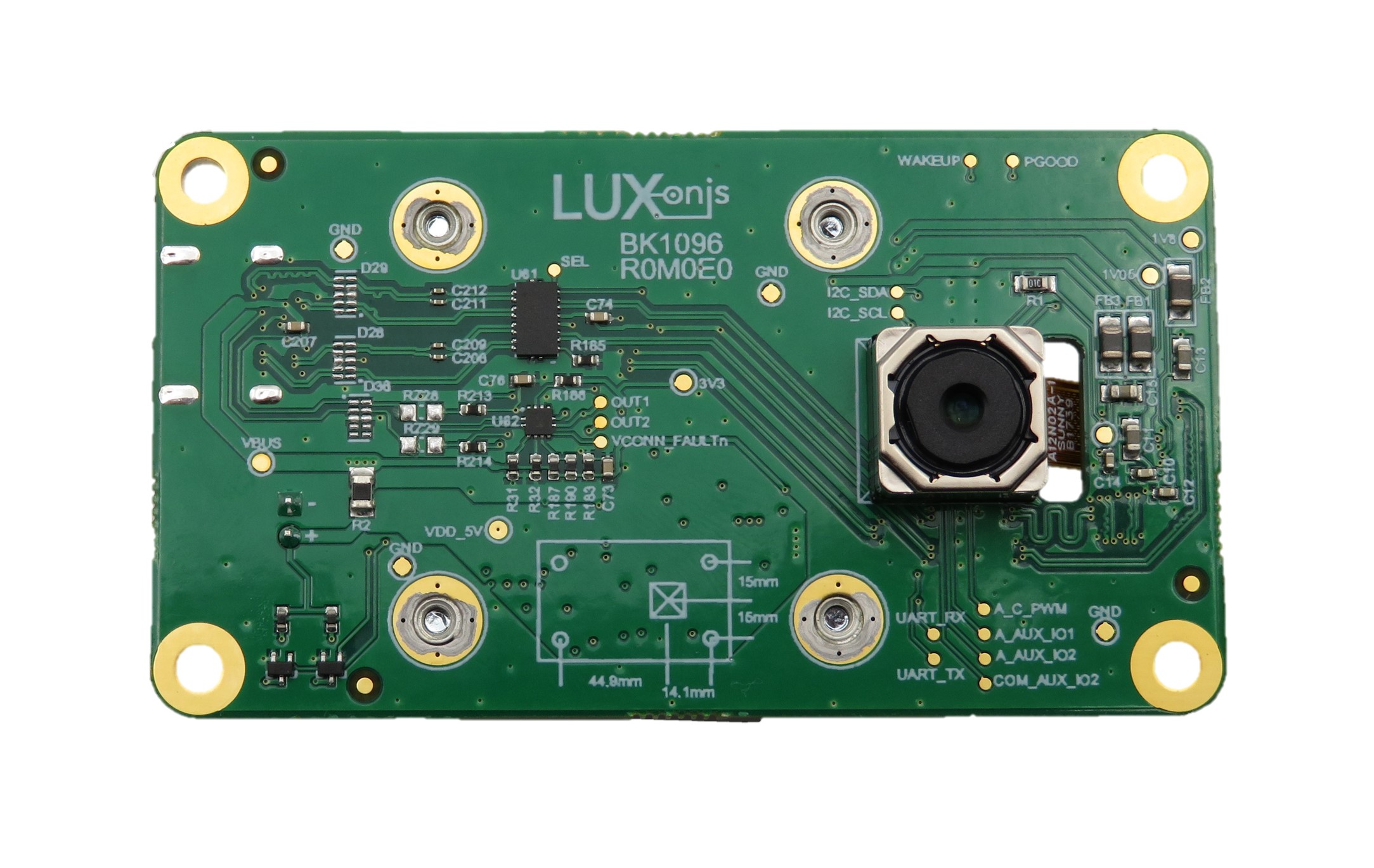
The BK1096 repository contains open hardware designed by Luxonis, and meant to be used as a baseboard for the Luxonis BW1099 OAK SoM. The BK1096 baseboard offers a quick and simple way to add USB3 Type-C device power and connectivity, and a single 12MP RGB camera module to the OAK SoM.
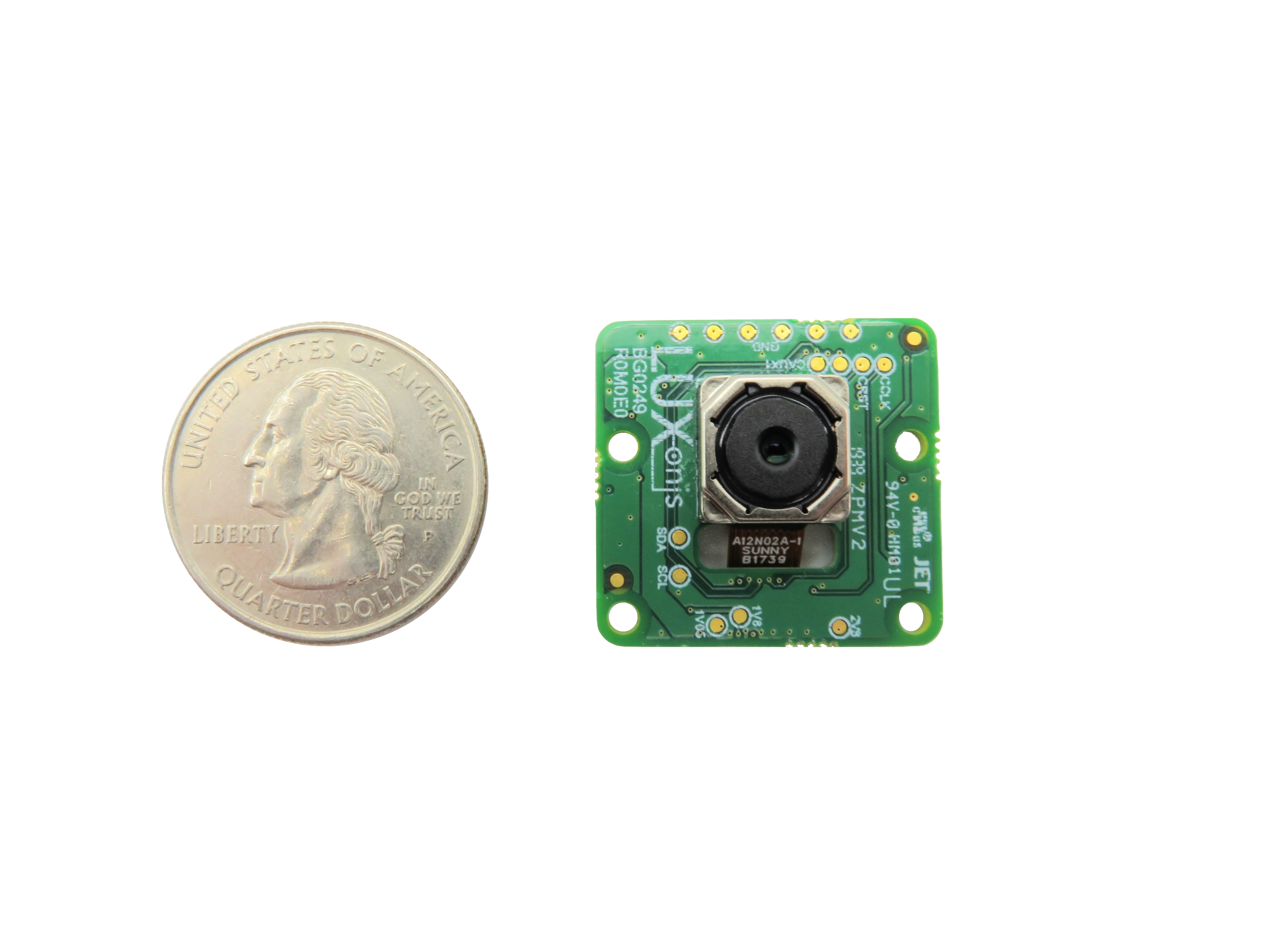
The BG0249 repository contains open hardware designed by Luxonis. The BW0249 is a carrier board for the Sunny A12N02A IMX378 camera module, and is designed to be compatible with the BW1094 and BW1098FFC baseboards. A 26-pin FFC is used to carry 5V power, 4-lane MIPI, I2C, and other control signals between the BW0249 and the controller baseboards.
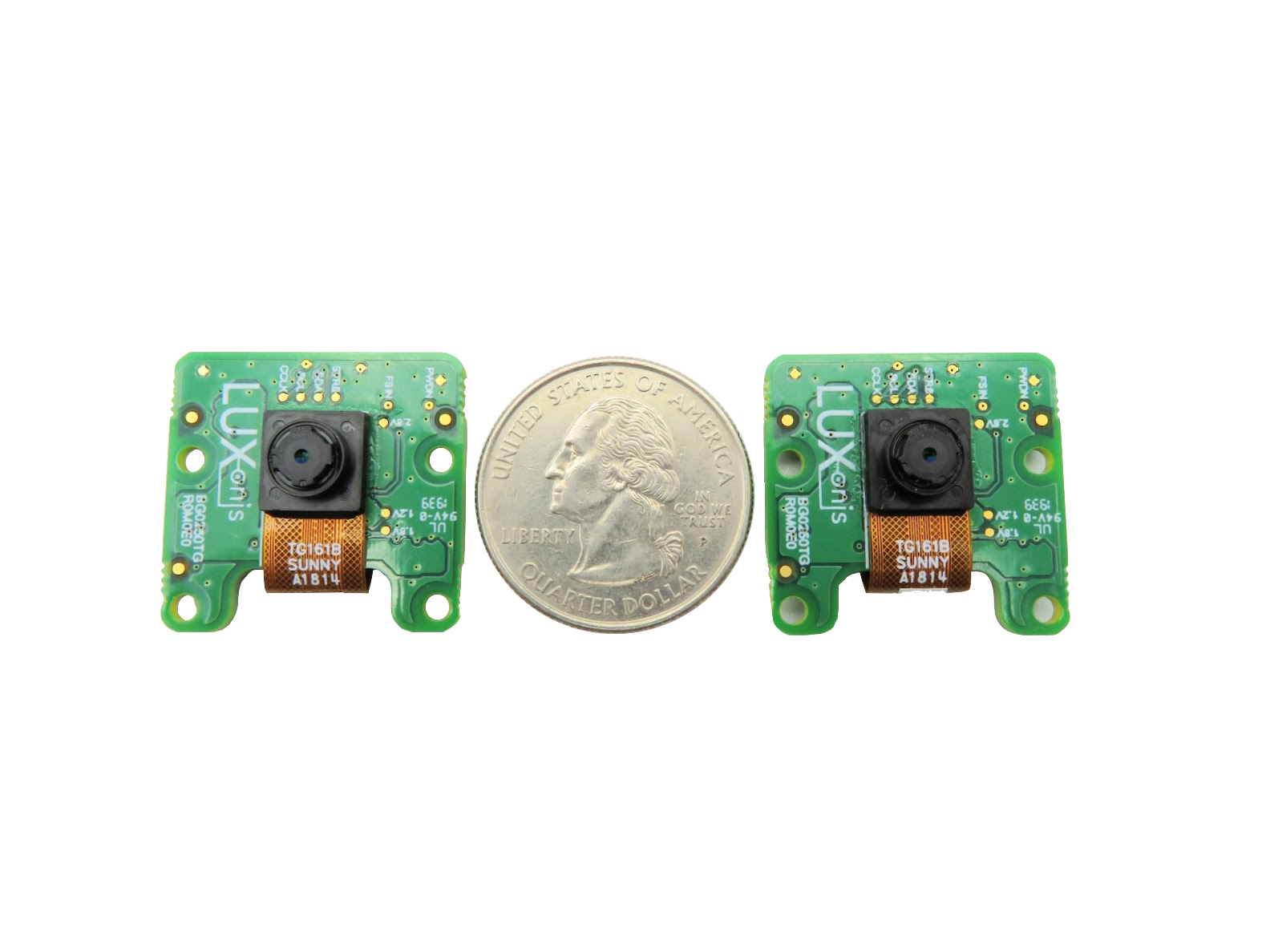
The BG0250TG repository contains open hardware designed by Luxonis. The BW0250TG is a carrier board for the Sunny TG161B or AN01V32 OV9282 camera module, and is designed to be compatible with the BW1094 and BW1098FFC baseboards. A 20-pin FFC is used to carry 5V power, 2-lane MIPI, I2C, and other control signals between the BW0250TG and the controller baseboards. A single BG0250TG is typically paired with another to create a stereo camera pair.
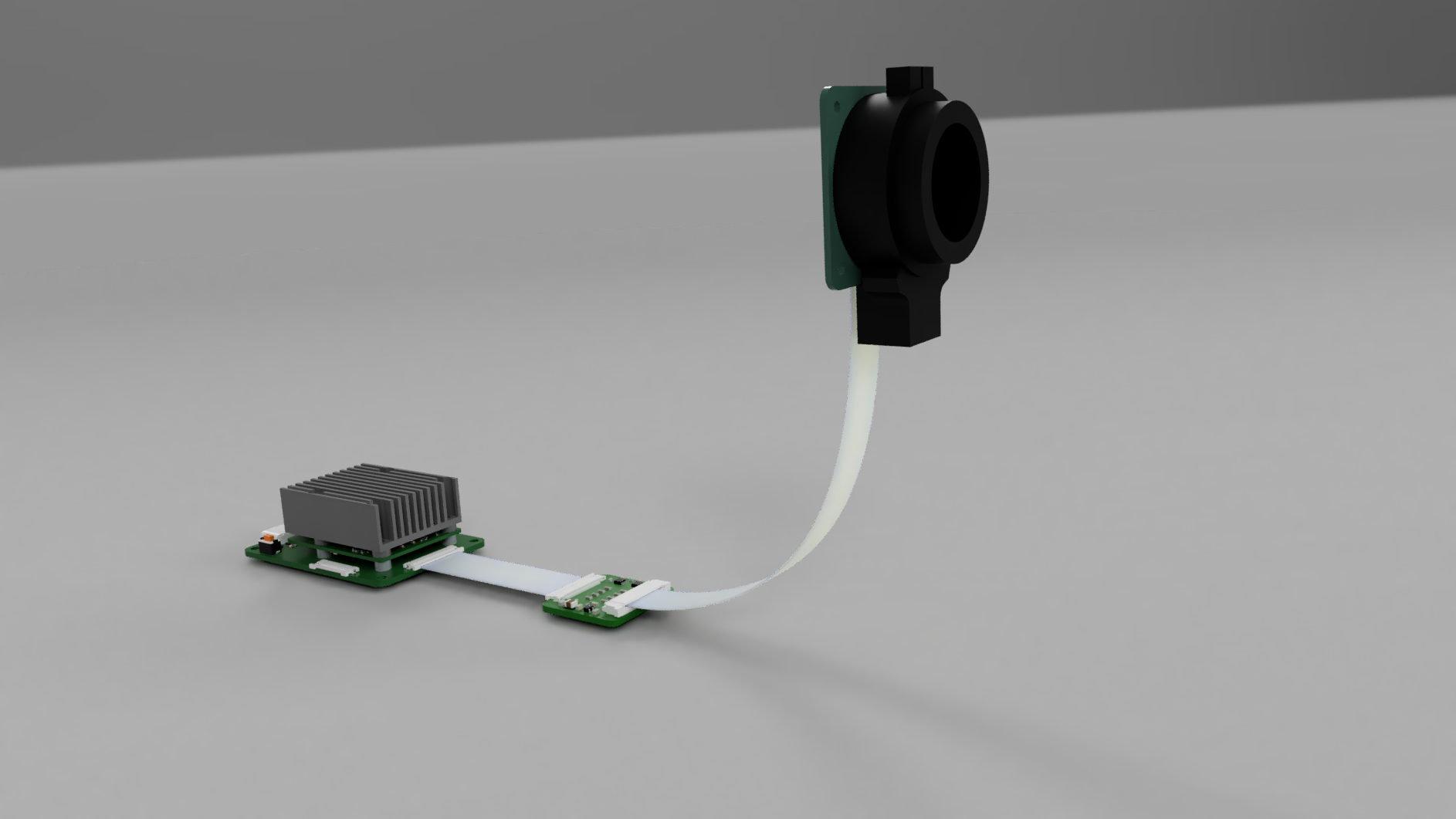
The BW0253_R0M0E0 is an adapter board to allow the Raspberry Pi HQ camera to physically interface to the DepthAI RGB camera port on the BW1098FFC.
This allows using DepthAI with all sorts of lens combinations, including variable zoom, variable focus, and even with a telescope.
| Qty | Value | Footprint | References |
|---|---|---|---|
| 21 | 0R | Resistor_SMD:R_0603_1608Metric | R10, R11, R12, R13, R14, R15, R27, R28, R31, R32, R33, R34, R37, R38, R39, R40 +5 |
| 14 | ~ | TestPoint:TestPoint_Pad_D2.0mm | TP1, TP2, TP3, TP4, TP5, TP6, TP7, TP8, TP9, TP10, TP18, TP19, TP20, TP21 |
| 10 | 10k | Resistor_SMD:R_0603_1608Metric | R8, R16, R17, R18, R20, R22, R23, R24, R25, R26 |
| 8 | 10uF | Capacitor_SMD:C_0603_1608Metric | C1, C2, C3, C4, C32, C33, C38, C39 |
| 6 | 10 | Resistor_SMD:R_0603_1608Metric | R1, R2, R3, R4, R30, R36 |
| 6 | Fiducial | Fiducial:Fiducial_1mm_Mask2mm | FID1, FID2, FID3, FID4, FID5, FID6 |
| 5 | RK7002B | Package_TO_SOT_SMD:SOT-23 | Q1, Q2, Q3, Q4, Q5 |
| 4 | 0.1uF | Capacitor_SMD:C_0603_1608Metric | C34, C35, C36, C37 |
| 4 | MountingHole_4-40 | MountingHole:MountingHole_3mm_Pad | H9, H10, H11, H12 |
| 4 | MountingHole_M3 | MountingHole:MountingHole_3.2mm_M3_ISO7380_Pad | H1, H2, H3, H4 |
| 4 | MountingHole_Pad | Luxonis_KiCad_Master:Mounting_Wuerth_WA-SMSI-M2_H3mm_9774030243 | H5, H6, H7, H8 |
| 3 | 26_pin_FFC | Luxonis_KiCad_Master:F32R-26p-FFC | J6, J7, J9 |
| 3 | Arducam_Module | Luxonis_KiCad_Master:arducam_40mm_34mm | CAM1, CAM2, CAM3 |
| 3 | RED | LED_SMD:LED_0805_2012Metric | D1, D4, D5 |
| 2 | 1.8M | Resistor_SMD:R_0603_1608Metric | R19, R21 |
| 2 | 1k | Resistor_SMD:R_0603_1608Metric | R29, R35 |
| 2 | Conn_02x05_Odd_Even | Connector_PinSocket_2.54mm:PinSocket_2x05_P2.54mm_Vertical_SMD | J1, J4 |
| 2 | LOGO | ABC:CE_Logo | G***, G*** |
| 2 | YELLOW | LED_SMD:LED_0805_2012Metric | D2, D3 |
| 1 | 2-bit bidirectional level shifter | Package_SO:TSSOP-8_3x3mm_P0.65mm | U1 |
| 1 | BW1099EMB_SoM | Luxonis_KiCad_Master:DF40HC(3.0)-100DS-0.4V(58) | J3 |
| 1 | CBTL02043A | Package_DFN_QFN:WQFN-20-1EP_2.5x4.5mm_P0.5mm_EP1x2.9mm | U2 |
| 1 | Conn_02x25_Counter_Clockwise | ABC:DF23C-50DS-0.5V(51) | J8 |
| 1 | FAN | Connector_PinHeader_2.54mm:PinHeader_1x02_P2.54mm_Vertical | J2 |
| 1 | LOGO | Luxonis_KiCad_Master:DepthAI | G*** |
| 1 | Layout_Guide_ABC | ABC:ABC-Layout | MISC2 |
| 1 | Layout_Guide_BW1099 | Luxonis_KiCad_Master:BW1099_Layout_Guide | MISC1 |
| 1 | Off-Mohm, 50mA | depthABC:SW_PTS636_SM43J_SMTR_LFS | B1 |
| 1 | PTN5150HXMP | Luxonis_KiCad_Master:PTN5150HXMP | IC1 |
| 1 | USBC 3.1 Vertical | depthABC:AMPHENOL_10132328-10011LF | J5 |
The 116 most common of 117 parts.
It measures 152 × 65.2 mm and has 4 copper layers, 1.6 mm thick.
117 parts, built around the PTN5150HXMP, CBTL02043ABQ and RK7002BM. The full list of its parts is on this page, with links to each part's symbol and footprint where PCBKit's library has them.
From the luxonis/oak-hardware repository on GitHub, at the commit this page was made from: the board is OSHW_KiCad_Community/Reference Designs (In Progress)/DepthABC/DepthABC.kicad_pcb. PCBKit opens the board in the browser, with nothing to install.
Its repository publishes it under the MIT licence: you may reuse it on that licence's terms (keep the author's notice, and for a copyleft licence share your changes alike).
akaStanley/TalDoor
GatekeeperV2- POE powered NFC Door lock system using the PocketBeagle


AnterCreeper/pdaltmode
USB Power Delivery Alt-mode Negotiation using CH32X035

zephray/PenabledDisplay
Mod a ThinkPad X200T display into a USB-C pen display

pdyxs/glider
Fork of zephray/glider (Modos Glider e-ink monitor) with a DP AUX polarity fix and a standalone GCC firmware build


murexrobotics/electrical
Highly integrated electronics design and printed circuit boards (PCBs) for the MATE ROV Competition. Attempt the impossible.