2 layers284.7 × 94.2 mm

 louismessonnier/3H6MGD
Custom magnetic switch keypad for geometry dash
Gd keypad is an open-source printed circuit board by louismessonnier, from the louismessonnier/3H6MGD repository on GitHub, published under the MIT licence. It is a 2-layer board of 155 × 70 mm with 61 parts on 75 nets, routed with 532 tracks and 76 vias.
It is built around the AT32F405RCT7, TLV75733PDBV and USBLC6-2SC6, with the XC6206P332MR-G, TS-1187A-B-A-B and BSMD0805-050-24V among its other parts. Its parts include 22 capacitors, 7 ICs, 6 diodes, 4 resistors and 3 switches. It belongs with the keyboards and input boards of this library.


A custom analog macropad for Geometry Dash, built around magnetic Hall-effect switches for continuous key-travel sensing. The macroapd has three analog jump keys alongside six mechanical keys and a rotary encoder for volume control.
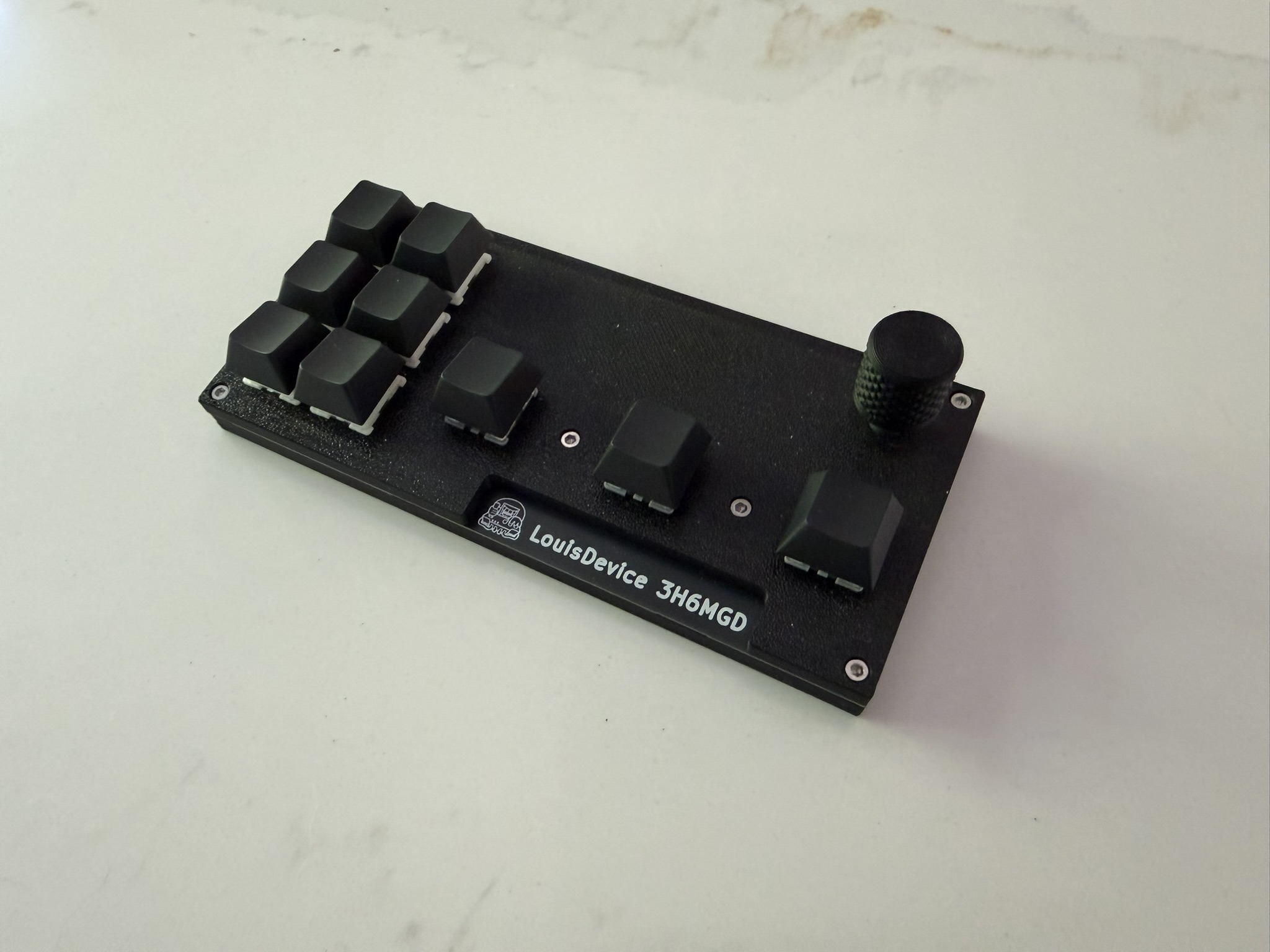
Most keyboards report a key as simply pressed or not pressed. Hall-effect switches instead measure how far the key has travelled, by reading the field of a magnet in the switch stem with a linear sensor on the PCB. That continuous position enables features that matter in a timing-based game like Geometry Dash — primarily adjustable actuation (choose exactly how far down counts as a press). This board brings that to a compact macropad.
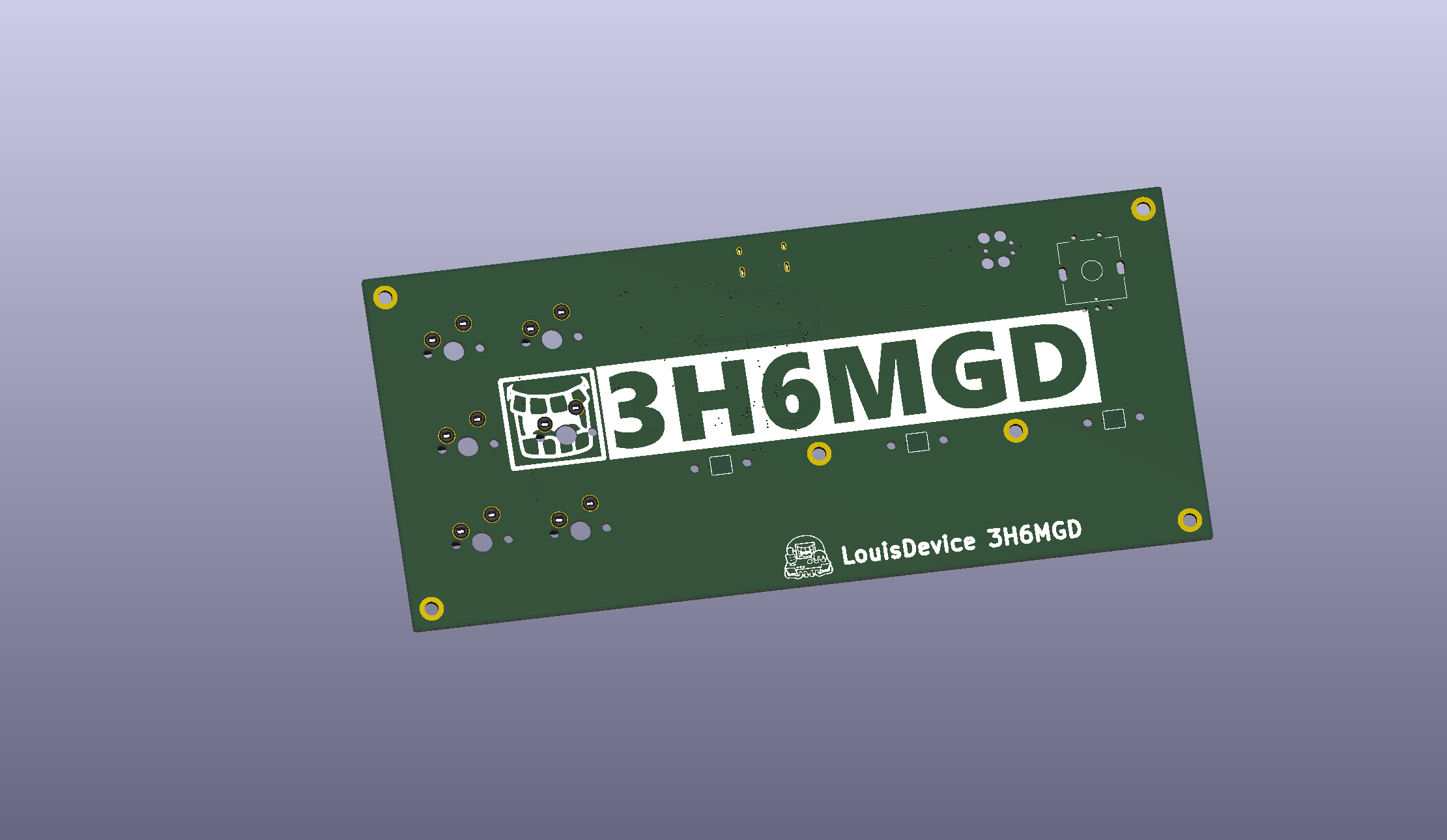
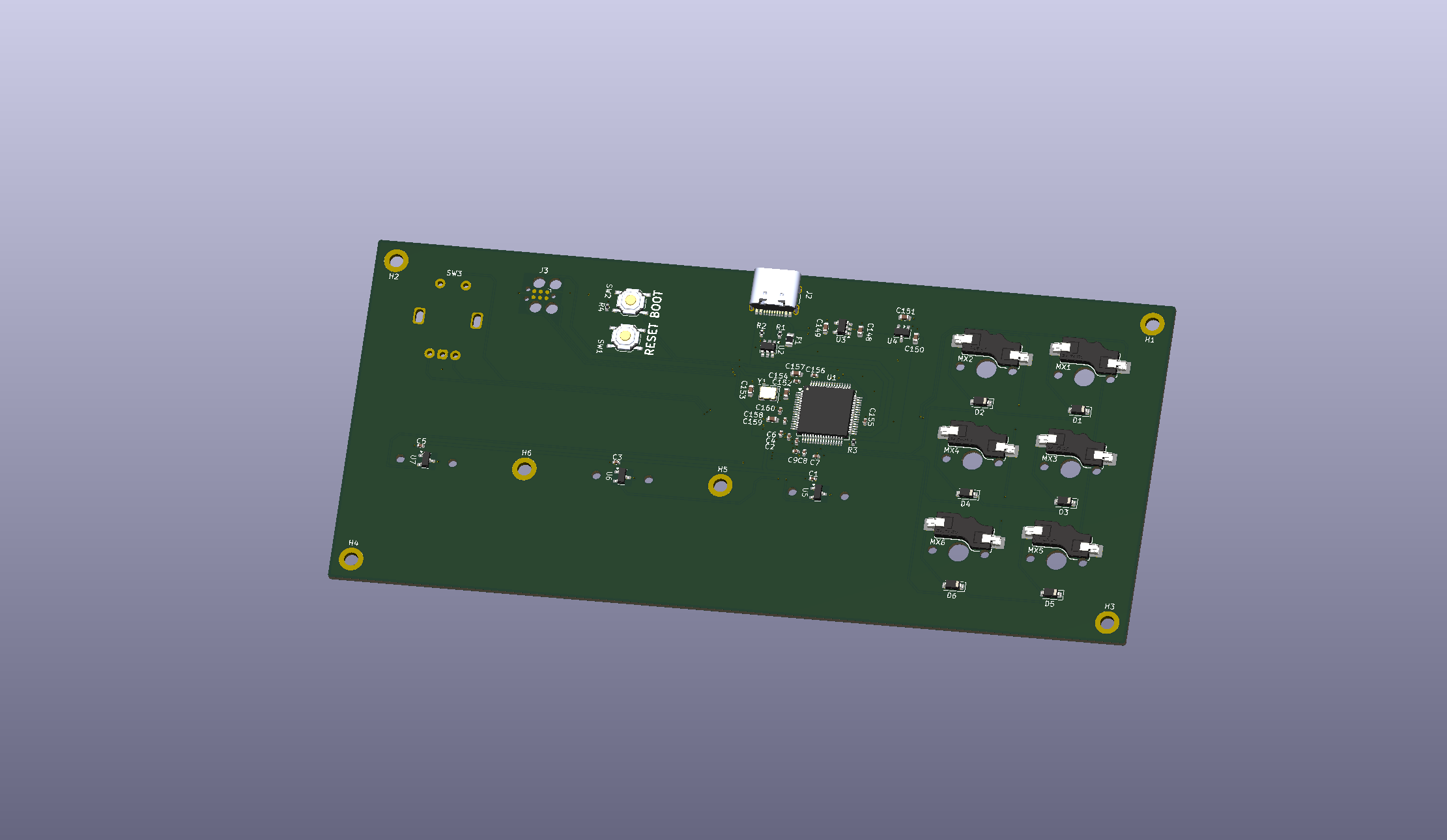
The board runs libhmk. Everything about the firmware (how the board is defined, the custom module that adds the mechanical matrix and encoder, how to build and flash it, and the calibration and volume-control setup) is in firmware/README.md.
firmware/   libhmk keyboard definition, custom matrix + encoder module, build docs
kicad/      KiCad project (schematic and PCB)_
cad/        Case and knob models
images/     Renders and photos
docs/ Design notes and referencesThis project builds on the open-source Hall-effect keyboard community:
The firmware (firmware/) is licensed under GNU General Public License v3.0, inherited from
libhmk, on which it is based. The hardware
(kicad/) and case (cad/) files are licensed under MIT License. The encoder
knob is a third-party design under CC BY-NC 4.0 — see Acknowledgements.
| Qty | Value | Footprint | References |
|---|---|---|---|
| 9 | 100n | Capacitor_SMD:C_0402_1005Metric | C1, C3, C5, C9, C154, C155, C156, C158, C160 |
| 6 | Diode | Diode_SMD:D_SOD-123 | D1, D2, D3, D4, D5, D6 |
| 6 | MX_SW_HS | PCM_marbastlib-mx:SW_MX_HS_KS-2P02B01-01_1u | MX1, MX2, MX3, MX4, MX5, MX6 |
| 6 | MountingHole_Pad | MountingHole:MountingHole_2.7mm_M2.5_DIN965_Pad | H1, H2, H3, H4, H5, H6 |
| 4 | 2.2u | Capacitor_SMD:C_0603_1608Metric | C148, C149, C150, C151 |
| 3 | 4.7n | Capacitor_SMD:C_0402_1005Metric | C2, C4, C6 |
| 3 | SW_MX_HE | PCM_marbastlib-he:SW_MX_HE_0deg_1u | U5, U6, U7 |
| 2 | 10n | Capacitor_SMD:C_0402_1005Metric | C7, C8 |
| 2 | 12k | Resistor_SMD:R_0402_1005Metric | R3, R4 |
| 2 | 30p | Capacitor_SMD:C_0603_1608Metric | C152, C153 |
| 2 | 5.1k | Resistor_SMD:R_0402_1005Metric | R1, R2 |
| 2 | TS-1187A-B-A-B | Button_Switch_SMD:SW_Push_1P1T_XKB_TS-1187A | SW1, SW2 |
| 1 | 10u | Capacitor_SMD:C_0603_1608Metric | C157 |
| 1 | 1u | Capacitor_SMD:C_0603_1608Metric | C159 |
| 1 | AT32F405RCT7 | Package_QFP:LQFP-64_10x10mm_P0.5mm | U1 |
| 1 | BSMD0805-050-24V | Fuse:Fuse_0805_2012Metric | F1 |
| 1 | LOGO | logos:gd_cube | G*** |
| 1 | LOGO | logos:gd_cube_cut+edited | G*** |
| 1 | LOGO | logos:gd_ufo | G*** |
| 1 | RotaryEncoder_Switch_MP | PCM_marbastlib-various:ROT_Alps_EC11E-Switch | SW3 |
| 1 | TC2030 | Connector:Tag-Connect_TC2030-IDC-FP_2x03_P1.27mm_Vertical | J3 |
| 1 | TLV75733PDBV | Package_TO_SOT_SMD:SOT-23-5 | U3 |
| 1 | USBLC6-2SC6 | Package_TO_SOT_SMD:SOT-23-6 | U2 |
| 1 | USB_C_Receptacle_USB2.0_16P | Connector_USB:USB_C_Receptacle_HRO_TYPE-C-31-M-12 | J2 |
| 1 | X322512MSB4SI | Crystal:Crystal_SMD_3225-4Pin_3.2x2.5mm | Y1 |
| 1 | XC6206P332MR-G | Package_TO_SOT_SMD:SOT-23-3 | U4 |

peppapighs/M256-WHE
M256-WHE is a Hall-effect keyboard PCB, specifically designed for Mode Encore, Mode SixtyFive v2, and Mode Envoy [1].

gohanda11/Chai45HE
Chai45HE is a 40% Hall-effect keyboard based on the HE60 project. This is a modified version that adapts the original 60% design to a compact 40% layout.


gohanda11/Split60HE
Split60HE is a split (left/right) version of the 60% Hall-effect keyboard HE60, designed in KiCad.


Mokeded/Symm60HE
Symmetrical Hall effect Alice keyboard based off of the Doe

HeyPCB/whisker
Drop-in controller for Petoi's Nybble robot cat running the stock OpenCat firmware: ATmega328P, PCA9685, MPU-6050, USB-C, 3 A buck, protected battery input. 4-layer KiCad 10 board plus printed cradle.
It measures 155 × 70 mm and has 2 copper layers, 1.2 mm thick.
61 parts, built around the AT32F405RCT7, TLV75733PDBV, USBLC6-2SC6 and XC6206P332MR-G. The full list of its parts is on this page, with links to each part's symbol and footprint where PCBKit's library has them.
From the louismessonnier/3H6MGD repository on GitHub, at the commit this page was made from: the board is kicad/gd-keypad-pcb/gd-keypad.kicad_pcb and its schematic kicad/gd-keypad-pcb/gd-keypad.kicad_sch. PCBKit opens the board in the browser, with nothing to install.
Its repository publishes it under the MIT licence: you may reuse it on that licence's terms (keep the author's notice, and for a copyleft licence share your changes alike).