2 layers57 × 55.2 mm
LogicAnalyzer
gusmanb/logicanalyzer
24 channel, 100Msps logic analyzer hardware and software
10 parts5.1kGPL-3.0
 lorenzogalli-dev/Prostart
A start unit that mounts on any starting block, and a phone app that turns a smartphone into a photo finish. The unit sounds the start commands, detects the push-off with an accelerometer and judges the start on its own…
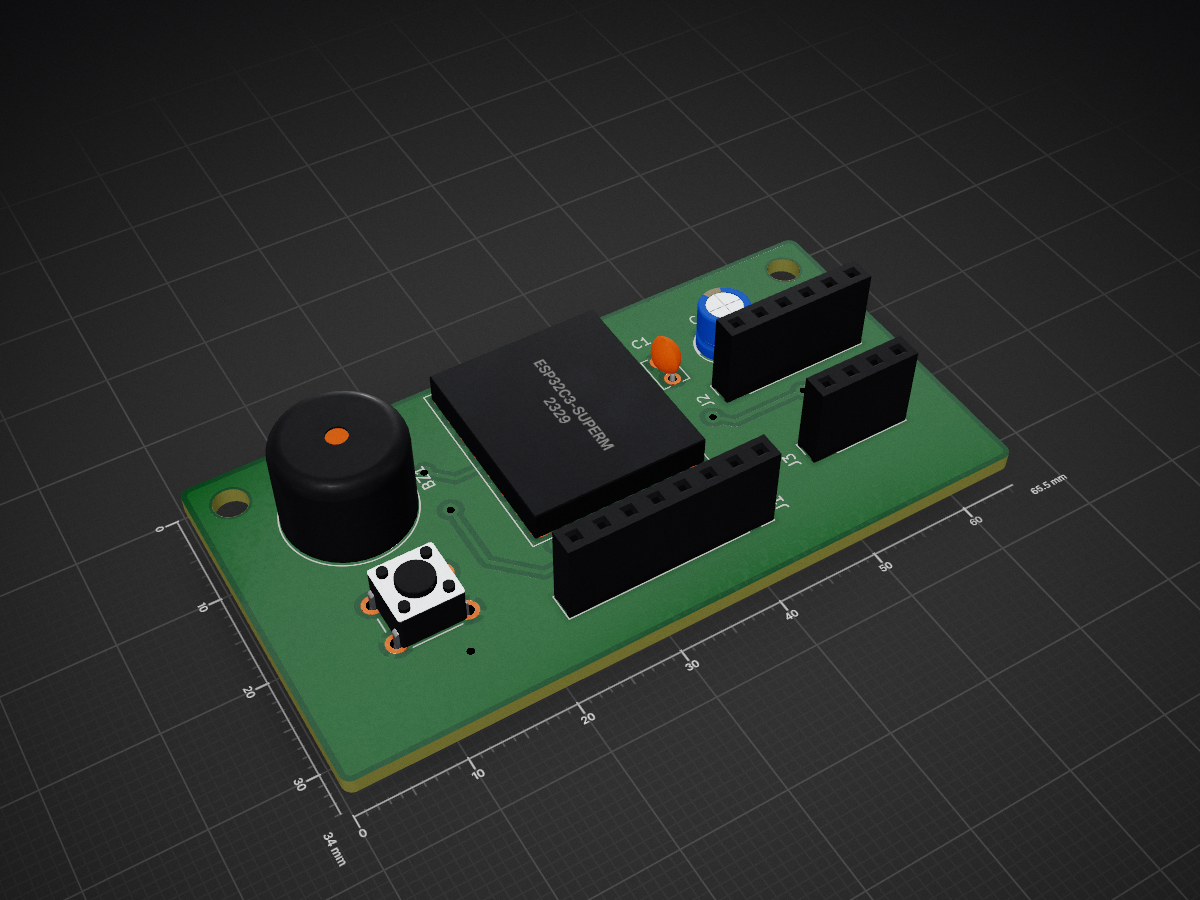
PCB ProStart POC is an open-source printed circuit board by lorenzogalli-dev, from the lorenzogalli-dev/Prostart repository on GitHub. It is a 2-layer board of 65.5 × 34 mm with 10 parts on 19 nets, routed with 90 tracks and 15 vias.
Its parts include 3 connectors, 2 capacitors, 1 IC and 1 switch. It belongs with the ESP32 and RISC-V boards of this library.
Reaction time and photo finish for every track, for the price of a pair of spikes.
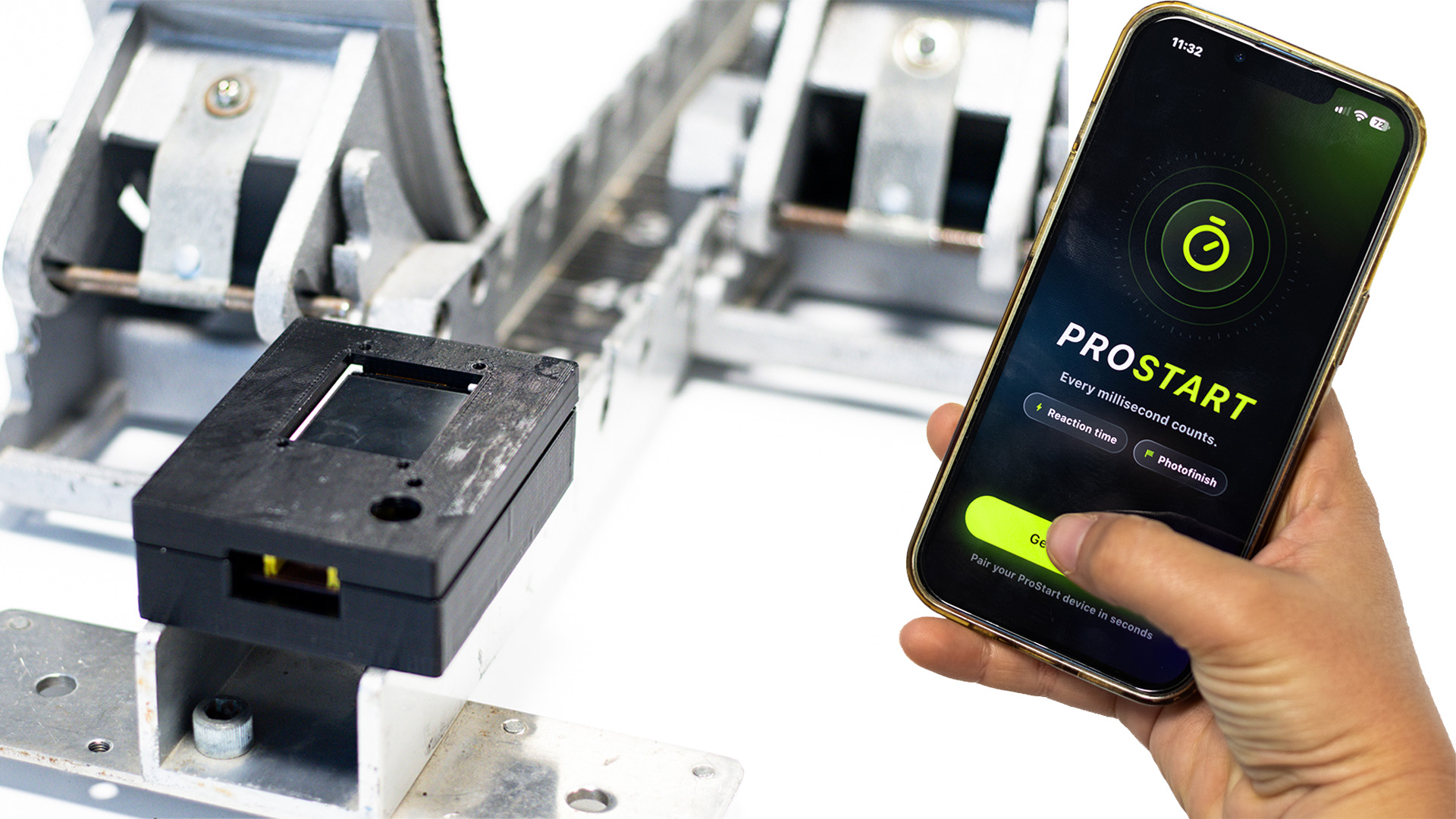
A start unit that mounts on any starting block, and a phone app that turns a smartphone into a photo finish. The unit sounds the start commands, detects the push-off with an accelerometer and judges the start on its own clock; the phone times the chest crossing the line from the same "go".
Course project, Technology and Health, KTH Royal Institute of Technology, HT26: Arianna Bartocci, Duarte Chambel, Lorenzo Galli, Loke Enlund Östangård, Ninad Purekar. Full write-up: Papers/Final Paper/CM2024_Sprint_Start_Final_Paper.pdf.
 start unit (on the block)                           phone (at the finish)
ESP32-C3 + BMI270, 803 Hz ──── BLE: events, clock sync, run data ──── Flutter app, camera 240 fps| Sampling | 803.2 Hz, no gaps, 0.9 µs timestamp jitter (2.8 µs with BLE connected) |
| Unit resolution | one sample, 1.2 ms; board and offline detector agree to the sample |
| Reaction time vs 240 fps video (LED at "go") | within ~8 ms, the resolution of the video reference |
| Finish time vs 60 fps reference | 10 ms (hand timing on the same runs: ~0.24 s fast) |
| Onset vs trigger threshold (10-50 mg, 79 starts) | same sample in 70 starts; a threshold-only detector drifts a median 9.3 ms |
Limits. Direct BLE reaches ~30 m; a full 100 m needs a finish relay (a second ESP32-C3 on long-range ESP-NOW, field-tested to 100-110 m). One athlete per run. The BMI270 filter delay and the sound's travel time (2.9 ms/m) are not yet measured.
Parts for one start unit, one-off retail prices (estimates):
| Part | SEK |
|---|---|
| ESP32-C3 SuperMini | 40 |
| BMI270 accelerometer breakout | 100 |
| 1.77" ST7735 TFT | 70 |
| Push button, 12 mm piezo, capacitors | 20 |
| Two-layer PCB (65.5 × 34 mm, batch of 5) | 30 |
| 3D-printed box, lid and button cap (PLA) | 15 |
| Strap to the block | 20 |
| Total | ≈ 295 |
For now the unit runs from a USB power bank; the next version will have a built-in LiPo cell and charger (~60 SEK more). The phone is the athlete's own. A single-block commercial reaction timer lists at about US$1,600 (~17,000 SEK); certified competition systems cost far more.
Customers: athletics clubs, school and university teams, coaches and individual sprinters who today time by hand.
| Product | Price | Notes |
|---|---|---|
| Start unit | 1,290 SEK | ~350 SEK cost at 1,000 units incl. assembly and test: ~70 % gross margin |
| App, Free | 0 | Reaction time, run history, manual photo finish (tap the crossing frame) |
| App, Pro | 49 SEK/month or 399 SEK/year | AI photo finish, analysis of recorded videos, data export |
| Club plan | 1,990 SEK/year | Pro for up to 30 athletes, squad dashboard |
Rough year-3 projection (Nordics first, then Europe; assumptions, not market research):
| Line | Volume | Revenue (SEK) |
|---|---|---|
| Start units | 3,000 | 3.9 M |
| Pro subscriptions | 1,500 | 0.6 M |
| Club plans | 150 | 0.3 M |
| Total | ≈ 4.8 M |
Gross profit ≈ 3.7 M SEK after 1.05 M of unit cost, against ~1.5 M SEK/year for a small team (firmware, app, support), after an initial ~1 M SEK to build the finish relay, certify (CE/RED) and tool a moulded enclosure.
Arduino/AlgorithmRealTimeESP32/  firmware (ESP32-C3 + BMI270, BLE); INFO.md: wiring, build, tests
Arduino/AlgorithmRealTime/       first prototype (XIAO nRF52840 Sense), same detector
Arduino/EspNowLrTest/            long-range ESP-NOW field test (finish relay)
Arduino/WifiFieldTest/           Wi-Fi range field test
prostart/                        Flutter app + native camera plugin (photo finish)
AI_Torso_Detector/               photo-finish reference in Python (MediaPipe)
Hardware/                        KiCad PCB, Gerbers, BOM; enclosure STL files
Data/                            block-start captures
Docs/                            algorithm, build and run notes, figures
Papers/ final paper (LaTeX, PDF, slides), half-time paperarduino-cli compile --fqbn esp32:esp32:nologo_esp32c3_super_mini Arduino/AlgorithmRealTimeESP32 (ESP32 core 3.3.x), then arduino-cli upload with the same FQBN and -p <port>.cd prostart && flutter pub get && flutter run (iOS tested on an iPhone 13).All rights reserved: see LICENSE. The code is visible for academic assessment only; no use, copy, modification or commercial use without the authors' written permission. Third-party code keeps its own license: Arduino/libraries/Seeed_Arduino_LSM6DS3 (MIT), Bosch's BMI270 configuration in Bmi270Config.h (BSD-3-Clause).
| Qty | Value | Footprint | References |
|---|---|---|---|
| 1 | 100 nF | Capacitor_THT:C_Disc_D3.8mm_W2.6mm_P2.50mm | C1 |
| 1 | 10uF | Capacitor_THT:CP_Radial_D5.0mm_P2.00mm | C2 |
| 1 | Button | Button_Switch_THT:SW_PUSH_6mm | SW1 |
| 1 | Buzzer | Buzzer_Beeper:Buzzer_12x9.5RM7.6 | BZ1 |
| 1 | ESP32C3-SUPERMINI | ESP32:DIP-ESP | U1 |
| 1 | IMU | Connector_PinSocket_2.54mm:PinSocket_1x06_P2.54mm_Vertical | J2 |
| 1 | IMU 2 | Connector_PinSocket_2.54mm:PinSocket_1x04_P2.54mm_Vertical | J3 |
| 1 | LCD Display | Connector_PinSocket_2.54mm:PinSocket_1x08_P2.54mm_Vertical | J1 |
The 8 most common of 10 parts.
It measures 65.5 × 34 mm and has 2 copper layers, 1.6 mm thick.
10 parts. The full list of its parts is on this page, with links to each part's symbol and footprint where PCBKit's library has them.
From the lorenzogalli-dev/Prostart repository on GitHub, at the commit this page was made from: the board is Hardware/PCB_ProStart_POC/PCB_ProStart_POC.kicad_pcb and its schematic Hardware/PCB_ProStart_POC/PCB_ProStart_POC.kicad_sch. PCBKit opens the board in the browser, with nothing to install.
Its repository states no licence, so its author keeps all rights: ask lorenzogalli-dev before reusing the design.
gusmanb/logicanalyzer
24 channel, 100Msps logic analyzer hardware and software

byrantech/laptop
anyon_e, a highly integrated, high end, open source laptop. Attempt the impossible.

joeycastillo/Sensor-Watch
A board replacement for the classic Casio F-91W wristwatch


OLIMEX/OLINUXINO
OLINUXINO is Open Source / Open Hardware, low cost from EUR 24 Linux Industrial grade Single Board Computer capable to operate -25+85C

rusefi/rusefi
rusefi - GPL internal combustion engine control unit

VoronDesign/Voron-Hardware
Cool Hardware designed by the Voron Design group

hoglet67/RGBtoHDMI
Bare-metal Raspberry Pi project that provides pixel-perfect sampling of Retro Computer RGB/YUV video and conversion to HDMI