
2 layers36.2 × 63.1 mm
PicoMemcard pico
dangiu/PicoMemcard
Emulating PSX Memory Card (or controller) using a Raspberry Pi Pico
8 parts694GPL-3.0
 loopj/wavephoenix430
Open-source implementation of the Nintendo WaveBird receiver using Silicon Labs Wireless Gecko SoCs
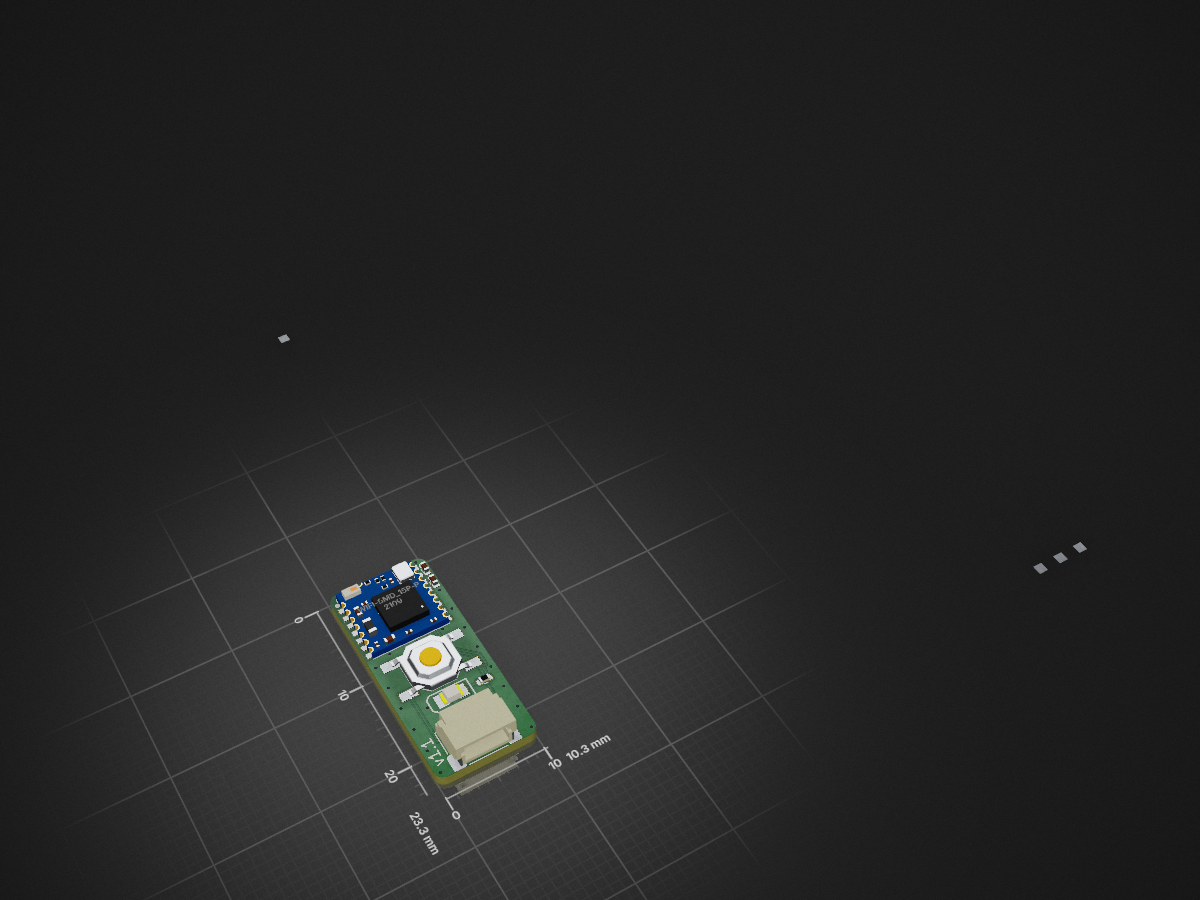
Mini receiver is an open-source printed circuit board by loopj, from the loopj/wavephoenix repository on GitHub. It is a 2-layer board of 10.3 × 23.3 mm with 11 parts on 16 nets, routed with 54 tracks and 32 vias.
It is built around the TS-1187A-B-A-B. Its parts include 2 capacitors, 1 resistor, 1 IC, 1 diode and 1 connector. It belongs with the retro computing and games boards of this library.
Open-source implementation of the Nintendo WaveBird receiver using Silicon Labs Wireless Gecko SoCs


The WaveBird controller is, in my opinion, one of the best controllers ever made. It is wireless, has an insane battery life, and is very comfortable to hold. The WaveBird set a new standard for wireless controllers. It was the first major console controller to use radio frequency (RF) technology, providing a reliable, lag-free connection that didn't require line-of-sight, unlike infrared controllers.
Unfortunately, Nintendo stopped producing the WaveBird more than a decade ago, causing a dwindling supply of controllers and, especially, receivers. Given the decreasing supply of receivers and the increasing resale prices, I decided to design my own from scratch.
The reference implementation of WavePhoenix includes the following features:
Don't want to build your own? A number of vendors are now selling pre-assembled WavePhoenix receivers!
The bare minimum hardware needed to build a WavePhoenix is a EFR32BG22 radio module (such as the RF-BM-BG22C3), a GameCube controller connector, and 3 wires!
Since most people prefer a more streamlined solution, I designed a custom PCB and 3D-printable case called the Mini Receiver.
You can find detailed build instructions in the hardware/mini-receiver directory.
The firmware for WavePhoenix is composed of the following components:
libwavebird - my implementation of Nintendo's WaveBird protocol for Silicon Labs Gecko SoCslibjoybus - my implementation of the Joybus protocol used by N64 and GameCube controllersfirmware/app - the main app firmware; a reference implementation of a WaveBird receiverfirmware/bootloader - bootloader to provide over-the-air firmware updates via BluetoothCheck out the worklog for a detailed history of the development of the WavePhoenix project.
WavePhoenix is a permissively licensed open source project.
The firmware is licensed under the MIT License.
The hardware is licensed under the Solderpad Hardware License v2.1.
| Qty | Value | Footprint | References |
|---|---|---|---|
| 1 | 0.1uF | Capacitor_SMD:C_0402_1005Metric | C1 |
| 1 | 0805G (Green) | project-footprints:LED0805-R-RD | D1 |
| 1 | 100R | Resistor_SMD:R_0402_1005Metric | R1 |
| 1 | 10uF | Capacitor_SMD:C_0402_1005Metric | C2 |
| 1 | C | TestPoint:TestPoint_Pad_D1.0mm | TP4 |
| 1 | Conn_01x04_MountingPin | Connector_JST:JST_SH_SM04B-SRSS-TB_1x04-1MP_P1.00mm_Horizontal | J1 |
| 1 | D | TestPoint:TestPoint_Pad_D1.0mm | TP3 |
| 1 | G | TestPoint:TestPoint_Pad_D1.0mm | TP1 |
| 1 | TS-1187A-B-A-B | project-footprints:SW-SMD_4P-L5.1-W5.1-P3.70-LS6.5-TL-2 | SW1 |
| 1 | V | TestPoint:TestPoint_Pad_D1.0mm | TP2 |
| 1 | WIFI-SMD_15P-P1.00-L8.0-W8.0-P1.00_RF-BM-BG22C3 | project-footprints:RF-BM-BG22C3 | U1 |
It measures 10.3 × 23.3 mm and has 2 copper layers, 1.2 mm thick.
11 parts, built around the TS-1187A-B-A-B. The full list of its parts is on this page, with links to each part's symbol and footprint where PCBKit's library has them.
From the loopj/wavephoenix repository on GitHub, at the commit this page was made from: the board is hardware/mini-receiver/KiCad/mini-receiver.kicad_pcb and its schematic hardware/mini-receiver/KiCad/mini-receiver.kicad_sch. PCBKit opens the board in the browser, with nothing to install.
Its repository states no licence, so its author keeps all rights: ask loopj before reusing the design.
dangiu/PicoMemcard
Emulating PSX Memory Card (or controller) using a Raspberry Pi Pico

jackw01/scanlight
A better light source for scanning color negative film

makeo/PicoLoader
A cheap and easy to install modchip for the Nintendo GameCube!


FujiNetWIFI/fujinet-hardware
Schematics and design files for FujiNet hardware

maxlab-io/tokay-lite-pcb
Tokay AI Camera - ESP32 camera development board
