2 layers105 × 98.1 mm

 llextv/leTube
LeTube is a DIY project to build a set of 10 LED tubes for stage lighting.
Tube is an open-source printed circuit board by llextv, from the llextv/leTube repository on GitHub. It is a 2-layer board of 83.1 × 34.9 mm with 34 parts on 41 nets, routed with 270 tracks and 14 vias.
It is built around the ESP32-C3-WROOM-02-H4, MAX3485ED and TPS54331DR-JSM, with the AP2112K-3.3, MF-MSMF200-2 and SMBJ33A among its other parts. Its parts include 10 capacitors, 7 resistors, 6 connectors, 4 ICs and 3 diodes. It belongs with the ESP32 and RISC-V boards of this library.


10 addressable LED tubes for stage lighting, controlled with Art-Net and QLC+.
LeTube is a DIY project to build a set of 10 LED tubes for stage lighting.
The goal is pretty simple: build something similar to commercial pixel tubes, but for much less money and using hardware that I can actually modify and repair myself.
The tubes use WS2815 12V LED strips and are controlled by a single ESP32 running WLED. QLC+ sends the lighting data through Art-Net over Wi-Fi.
Commercial pixel tubes can get expensive very quickly when you need 10 of them.
I wanted to build my own version instead of buying ready-made tubes.
Another choice I made was to not put an ESP32 inside every tube. All the tubes are controlled from one ESP32, which keeps the electronics inside the tubes very simple.
The current version is mainly a prototype / personal project. I'm not trying to make a commercial product with it.
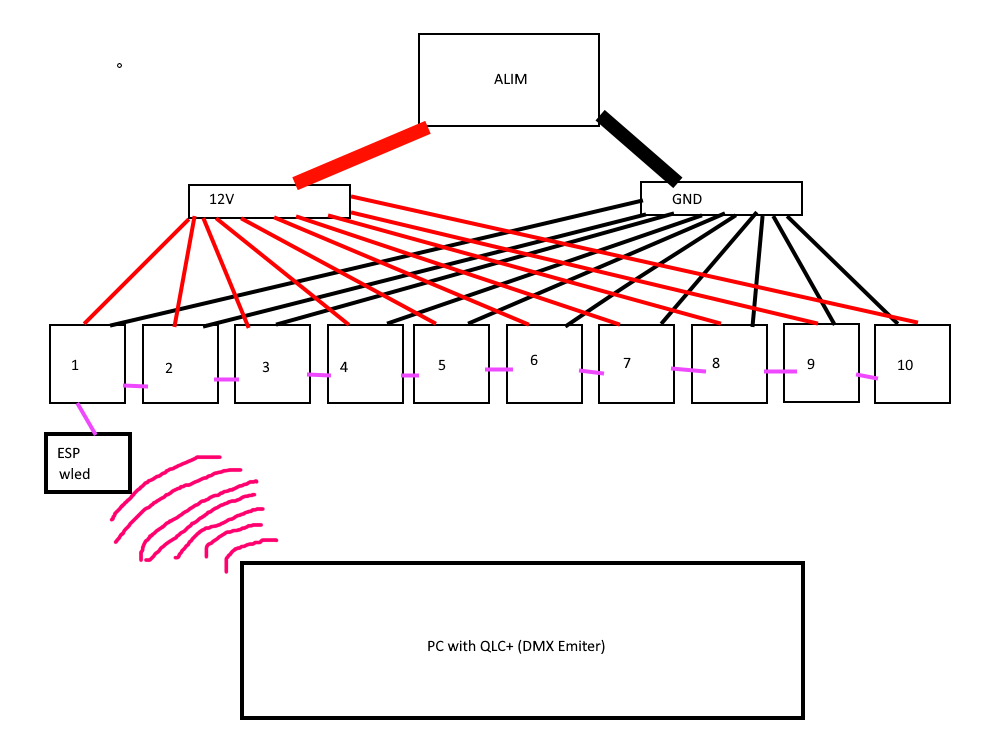
QLC+ generates the DMX values and sends them to the ESP32 using Art-Net.
The ESP32 receives the data and WLED handles the LED output.
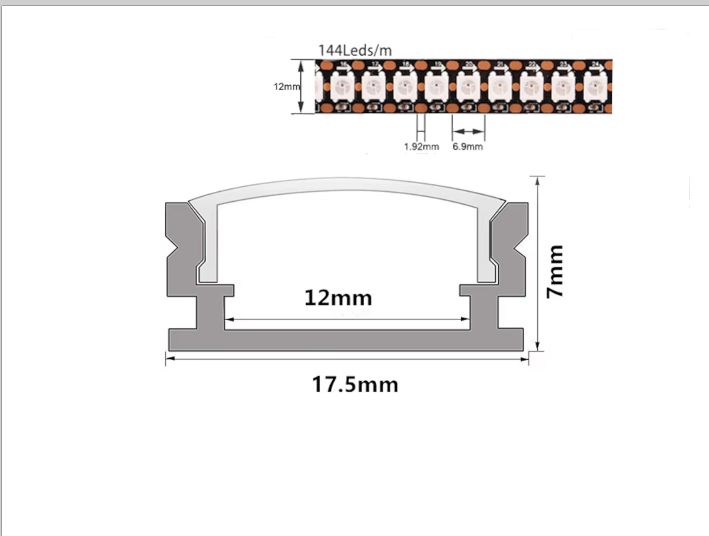
Each tube contains a 1 meter section of WS2815 strip, so every LED can be controlled individually.
Each tube is made from an aluminium LED profile with a diffuser.
The current design uses:
There is no microcontroller inside the tube.
The 10 tubes are connected back to the central controller and power distribution.
The whole LED system is powered from a 12V 600W power supply.
I use two busbars to distribute the power.
The ESP32 is powered separately.
The reason for using centralized power is mostly simplicity. I don't need a power supply or converter inside every tube.
The power supply can deliver a lot of current, so the final installation needs properly sized wiring and suitable protection/fusing.
The ESP32 runs WLED.
WLED is used to handle the addressable LEDs and the network communication.
Official documentation:
Main components:
The complete BOM is available here:
The KiCad files are available here:
| Category | Item | Quantity | Unit Price (€) | Total (€) | Notes |
|---|---|---|---|---|---|
| Power Supply | 12 V 600 W Switching Power Supply | 1 | 35.99 | 35.99 | Main power supply |
| Power Distribution | M6 Battery Bus Bar Power Distribution Block | 2 | 6.50 | 13.00 | 1 positive + 1 negative |
| LED Profile | Aluminium LED Profile, 0.5 m | 20 | 2.55 | 51.00 | 10 m total |
| LED Strip | WS2815 Addressable RGB LED Strip | 10 m | 6.656 | 66.56 | 12 V |
| Wiring | Electrical Wire | — | 0.00 | 0.00 | Already available |
| Controller | ESP-WROOM-32 | 1 | 0.00 | 0.00 | Already available |
| TOTAL | 176.55 € | ≈ 195 USD |
| Qty | Value | Footprint | References |
|---|---|---|---|
| 3 | 100 µF | Capacitor_SMD:CP_Elec_6.3x5.8 | C3, C6, C9 |
| 2 | 10 nF | PCM_JLCPCB:C_0603 | C4, C5 |
| 2 | 1uF | PCM_JLCPCB:C_0603 | C7, C8 |
| 2 | R5.1k | Capacitor_SMD:C_0201_0603Metric | R2, R4 |
| 1 | 100 nF | PCM_JLCPCB:C_0603 | C1 |
| 1 | 100nF | PCM_JLCPCB:C_0603 | C10 |
| 1 | 22 µH 4 A | Inductor_SMD:L_7.3x7.3_H4.5 | L1 |
| 1 | 220 µF | Capacitor_SMD:CP_Elec_6.3x7.7 | C2 |
| 1 | 24V IN | Connector_JST:JST_XH_B2B-XH-A_1x02_P2.50mm_Vertical | J3 |
| 1 | 24V OUT | Connector_JST:JST_XH_B2B-XH-A_1x02_P2.50mm_Vertical | J2 |
| 1 | AP2112K-3.3 | PCM_JLCPCB:SOT-23-5_L3.0-W1.7-P0.95-LS2.8-BL | U4 |
| 1 | Boot | PCM_JLCPCB:SW-SMD_4P-L5.1-W5.1-P3.70-LS6.5-TL-2 | SW3 |
| 1 | DMX IN | Connector_JST:JST_XH_B3B-XH-A_1x03_P2.50mm_Vertical | J7 |
| 1 | DMX OUT | Connector_JST:JST_XH_B3B-XH-A_1x03_P2.50mm_Vertical | J5 |
| 1 | ESP32-C3-WROOM-02 | RF_Module:ESP32-C3-WROOM-02 | U1 |
| 1 | LED | Connector_JST:JST_XH_B3B-XH-A_1x03_P2.50mm_Vertical | J1 |
| 1 | LED | PCM_JLCPCB:D_0603 | D3 |
| 1 | MAX3485 | PCM_JLCPCB:SOIC-8_3.9x4.9mm_P1.27mm | U2 |
| 1 | MF-MSMF200 | Fuse:Fuse_1812_4532Metric | F1 |
| 1 | R100k | Capacitor_SMD:C_0201_0603Metric | R1 |
| 1 | R105k | Capacitor_SMD:C_0201_0603Metric | R5 |
| 1 | R10k | Capacitor_SMD:C_0201_0603Metric | R7 |
| 1 | R20k | Capacitor_SMD:C_0201_0603Metric | R6 |
| 1 | R330 | Capacitor_SMD:C_0201_0603Metric | R3 |
| 1 | RESET | PCM_JLCPCB:SW-SMD_4P-L5.1-W5.1-P3.70-LS6.5-TL-2 | SW2 |
| 1 | SMBJ33A | PCM_JLCPCB:D_SMB | D2 |
| 1 | SS34 | PCM_JLCPCB:D_DO-214AC(SMA) | D1 |
| 1 | TPS54331DR | PCM_JLCPCB:SOIC-8_3.9x4.9mm_P1.27mm | U3 |
| 1 | USB_C_Receptacle_USB2.0_14P | PCM_JLCPCB:TYPE-C-SMD_HX-TYPE-C-16PIN | J6 |

gallicchio/AMOD-and-RFMOD
The tutorial's 2x12 adapter (/mudd/133electronics/icepi-zero-dac-adc/adapterboard/) with a 2 x 6 right-angle Pmod socket on a 15 mm extension of its right-hand end, so an Icepi Zero can drive AMOD-A's and RF-MOD's Pmod…

danielmcmillan/irrigation-system
Hardware and software for irrigation control and monitoring

Marimugeshbabu/STM32-Industrial-Data-Logger
4-layer STM32 Industrial Data Logger designed in KiCad 9 with RS485, microSD, voltage/current sensing and protection circuitry.

AskAlice/home-automation-pcbs
Daily Kimi-generated home automation PCB designs with KiCad sources, 3D models, and rendered documentation

willem-pennings/balancing-cube
A cube that balances itself in a corner or edge using reaction wheels

rein-baremetal/REIN_R1_KiCad
Dual-MCU baremetal embedded development board featuring high-speed QSPI storage, hardware USB hub, and flexible power management. Open for PCB trace routing collaboration

It measures 83.1 × 34.9 mm and has 2 copper layers, 1.6 mm thick.
34 parts, built around the ESP32-C3-WROOM-02-H4, MAX3485ED, TPS54331DR-JSM and AP2112K-3.3. The full list of its parts is on this page, with links to each part's symbol and footprint where PCBKit's library has them.
From the llextv/leTube repository on GitHub, at the commit this page was made from: the board is assets/tube.kicad_pcb and its schematic assets/tube.kicad_sch. PCBKit opens the board in the browser, with nothing to install.
Its repository states no licence, so its author keeps all rights: ask llextv before reusing the design.