2 layers64.2 × 28.5 mm

 LinuxJedi/RAMesses11
RAMesses Amiga 2MB Chip RAM board
Agnus is an open-source printed circuit board by LinuxJedi, from the LinuxJedi/RAMesses repository on GitHub, published under the GPL-2.0 licence. It is a 4-layer board of 81.8 × 46.1 mm with 22 parts on 97 nets, routed with 603 tracks and 75 vias.
It is built around the 74LVC2G157DCU and 74AHC1G08GW. Its parts include 10 capacitors, 7 ICs, 2 resistors and 2 connectors. It belongs with the retro computing and games boards of this library.


RAMesses is a plug and play Amiga 500/2000/CDTV board which will convert a 2MB 8375 Agnus to work in a 512KB/1MB motherboard and add 2MB of RAM. RAMesses has two switchable modes, the first gives the full 2MB to Chip RAM, the second gives 1MB of Chip RAM and 512KB of Pseudo-Fast RAM. This is for compatibility with older games.
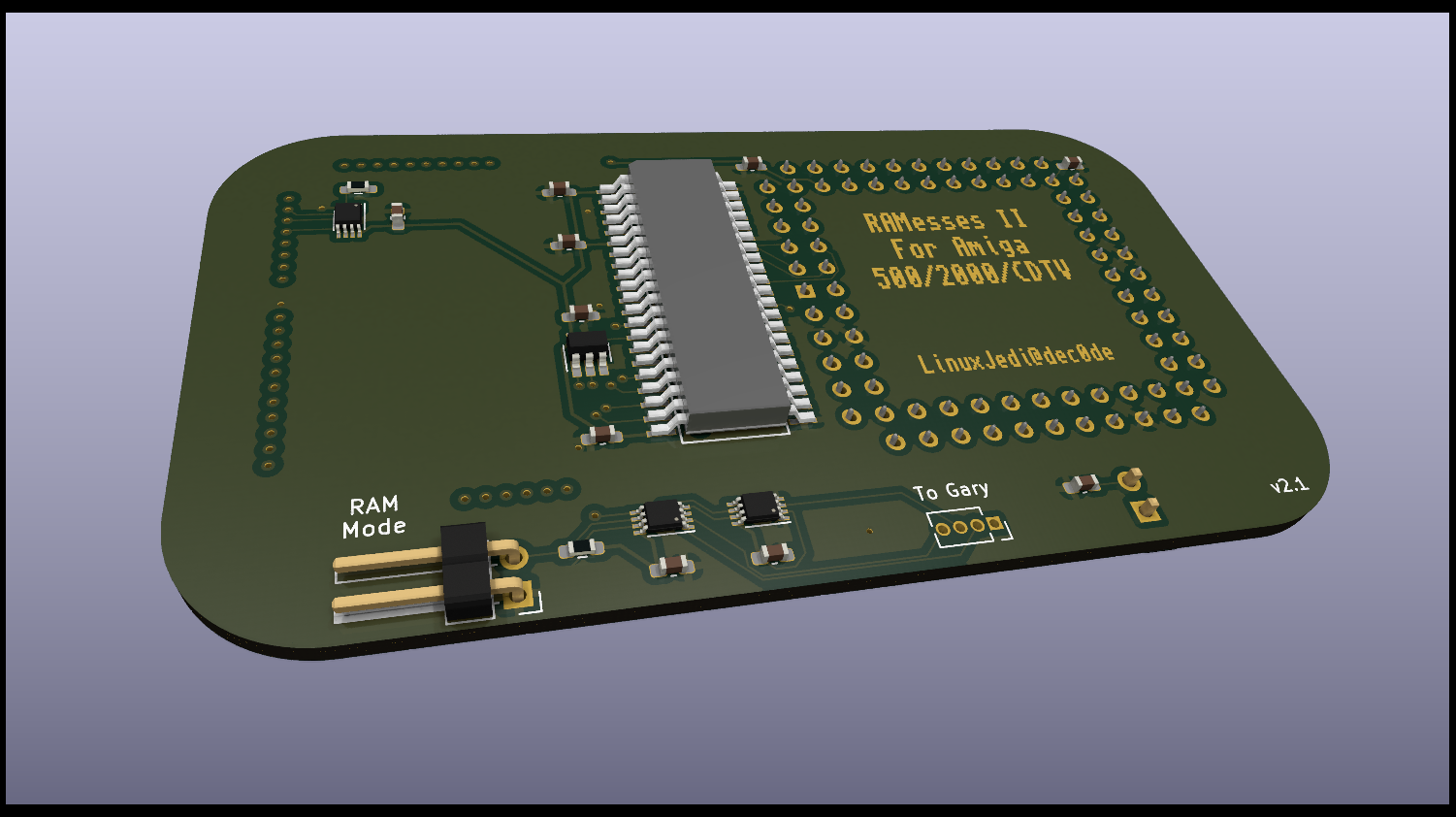
The project is in two parts, one is a board that sits in the Agnus socket and the other is a board that sits in the Gary socket, the two boards need to be linked together with a four wire cable, preferably around 20cm in length.
| Designator | Component |
|---|---|
| C1 - C9 | 100nF 0603 capacitor |
| C10 | 22pF 0603 capacitor |
| R1 | 150R 0603 resistor |
| R2 | 4.7K 0603 resistor |
| U4, U5, U7 | 74LVC2G157 VSSOP |
| U1 | Winslow W9328 PLCC Plug |
| U2 | PLCC-84 socket |
| U3 | 74AHC1G08 SOT-23 |
| U6 | GM71C18163C SOJ-42 |
| JP1, J6 | 01x02 2.54mm horizontal pin header |
Notes:
This simply requires a 48pin DIP socket and 2 strips of 24pin machined pins.
Hand soldering the PLCC plug is highly recommended, this seems to create a stronger bond and this will be the most physically stressed part.
The two boards should be linked using four wires of roughly 26-32AWG. The order of the four wires is the opposite on each board (1 - 4 on one board, 4 - 1 on the other).
You need an 2MB 8375 Agnus in the PLCC socket. Known models to work are:
Please note that there are 1MB versions of the 8375 that are not compatible. The 2MB A3000 Agnus chips are not compatible.
Put a jumper on the bottom VBB jumper pins if the Agnus chip is marked as VBB.
The jumper on the top RAM Mode will give 2MB of chip RAM, the jumper removed will provide 1MB of chip RAM and 0.5MB of Pseudo-Fast RAM.
If you like this design and use it, please consider donating so I can design more Amiga things:
| Qty | Value | Footprint | References |
|---|---|---|---|
| 9 | 0.1uF | Capacitor_SMD:C_0603_1608Metric_Pad1.08x0.95mm_HandSolder | C1, C2, C3, C4, C5, C6, C7, C8, C9 |
| 3 | 74LVC2G157 | Package_SO:VSSOP-8_2.3x2mm_P0.5mm | U4, U5, U7 |
| 1 | 150 | Resistor_SMD:R_0603_1608Metric_Pad0.98x0.95mm_HandSolder | R1 |
| 1 | 22pF | Capacitor_SMD:C_0603_1608Metric_Pad1.08x0.95mm_HandSolder | C10 |
| 1 | 4.7K | Resistor_SMD:R_0603_1608Metric_Pad0.98x0.95mm_HandSolder | R2 |
| 1 | 74AHC1G08 | Package_TO_SOT_SMD:SOT-23-5_HandSoldering | U3 |
| 1 | ADDR | Connector_PinSocket_1.27mm:PinSocket_1x04_P1.27mm_Vertical | J1 |
| 1 | Agnus8372 | A500:PLCC Plug | U1 |
| 1 | Agnus8375 | Package_LCC:PLCC-84_THT-Socket | U2 |
| 1 | Conn_01x02 | Connector_PinHeader_2.54mm:PinHeader_1x02_P2.54mm_Horizontal | J6 |
| 1 | GM71C18163C | A500:SOJ-42 | U6 |
| 1 | VBB | Connector_PinHeader_2.54mm:PinHeader_1x02_P2.54mm_Horizontal | JP1 |
It measures 81.8 × 46.1 mm and has 4 copper layers, 1.62 mm thick.
22 parts, built around the 74LVC2G157DCU and 74AHC1G08GW. The full list of its parts is on this page, with links to each part's symbol and footprint where PCBKit's library has them.
From the LinuxJedi/RAMesses repository on GitHub, at the commit this page was made from: the board is Agnus/Agnus.kicad_pcb and its schematic Agnus/Agnus.kicad_sch. PCBKit opens the board in the browser, with nothing to install.
Its repository publishes it under the GPL-2.0 licence: you may reuse it on that licence's terms (keep the author's notice, and for a copyleft licence share your changes alike).


stonedDiscord/Automatenplatinen
Reverse engineerte Hardware aus deutschen Spielautomaten.

tdunning/xmit
A simple low-power digital transmitter for amateur bands using new components


LIV2/A500-2Meg-Chip-ram
An Adapter to retrofit a 2MB agnus into a 1MB Amiga 500/2000

elixpo/elixpo_chapter
Elixpo’s canonical collection for public build-and-release Chapters, bringing open-source software, reproducible research, hardware, and community contributions into one attributable record.