
2 layers50.5 × 128.5 mm

 lbehrler/LED-Matrix-HUB-75-Breakout-Board4
KiCAD files for LED Matrix HUB75 Breakout Board for ESP32
ESP32 to HUB75 Shield Pass through Xover TILT variant is an open-source printed circuit board by lbehrler, from the lbehrler/LED-Matrix-HUB-75-Breakout-Board repository on GitHub. It is a 2-layer board of 50.8 × 50.8 mm with 7 parts on 58 nets, routed with 75 tracks and 47 vias.
It is built around the LP2985-33DBV. Its parts include 5 connectors, 1 IC and 1 fuse. It belongs with the lEDs and displays and interfaces and adapters boards and the ESP32 boards of this library.
KiCAD files for LED Matrix HUB75 Breakout Board for ESP32
This is a work in progress for a simple ESP32 to HUB75 breakout board.
Please use at your own risk


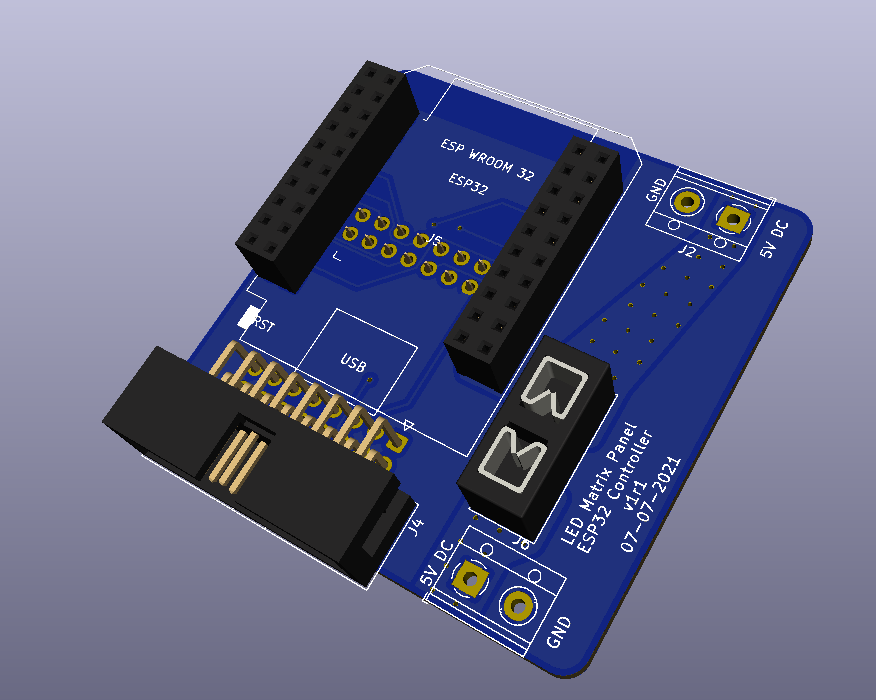
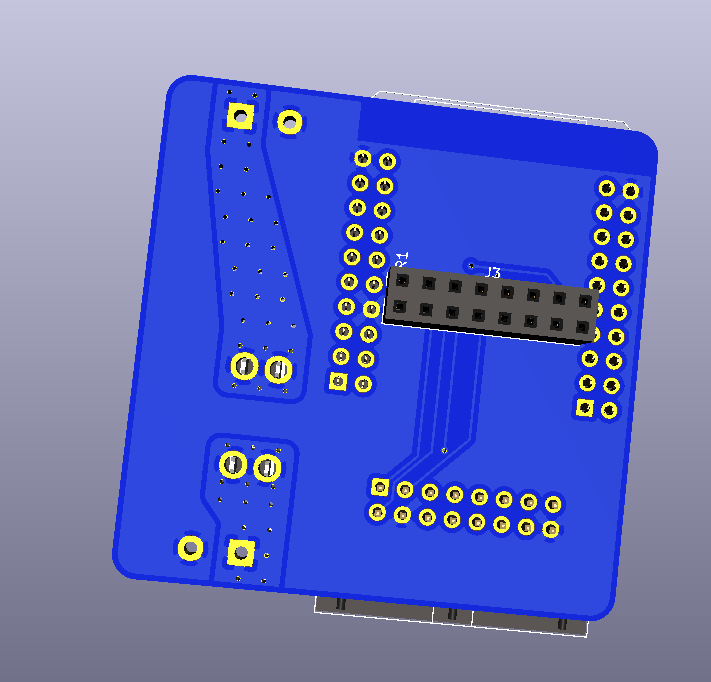
| Qty | Value | Footprint | References |
|---|---|---|---|
| 1 | Fuse | Fuse:Fuseholder_Blade_Mini_Keystone_3568 | F1 |
| 1 | LED Matrix Pinheader | Connector_PinSocket_2.54mm:PinSocket_2x08_P2.54mm_Vertical | J3 |
| 1 | LED X-over Data Out Socket | Connector_IDC:IDC-Header_2x08_P2.54mm_Horizontal | J4 |
| 1 | LP2985-3.3 | Package_TO_SOT_SMD:SOT-23-5 | U2 |
| 1 | Pin-Socket-02x10x02_ESP32-Mini-ESP32_mini | ESP32_mini:ESP32_mini-MHET-Live | J5 |
| 1 | Pwr In | TerminalBlock_RND:TerminalBlock_RND_205-00012_1x02_P5.00mm_Horizontal | J2 |
| 1 | Pwr Out to LED Matrix | TerminalBlock_RND:TerminalBlock_RND_205-00012_1x02_P5.00mm_Horizontal | J6 |


anjennings/Tom80
2B is the "definitive" version so all code going forward is designed for that version of the board. Minor hardware differences mean that code for 2.0 may not work on 2.0B without tweaks (mostly related to ram banking)

anthony-bernaert/ftdi-jtag-programmer
FTDI-based JTAG Programmer Circuit for FPGAs

emeb/up5k_osc
The brute-force approach is to synthesize these analog waveforms at sufficiently high sample rates that the timing jitter becomes imperceptible.


emeb/RP2040_Audio
A Eurorack module for stereo audio effects based on the Raspberry Pi RP2040 MCU

hkzlab/DWAVE_MIDI_Wavetable
DWAVE is a small General MIDI module for the wavetable connector of your old sound card, based on the SAM2695 chip
It measures 50.8 × 50.8 mm and has 2 copper layers, 1.6 mm thick.
7 parts, built around the LP2985-33DBV. The full list of its parts is on this page, with links to each part's symbol and footprint where PCBKit's library has them.
From the lbehrler/LED-Matrix-HUB-75-Breakout-Board repository on GitHub, at the commit this page was made from: the board is ESP32 to HUB75 Shield Pass through Xover TILT variant.kicad_pcb. PCBKit opens the board in the browser, with nothing to install.
Its repository states no licence, so its author keeps all rights: ask lbehrler before reusing the design.