4 layers140 × 100 mm
Dc usv
TobleMiner/DC-UPS
A small DC UPS, designed to keep small appliances like consumer network equipment running during power outages
351 parts223CERN-OHL-P-2.0

 kyle-tennison/night-vision
Vision Alarm Clock
Gpt alarm is an open-source printed circuit board by kyle-tennison, from the kyle-tennison/night-vision repository on GitHub. It is a 2-layer board of 100 × 79 mm with 18 parts on 16 nets, routed with 59 tracks and 5 vias.
It is built around the 1N4148WS and AO3400A. Its parts include 8 connectors, 3 resistors, 3 diodes, 2 transistors and 1 switch.


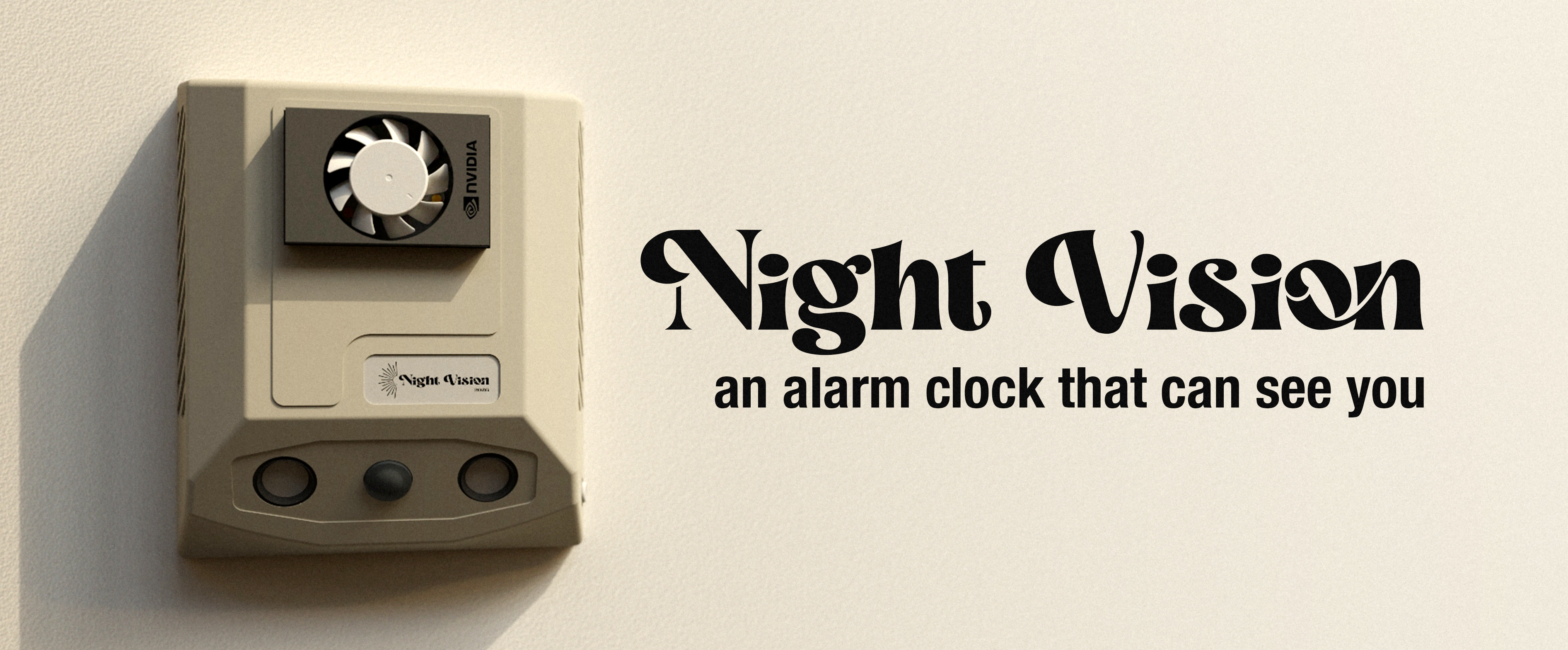
Getting up in the morning sounds simple, but for many people, the hardest part is staying out of bed after the alarm goes off. Traditional alarms only solve half the problem: they can wake you up, but they can’t stop you from crawling back under the covers five minutes later.
Night Vision takes a different approach; it's an AI-powered alarm clock that uses an infrared camera and a fully local AI model to determine whether you’re still in bed. The alarm goes off at your set time, and only turns off when it sees you get out of bed. If the system detects that you’ve gone back to bed, the alarm starts again automatically. Once you’re actually up, it stays silent.
Having a camera pointed at your bed is unnerving to most people. However, it's really no different than having your phone camera near your bed. Nothing is being sent over the web: the photos are streamed directly to an on-prem vision-language model, and are never even written to disk.
This project is implemented in Rust on a Jetson Orin Nano dev board. This is more of an embedded project than an AI project. Fast iteration is desired, so the following system was chosen in an attempt to maximize efficiency.
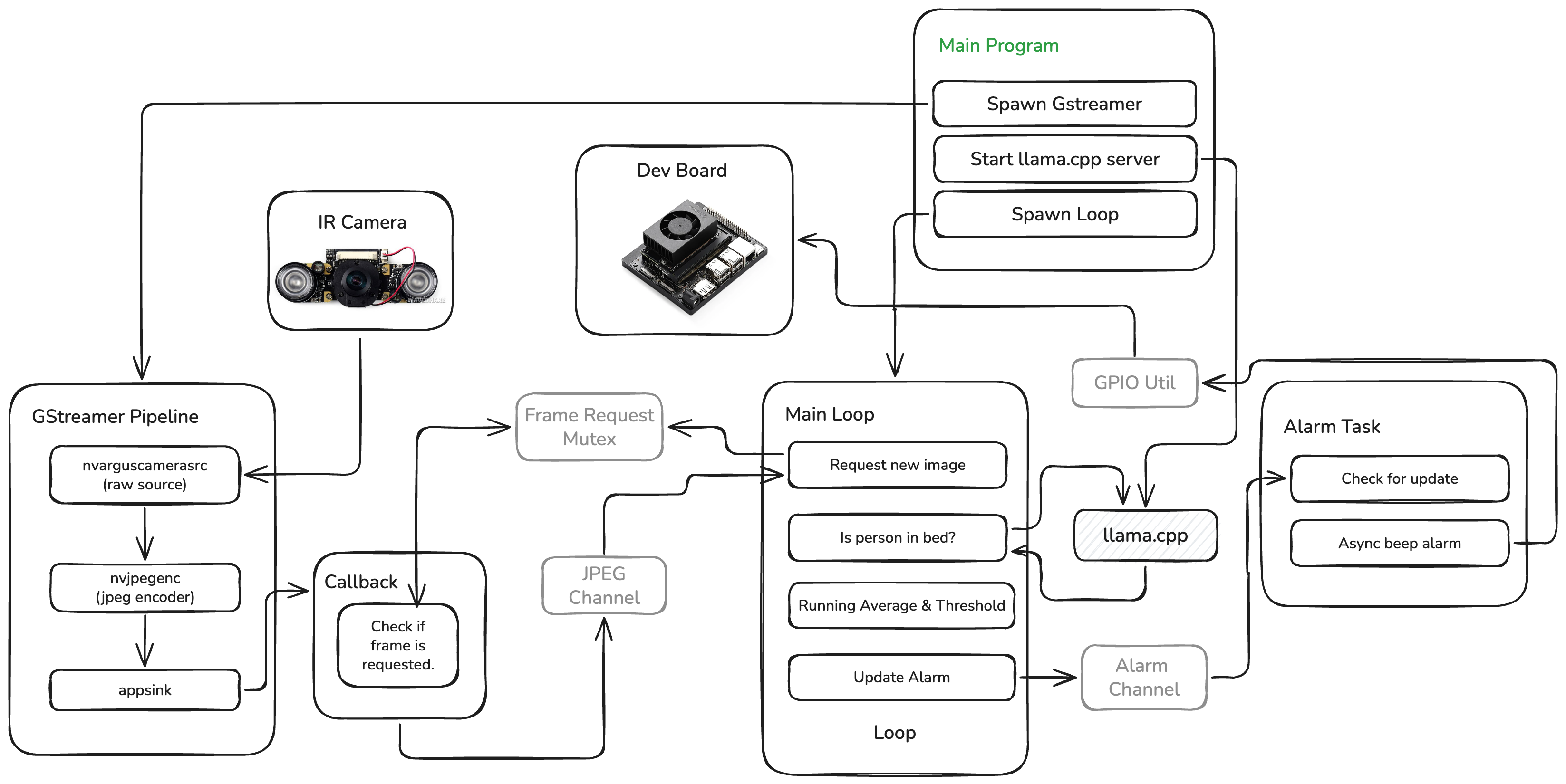
The gstreamer-rs crate was used to implement GStreamer directly in Rust. This allows frames to be read directly from a callback function. This bypasses any network or file I/O, and doesn't need to make any kernel calls whatsoever because everything happens in shared memory1.
There is a bit of time lost between requesting a frame in the "Frame Request Mutex" and the time the callback is triggered. However, the current implementation prefers a more recent frame over the fastest frame. There is no point in running the loop on an old frame.
llama.cpp is used for all AI-related processing. It was recompiled to take full advantage of the NVIDIA hardware. The model of choice is a tiny 450M vision-language model from LiquidAI: LiquidAI/LFM2.5-VL-450M-GGUF. With the NVIDIA chip, the entire loop, from image to prediction, takes 0.3s.
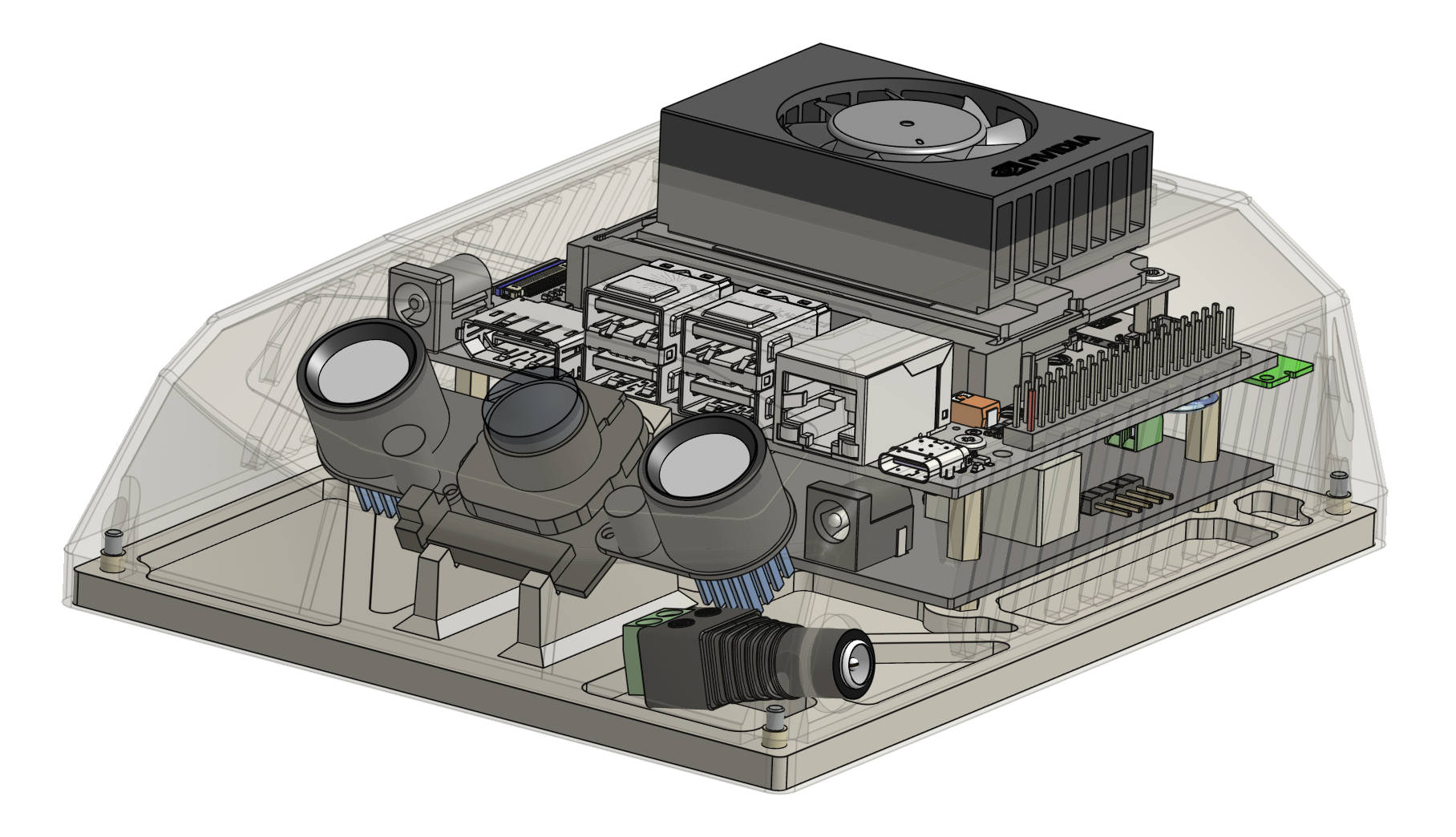
A public Onshape CAD model is provided here. I was going for an 80s beige vibe, which a lot of people hate, but I personally love.

A very simple PCB sits under the Jetson Orin Nano dev board. KiCad files for this are in board/. There is a spot for a relay here that is unused, but might be useful in a future version. The main purpose of this board is to operate the buzzer and an indicator LED.
For a very long time, I've wanted an alarm clock that could detect when I was in bed. When I was 15, I tried a very similar approach using a very sketchy force transducer made from my parents' bathroom scale. This is what it looked like:
This worked for a couple of days, but I had to plug my laptop into it every night, so it didn't last long. I remember at the time contemplating running a CNN on a Raspberry Pi that could monitor a video feed of my bed. I actually found the blog post where I was thinking about this:
"I also considered the option of training an AI to use a picture to determine if I was in bed or not. I also ended up deciding against this because of the sheer complexity."
From a blog post in 2020.
And it's good that I dropped that idea, because a conventional CNN would be extremely sensitive to any change in the environment. That is if I could even get it trained in the first place. It would require a lot of training data, and the moment my room changed (new picture, different bedding, etc.), the model could easily start spitting out garbage.
Don't quote me on the kernel part—I might be mistaken. ↩
| Qty | Value | Footprint | References |
|---|---|---|---|
| 2 | 10k | Resistor_SMD:R_1206_3216Metric | R1, R3 |
| 2 | 1N4148WS | Diode_SMD:D_SOD-323 | D3, D4 |
| 2 | AO3400A | Package_TO_SOT_SMD:SOT-23 | Q1, Q2 |
| 1 | 100 | Resistor_SMD:R_1206_3216Metric | R2 |
| 1 | 19V IN | Connector_BarrelJack:BarrelJack_Horizontal | J3 |
| 1 | 19V OUT | TerminalBlock:TerminalBlock_Xinya_XY308-2.54-2P_1x02_P2.54mm_Horizontal | J4 |
| 1 | BUCK IN + | Connector_PinHeader_2.54mm:PinHeader_1x02_P2.54mm_Vertical | J6 |
| 1 | BUCK IN - | Connector_PinHeader_2.54mm:PinHeader_1x02_P2.54mm_Vertical | J5 |
| 1 | BUCK OUT + | Connector_PinHeader_2.54mm:PinHeader_1x02_P2.54mm_Vertical | J8 |
| 1 | BUCK OUT - | Connector_PinHeader_2.54mm:PinHeader_1x02_P2.54mm_Vertical | J7 |
| 1 | Buzzer | Buzzer_Beeper:MagneticBuzzer_StarMicronics_TMB | BZ1 |
| 1 | Conn_01x05_Pin | Connector_PinHeader_2.54mm:PinHeader_1x05_P2.54mm_Horizontal | J1 |
| 1 | HK19F-DCxxV-SHC | Relay_THT:Relay_DPDT_Finder_30.22 | K1 |
| 1 | LED | Diode_SMD:D_1206_3216Metric | D1 |
| 1 | Siren_Out | TerminalBlock:TerminalBlock_Xinya_XY308-2.54-2P_1x02_P2.54mm_Horizontal | J2 |
TobleMiner/DC-UPS
A small DC UPS, designed to keep small appliances like consumer network equipment running during power outages

Twisted-Fields/acorn-robot-electronics
PCB hardware designs in KICAD for Acorn, the precision farming rover from Twisted Fields.

Arkos-Engineering/HT-15_hardware
We can split this out into separate repos later, right now its very convenient to have everything here.


OpenLogicEFI/Hardware
Hardware is based off an open source project called Speeduino by Josh Stewart.


It measures 100 × 79 mm and has 2 copper layers, 1.6 mm thick.
18 parts, built around the 1N4148WS and AO3400A. The full list of its parts is on this page, with links to each part's symbol and footprint where PCBKit's library has them.
From the kyle-tennison/night-vision repository on GitHub, at the commit this page was made from: the board is board/gpt-alarm.kicad_pcb and its schematic board/gpt-alarm.kicad_sch. PCBKit opens the board in the browser, with nothing to install.
Its repository states no licence, so its author keeps all rights: ask kyle-tennison before reusing the design.