
2 layers59.2 × 93.2 mm
Aws iot expresslink demo badge
aws/iot-expresslink
This device was designed and created for the AWS IoT ExpressLink Demo Badge Workshop, which was run at re:Invent 2022.
74 parts29MIT-0

 kwame-y/PCBCard
Custom PCB Business card as my first electrical engineering related project (for Hack Club Forge)
PCBCard is an open-source printed circuit board by kwame-y, from the kwame-y/PCBCard repository on GitHub, published under the MIT licence. It is a 2-layer board of 89 × 51 mm with 14 parts on 20 nets, routed with 147 tracks and 23 vias.
It is built around the ATTINY85-20SU, MAX30102 and NT3H2211W0FHKH. Its parts include 4 resistors, 3 ICs, 2 capacitors and 2 diodes. It belongs with the AVR (ATmega, ATtiny) boards of this library.


A custom-designed PCB Business card inspired by isayx & ghastly. The main goal was to include an NFC chip/antenna to send a portfolio and a heart-rate sensor linked to LEDs as a fun way to create interactions.
I mainly worked on this because I wanted to challenge to construct my fully polished PCB device, and to get my foot in the door in learning electronics, KiCAD, and some SVG editors.
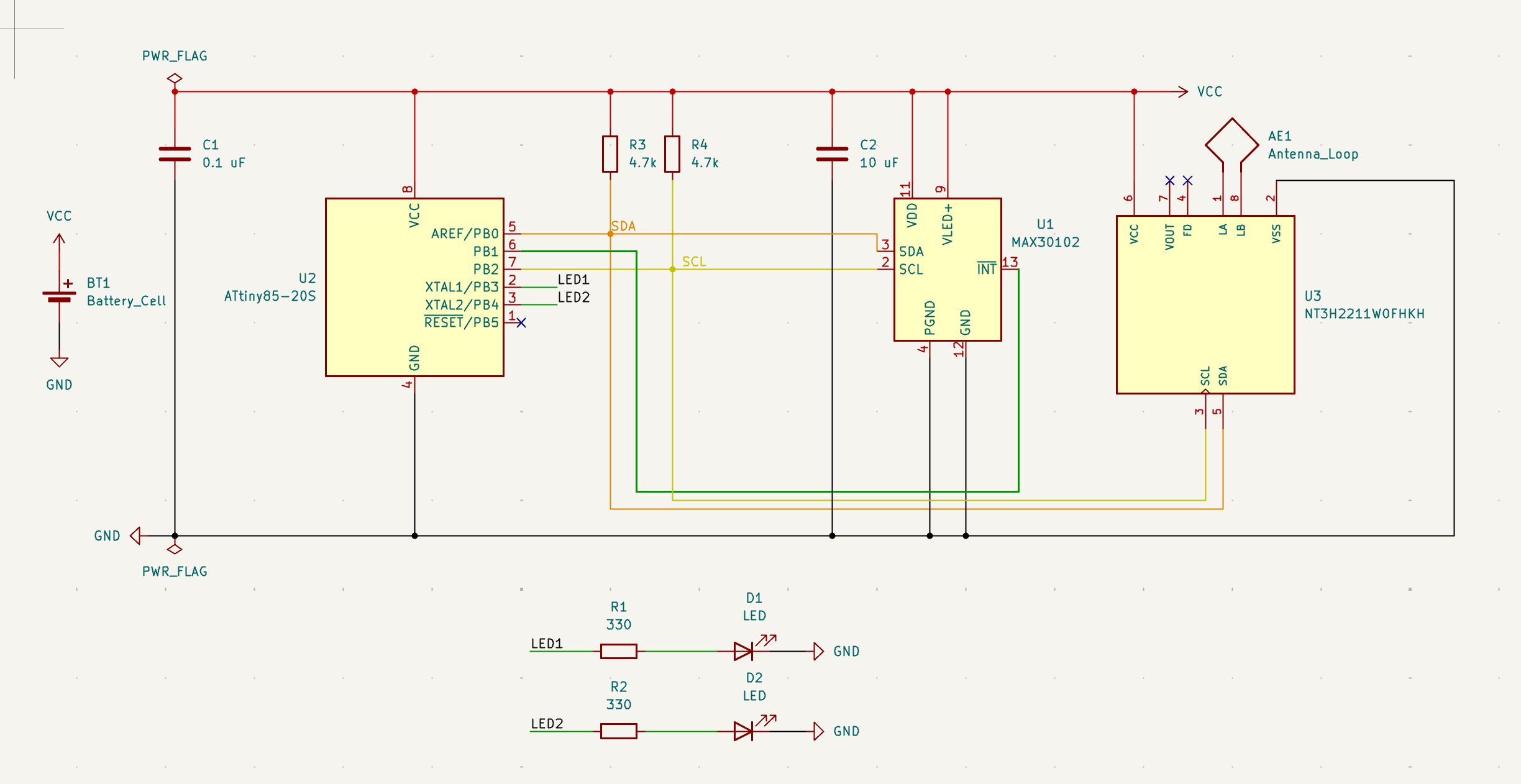


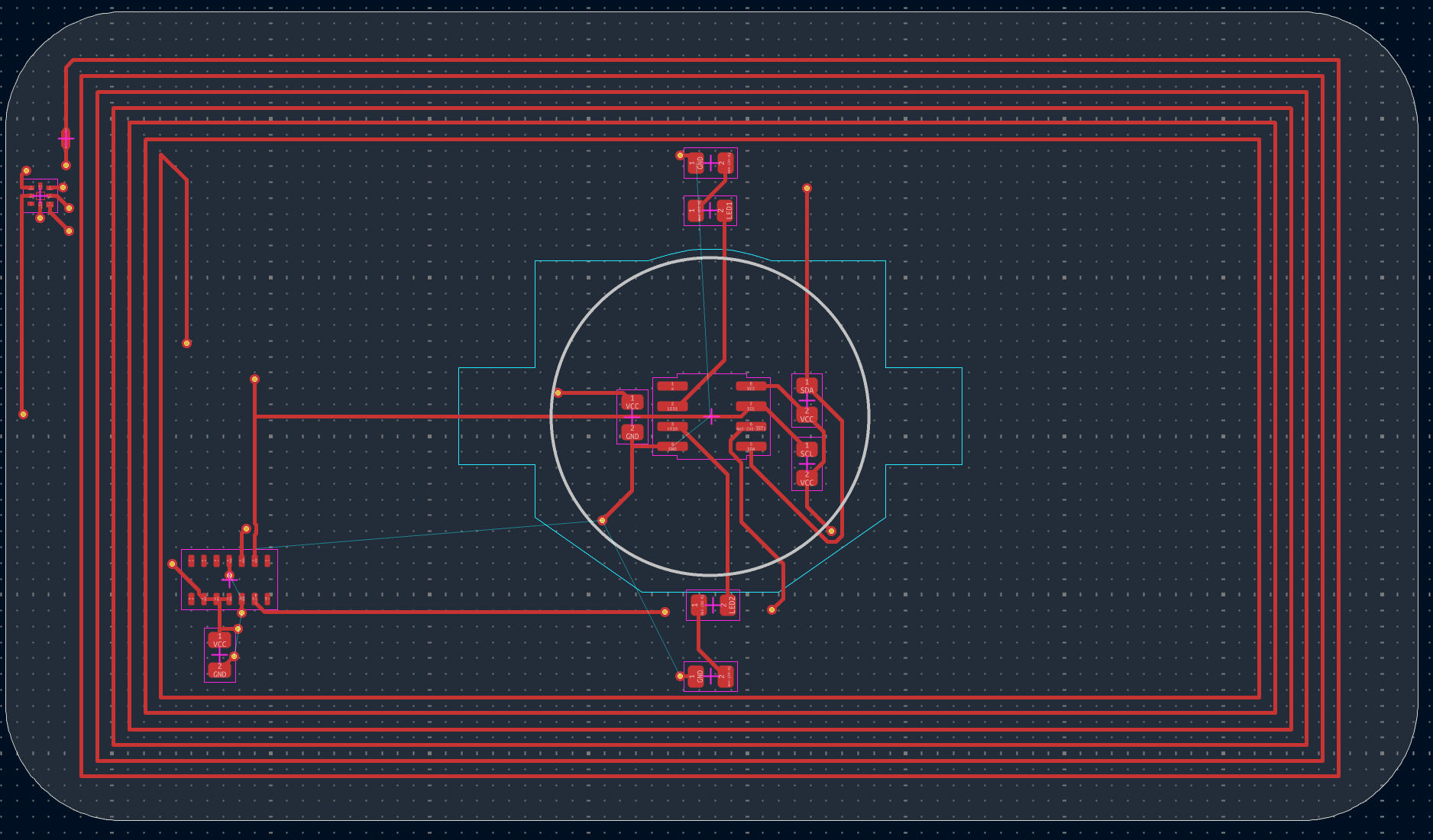
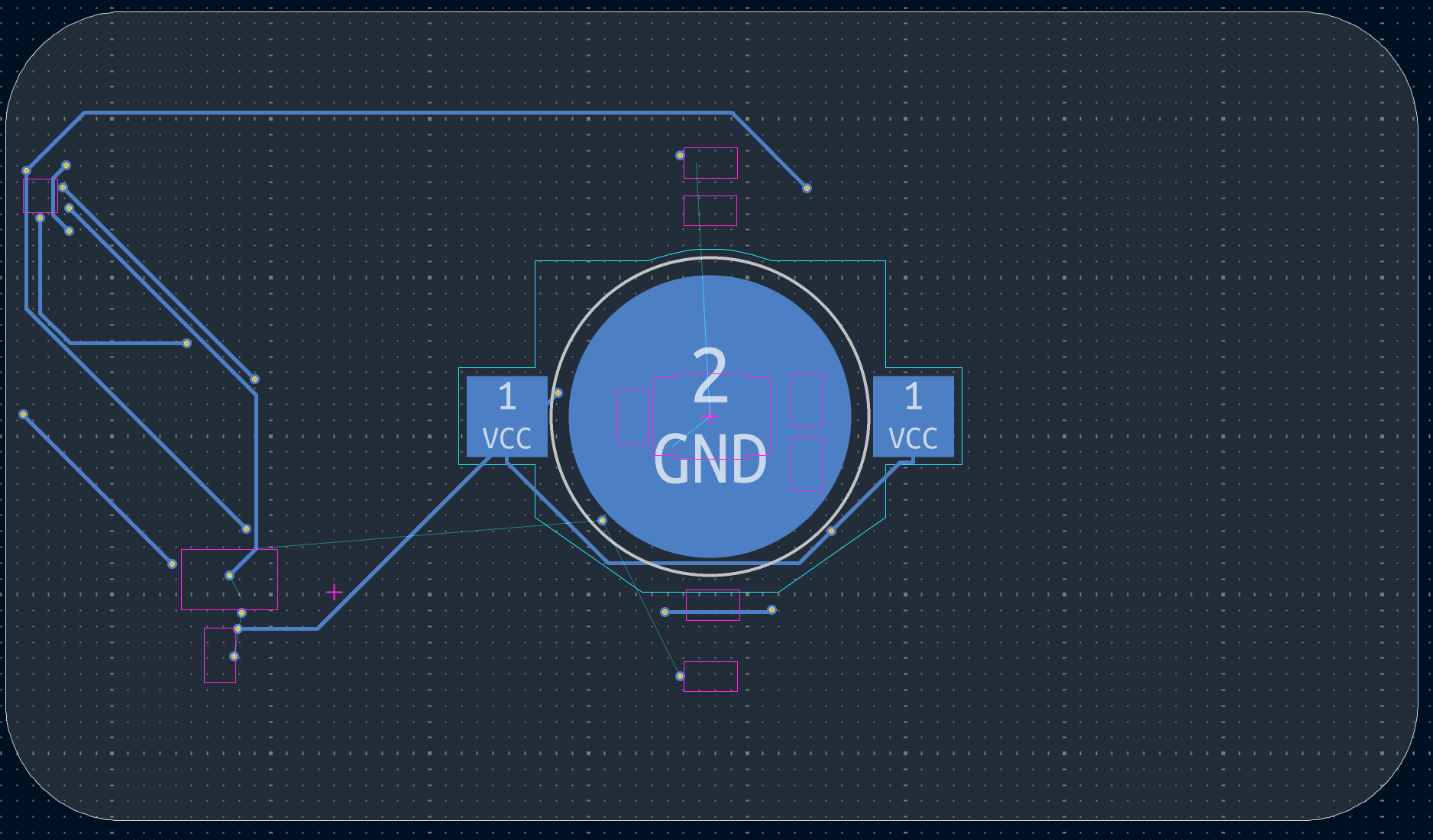
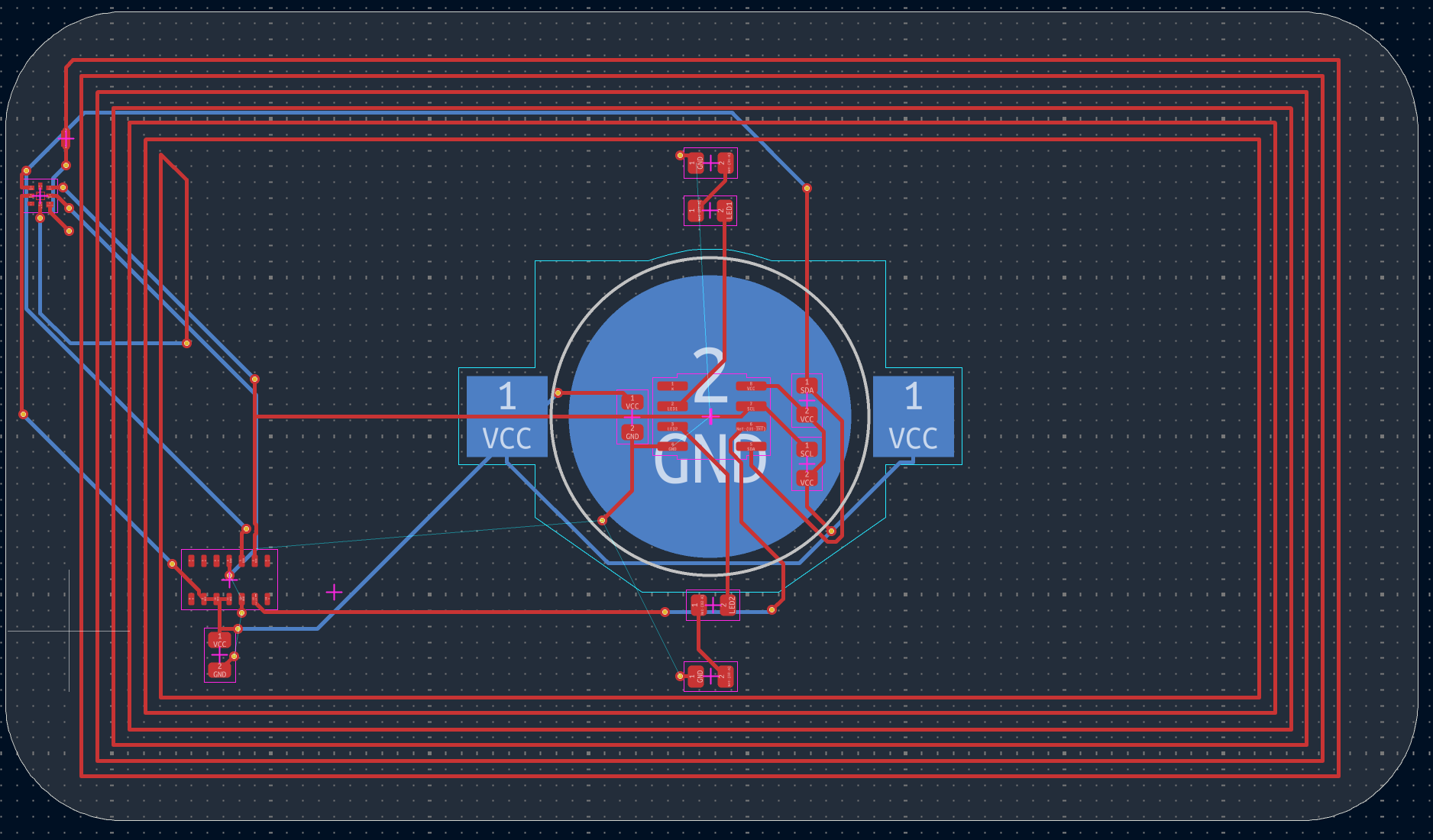
Note: Ground Pour on Back Layer is not shown in these images
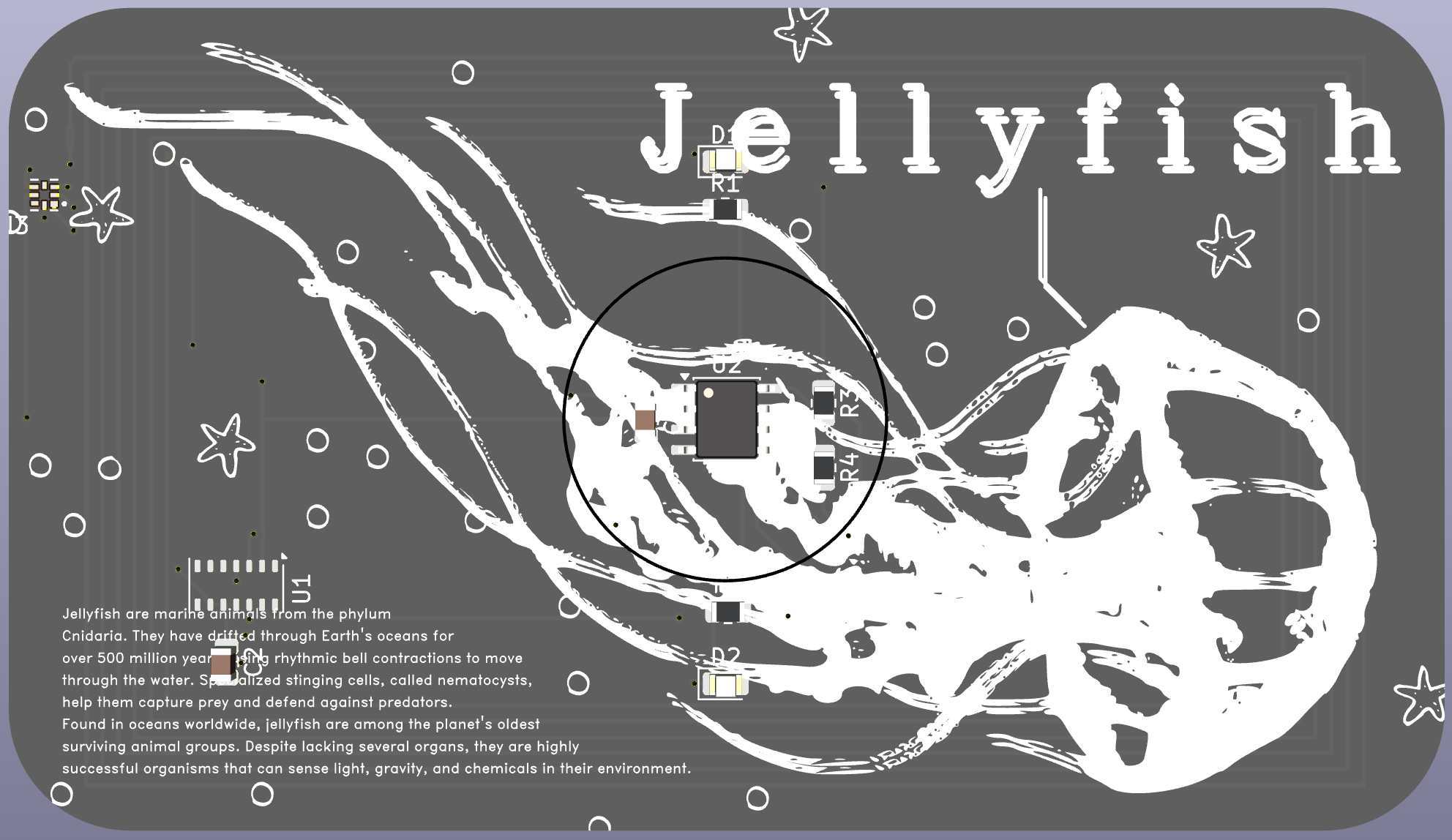

| Designator | Part Kind | Part # | Manufacturer | Product link | Qty | Total Price ($) |
|---|---|---|---|---|---|---|
| C1 | 0.1uF | CC0805KRX7R9BB104 | YAGEO | https://jlcpcb.com/partdetail/YAGEO-CC0805KRX7R9BB104/C49678 | 2 | 0.0184 |
| C2 | 10uF | GRM21BR61H106KE43L | Murata Electronics | https://jlcpcb.com/partdetail/439567-GRM21BR61H106KE43L/C440198 | 2 | 0.6418 |
| D1,D2 | LED | NCD0805R1 | Foshan NationStar Optoelectronics | https://jlcpcb.com/partdetail/85425-NCD0805R1/C84256 | 4 | 0.0532 |
| R1,R2 | 330 | 0805W8F3300T5E | UNI-ROYAL(Uniroyal Elec) | https://jlcpcb.com/partdetail/18318-0805W8F3300T5E/C17630 | 4 | 0.0108 |
| R3,R4 | 4.7k | 0805W8F4701T5E | UNI-ROYAL(Uniroyal Elec) | https://jlcpcb.com/partdetail/18361-0805W8F4701T5E/C17673 | 4 | 0.0084 |
| U1 | MAX30102 | MAX30102EFD+T | Analog Devices Inc./Maxim Integrated | https://jlcpcb.com/partdetail/7407610-MAX30102EFDT/C6454833 | 0 (2) | 0 (26.26) |
| U2 | ATtiny85-20S | ATTINY85-20SU | Microchip Technology | https://jlcpcb.com/partdetail/MicrochipTech-ATTINY8520SU/C31540447 | 0 (2) | 0 (5.16) |
| U3 | NT3H2211W0FHKH | NT3H2211W0FHKH | NXP Semicon | https://jlcpcb.com/partdetail/NXPSemicon-NT3H2211W0FHKH/C2905792 | 0 (2) | 0 (1.88) |
| BT1 | CR2032-BS-6-1 | CR2032-BS-6-1 | Q&J | https://jlcpcb.com/partdetail/QJ-CR2032_BS_61/C70377 | 0 (2) | 0 (0.28) |
| Total: | $0.74 ($0.37 per Card) | |||||
| Full Total (including NFC, battery, and sensor): | $34.32 ($17.16 per Card) |
Note: I decided I'd buy the NFC chip, Attiny, Battery Cell & Holder, & Heartbeat myself, which is why they have 0 listed for price and quantity. The main cost is the Heart Rate/Oximeter sensor. I'm not sure if I could've found a cheaper option, so this may be a one-off thing
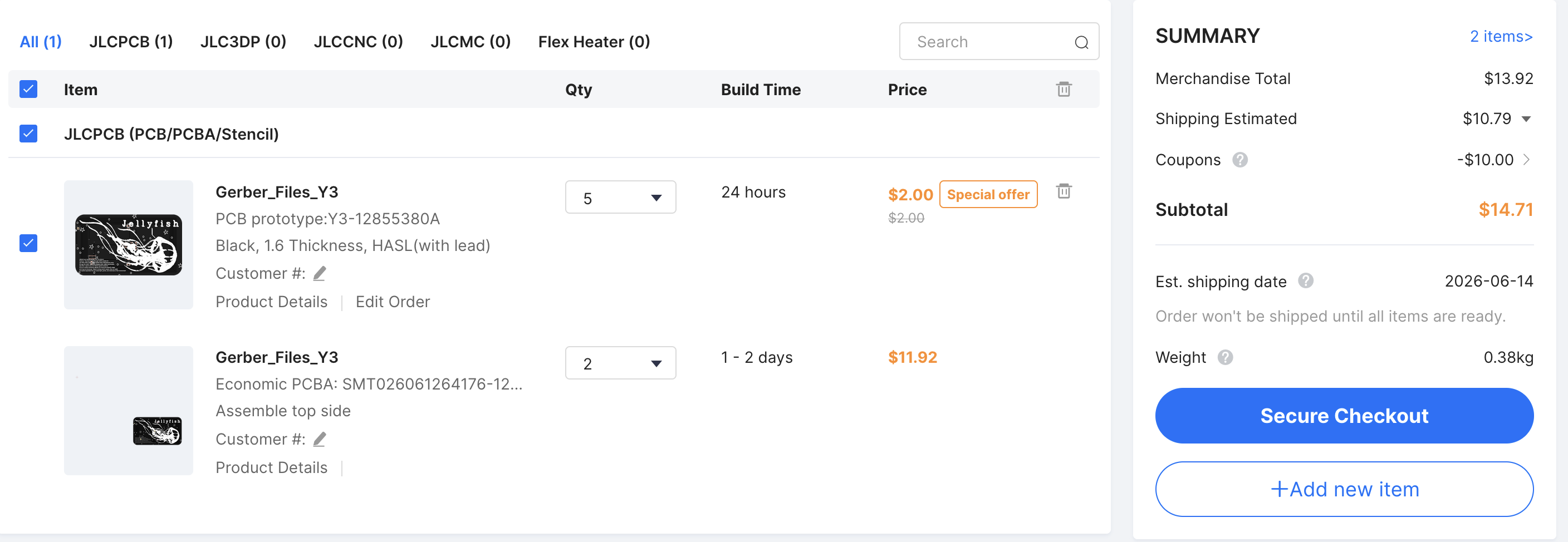
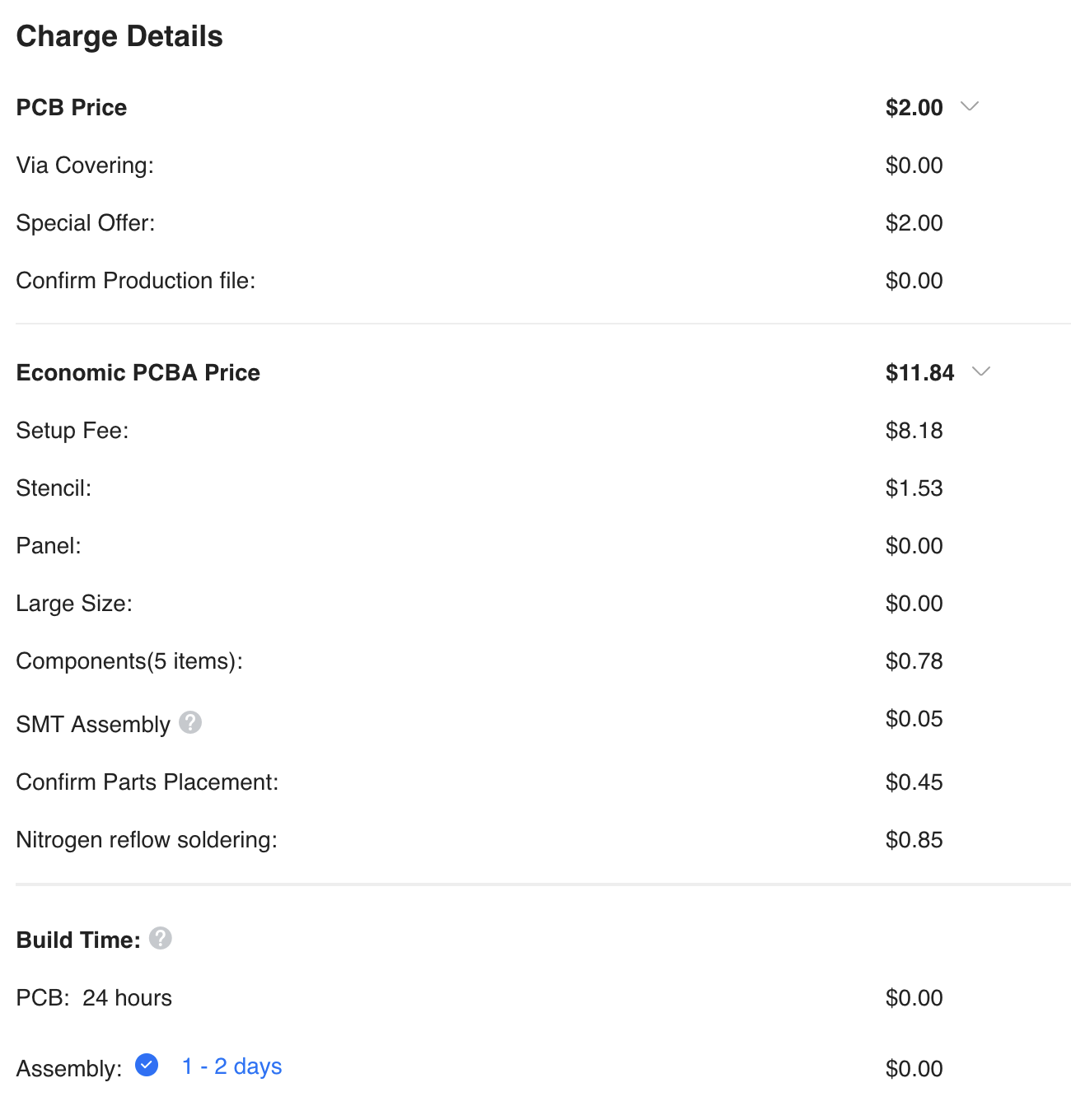
Note: Order from JLCPCB, which only includes the capacitors, LEDs, and resistors. I think a good chunk of this cost is the manufacturing, but I'm also completely new to this process, so I'm not sure what a 'good' price is. I do believe this is justifiable enough?
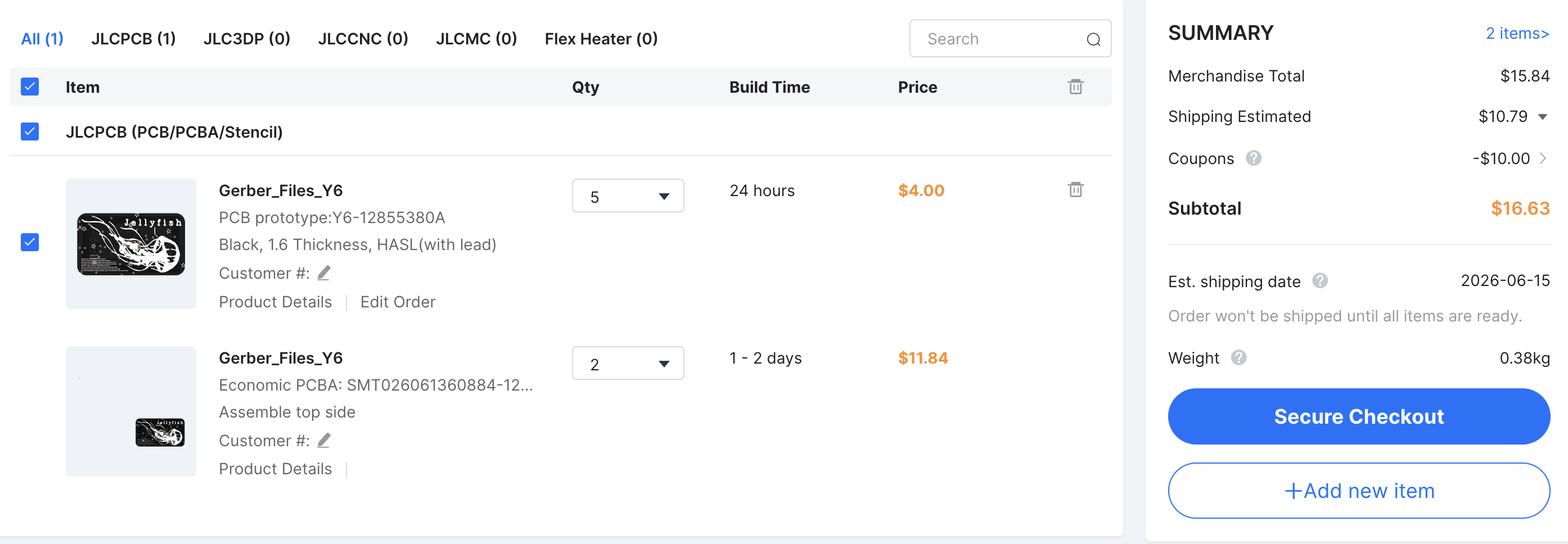
Note: The price went up, because my special order time ran out. It only went up by 2 dollars though.
| Qty | Value | Footprint | References |
|---|---|---|---|
| 2 | 330 | Resistor_SMD:R_0805_2012Metric | R1, R2 |
| 2 | 4.7k | Resistor_SMD:R_0805_2012Metric | R3, R4 |
| 2 | LED | LED_SMD:LED_0805_2012Metric | D1, D2 |
| 1 | 0.1 uF | Capacitor_SMD:C_0805_2012Metric | C1 |
| 1 | 10 uF | Capacitor_SMD:C_0805_2012Metric | C2 |
| 1 | ATtiny85-20S | Package_SO:SOIC-8_3.9x4.9mm_P1.27mm | U2 |
| 1 | Battery_Cell | Battery:BatteryHolder_Keystone_3002_1x2032 | BT1 |
| 1 | LOGO | LOGO | |
| 1 | MAX30102 | OptoDevice:Maxim_OLGA-14_3.3x5.6mm_P0.8mm | U1 |
| 1 | NT3H2211W0FHKH | Custom_Libraries:IC_NT3H2211W0FHKH | U3 |
The 13 most common of 14 parts.
aws/iot-expresslink
This device was designed and created for the AWS IoT ExpressLink Demo Badge Workshop, which was run at re:Invent 2022.

devinhorowitz/solar-business-card
Front — the card face Back — the component side

EIT-team/sVNS_circular_implant_kicad
KiCad project for sVNS circular formfactor implant


sandgum/Triangulate-ES_01-Watch
A 5mm thick smartwatch which uses an E-ink display and two OLEDs to display information while consuming very little power

theheraldproject/herald-hardware
Permissively licensed opensource hardware designs for Herald powered wearables and beacons. Supports digital contact tracing and other eHealth approaches.

abhinav937/RP2040_SOS_band
PCB design files for RP2040 based SmartWatch. It features an accelerometer, a GPS module and a cellular module.

Epivaral/CursoIoT
Material complementario del curso: INTRODUCCIÓN A IOT, ALMACENAMIENTO EN LA NUBE Y ANÁLISIS DE DATA
It measures 89 × 51 mm and has 2 copper layers, 1.6 mm thick.
14 parts, built around the ATTINY85-20SU, MAX30102 and NT3H2211W0FHKH. The full list of its parts is on this page, with links to each part's symbol and footprint where PCBKit's library has them.
From the kwame-y/PCBCard repository on GitHub, at the commit this page was made from: the board is Hardware/PCBCard.kicad_pcb and its schematic Hardware/PCBCard.kicad_sch. PCBKit opens the board in the browser, with nothing to install.
Its repository publishes it under the MIT licence: you may reuse it on that licence's terms (keep the author's notice, and for a copyleft licence share your changes alike).