2 layers40 × 20 mm

 kurtjd/CHIPnGo122
A custom-built CHIP-8 hand-held gaming console powered by a STM32 microcontroller.
CHIPnGo is an open-source printed circuit board by kurtjd, from the kurtjd/CHIPnGo repository on GitHub, published under the MIT licence. It is a 2-layer board of 165 × 78 mm with 13 parts on 40 nets, routed with 116 tracks and 0 vias.
It belongs with the retro computing and games boards and the STM32 boards of this library.
| Current Status |
|---|
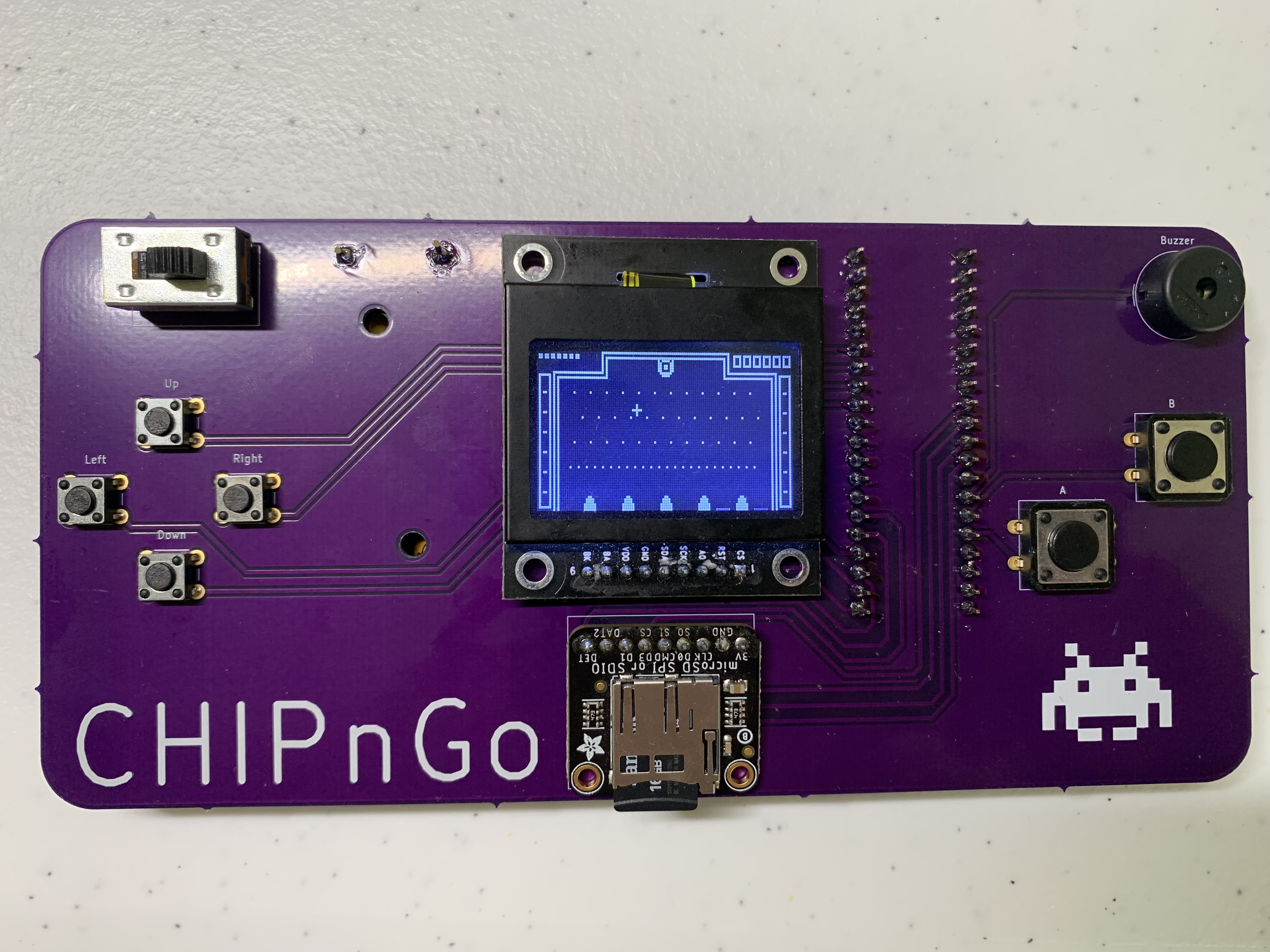 |
Recently I've taken a serious interest in embedded development, so I decided for my first project I would attempt to port my CHIP-8 emulator to a STM32 microcontroller in order to eventually build a CHIP-8 hand-held gaming console. Since this is being done as a learning experience, I also decided I would do this bare-metal with no libraries and write all drivers from scratch. While this is proving to be slow and extremely frustrating at times, it has also been very insightful and I've already learned a ton in such a short time.
If you are interested in building your own CHIPnGo, check out this guide.
If you are interested in reading about my development of the project, some challenges I faced, and the bone-headed design decisions I made along the way due to my inexperience, check out my dev blog.
Although my original emulator also has full support for XO-CHIP roms, I decided to focus on just CHIP-8 and S-CHIP for now for several reasons:
CHIP-8 supports 16 keys for input, however for design purposes, the console only has 6 buttons. However, most games only use a few buttons so this isn't too much of an issue.
| Qty | Value | Footprint | References |
|---|---|---|---|
| 1 | A_Btn | Button_Switch_THT:SW_PUSH-12mm | A |
| 1 | Adafruit_MicroSD_Breakout | Adafruit_SD_Reader:Adafruit_SD_Reader | SD Reader |
| 1 | B_Btn | Button_Switch_THT:SW_PUSH-12mm | B |
| 1 | Batteries | Battery:BatteryHolder_Keystone_2468_2xAAA | Batteries |
| 1 | Down_Btn | Button_Switch_THT:SW_PUSH_6mm_H5mm | Down |
| 1 | ERM12864-8_Display | ERM12864:ERM12864 | Display |
| 1 | LOGO | Logo:Logo | G*** |
| 1 | Left_Btn | Button_Switch_THT:SW_PUSH_6mm_H5mm | Left |
| 1 | Piezo_Buzzer | Buzzer_Beeper:Buzzer_TDK_PS1240P02BT_D12.2mm_H6.5mm | Buzzer |
| 1 | Power_Switch | Switch:GF-123-0054 | Power_Switch |
| 1 | Right_Btn | Button_Switch_THT:SW_PUSH_6mm_H5mm | Right |
| 1 | STM32_BluePill | bp:YAAJ_BluePill_1 | BluePill |
| 1 | Up_Btn | Button_Switch_THT:SW_PUSH_6mm_H5mm | Up |
It measures 165 × 78 mm and has 2 copper layers, 1.6 mm thick.
13 parts. The full list of its parts is on this page, with links to each part's symbol and footprint where PCBKit's library has them.
From the kurtjd/CHIPnGo repository on GitHub, at the commit this page was made from: the board is PCB/CHIPnGo.kicad_pcb and its schematic PCB/CHIPnGo.kicad_sch. PCBKit opens the board in the browser, with nothing to install.
Its repository publishes it under the MIT licence: you may reuse it on that licence's terms (keep the author's notice, and for a copyleft licence share your changes alike).


samyk/magspoof
A portable device that can spoof/emulate any magnetic stripe, credit card or hotel card "wirelessly", even on standard magstripe (non-NFC/RFID) readers.

fossasia/pslab-scripts
Pocket Science Lab - Scripts for Sensor Experiments


willem-pennings/balancing-cube
A cube that balances itself in a corner or edge using reaction wheels

VoronDesign/Voron-Hardware
Cool Hardware designed by the Voron Design group

hoglet67/RGBtoHDMI
Bare-metal Raspberry Pi project that provides pixel-perfect sampling of Retro Computer RGB/YUV video and conversion to HDMI