4 layers57.4 × 23.9 mm

 korken89/wch-probe1
CH347F-based JTAG & SWD debug probe
Wch probe is an open-source printed circuit board by korken89, from the korken89/wch-probe repository on GitHub, published under the CERN-OHL-P-2.0 licence. It is a 4-layer board of 33 × 11 mm with 36 parts on 52 nets, routed with 382 tracks and 80 vias.
It is built around the CH347F, CH412K and AP2112K-3.3, with the SMF5.0A among its other parts. Its parts include 11 capacitors, 9 resistors, 5 ICs, 5 connectors and 4 diodes. It belongs with the interfaces and adapters and sensors and measurement boards of this library.


KiCad hardware for a CH347F-based JTAG & SWD debug probe. USB-C on one end, a 10-pin 1.27 mm Cortex debug header on the other, plus a UART on the bottom-side TX/RX/GND pads. The I/O voltage (VIO) tracks the target's VTref (valid range 1.8 V to 3.3 V), and defaults to 3.3 V when the target does not drive VTref.
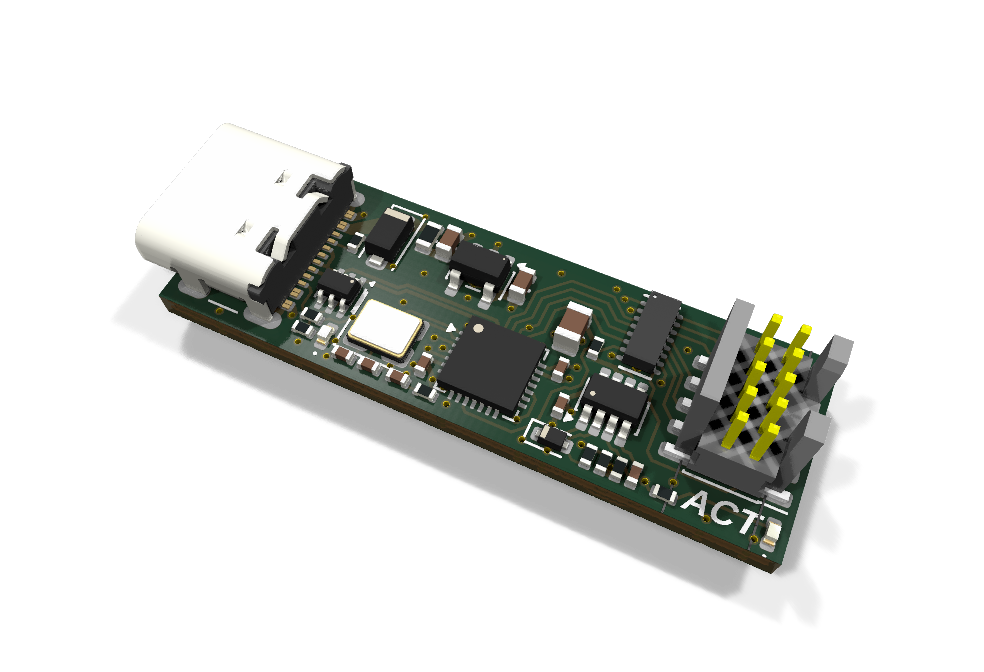
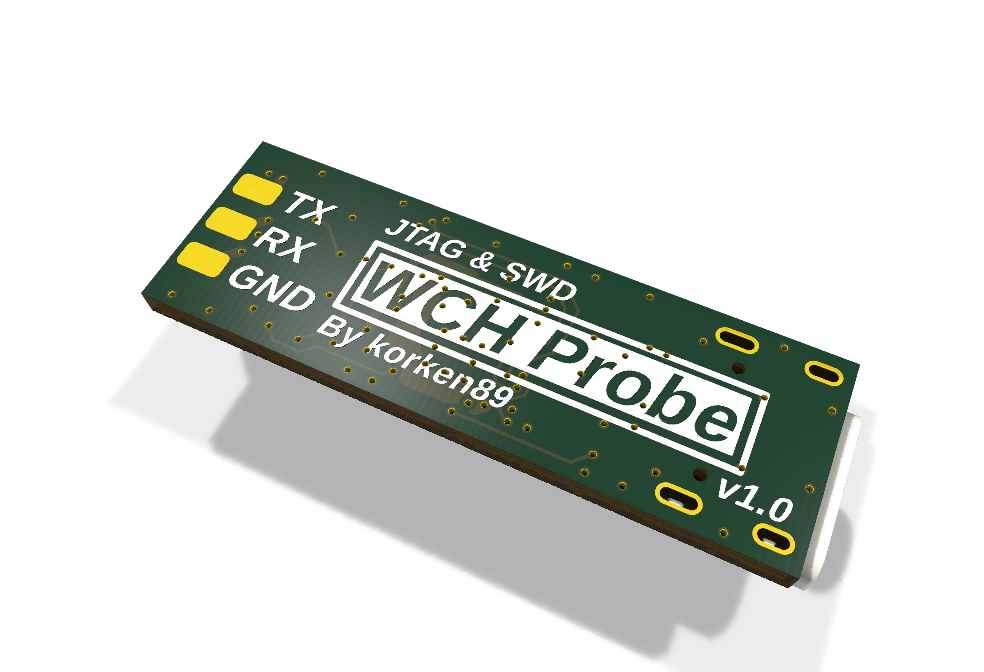
The fabrication outputs (gerber zip, BOM, placement file, schematic PDF) for
each board revision are attached to the
releases. To generate them
locally, make fab writes the same set to Fabrication/ and make check
runs ERC and DRC; both need KiCad 10's kicad-cli.
JLCPCB, 4 layers, 1.6 mm thick. Order options:
Stock CH347s ship with a blank config and all enumerate with the same default serial. Use wch-cfg to write each board's USB identity (serial number, product and manufacturer strings):
wch-cfg version --min 1.01 && wch-cfg write --init --random-serial --product wch-probe --manufacturer korken89
# replug the board (the chip reads the strings at power-on), then
wch-cfg verify --serial <the printed serial> --product wch-probe --manufacturer korken89
write prints the serial for the label on stdout once the OS has enumerated it.
The CH347 declares its interrupt endpoints with 125/250 us polling, and the
host controller reserves that bandwidth at enumeration whether the endpoints
are used or not. After a few probes it will error with can't set config #1, error -28 ("Not enough bandwidth"). Work around it on Linux by treating
the bInterval values as milliseconds (will support 8x more probes - UART,
JTAG and SWD run on bulk endpoints and are unaffected):
echo '1a86:55de:l' | sudo tee /sys/module/usbcore/parameters/quirksthen replug the probes (quirks apply at enumeration). To make it permanent,
add usbcore.quirks=1a86:55de:l to the kernel command line. dmesg printing
endpoint 0x85 has an invalid bInterval 1, changing to 4 for each probe
confirms the quirk is active.
CERN-OHL-P-2.0, see LICENSE.
| Qty | Value | Footprint | References |
|---|---|---|---|
| 5 | 0.1u | passive:C_0402 | C5, C6, C7, C9, C10 |
| 4 | 10u | passive:C_0603 | C1, C2, C8, C11 |
| 4 | 33k | passive:R_0402 | R5, R6, R7, R9 |
| 4 | 5.1k | passive:R_0402 | R1, R2, R3, R8 |
| 3 | Conn_01x01 | connectors:pad_1.5x2.5mm | J3, J4, J5 |
| 2 | 30p | passive:C_0402 | C3, C4 |
| 1 | 1 | passive:R_0402 | R4 |
| 1 | 1N4148 | Diode_SMD:D_SOD-523 | D2 |
| 1 | 450mΩ 600Ω@100MHz | passive:R_0603 | FB1 |
| 1 | 8 MHz | Crystal:Crystal_SMD_3225-4Pin_3.2x2.5mm | Y1 |
| 1 | AP2112K-3.3 | Package_TO_SOT_SMD:SOT-23-5 | U1 |
| 1 | CH347F | Package_DFN_QFN:WQFN-28-1EP_4x4mm_P0.4mm_EP2.7x2.7mm | U3 |
| 1 | CH412K | Package_TO_SOT_SMD:SOT-363_SC-70-6 | U2 |
| 1 | Conn_ARM_JTAG_SWD_10 | connectors:PinHeader_2x05_FTSH-105-01-L-DV-K | J2 |
| 1 | GREEN | LED_SMD:LED_0402_1005Metric | D3 |
| 1 | NUF8401MNT4G | dfn:DFN-16-1EP_1.6x4mm_P0.5mm | U5 |
| 1 | ORANGE | LED_SMD:LED_0402_1005Metric | D4 |
| 1 | SMF5.0A | Diode_SMD:D_SOD-123F | D1 |
| 1 | TLV9062IDDFR | Package_TO_SOT_SMD:SOT-23-8 | U4 |
| 1 | USB_C_Receptacle_USB2.0_14P | Connector_USB:USB_C_Receptacle_GCT_USB4105-xx-A_16P_TopMnt_Horizontal | J1 |


lsartory/Clavier
An FPGA-based mechanical keyboard with an integrated USB hub and communication interfaces

LuizFernandoOliveira/Conversor-USB-UART-SPI-I2C-JTAG
This work is licensed under a [Creative Commons Attribution-NonCommercial-NoDerivs 4.0 International License][cc-by-nc-nd].


reza-bakhshi/RB-347
RB-347 is a small USB interface and debugging module built around the WCH CH347F. It provides several commonly used digital interfaces from a single USB-C connection, making it useful for embedded development, board…

It measures 33 × 11 mm and has 4 copper layers, 1.6 mm thick.
36 parts, built around the CH347F, CH412K, AP2112K-3.3 and SMF5.0A. The full list of its parts is on this page, with links to each part's symbol and footprint where PCBKit's library has them.
From the korken89/wch-probe repository on GitHub, at the commit this page was made from: the board is wch-probe.kicad_pcb and its schematic wch-probe.kicad_sch. PCBKit opens the board in the browser, with nothing to install.
Its repository publishes it under the CERN-OHL-P-2.0 licence: you may reuse it on that licence's terms (keep the author's notice, and for a copyleft licence share your changes alike).