2 layers123 × 154.9 mm
Pyaa
konomu/pyaa
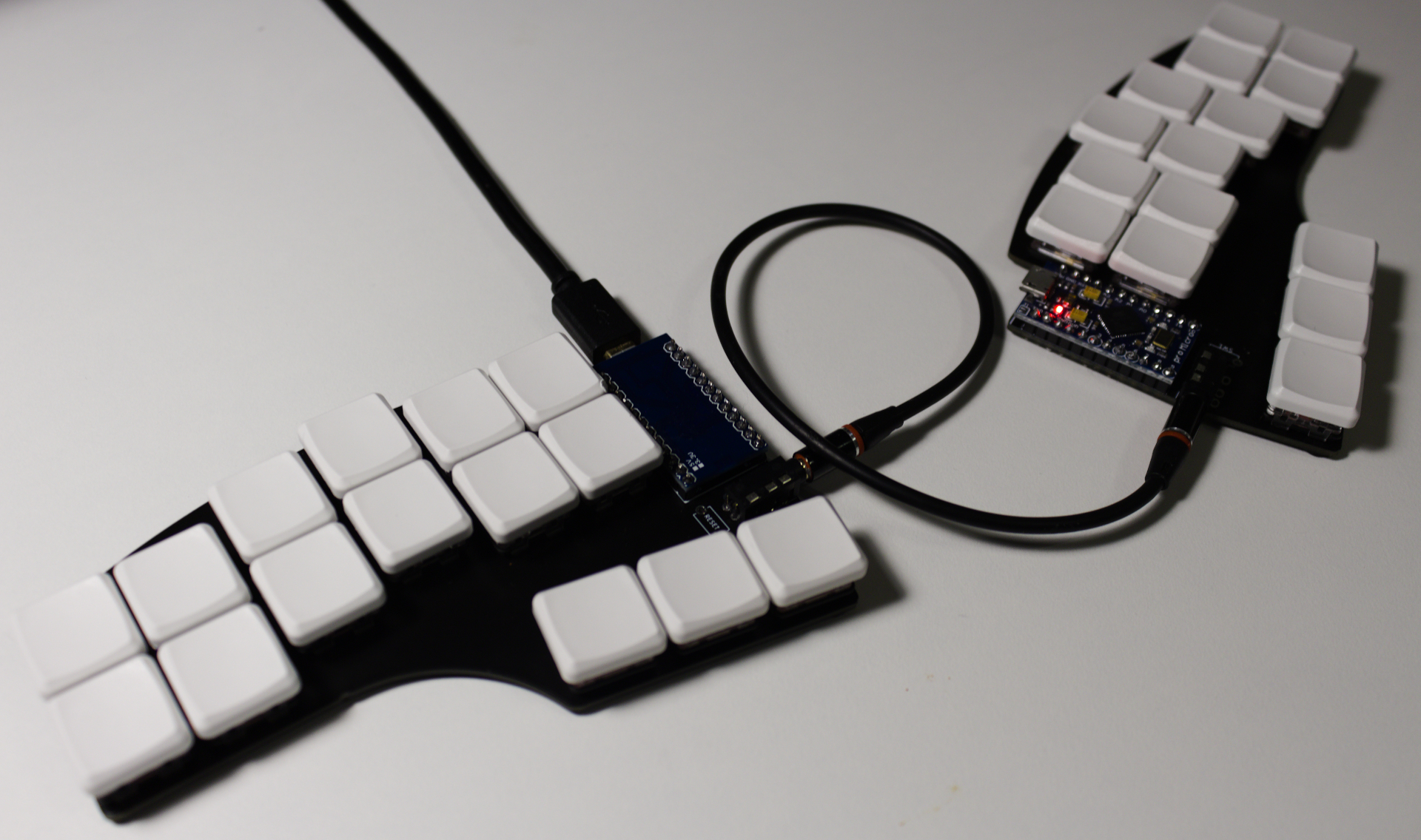
A thirty key steno keyboard that runs with QMK firmware and direct pin connections. It only requires kailh choc switches, two pro micros, and two TRRS jacks.
18 parts3Apache-2.0

 konomu/pyaa3
A thirty key steno keyboard that runs with QMK firmware and direct pin connections. It only requires kailh choc switches, two pro micros, and two TRRS jacks.
Pyaa is an open-source printed circuit board by konomu, from the konomu/pyaa repository on GitHub, published under the Apache-2.0 licence. It is a 2-layer board of 250.6 × 168.3 mm with 42 parts on 44 nets, routed with 532 tracks and 0 vias.
Its parts include 32 switches, 2 ICs and 2 connectors. It belongs with the keyboards and input boards and the AVR (ATmega, ATtiny) boards of this library.
A thirty key steno keyboard powered by QMK firmware and Plover.
To build pyaa, all you need is the following:
Once you have finished building it, you must flash the firmware onto the keyboard with QMK.
pyaa is powered by QMK firmware and takes advantage of its stenography, combo, and direct pin implementations. Its firmware is available here. It functions along with Plover, a desktop application developed as a part of the Open Steno Project.
There are many other steno keyboards out there, all of which allow you to input text at speeds upwards of 200 words per minute with the magic of Plover! (and of course, a bit of practice) In fact, pyaa is heavily inspired by Georgi, which was developed by g Heavy Industries' Jane Bernhardt and is available at gboards. Other options for steno keyboards can be found on Plover's wiki.
The PCB uses a direct pin matrix, where each key is connected to an I/O pin on the microcontroller and ground. This makes it so that soldering diodes onto the pcb is not necessary as with other keyboards, reducing cost slightly. N-key rollover functionality, which is crucial for stenography, is left intact.
| Qty | Value | Footprint | References |
|---|---|---|---|
| 30 | KEYSW | switches:Choc_PG1350_Choc_Spacing | K0, K1, KA1, KBR1, KDR1, KER1, KFR1, KGR1, KHL1, KKL1, KLR1, KN1, KN2, KO1, KPL1, KPR1 +14 |
| 2 | LOGO | dolores:flora | G***, G*** |
| 2 | LOGO | dolores:pyaa | G***, G*** |
| 2 | MJ-4PP-9 | Keebio-Parts:TRRS-PJ-320A | J1, J2 |
| 2 | ProMicro | Lily58-footprint:ProMicro_rev | U1, U2 |
| 2 | SW_PUSH | Lily58-footprint:TACT_SWITCH_TVBP06 | SW1, SW2 |
| 2 | VAL** | Panelization:mouse-bite-2mm-slot | mouse-bite-2mm-slot, mouse-bite-2mm-slot |
konomu/pyaa
A thirty key steno keyboard that runs with QMK firmware and direct pin connections. It only requires kailh choc switches, two pro micros, and two TRRS jacks.

rusefi/rusefi
rusefi - GPL internal combustion engine control unit


hackclub/sprig
🍃 Learn to code by making games in a JavaScript web-based game editor.

jamro/tiny-engineer
A small desktop robot that brings an AI coding assistant to life, physically acting out when it reads files, thinks, writes code, and finishes work.

hoglet67/RGBtoHDMI
Bare-metal Raspberry Pi project that provides pixel-perfect sampling of Retro Computer RGB/YUV video and conversion to HDMI

hackclub/OnBoard
💡 Join 1,000 teenagers and make your first PCB with a $100 grant!


It measures 250.6 × 168.3 mm and has 2 copper layers, 1.6 mm thick.
42 parts. The full list of its parts is on this page, with links to each part's symbol and footprint where PCBKit's library has them.
From the konomu/pyaa repository on GitHub, at the commit this page was made from: the board is v2/pyaa.kicad_pcb. PCBKit opens the board in the browser, with nothing to install.
Its repository publishes it under the Apache-2.0 licence: you may reuse it on that licence's terms (keep the author's notice, and for a copyleft licence share your changes alike).