
2 layers95 × 46 mm

 JurCag/NB_IoT_app3
Project utilizes NB-IoT technology to transmit sensory data to the cloud, while simultaneously enabling local communication through BLE mesh.
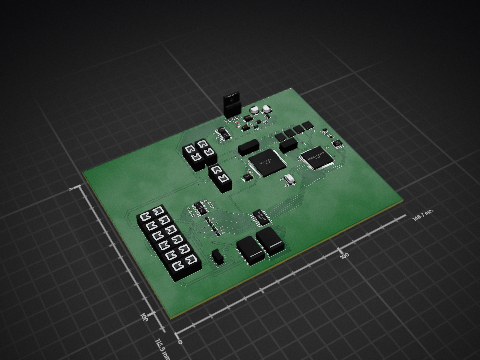
NB IoT PCB rev 1 1 is an open-source printed circuit board by JurCag, from the JurCag/NB_IoT_app repository on GitHub. It is a 4-layer board of 42.4 × 66.1 mm with 58 parts on 67 nets, routed with 347 tracks and 59 vias.
It is built around the ESP32-C3-WROOM-02-H4, 100UF 10V 4*7 and 1N5819HW, with the BC817, PRTR5V0U2X and BZV55C15 among its other parts. Its parts include 16 resistors, 14 capacitors, 10 diodes, 6 connectors and 3 ICs. It belongs with the home automation and IoT and radio and wireless boards and the ESP32 and RISC-V boards of this library.


Table of contents:
Project showcases the application of NB-IoT technology for uploading data to the cloud.
Hardware involves an NB-IoT concentrator and 6 sensor nodes equipped with different sensors, specifically designed to measure parameters of a photobioreactor.
Simple concept of the application including PBR is available here.

Simple web application for sensor data visualization and control of NB-IoT concentrator.

The application uses MQTT protocol to communicate with broker within the AWS IoT Core. MQTT topics and structure of JSON payloads sent in the messages is shown below.

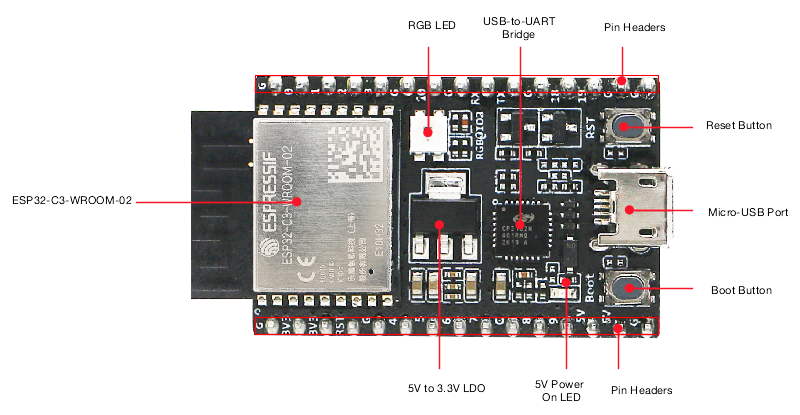
Custom PCB board with ESP32-C3 controller and Quectel BG96 module.
| Component | Link |
|---|---|
| MCU | ESP32-C3 |
| NB-IoT module | Quectel BG96 |
| NB-IoT module board | LTE IoT 2 Click |
| NB-IoT concentrator | NB-IoT_PCB_rev_1_1 |

| Physical quantities | Sensor | Connection |
|---|---|---|
| temperature, humidity, pressure | BME280 |  |
| pH | PH4502C |  |
| CO_2 concentration | MHZ19B |  |
| light intensity | GL5528 |  |
| turbidity | TS300B |  |
| electric current | ACS712 |  |
| Qty | Value | Footprint | References |
|---|---|---|---|
| 6 | 100nF/50V | Capacitor_SMD:C_0603_1608Metric_Pad1.08x0.95mm_HandSolder | C2, C8, C10, C11, C13, C14 |
| 4 | 1k | Resistor_SMD:R_0603_1608Metric_Pad0.98x0.95mm_HandSolder | R3, R7, R8, R12 |
| 4 | MountingHole_Pad | MountingHole:MountingHole_3.2mm_M3_Pad_Via | H1, H2, H3, H4 |
| 3 | 10k(1%) | Resistor_SMD:R_0603_1608Metric_Pad0.98x0.95mm_HandSolder | R9, R10, R11 |
| 2 | 0(1%) | Resistor_SMD:R_0603_1608Metric_Pad0.98x0.95mm_HandSolder | R4, R5 |
| 2 | 100uF/10V | Capacitor_THT:CP_Radial_D5.0mm_P2.00mm | C3, C5 |
| 2 | 10uF/50V | Capacitor_SMD:C_0805_2012Metric_Pad1.18x1.45mm_HandSolder | C7, C12 |
| 2 | 1N5819HW | snapeda:SOD3715X145N | D1, D2 |
| 2 | 1k(NC) | Resistor_SMD:R_0603_1608Metric_Pad0.98x0.95mm_HandSolder | R13, R14 |
| 2 | 1uF/50V | Capacitor_SMD:C_0603_1608Metric_Pad1.08x0.95mm_HandSolder | C4, C6 |
| 2 | BC817 | Package_TO_SOT_SMD:SOT-23 | Q1, Q2 |
| 2 | Conn_01x07 | Connector_PinSocket_2.54mm:PinSocket_1x07_P2.54mm_Vertical | J7, J8 |
| 2 | Conn_01x08_Female | Connector_PinSocket_2.54mm:PinSocket_1x08_P2.54mm_Vertical | J3, J6 |
| 2 | PRTR5V0U2X | Package_TO_SOT_SMD:SOT-143_Handsoldering | D4, D5 |
| 2 | SW_Push | Button_Switch_THT:SW_PUSH_6mm_H5mm | BOOT1, RST1 |
| 1 | 0(1%)(NC) | Resistor_SMD:R_0603_1608Metric_Pad0.98x0.95mm_HandSolder | R6 |
| 1 | 10k | Resistor_SMD:R_0603_1608Metric_Pad0.98x0.95mm_HandSolder | R15 |
| 1 | 10k(NC) | Resistor_SMD:R_0603_1608Metric_Pad0.98x0.95mm_HandSolder | R16 |
| 1 | 10uF/50V | Capacitor_SMD:C_1206_3216Metric_Pad1.33x1.80mm_HandSolder | C9 |
| 1 | 22.1k | Resistor_SMD:R_0603_1608Metric_Pad0.98x0.95mm_HandSolder | R1 |
| 1 | 4.7uF | Capacitor_SMD:C_1210_3225Metric_Pad1.33x2.70mm_HandSolder | C1 |
| 1 | 47.5k | Resistor_SMD:R_0603_1608Metric_Pad0.98x0.95mm_HandSolder | R2 |
| 1 | BZV55C15 | Diode_SMD:D_MiniMELF | D3 |
| 1 | CP2102N-Axx-xQFN28 | Package_DFN_QFN:QFN-28-1EP_5x5mm_P0.5mm_EP3.35x3.35mm | U1 |
| 1 | ESP32-C3-WROOM-02 | Espressif:ESP32-C3-WROOM-02 | U3 |
| 1 | LD1117S33TR_SOT223 | Package_TO_SOT_SMD:SOT-223-3_TabPin2 | U2 |
| 1 | PWR LED | Diode_SMD:D_0805_2012Metric_Pad1.15x1.40mm_HandSolder | D8 |
| 1 | RX LED | Diode_SMD:D_0805_2012Metric_Pad1.15x1.40mm_HandSolder | D7 |
| 1 | SD050-16_Poly_Fuse | lightigo_parts_footprints:FP_for_SD050-16_POLY_FUSE | F1 |
| 1 | TX LED | Diode_SMD:D_0805_2012Metric_Pad1.15x1.40mm_HandSolder | D6 |
| 1 | USB | Connector_USB:USB_Micro-B_Amphenol_10118194_Horizontal | J1 |
| 1 | USB_UART | Connector_USB:USB_Micro-B_Amphenol_10118194_Horizontal | J2 |
| 1 | USER LED 1 | Diode_SMD:D_0805_2012Metric_Pad1.15x1.40mm_HandSolder | LED1 |
| 1 | USER LED 2 | Diode_SMD:D_0805_2012Metric_Pad1.15x1.40mm_HandSolder | LED2 |
Mustafa614/Body-Control-Module-Mini
This Module are controlling wipers,baclights,door statues and comminicates with another ecu's via can bus

pyshrekek/ufluidics
Firmware for an Elegoo Mega 2560 R3 driving five NEMA17 syringe pumps on a microfluidic device.

DVA490-474-Project-Course/SSL-Hardware-Development
Contains all hardware related material. (No software).

onhala/pirhat
This repository focuses on the development of an adaptation board for the PIR sensor HC-SR501, intended for use in home automation projects. The board adapts the PIR module for integration into a 24V control system.

bkuhn4/golf-gps
The Pocket Caddy hardware is built around the ESP32-C3 microcontroller and includes the following components:

minhtenlado/esp32-4-channel-relays-temp
⚡ Open-source ESP32 4-Channel Opto-Isolated Relay Controller board designed in KiCad.

emertcakir/OpenAirScope
Open-source air quality and environmental monitoring node with STM32H743 + ESP32-C3, LoRaWAN, RS485, USB-C, Li-ion charging, and multi-sensor support.
It measures 42.4 × 66.1 mm and has 4 copper layers, 4.69 mm thick.
58 parts, built around the ESP32-C3-WROOM-02-H4, 100UF 10V 4*7, 1N5819HW and BC817. The full list of its parts is on this page, with links to each part's symbol and footprint where PCBKit's library has them.
From the JurCag/NB_IoT_app repository on GitHub, at the commit this page was made from: the board is NB-IoT_PCB_rev_1_1/NB-IoT_PCB_rev_1_1.kicad_pcb and its schematic NB-IoT_PCB_rev_1_1/NB-IoT_PCB_rev_1_1.kicad_sch. PCBKit opens the board in the browser, with nothing to install.
Its repository states no licence, so its author keeps all rights: ask JurCag before reusing the design.