Skip to the content
2 layers34.7 × 45.1 mm514 final sensing, the printed circuit board in 3D
Size
34.7 × 45.1 mm
Copper layers
2
Thickness
1.6 mm
Parts
5
Nets
18
Pads
29
Tracks, vias
31, 0
Pours
1
Routed
Yes
KiCad
KiCad 9.0 (file 20241229)
Created
20 Jan 2026
Updated
14 Mar 2026

Overview

514 final sensing is an open-source printed circuit board by junction-su, from the junction-su/514_Final_InnerOracle repository on GitHub. It is a 2-layer board of 34.7 × 45.1 mm with 5 parts on 18 nets, routed with 31 tracks and 0 vias.

Its parts include 1 IC, 1 diode, 1 connector and 1 switch. It belongs with the ESP32 and RISC-V boards of this library.

README

README.md

🔮 InnerOracle: Biometric Fortune Teller

1. Project Overview

InnerOracle is an interactive, tangible interface that translates physiological stress into mystical guidance. Unlike traditional fortune-telling machines that rely on random chance, InnerOracle utilizes Galvanic Skin Response (GSR) to measure the user's emotional arousal and provides a personalized Tarot reading through a mechanical dial and an OLED display.
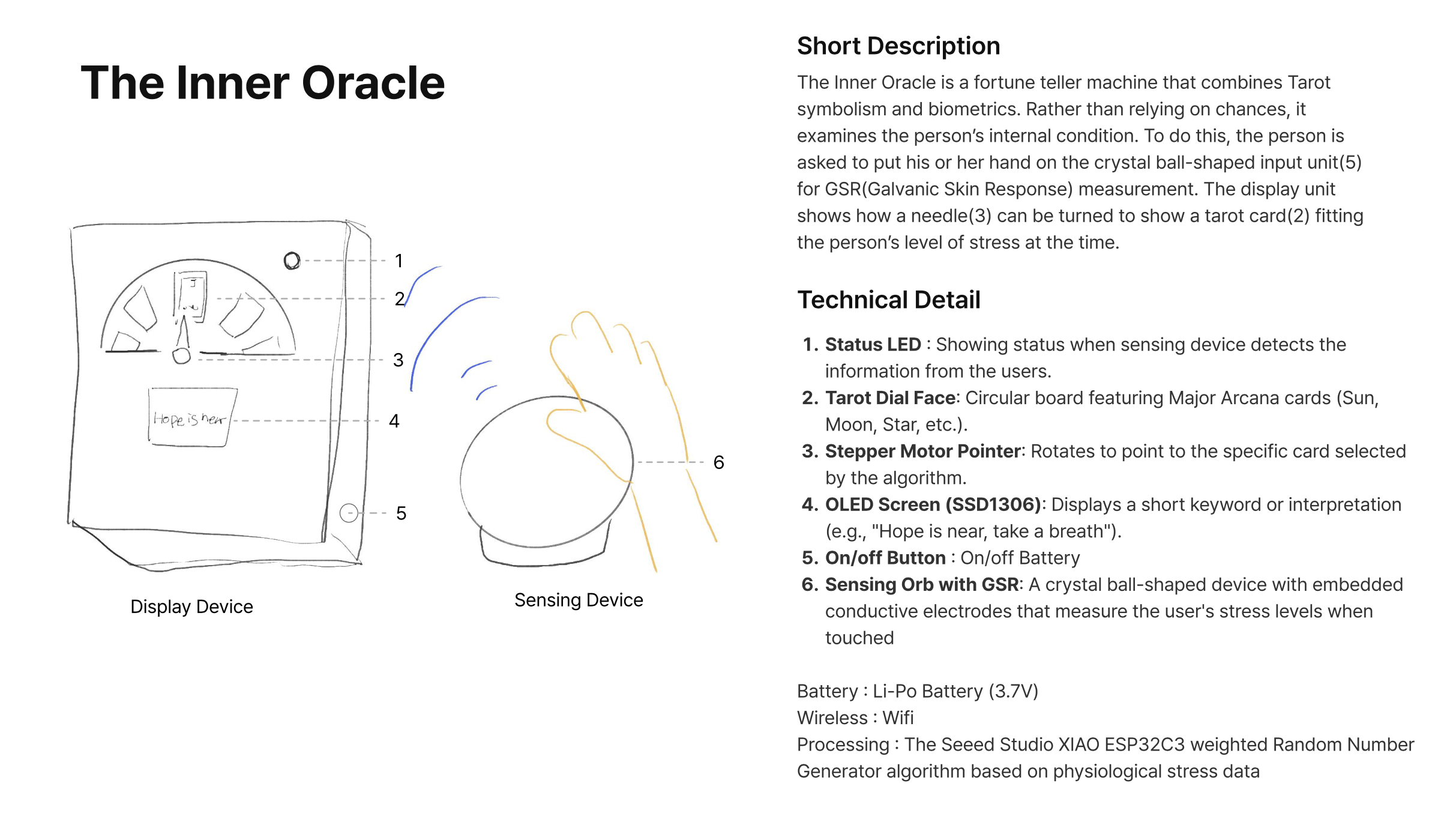
Concept Sketch

2. Technical Complexity & System Architecture

The system is built with a Dual-Node Architecture using two Seeed Studio XIAO ESP32-C3 microcontrollers communicating via the ESP-NOW wireless protocol.

[Sensing Node]

  • Microcontroller: Seeed Studio XIAO ESP32-C3
  • Sensor: Grove GSR Sensor with custom Copper Tape Electrodes
  • Logic: Implements an Adaptive Baseline Tracking algorithm to detect emotional triggers beyond skin resistance fluctuations.
  • Feedback: Provides immediate visual feedback via NeoPixel LED (Rainbow effect).

[Display Node]

  • Microcontroller: Seeed Studio XIAO ESP32-C3
  • Actuator: X27.168 Stepper Motor (Precision Gauge Motor)
  • Display: 0.96" I2C SSD1306 OLED
  • Logic: Receives real-time stress data and controls the physical needle with custom homing and calibration sequences.

3. Data Flow

[User's Hand] -> [GSR Sensor] -> [Sensing XIAO] --(ESP-NOW Wireless)--> [Display XIAO] -> [X27 Motor & OLED]

4. Hardware Fabrication

  • Custom PCB: Designed and soldered at GIX Prototyping Labs.
  • Enclosure: 2-part 3D printed housing ("The Orb" and "The Dial Box").
  • Power: Powered by 3.7V 1000mAh LiPo batteries, optimized for up to 150+ hours of typical usage.

5. Repository Structure

  • /Sensing_Node: Source code for GSR data processing and ESP-NOW transmission.
  • /Display_Node: Source code for motor control, OLED UI, and data reception.

6. Budget Summary

  • Total Project Cost: $66.95
  • Key Components: GSR Sensor ($32.99), 1000mAh Batteries ($16.98), XIAO ESP32C3 ($10.99).

Parts

5
QtyValueFootprintReferences
1Battery_CellConnector_JST:JST_PH_B2B-PH-K_1x02_P2.00mm_VerticalBT2
1ESP32-C3-XIAOesp32c3:XIAO_ESP32U2
1NeoPixel_THTLED_THT:LED_Rectangular_W5.0mm_H2.0mm-3PinsD2
1SMD GroveConnector:NS-Tech_Grove_1x04_P2mm_VerticalJ1
1SW_PushButton_Switch_THT:SW_PUSH_6mmSW2

More from junction-su/514_Final_InnerOracle

2
  • 2 layers24 × 17 mmTechin514 Lab3, the printed circuit board in 3D

    Techin514 Lab3

    junction-su/514_Final_InnerOracle

    11 parts

Similar boards

  • 2 layers98 × 27 mmXy limit, the printed circuit board in 3D

    Xy limit

    opulo-inc/lumenpnp

    The LumenPnP is an open source pick and place machine.

    5 parts3.7k
  • 2 layers21 × 33 mm24g2usb pico2w, the printed circuit board in 3D

    24g2usb pico2w

    joypad-ai/joypad-os

    Universal controller firmware for building adapters, dongles, and custom controllers.

    5 parts1.7kApache-2.0
  • 2 layers53.2 × 59.6 mmA10 OLinuXino Lime Rev B SHIELD TEMPLATE, the printed circuit board in 3D

    A10 OLinuXino Lime Rev B SHIELD TEMPLATE

    OLIMEX/OLINUXINO

    OLINUXINO is Open Source / Open Hardware, low cost from EUR 24 Linux Industrial grade Single Board Computer capable to operate -25+85C

    5 parts1.5k
  • 2 layers30 × 11 mmMain control board servo tester, the printed circuit board in 3D

    Main control board servo tester

    jamro/tiny-engineer

    A small desktop robot that brings an AI coding assistant to life, physically acting out when it reads files, thinks, writes code, and finishes work.

    5 parts1.1k
  • 2 layers78.8 × 35.3 mmKiCadTest, the printed circuit board in 3D

    KiCadTest

    hackclub/OnBoard

    💡 Join 1,000 teenagers and make your first PCB with a $100 grant!

    5 parts915
  • 2 layers50 × 23 mmMiniCircuits LTCC, the printed circuit board in 3D

    MiniCircuits LTCC

    VanceVagell/kv4p-ht

    Open source handheld ham radio project KV4P-HT

    5 parts828GPL-3.0
  • 2 layers20.3 × 15.2 mmL0 light sensor, the printed circuit board in 3D

    L0 light sensor

    Luos-io/luos_engine

    Open-source and real-time orchestrator for cyber-physical-systems, to easily design, test and deploy embedded applications and digital twins.

    5 parts546MIT

Questions

How big is the 514 final sensing PCB?

It measures 34.7 × 45.1 mm and has 2 copper layers, 1.6 mm thick.

What parts does the 514 final sensing use?

5 parts. The full list of its parts is on this page, with links to each part's symbol and footprint where PCBKit's library has them.

Where can I download the 514 final sensing KiCad files?

From the junction-su/514_Final_InnerOracle repository on GitHub, at the commit this page was made from: the board is Schematics/514_final_sensing.kicad_pcb and its schematic Schematics/514_final_display.kicad_sch. PCBKit opens the board in the browser, with nothing to install.

Can I use the 514 final sensing design in my own project?

Its repository states no licence, so its author keeps all rights: ask junction-su before reusing the design.