2 layers51.3 × 86 mm
 junction-su/514_Final_InnerOracle
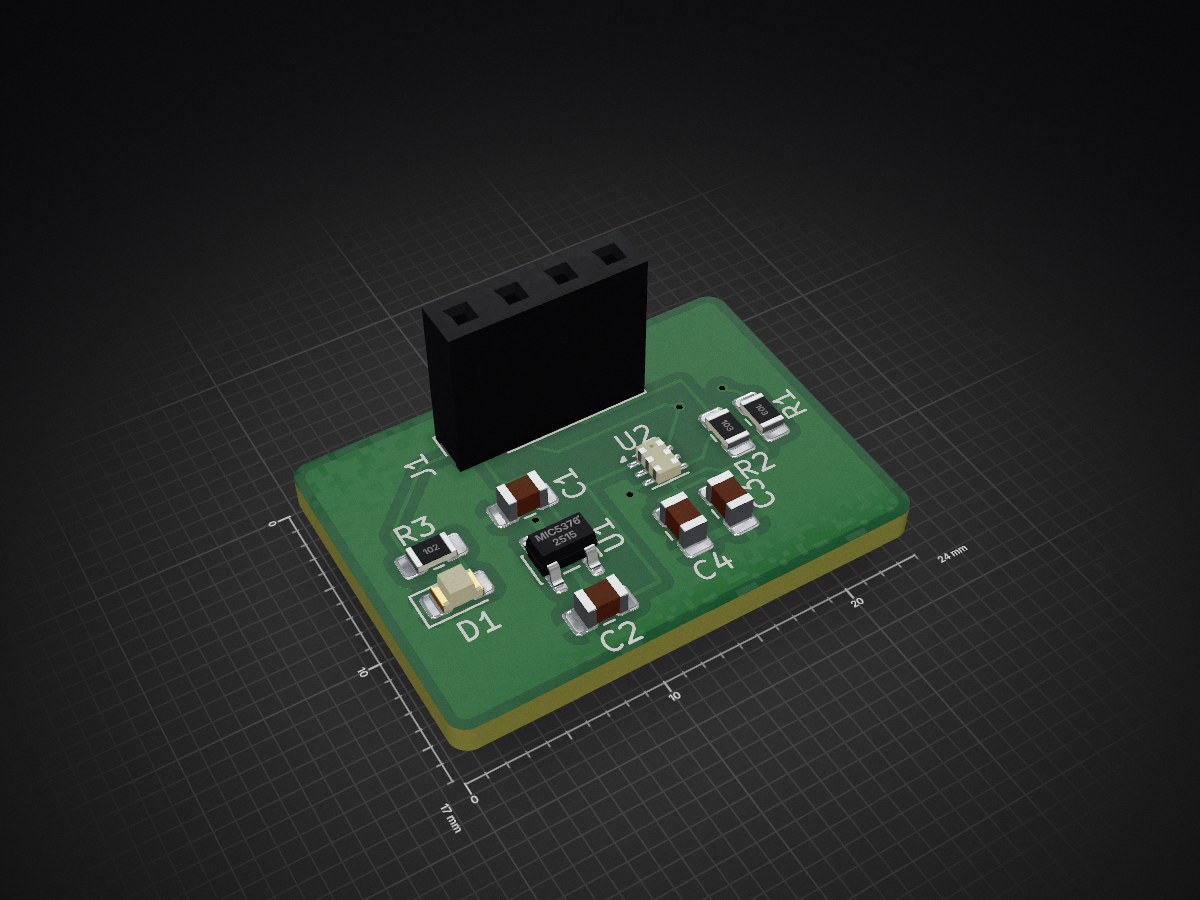
Techin514 Lab3 is an open-source printed circuit board by junction-su, from the junction-su/514_Final_InnerOracle repository on GitHub. It is a 2-layer board of 24 × 17 mm with 11 parts on 9 nets, routed with 56 tracks and 5 vias.
Its parts include 4 capacitors, 3 resistors, 2 ICs, 1 diode and 1 connector.
InnerOracle is an interactive, tangible interface that translates physiological stress into mystical guidance. Unlike traditional fortune-telling machines that rely on random chance, InnerOracle utilizes Galvanic Skin Response (GSR) to measure the user's emotional arousal and provides a personalized Tarot reading through a mechanical dial and an OLED display.
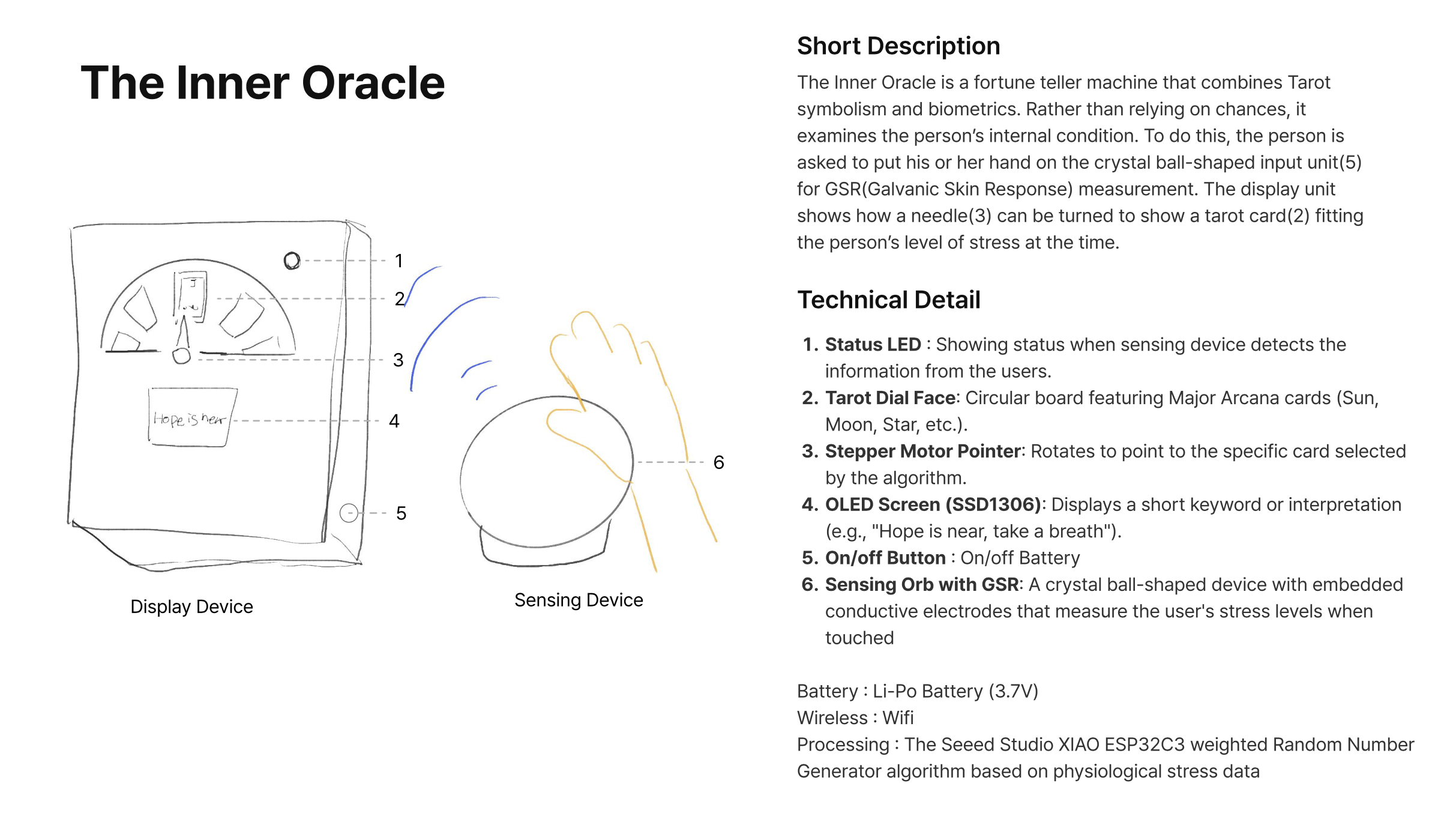
The system is built with a Dual-Node Architecture using two Seeed Studio XIAO ESP32-C3 microcontrollers communicating via the ESP-NOW wireless protocol.
[User's Hand] -> [GSR Sensor] -> [Sensing XIAO] --(ESP-NOW Wireless)--> [Display XIAO] -> [X27 Motor & OLED]
/Sensing_Node: Source code for GSR data processing and ESP-NOW transmission./Display_Node: Source code for motor control, OLED UI, and data reception.| Qty | Value | Footprint | References |
|---|---|---|---|
| 2 | 10k | Resistor_SMD:R_0805_2012Metric_Pad1.20x1.40mm_HandSolder | R1, R2 |
| 2 | 1uf | Capacitor_SMD:C_0805_2012Metric_Pad1.18x1.45mm_HandSolder | C1, C2 |
| 1 | 0.1uf | Capacitor_SMD:C_0805_2012Metric_Pad1.18x1.45mm_HandSolder | C3 |
| 1 | 1k | Resistor_SMD:R_0805_2012Metric_Pad1.20x1.40mm_HandSolder | R3 |
| 1 | 4.7uf | Capacitor_SMD:C_0805_2012Metric_Pad1.18x1.45mm_HandSolder | C4 |
| 1 | Conn_01x04_Pin | Connector_PinSocket_2.54mm:PinSocket_1x04_P2.54mm_Vertical | J1 |
| 1 | LED | LED_SMD:LED_0805_2012Metric_Pad1.15x1.40mm_HandSolder | D1 |
| 1 | LTR390 | OptoDevice:Lite-On_LTR-303ALS-01 | U2 |
| 1 | MIC5376 | Package_TO_SOT_SMD:SOT-23-5 | U1 |


google/mozc-devices
Circuit diagrams and firmware source code for Gboard DIY keyboards


FrameworkComputer/ExpansionCards
Reference designs and documentation to create Expansion Cards for the Framework Laptop

hoglet67/RGBtoHDMI
Bare-metal Raspberry Pi project that provides pixel-perfect sampling of Retro Computer RGB/YUV video and conversion to HDMI

hackclub/OnBoard
💡 Join 1,000 teenagers and make your first PCB with a $100 grant!


tardate/LittleArduinoProjects
a collection of "Little Electronic & Arduino Projects", most involving electronics or an Arduino in one way or another!

basilfx/TRADFRI-Hacking
Hacking IKEA TRÅDFRI products, such as light bulbs, window blinds and other accessories.
It measures 24 × 17 mm and has 2 copper layers, 1.6 mm thick.
11 parts. The full list of its parts is on this page, with links to each part's symbol and footprint where PCBKit's library has them.
From the junction-su/514_Final_InnerOracle repository on GitHub, at the commit this page was made from: the board is TECHIN514_w26_project_PCB/techin514_Lab3.kicad_pcb and its schematic Schematics/514_final_display.kicad_sch. PCBKit opens the board in the browser, with nothing to install.
Its repository states no licence, so its author keeps all rights: ask junction-su before reusing the design.