Skip to the content
2 layers23.4 × 27 mmSimon pocket, the printed circuit board in 3D

A pocket version of the classic Simon says game

Size
23.4 × 27 mm
Copper layers
2
Thickness
1.6 mm
Parts
40
Nets
52
Pads
132
Tracks, vias
230, 29
Pours
1
Routed
Yes
KiCad
KiCad 10.0 (file 20260206)
Created
7 Aug 2026
Updated
31 Aug 2026

Overview

Simon pocket is an open-source printed circuit board by JorisBar, from the JorisBar/Simon_pocket repository on GitHub. It is a 2-layer board of 23.4 × 27 mm with 40 parts on 52 nets, routed with 230 tracks and 29 vias.

Its parts include 13 resistors, 10 capacitors, 4 diodes, 4 connectors and 4 switches. It belongs with the STM32 boards of this library.

README

README.md

Simon_pocket – A pocket version of the classic Simon says game

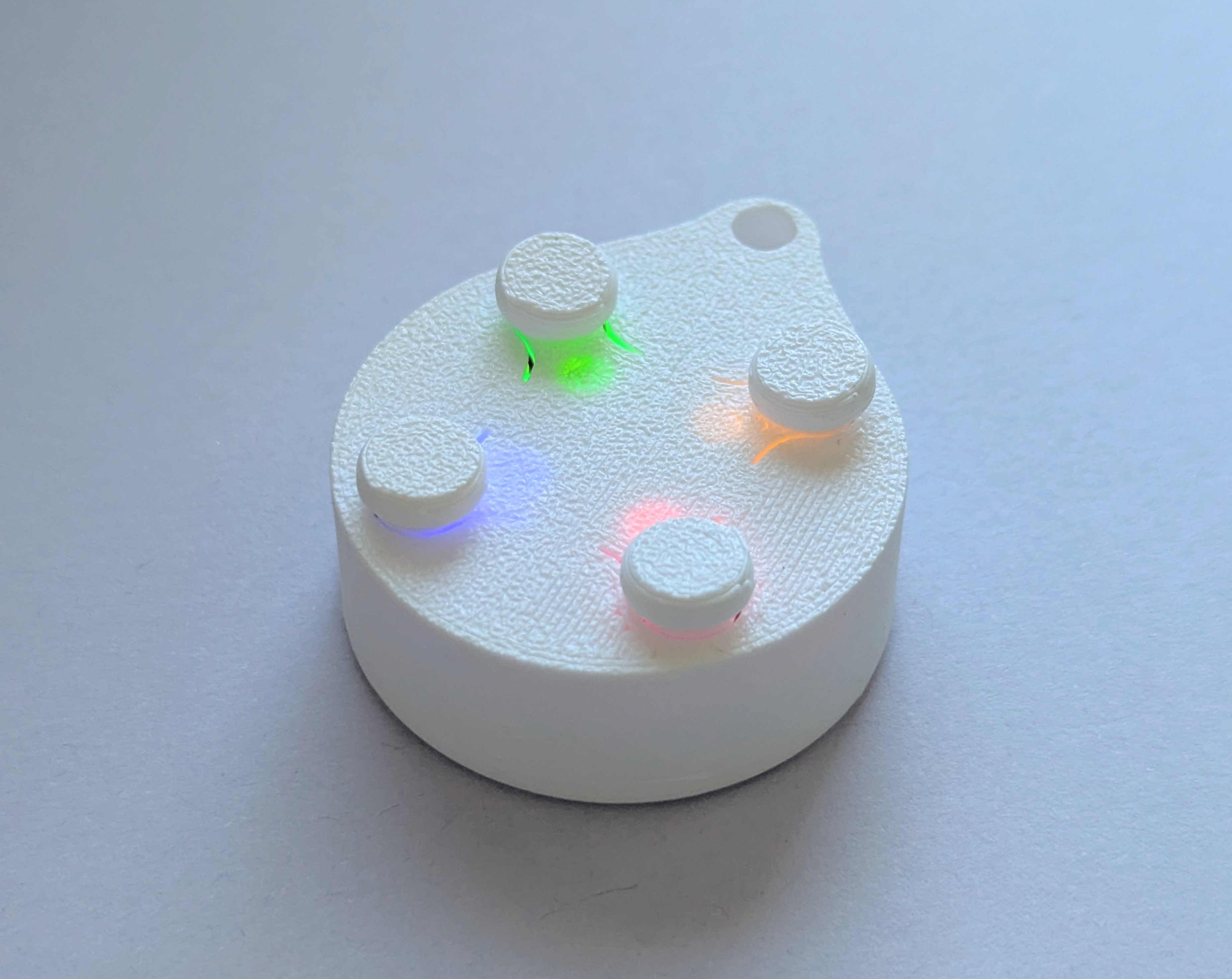
Main photo with housing

Simon_pocket is a pocket sized memory training game. Players have to repeat a button sequence that gets longer each round. This project includes a custom PCB, bare metal programming for an STM32 MCU and a 3D printed housing.


Gameplay

Gameplay Diagram


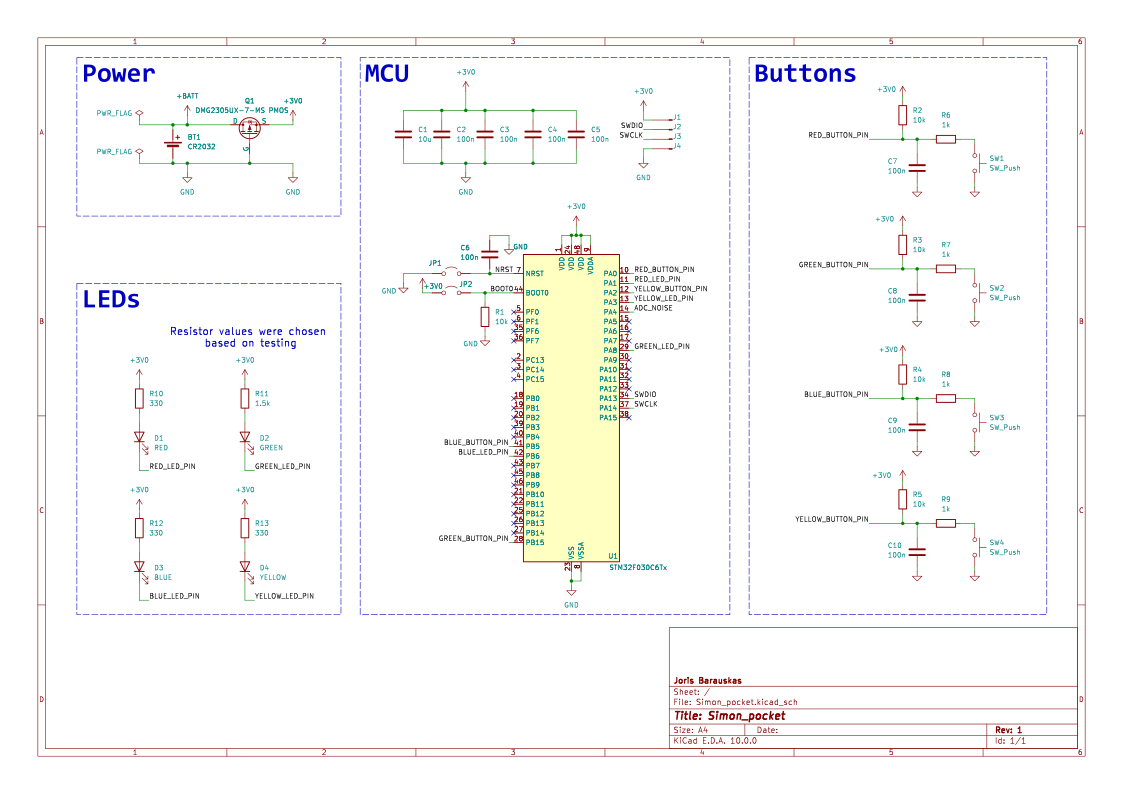
Hardware Architecture

Hardware Diagram


Component Selection and Design Considerations

  • Microcontroller: The STM32F030C6T6 was chosen for being inexpensive (0.5€ @ 30+ Qty) and having good documentation and support.
  • Battery: The CR2032 was selected because of the 3V nominal voltage, compact size and availability.
  • Sound system: Buzzers/speakers had to be omitted due to the high internal resistance of the battery.
  • Power on: Due to space constraints, a dedicated power button was not possible. Instead, every button is configured to wake up the MCU from STOP mode.
  • Standby current: To decrease standby current to ~6uA:
    • A low leakage current PMOS was selected.
    • No LDOs or switching regulators were used.
    • The MCU operates mostly in STOP power saving mode.

PCB Design & Layout Details

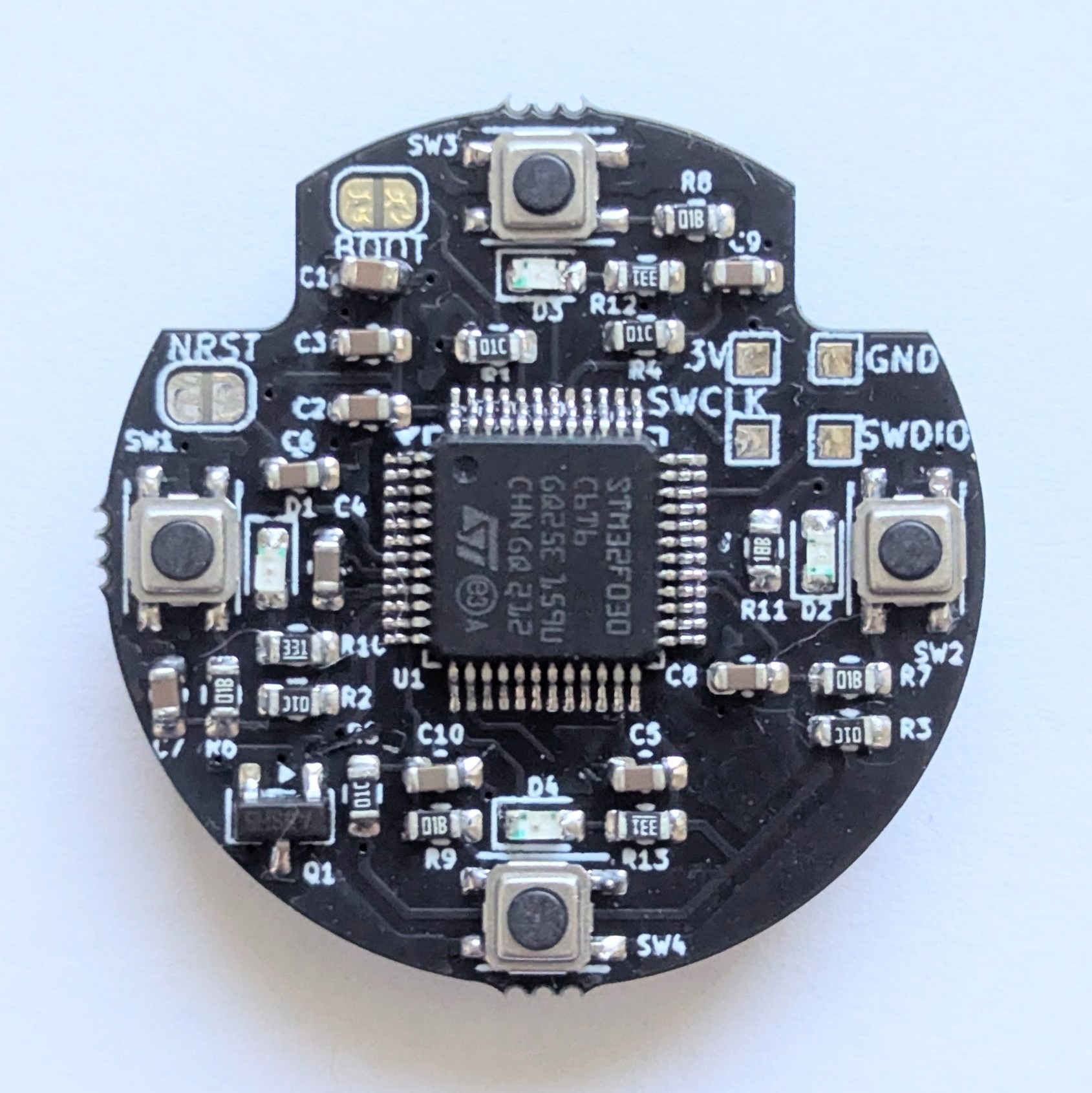
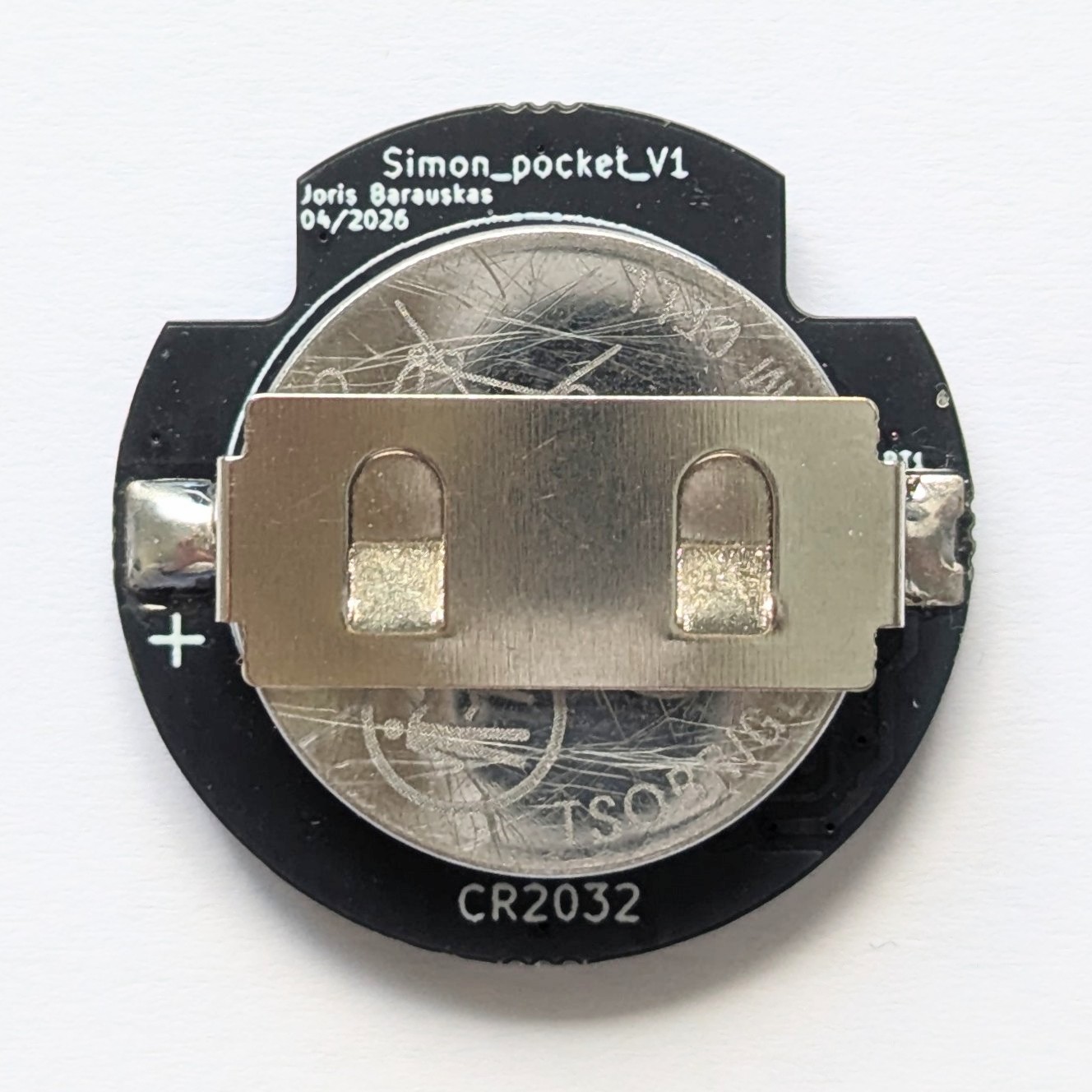
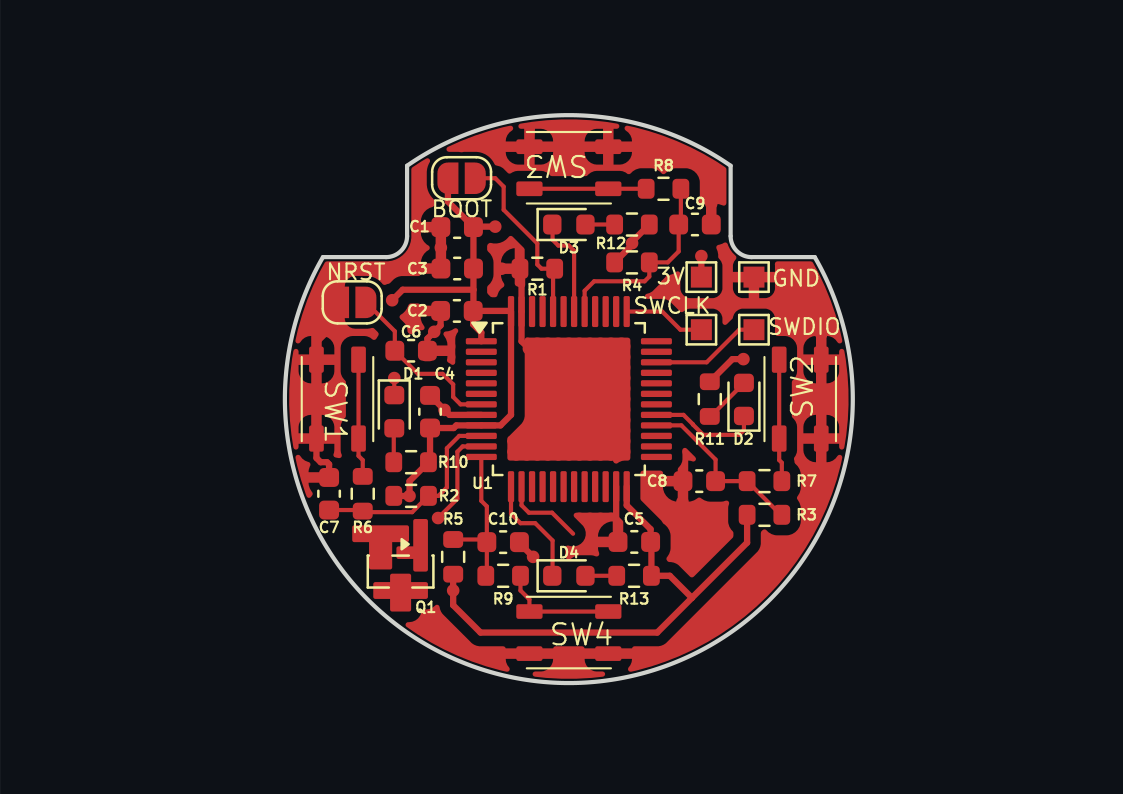
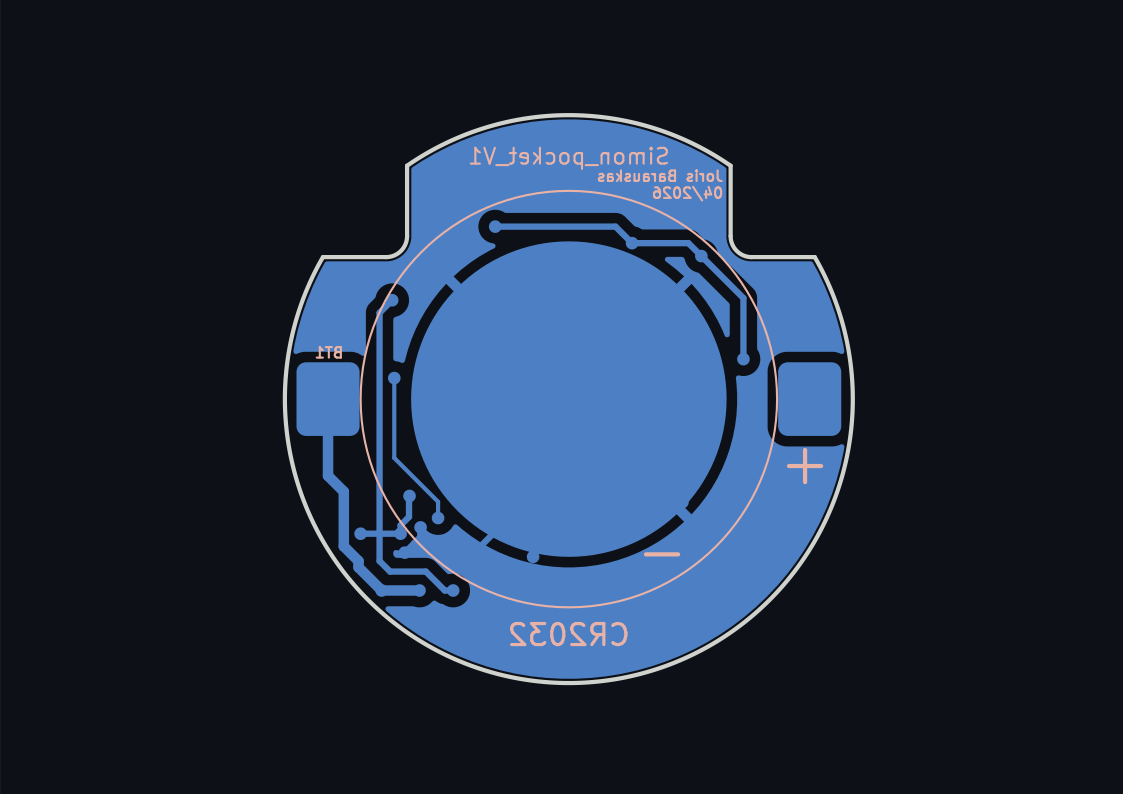
PCB top layer PCB bottom layer

PCB top layer PCB bottom layer

PCB Schematic

Layer Stackup (2-Layer)

  1. Top (Signal / Power): MCU, LED and button traces. Power distribution.
  2. Bottom (Ground / Power): Negative battery contact and ground plane. Power distribution.

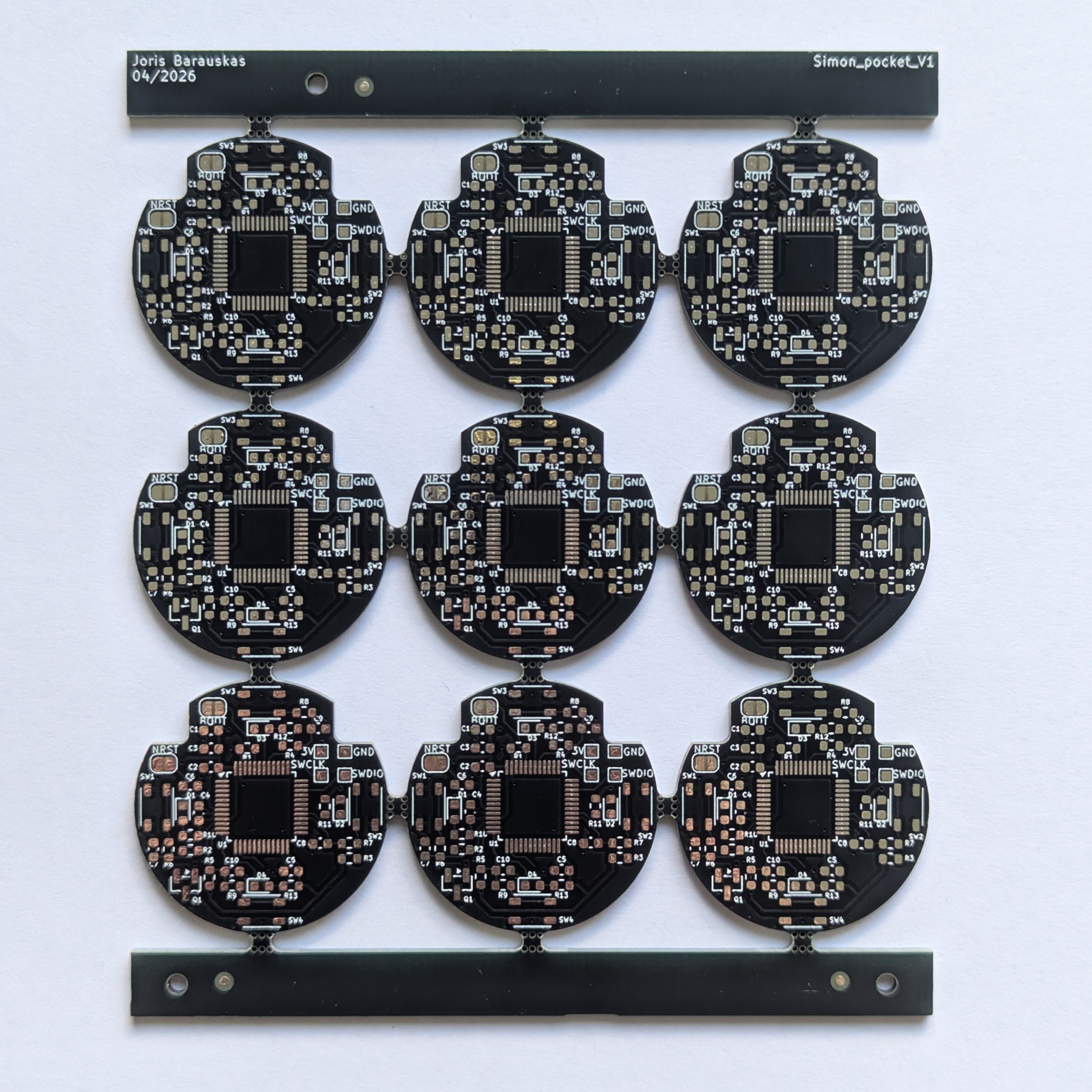
PCB panel

A PCB panel was designed to decrease the cost of each PCB.

PCB panel


Programming

The code was written in bare metal CMSIS C using the STM32CubeIDE. To upload the code an ST-LINK V2 has to be connected to the programming contacts on the PCB.

Code structure

Event-driven low power code structure

State machine transitions

State machine transitions


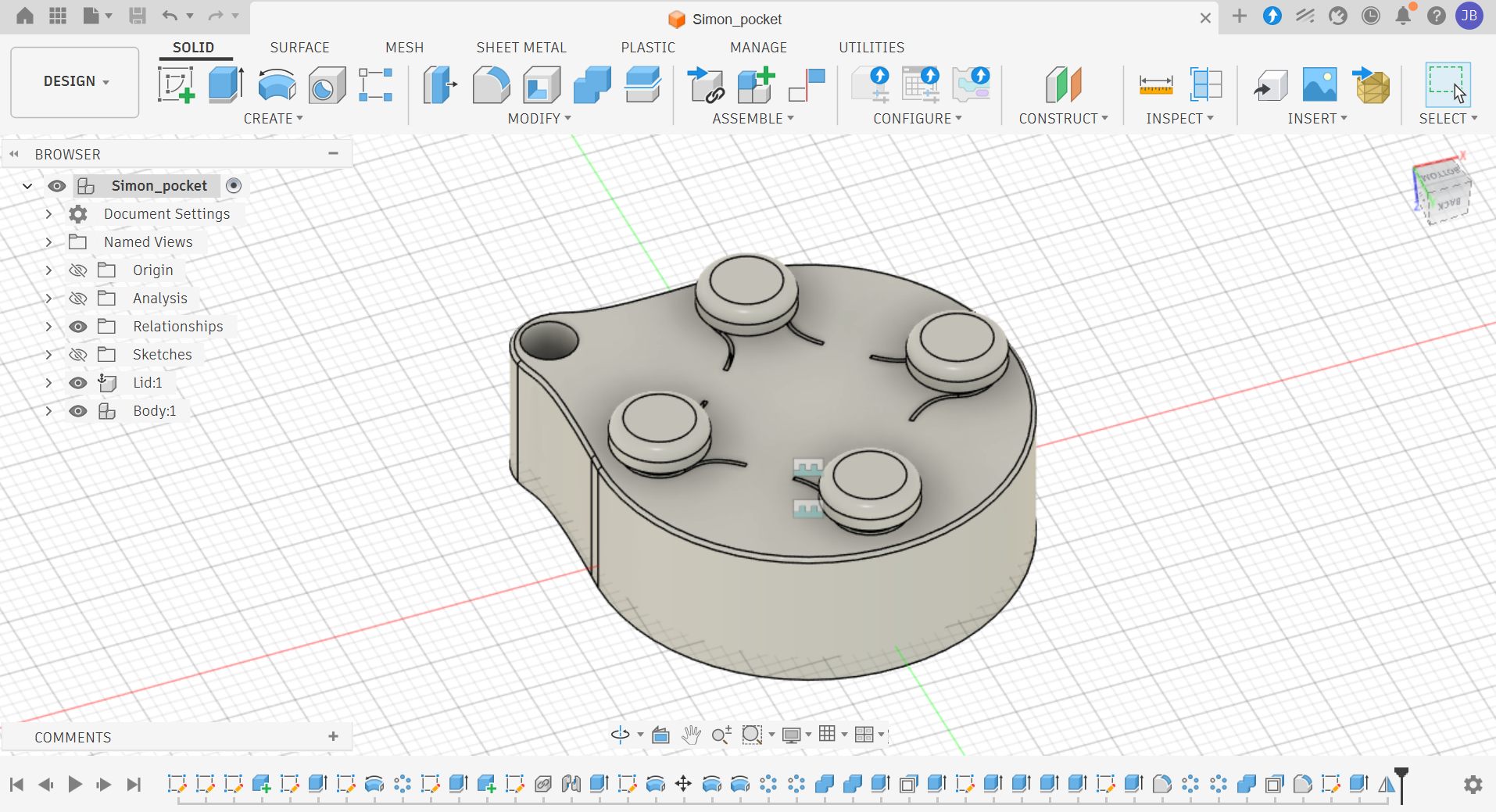
3D modeling and printing

The housing was modeled using Autodesk Fusion. It was printed using a Bambu Lab A1 mini 3D printer.

Fusion Workspace

Parts

40
QtyValueFootprintReferences
9100nCapacitor_SMD:C_0603_1608MetricC2, C3, C4, C5, C6, C7, C8, C9, C10
510kResistor_SMD:R_0603_1608MetricR1, R2, R3, R4, R5
41kResistor_SMD:R_0603_1608MetricR6, R7, R8, R9
4Conn_01x01_PinTestPoint:TestPoint_Pad_1.0x1.0mmJ1, J2, J3, J4
4SW_PushMy library:SW_Push mini square HansElectricity C22375378SW1, SW2, SW3, SW4
3330Resistor_SMD:R_0603_1608MetricR10, R12, R13
2Jumper_2_OpenJumper:SolderJumper-2_P1.3mm_Open_RoundedPad1.0x1.5mmJP1, JP2
11.5kResistor_SMD:R_0603_1608MetricR11
110uCapacitor_SMD:C_0603_1608MetricC1
1BLUELED_SMD:LED_0603_1608MetricD3
1Battery_CellMy library:CR2032 slim holderBT1
1GREENLED_SMD:LED_0603_1608MetricD2
1PMOSPackage_TO_SOT_SMD:SOT-23Q1
1REDLED_SMD:LED_0603_1608MetricD1
1STM32F030C6TxPackage_QFP:LQFP-48_7x7mm_P0.5mmU1
1YELLOWLED_SMD:LED_0603_1608MetricD4

More from JorisBar/Simon_pocket

1
  • 2 layers85.4 × 102.1 mmSimon pocket panel, the printed circuit board in 3D

    Simon pocket panel

    JorisBar/Simon_pocket

    A pocket version of the classic Simon says game

    378 parts1

Similar boards

  • 2 layers139.7 × 73.7 mm134pin 7-967288-1, the printed circuit board in 3D

    134pin 7-967288-1

    rusefi/rusefi

    rusefi - GPL internal combustion engine control unit

    40 parts1.2k
  • 2 layers149.4 × 177.4 mmLightsculpture, the printed circuit board in 3D

    Lightsculpture

    hackclub/OnBoard

    💡 Join 1,000 teenagers and make your first PCB with a $100 grant!

    40 parts915
  • 2 layers150 × 50 mmEleLab v2 Bus150, the printed circuit board in 3D

    EleLab v2 Bus150

    Chrismettal/EleLab_v2

    Cheap DIY lab system for hobbyists and the tinkering folk

    40 parts531GPL-3.0
  • 2 layers66.4 × 48.1 mmRaspberry, the printed circuit board in 3D

    Raspberry

    Chrismettal/flipper-zero-backpacks

    Backpack-style addon boards for the Flipper Zero!

    40 parts456
  • 2 layers44 × 44 mmTrackball, the printed circuit board in 3D

    Trackball

    jfedor2/rp2040-pmw3360

    RP2040+PMW3360 PCB and code

    40 parts432
  • 2 layers90.8 × 53.3 mmABSIS Bus Master, the printed circuit board in 3D

    ABSIS Bus Master

    jrsteensen/OpenHornet

    OpenHornet 1:1 F/A-18C Simulator Repository

    40 parts431
  • 2 layers59.6 × 109.5 mmDrop, the printed circuit board in 3D

    Drop

    ohmtech-rdi/eurorack-blocks

    Software to Hardware Prototyping for Eurorack using C++, Max/Gen~ or Faust

    40 parts410
  • 2 layers123.8 × 73.5 mmAttic, the printed circuit board in 3D

    Attic

    simondlevy/Hackflight

    Minimalist flight-control toolkit for makers

    40 parts334GPL-3.0

Questions

How big is the Simon pocket PCB?

It measures 23.4 × 27 mm and has 2 copper layers, 1.6 mm thick.

What parts does the Simon pocket use?

40 parts. The full list of its parts is on this page, with links to each part's symbol and footprint where PCBKit's library has them.

Where can I download the Simon pocket KiCad files?

From the JorisBar/Simon_pocket repository on GitHub, at the commit this page was made from: the board is PCB/Standard/Simon_pocket.kicad_pcb and its schematic PCB/Standard/Simon_pocket.kicad_sch. PCBKit opens the board in the browser, with nothing to install.

Can I use the Simon pocket design in my own project?

Its repository states no licence, so its author keeps all rights: ask JorisBar before reusing the design.