4 layers20 × 106 mm

 jamesmunns/BERLINER9
Dev boards in eurorack format
Backplane is an open-source printed circuit board by jamesmunns, from the jamesmunns/BERLINER repository on GitHub. It is a 4-layer board of 237 × 84 mm with 92 parts on 133 nets, routed with 1,566 tracks and 261 vias.
It is built around the CH224K and GT-USB-7051A. Its parts include 21 capacitors, 21 diodes, 20 resistors, 14 connectors and 8 ICs. It belongs with the audio and music boards of this library.


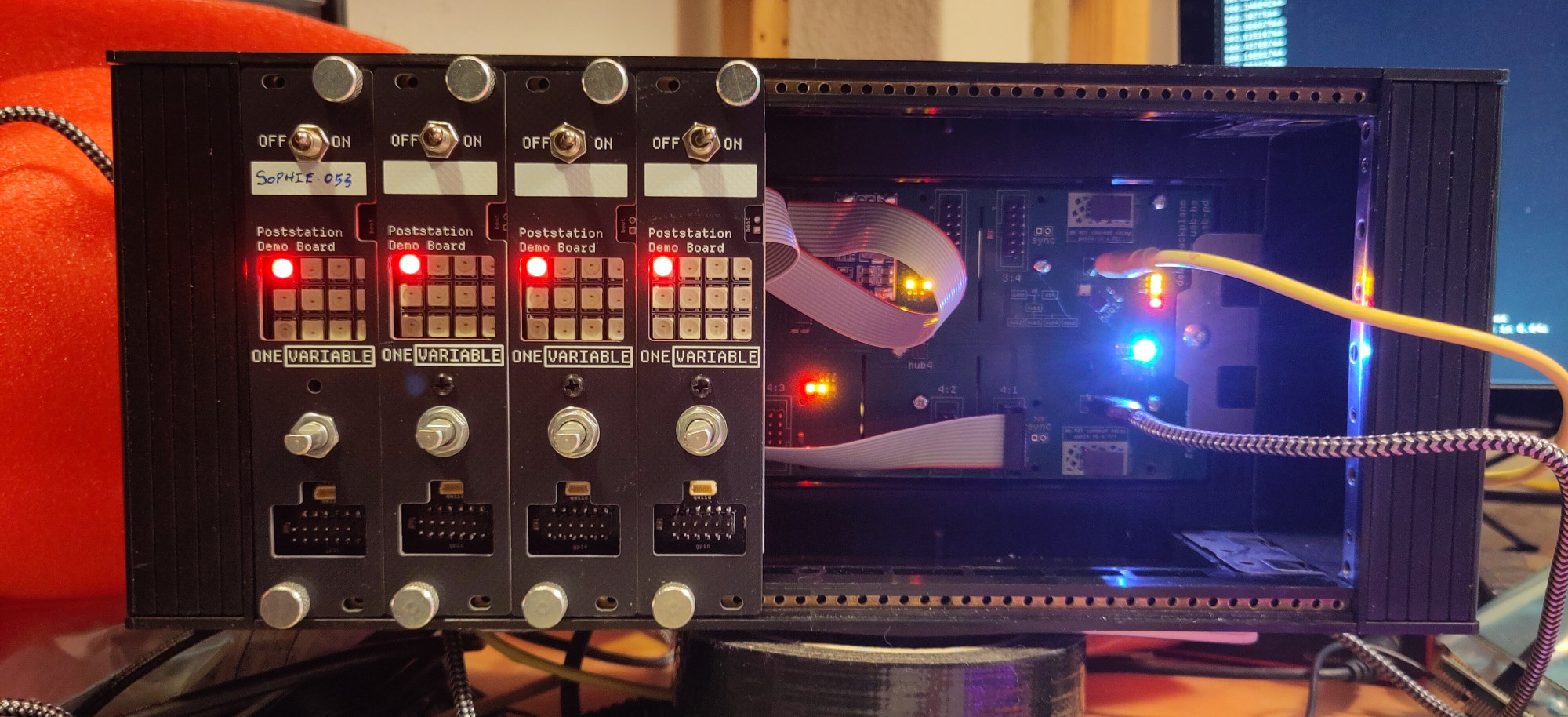
BERLINER (BERLINER Euro Rack-Like Is Not Euro Rack) is an informal standard for USB and microcontroller oriented cards, using the eurorack form factor (but not the same power supply).
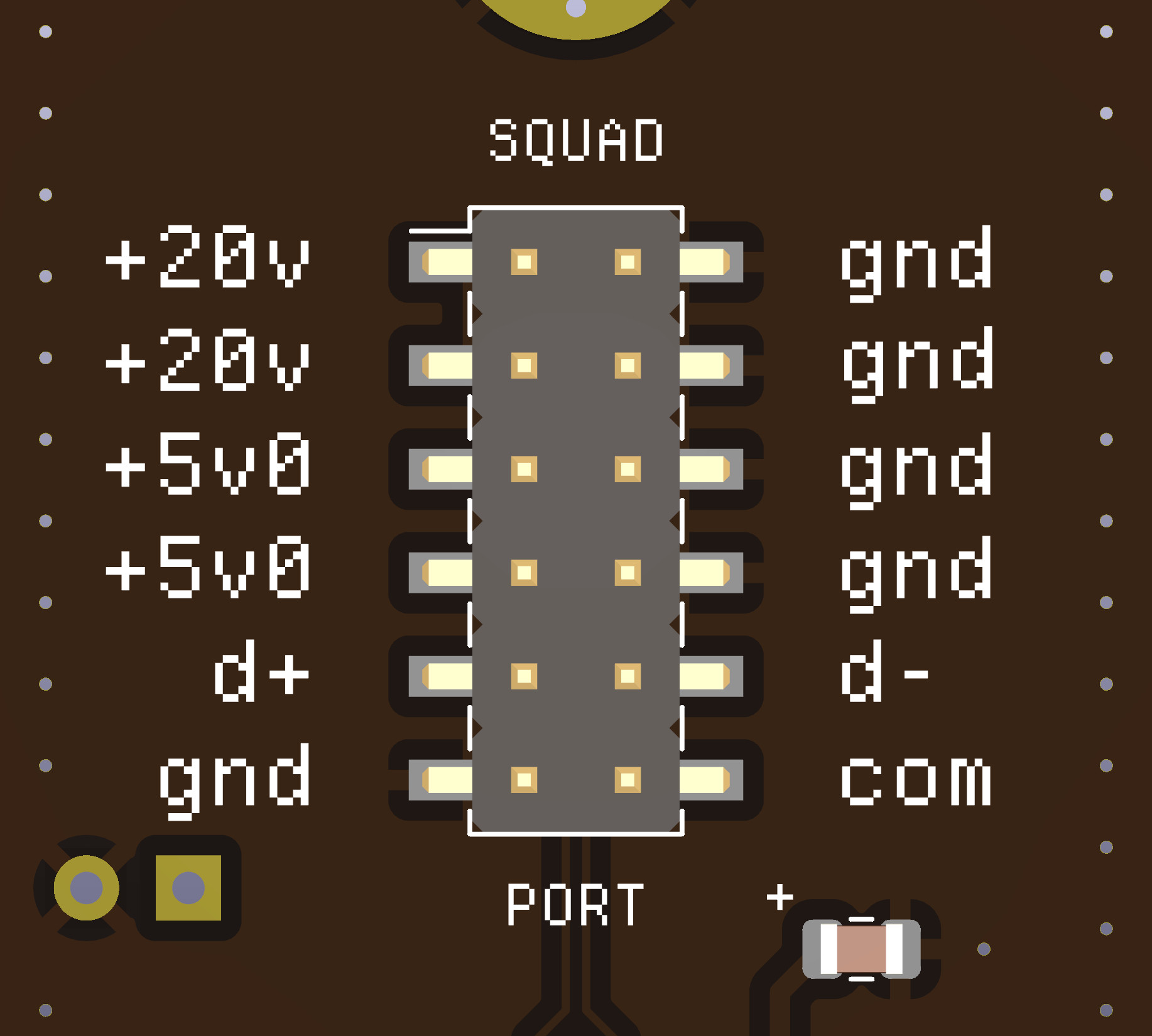
Most of the "standard" here is the connector used on the boards. It's a 0.1" pitch 2x6 IDC connector. The picture above is taken looking at the BACK of the board.
The pins are:
| Use | Pin | Pin | Use |
|---|---|---|---|
| +20v power | 1 | 2 | Ground |
| +20v power | 3 | 4 | Ground |
| +5v0 power | 5 | 6 | Ground |
| +5v0 power | 7 | 8 | Ground |
| USB FS/HS D+ | 9 | 10 | USB FS/HS D- |
| Ground | 11 | 12 | Common |
This is intended to be supplied by USB-PD, so it should be expected this rail can be any voltage 5v0 to 20v0 max. This rail is expected to have more wattage available than the +5v0 power rail. You may need a variable input DC/DC that can handle this.
This is a 5-volt-ish rail. Probably something in the tolerance of regular USB 5v, so +/- 0.25v. You can use this exclusively, but current may be shared with many other boards. If you need to do something high current, do it from the +20v power rail.
This is the normal differential pair used by USB Full Speed or USB High Speed.
This isn't super well defined, but it is intended as a low frequency, open-drain, interface, usable for clock sync or trigger. TBD who provides the pullup, maybe all boards on the order of 10k-50k (i.e. internal MCU pullups).
cards/ folderThese are board designs that are compatible with this "standard". They are intended to be mounted using the [Eurorack] device conventions, meaning a 128.5mm tall board, with M3 screws.
Some boards will have separate "face plates" or "covers" and "logic boards". In this case, the cover will be the full 128.5mm tall, and the logic board will often be a bit shorter (typ: 106.0mm), as it needs clearance to "drop into" the frame.
In these cases, covers will be mounted to the face plate either using hardware that is present (switches, dials), M3 headers, or some other mechanical means (outside the scope of this standard).
Feel free to open a PR with any designs you would like to share. KICAD designs preferred.
hubs/ folderSince the cards don't take standard USB cables as input, it is generally necessary to have another PCBA that acts as an adapter. These have three main responsibilities:
There are many options for chips that do this, but the CH334F (4 port USB hub) and CH224K (USB-PD negotiation) are used in some designs, and are available at reasonable prices.
Hubs can be present in two main forms:
hubs/usb-demo-4 for an example hub in this form factor.hubs/backplane for an example hub in this form factor, designed to fit the Sinusoda CAN eurorack case.idk something like cc-by-sa-nc?
| Qty | Value | Footprint | References |
|---|---|---|---|
| 16 | GREEN | Diode_SMD:D_0603_1608Metric | D1, D2, D3, D4, D6, D7, D8, D9, D11, D12, D13, D14, D16, D17, D18, D19 |
| 12 | 22uF | Capacitor_SMD:C_0805_2012Metric | C10, C11, C12, C13, C14, C15, C16, C17, C18, C19, C20, C21 |
| 12 | Conn_02x06_Odd_Even | Connector_IDC:IDC-Header_2x06_P2.54mm_Vertical | J1, J2, J3, J4, J5, J6, J7, J8, J9, J10, J11, J12 |
| 9 | 10u | Capacitor_SMD:C_0603_1608Metric | C1, C2, C3, C4, C5, C6, C7, C8, C9 |
| 8 | 220 | Resistor_SMD:R_0603_1608Metric | R1, R2, R4, R5, R7, R8, R10, R11 |
| 5 | 10K | Resistor_SMD:R_0603_1608Metric | R14, R15, R16, R17, R18 |
| 4 | 470 | Resistor_SMD:R_0603_1608Metric | R3, R6, R9, R12 |
| 4 | Crystal_GND24 | Crystal:Crystal_SMD_3225-4Pin_3.2x2.5mm | Y1, Y2, Y3, Y4 |
| 4 | GT-USB-7051A | easyeda2kicad:USB-C-SMD_GT-USB-7051A | USB1, USB2, USB3, USB4 |
| 4 | RED | Diode_SMD:D_0603_1608Metric | D5, D10, D15, D20 |
| 4 | ~ | Package_DFN_QFN:QFN-24-1EP_4x4mm_P0.5mm_EP2.7x2.7mm_ThermalVias | U1, U2, U3, U4 |
| 3 | mini-560 | backbone-16:mini-560-smd | U5, U6, U7 |
| 2 | 5K1 | Resistor_SMD:R_0603_1608Metric | R19, R20 |
| 2 | Conn_01x02 | Connector_PinHeader_2.54mm:PinHeader_1x02_P2.54mm_Vertical | J13, J14 |
| 1 | 1K | Resistor_SMD:R_0603_1608Metric | R13 |
| 1 | CH224K | easyeda2kicad:ESSOP-10_L4.9-W3.9-P1.0-LS6.0-TL-EP | U8 |
| 1 | WHITE | Diode_SMD:D_0603_1608Metric | D21 |
It measures 237 × 84 mm and has 4 copper layers, 1.6 mm thick.
92 parts, built around the CH224K and GT-USB-7051A. The full list of its parts is on this page, with links to each part's symbol and footprint where PCBKit's library has them.
From the jamesmunns/BERLINER repository on GitHub, at the commit this page was made from: the board is hubs/backplane/backplane.kicad_pcb and its schematic cards/demo-card-cover/stamp-card-cover.kicad_sch. PCBKit opens the board in the browser, with nothing to install.
Its repository states no licence, so its author keeps all rights: ask jamesmunns before reusing the design.


SK-Electronics-Consulting/electronics-widgets
Small, Custom Tools for Electronics

techmiguel/stillpoint
Open-hardware 60 GHz radar ceiling sensor: presence & fall detection without a camera. Matter over Thread, KiCad 4-layer Ø60 mm board.

ephemerkey/ephemerkey
The consumer half of the ephemerkey system, and the second PCB in this repo (alongside hardware/ephemerkey/, sharing the same scripts/kschgen.py engine, Makefile, and lib tables — the multi-project layout used by…

npgo22/APRL-Electrical-New
To use the board templates, set KICADUSERTEMPLATEDIR by:


schenkmi/electronic-retro-computing-projects
In revision 2, the PCB size has been reduced by more than 50% and TAPuino support has been ditched. It now features a Micro SD slot and a few other improvements.

openwch/ch32v003
CH32V003 is an ultra-cheap RISC-V MCU with 2KB SRAM, 16KB flash, and up to 18 GPIOs that sells for under $0.10