4 layers45 × 38 mm
MerlynCAM
YeetTheAnson/MerlynCAM
An action camera that records at 1080p@90, 1440p@60 and 4k@20 (With I2S microphone and gyro logging @ 150Hz)
150 parts1

 Jamane92/ESP32_C5_DRONE_VTX
Custom 4-layer FPV camera transmitter featuring an ESP32-C5 microcontroller, OV5640 camera sensor via PARLIO DVP, SD card logging, and 5.8 GHz Wi-Fi video streaming. Designed in KiCad.
Projet Drone C5 VTX is an open-source printed circuit board by Jamane92, from the Jamane92/ESP32_C5_DRONE_VTX repository on GitHub. It is a 4-layer board of 43 × 51.1 mm with 67 parts on 66 nets, routed with 556 tracks and 143 vias.
It is built around the ESP32-C5-WROOM-1U-N8R8, SN74LVC1G34DBVRE and TF-115-BCP9, with the USBLC6-2P6, XC6206-2.8V and XC6206P152MR-MS among its other parts. Its parts include 26 resistors, 21 capacitors, 6 ICs, 4 diodes and 3 connectors. It belongs with the robots and motor control boards and the ESP32 and RISC-V boards of this library.


Ce PCB contient 4 couches, étant embarqué sur un drone, il possède des entrées d'alimentations +5V, que sont l'USB-C, également utilisé pour programmer l'ESP32, ainsi que des PADs de cuivre, qui viendront directement être branché à partir de mon flight controler. Il possède deux diodes Schottky pour faire du OR'ing. Une OV5640, un lecteur de carte SD, ainsi qu'un module 1U spécialement choisi pour la possibilité d'y brancher une antenne, qui est une lollipop en RHCP, mieux qu'une antenne "simple", car celle-ci émettra un signal en forme de cercle, parfaitement adapté pour une antenne en hauteur qui va communiquer avec le sol.
Je suis parti sur un 4 couches pour me simplifier la vie. Mon stack-up est le suivant :
Tous les composants sont sur la même face pour des raisons économiques (plus cher de faire les deux face lors de l'assemblage chez JLCPCB).
Afin d'optimiser l'intégrité des signaux, de nombreux vias de masse (ground vias) ont été placés pour relier (stitching) les plans de masse entre les couches L2 et L3. Ce stitching de masse assure un chemin de retour court, direct et ininterrompu pour les signaux numériques à haute vitesse (bus de la caméra OV5640, interface de la carte SD) ainsi que pour la section RF à 5.8 GHz. Cela permet de minimiser l'inductance des boucles de courant et de réduire drastiquement les interférences électromagnétiques (EMI), un point absolument critique dans l'environnement très bruyant d'un drone (ESC, moteurs).
L'impédance de la ligne de communication différentiel D+/D- est matché à 90Ω
Voici la schématique :
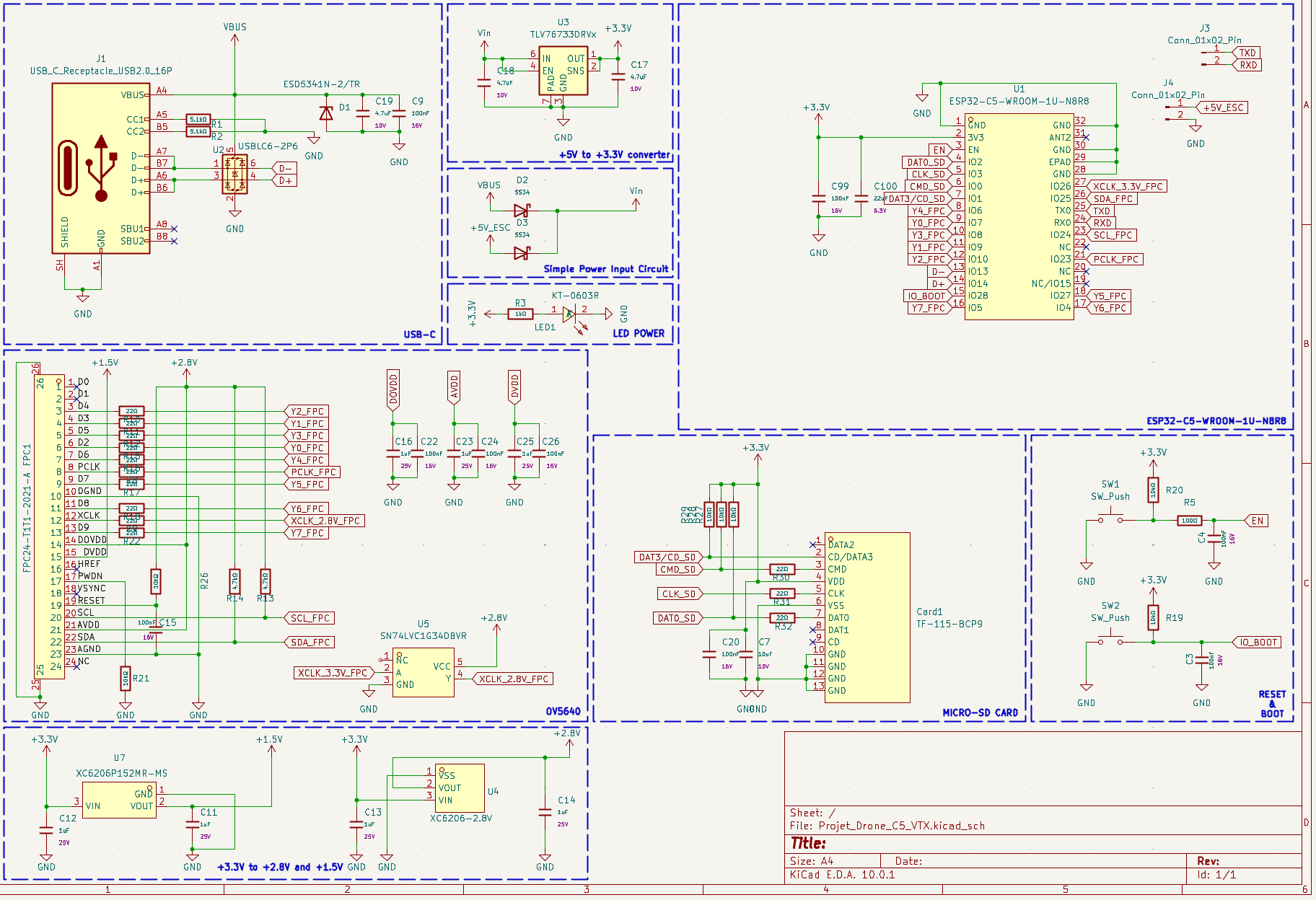
Voici le routage :
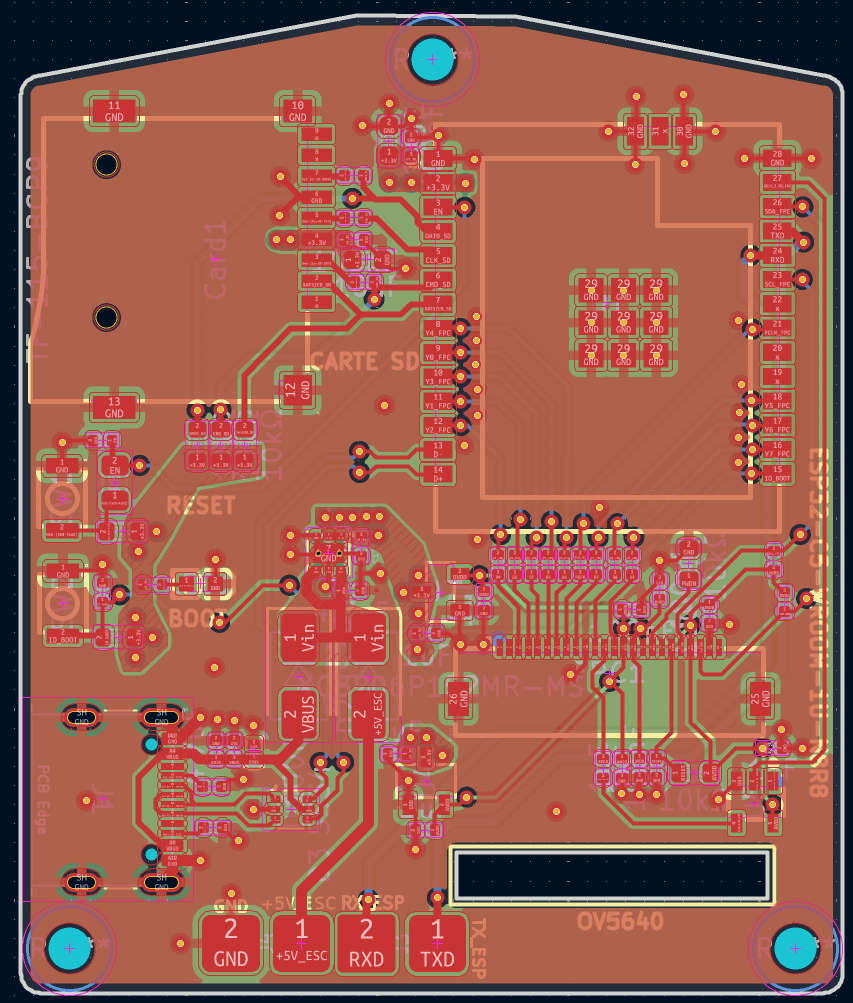
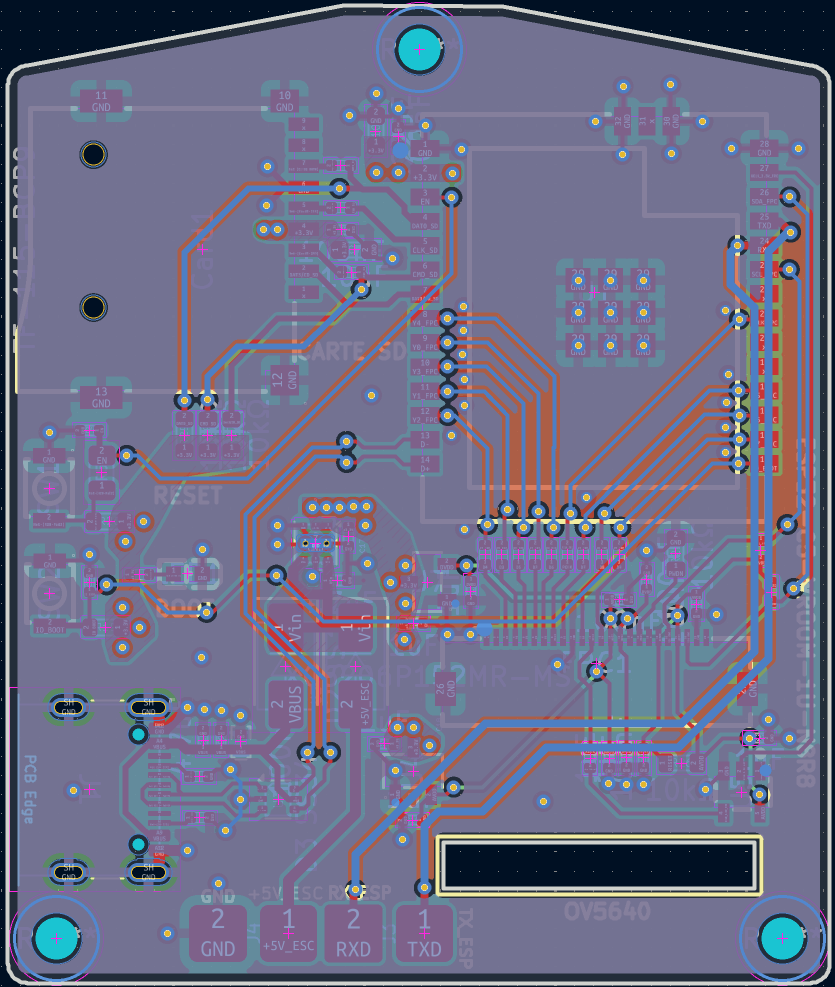
Voici la 3D :
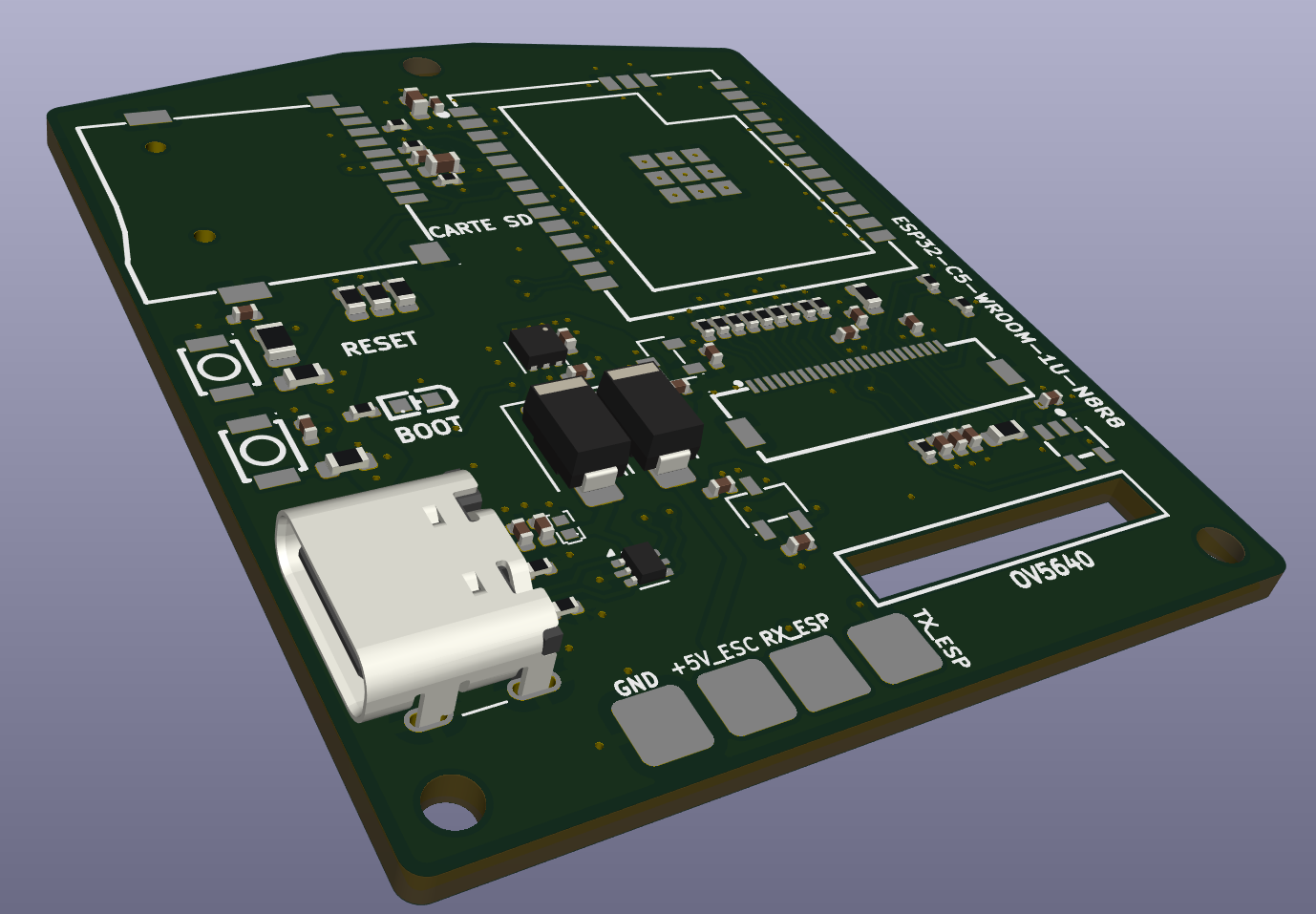
| Qty | Value | Footprint | References |
|---|---|---|---|
| 13 | 22Ω | PCM_JLCPCB:R_0402 | R8, R9, R10, R11, R12, R15, R16, R17, R18, R22, R30, R31, R32 |
| 9 | 100nF | PCM_JLCPCB:C_0402 | C3, C4, C9, C15, C20, C22, C24, C26, C99 |
| 7 | 10kΩ | PCM_JLCPCB:R_0603 | R19, R20, R21, R26, R27, R28, R29 |
| 7 | 1uF | PCM_JLCPCB:C_0402 | C11, C12, C13, C14, C16, C23, C25 |
| 3 | 4.7uF | PCM_JLCPCB:C_0402 | C17, C18, C19 |
| 2 | 4.7kΩ | PCM_JLCPCB:R_0402 | R13, R14 |
| 2 | 5.1kΩ | PCM_JLCPCB:R_0402 | R1, R2 |
| 2 | Conn_01x02_Pin | Connector_Wire:SolderWire-0.127sqmm_1x02_P3.7mm_D0.48mm_OD1mm | J3, J4 |
| 2 | SS34 | PCM_JLCPCB:D_SMA | D2, D3 |
| 2 | SW_Push | easyeda2kicad:KEY-SMD_B3U-1000PM | SW1, SW2 |
| 1 | 100Ω | PCM_JLCPCB:R_0805 | R5 |
| 1 | 10uF | PCM_JLCPCB:C_0603 | C7 |
| 1 | 1kΩ | PCM_JLCPCB:R_0402 | R3 |
| 1 | 22uF | PCM_JLCPCB:C_0603 | C100 |
| 1 | ESD5341N-2/TR | easyeda2kicad:DFN1006-2L-RD | D1 |
| 1 | ESP32-C5-WROOM-1U-N8R8 | easyeda2kicad:COMM-SMD_32P-L21.2-W18.0_ESP32-C5-WROOM-1U | U1 |
| 1 | FPC24-T1T1-2021-A | easyeda2kicad:FPC-SMD_FPC24-T1T1-2021-A | FPC1 |
| 1 | KT-0603R | easyeda2kicad:LED-SMD_L1.6-W0.8-R-RD | LED1 |
| 1 | SN74LVC1G34DBVR | easyeda2kicad:SOT-23-5_L2.9-W1.6-P0.95-LS2.8-BR | U5 |
| 1 | TF-115-BCP9 | easyeda2kicad:TF-SMD_TF-115-BCP9 | Card1 |
| 1 | TLV76733DRVx | Package_SON:WSON-6-1EP_2x2mm_P0.65mm_EP1x1.6mm_ThermalVias | U3 |
| 1 | USBLC6-2P6 | Package_TO_SOT_SMD:SOT-666 | U2 |
| 1 | USB_C_Receptacle_USB2.0_16P | Connector_USB:USB_C_Receptacle_GCT_USB4105-xx-A_16P_TopMnt_Horizontal | J1 |
| 1 | XC6206-2.8V | easyeda2kicad:SOT-23-3_L2.9-W1.6-P1.90-LS2.8-BR | U4 |
| 1 | XC6206P152MR-MS | easyeda2kicad:SOT-23-3_L2.9-W1.3-P1.90-LS2.4-BR | U7 |
The 64 most common of 67 parts.
YeetTheAnson/MerlynCAM
An action camera that records at 1080p@90, 1440p@60 and 4k@20 (With I2S microphone and gyro logging @ 150Hz)


YeetTheAnson/RFly-One
Offline general aviation proximity awareness system with support for ADS-B, FLARM AIR V7, OGNTP and FANET+


duanestorey/hifi-amp
A high-fidelity four-channel amplifier with active-crossovers and room correction

DeadlySIn777/Controller
Unfinished CNC controller motherboard: native KiCad sources, rules, DSN and global routing review

thejamesrhodes/Hyades-Flight-Computer
Full Hardware and Electronics design, Bare-metal GNC flight software for an actively attitude-controlled high-power rocket

jbilander/SF2000
Spitfire 2000, A low-end 42 MHz Accelerator with IDE and 4/8 MB fast RAM for the Amiga 2000 co-pro slot (or A500 through an adapter).
It measures 43 × 51.1 mm and has 4 copper layers, 1.6 mm thick.
67 parts, built around the ESP32-C5-WROOM-1U-N8R8, SN74LVC1G34DBVRE, TF-115-BCP9 and USBLC6-2P6. The full list of its parts is on this page, with links to each part's symbol and footprint where PCBKit's library has them.
From the Jamane92/ESP32_C5_DRONE_VTX repository on GitHub, at the commit this page was made from: the board is PCB/Projet_Drone_C5_VTX.kicad_pcb and its schematic PCB/Projet_Drone_C5_VTX.kicad_sch. PCBKit opens the board in the browser, with nothing to install.
Its repository states no licence, so its author keeps all rights: ask Jamane92 before reusing the design.