

2 layers34.6 × 10.9 mm
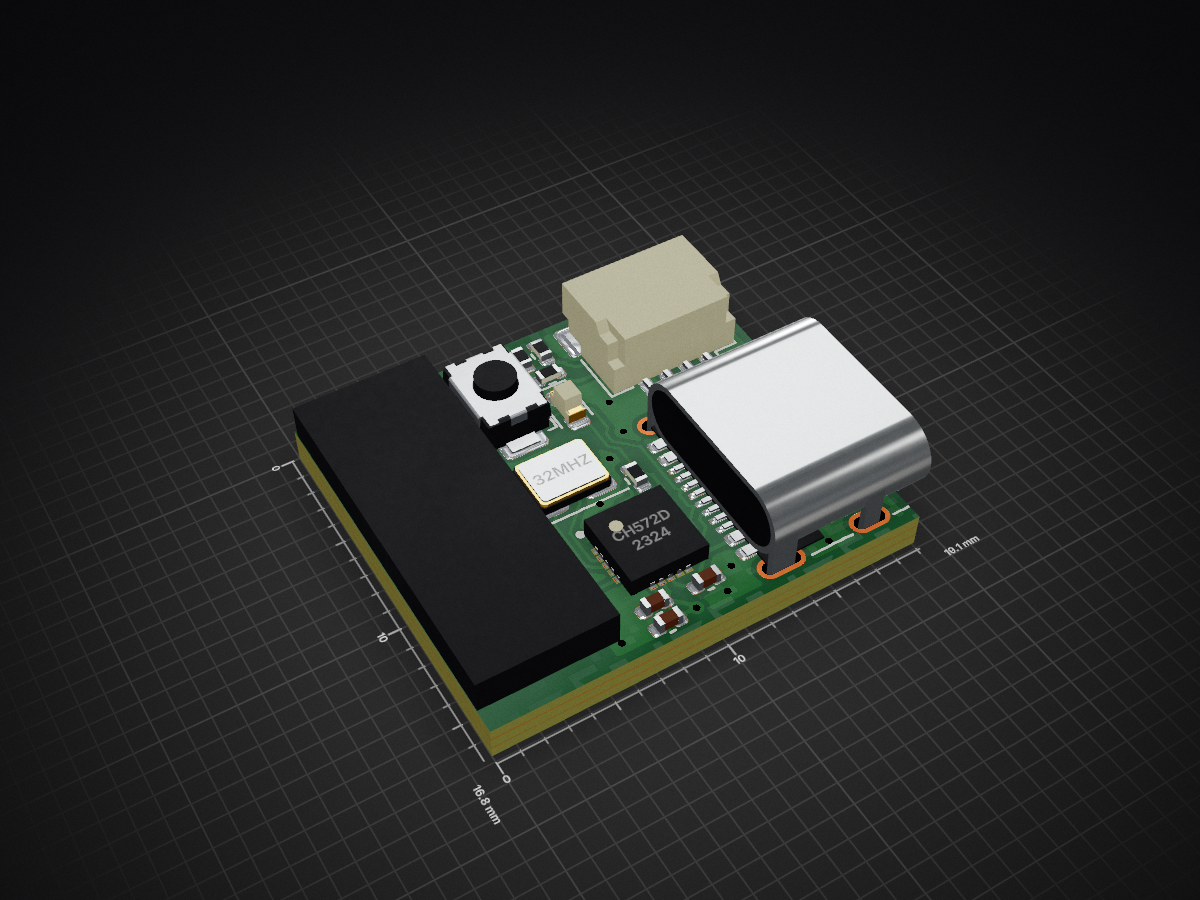
 JackToaster/SynthPass4
An open-source protocol & hardware design for to detect nose boops & transfer simple data, designed for protogen/synth fursuits
SynthPass is an open-source printed circuit board by JackToaster, from the JackToaster/SynthPass repository on GitHub, published under the GPL-3.0 licence. It is a 4-layer board of 19.1 × 16.8 mm with 17 parts on 24 nets, routed with 148 tracks and 41 vias.
It is built around the CH572D and SM04B-SRSS-TB. Its parts include 4 resistors, 3 capacitors, 2 connectors, 1 IC and 1 diode. It belongs with the audio and music boards of this library.
An open-source protocol & hardware design for to detect nose boops & transfer simple data, designed for protogen/synth fursuits.
Built to solve a very important problem. With SynthPass, you won't have to break character or pull off your paws and fumble with your phone to trade contact details. Just nose-boop, and SynthPass will automagically trade a small chunk of user-defined data, like a web link, username, or anything else that can fit in a couple hundred bytes of plain text. Then plug in your SynthPass at the end of the day and download all the data you've collected.
SynthPass is also designed to easily interface with nearly any protogen/synth fursuit. SynthPass hardware can be powered by a single 3.3V supply, and supports digital several digital interface options.
MESSAGES.HTM in your web browser.
ME/BOOP.TXT and ME/PROX.TXT to set your own messages to be transferred on proximity/boopME/SYNTHPAS.INI to change settings for LED behavior, boop range, and enable proximity messagesSynthPass is based on the ultra-low-cost WCH CH57x series microcontrollers.
Using CH32Fun + iSLER library for communication
SynthPass communicates using BLE advertising frames with a fixed MAC address so that SynthPassdevices can easily be detected.
Communication (currently) uses a fixed channel (Channel 37) and PHY mode (1Mbps).
TODO document stuff better :3
Building SynthPass
SynthPass uses PlatformIO to manage the firmware toolchain, and the ch32fun framework to handle the ch572's hardware interfaces.
To compile the firmware, you'll need to:
git clone https://github.com/JackToaster/SynthPass.gitpio run -e [board hardware target]. [board hardware target] should be replaced with one of the targets defined in platformio.ini:
nanoch57x for the nanoch57x dev boardpretzelslab for the SynthPass hardware in this repo & the SynthPasses handed out at Anthrocon 2026axionqc for AxionQc's hardware designUpdating firmware
We have a custom upload script built into the PlatformIO configuration for SynthPass, all you need to do to update the firmware is:
pio run -e [board target] -t upload
for the "official" Pretzel's Lab hardware: pio run -e pretzelslab -t upload
If the firmware is borked and the flashing script doesn't work, hold down the boot button while plugging in the SynthPass to force it into ISP bootloader mode.
| Qty | Value | Footprint | References |
|---|---|---|---|
| 4 | 5.1k | Resistor_SMD:R_0402_1005Metric | R1, R2, R3, R4 |
| 2 | 10u | Capacitor_SMD:C_0402_1005Metric | C1, C3 |
| 1 | 0.1u | Capacitor_SMD:C_0402_1005Metric | C4 |
| 1 | 32MHz | Crystal:Crystal_SMD_3225-4Pin_3.2x2.5mm | Y2 |
| 1 | CH572D | CH572D:CH572D | U2 |
| 1 | LED_Small | LED_SMD:LED_0603_1608Metric | D1 |
| 1 | LOGO | graphics:synthpass | G*** |
| 1 | LOGO | graphics:qr | G*** |
| 1 | LOGO | graphics:pretzel | G*** |
| 1 | PCB Antenna | RF_Antenna:Texas_SWRA117D_2.4GHz_Right | AE1 |
| 1 | SM04B-SRSS-TB | Connector_JST:JST_SH_SM04B-SRSS-TB_1x04-1MP_P1.00mm_Horizontal | J1 |
| 1 | SW_Push | Button_Switch_SMD:SW_SPST_TS-1088-xR020 | SW1 |
| 1 | USB_C_Plug_USB2.0 | Connector_USB:USB_C_Receptacle_G-Switch_GT-USB-7010ASV | P1 |
It measures 19.1 × 16.8 mm and has 4 copper layers, 1.6 mm thick.
17 parts, built around the CH572D and SM04B-SRSS-TB. The full list of its parts is on this page, with links to each part's symbol and footprint where PCBKit's library has them.
From the JackToaster/SynthPass repository on GitHub, at the commit this page was made from: the board is hardware/SynthPass.kicad_pcb and its schematic hardware/SynthPass.kicad_sch. PCBKit opens the board in the browser, with nothing to install.
Its repository publishes it under the GPL-3.0 licence: you may reuse it on that licence's terms (keep the author's notice, and for a copyleft licence share your changes alike).

Ismael034/usbsp
Have you ever tried to plug a USB device into a computer that has USB restrictions enabled? It's frustrating, isn't it? You can't use your USB devices, and you have no way to bypass the restrictions.

cyao1234/c57
Low-cost bluetooth devboard with a ch572 MCU. To program it press the boot button, and use either mountriver studio or ch32fun.

tobycm/divine-light
A handheld device with neopixels so you can have lights wherever you want :b

cnlohr/cnhardware
My dumping grounds for all my kicad projects and random hardware bringup.


brown-studios/minuet
Minuet upgrades your MAXXAIR Maxxfan with a brushless DC motor, home automation features, and accessories.
