
2 layers23.3 × 47.8 mm
HyperPlex
itsThatCoderBoy/Plex-Console-Stage-1
A small devboard that will be used for emulation!
28 partsUnlicense
 itsThatCoderBoy/Plex-Console-Stage-1
A small devboard that will be used for emulation!
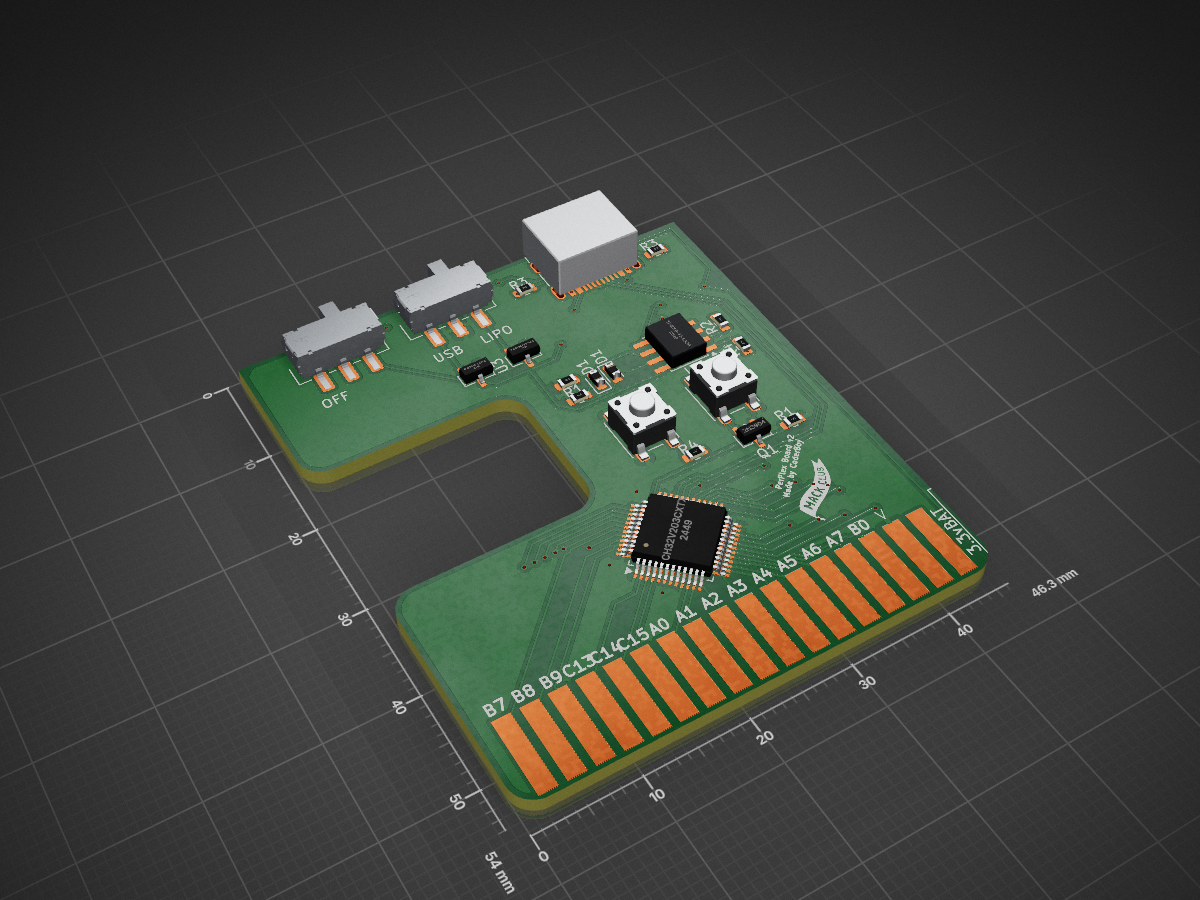
HyperPlex is an open-source printed circuit board by itsThatCoderBoy, from the itsThatCoderBoy/Plex-Console-Stage-1 repository on GitHub, published under the Unlicense licence. It is a 2-layer board of 46.3 × 54 mm with 22 parts on 58 nets, routed with 326 tracks and 42 vias.
It is built around the TP4056-42-ESOP8. Its parts include 8 resistors, 4 ICs, 4 switches, 2 diodes and 1 transistor. It belongs with the microcontroller boards boards and the RISC-V boards of this library.
The way it works is simple: Have the main board, attach it to whatever output device is needed for the game you want to play, and bam! You have a small pocket-sized devboard with endless possibilities of emulation. All you have to do is make your attachment board, code the game, and snap on the main board!
This is Stage 1 of this project; it is just the Devboard. After I build this project and it (hopefully) works, I am going to add a case and move on making a tester module.
This is my first project as part of Hack Club, and I certainly hope it isn't my last! This has already been so fun, even just a couple hours in.
This project came about because i really liked Bitluni's Megaplex video (oh boy I wonder where the name came from), and I wanted to make something inspired by it.
I initially was thinking of doing something exactly like his, but then realised that that would be a bad idea, and so I decided to make it my own by adding:
Thank you so much to Hack Club and Forge for making this whole thing possible! This really is an amazing oppurtunity.
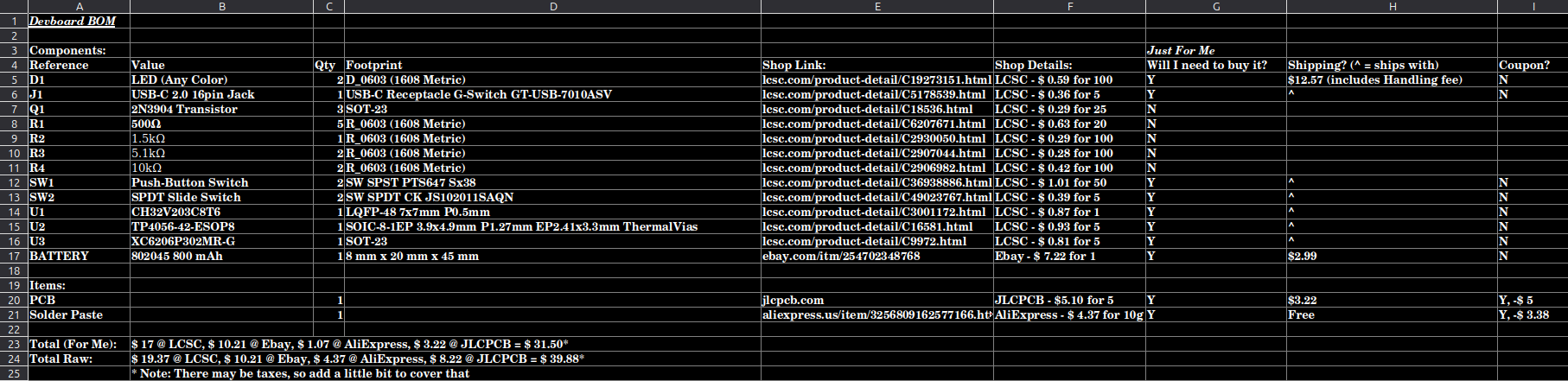
This project firstly involves a devboard. The reason it isn't a single board with the I/O and everything is because the main devboard is one of the more expensive things (~$35-40 including shipping for components), and I wanted you to just have one for all of the possible modules. (Also because I wanted a concrete starting point)
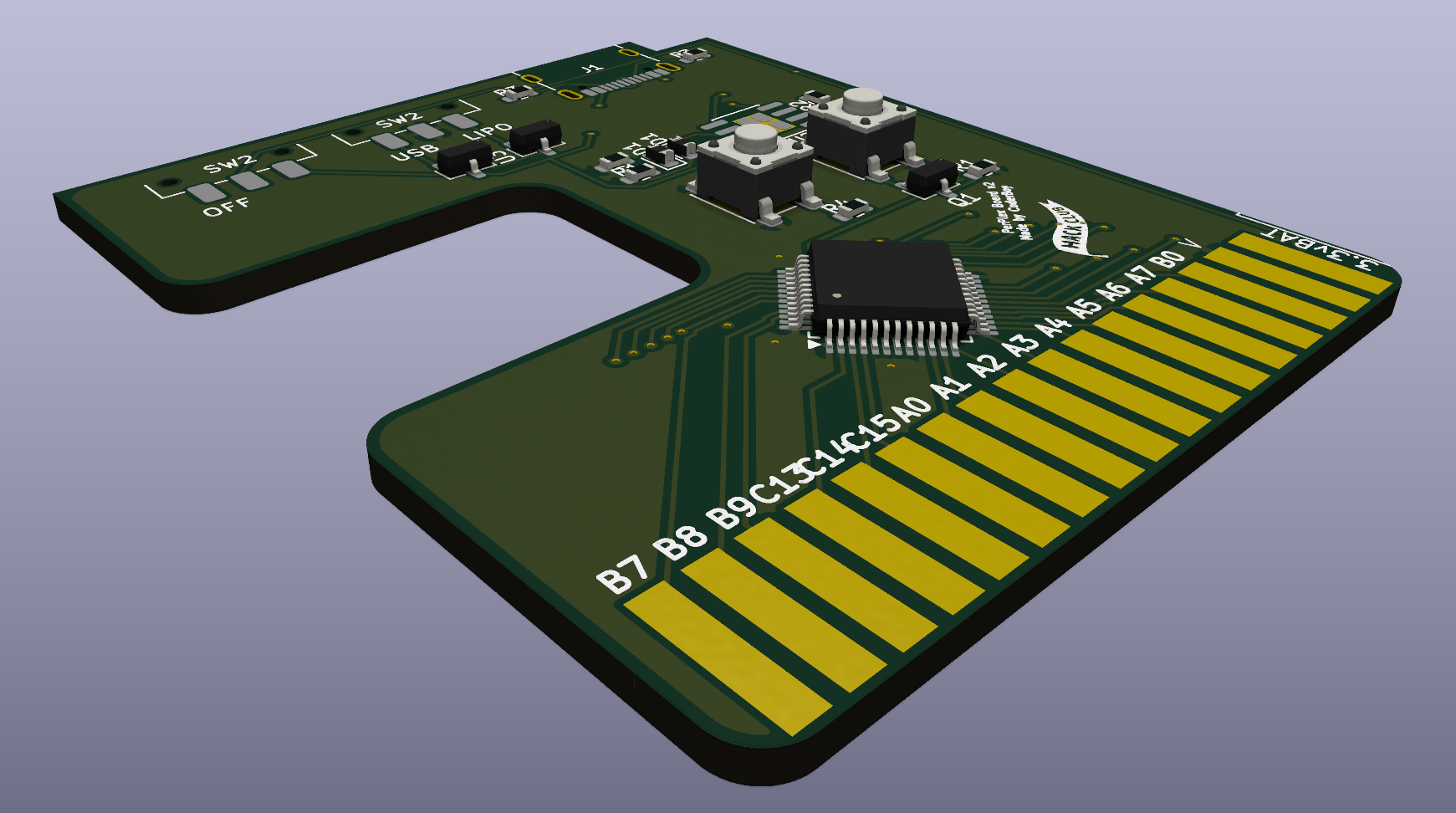
Note: This is a test for just the devboard. I am going to make a case and print it myself when I have confirmation that it works and I will be able to measure something concrete. Also, the 3D model on KiCad is missing quite a few componenets and I am going to need those in order to make a good case.
The second part of the project is the modules. They snap onto the devboard with magnets and communicate with pads on the back of both. Modules can do anything, as long as you code it right and have enough I/O pins!
I currently have the devboard designed and ready to ship off to JLCPCB when I get funding!
The first module that I am going to create is just a simple screen made of Charlie-Plexed LEDS. This is mainly just to practice coding, get the connection between the devboard and module hammered down, and make sure that the devboard works of course.
After that, I move on to the main idea: The Nintendon't GameMan. This is basically a Gameboy-like little pocket console with famous games like Tesris, Pac-Boy, and maybe even Toader! I haven't gotten to this point yet of course, but I am moving swiftly along.
Last but not least, if I have any extra time, I'd eventually like to make other attachments (feel free to leave suggestions).
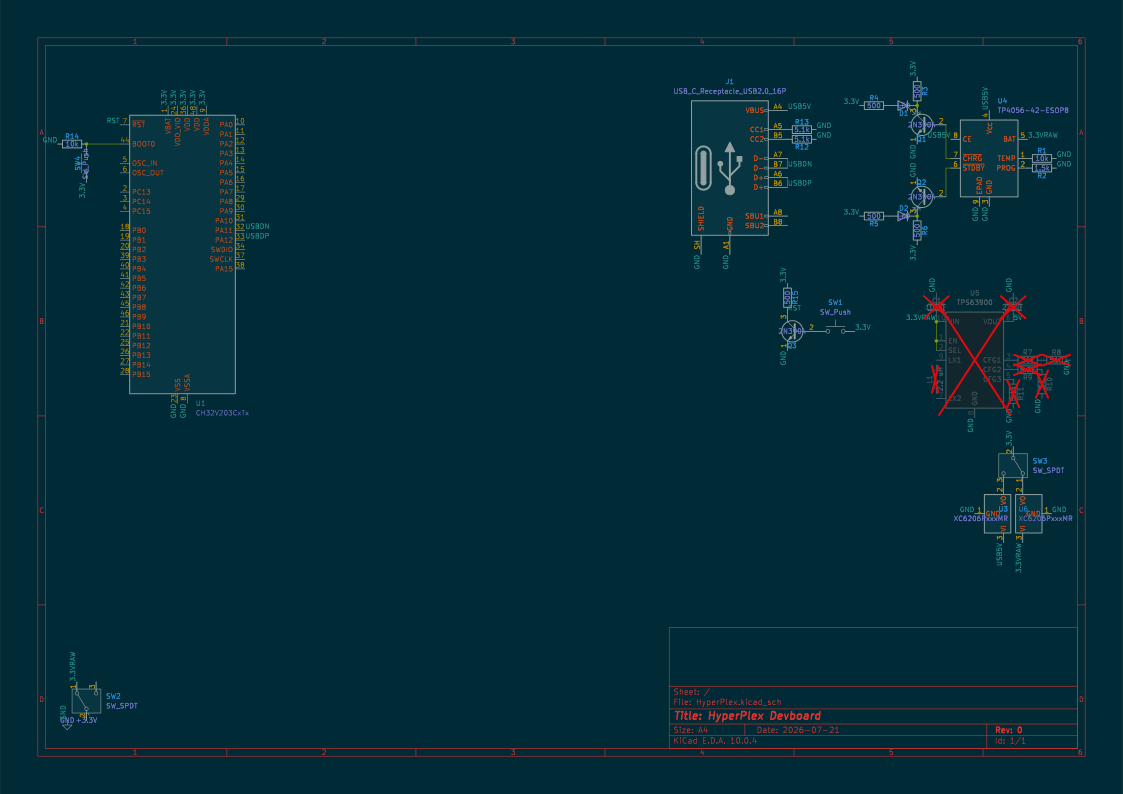
Schematic
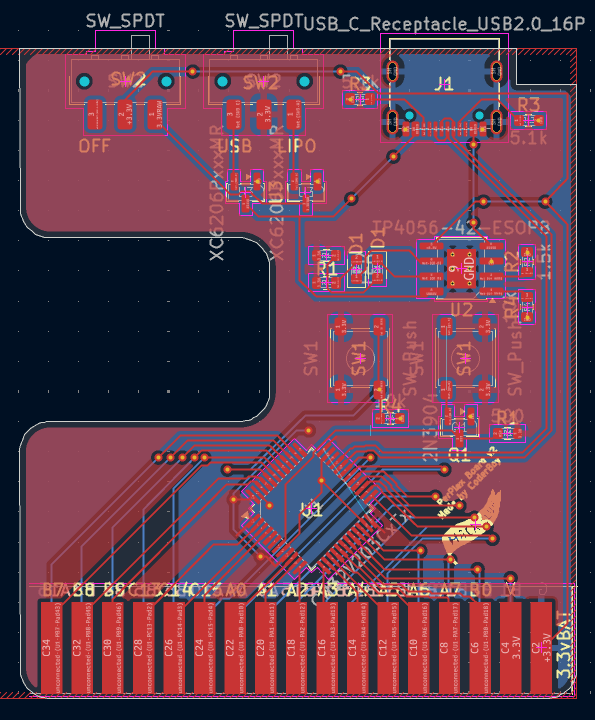
PCB Layout
Built-in KiCad 3D Model Front
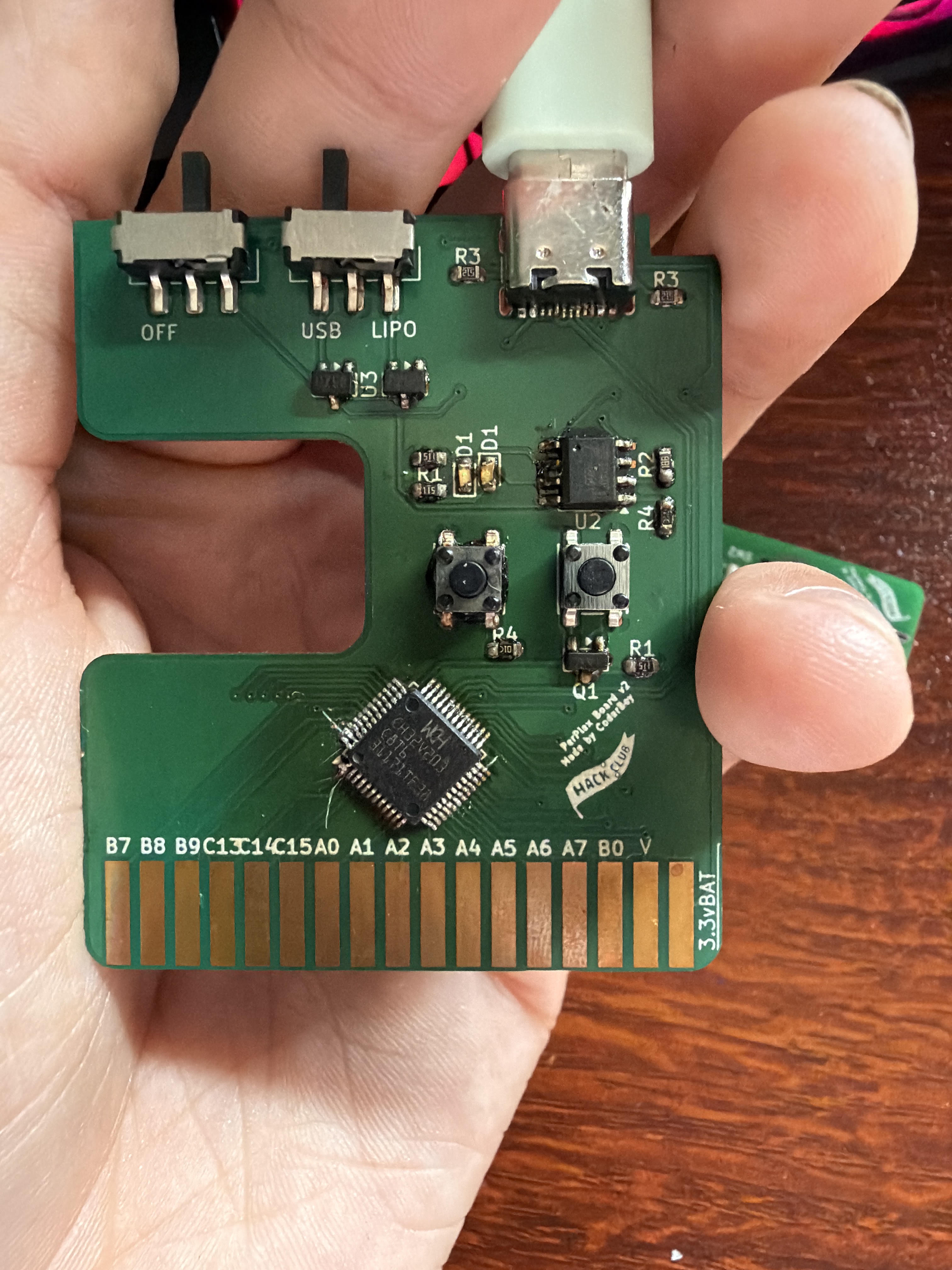
Build Photo
View my project timeline on Lapse
https://github.com/user-attachments/assets/fe2d55e1-1f7b-49ab-ab0b-663dc05e2e7f
https://github.com/user-attachments/assets/89aea018-e0ea-4a9d-9f60-57c4afef2afe
https://github.com/user-attachments/assets/4f556e5a-54bf-4c0b-9238-5e6fd982241c
| Qty | Value | Footprint | References |
|---|---|---|---|
| 3 | 500 | Resistor_SMD:R_0603_1608Metric | R1, R1, R1 |
| 2 | 10k | Resistor_SMD:R_0603_1608Metric | R4, R4 |
| 2 | 5.1k | Resistor_SMD:R_0603_1608Metric | R3, R13 |
| 2 | LED | Diode_SMD:D_0603_1608Metric | D1, D1 |
| 2 | SW_Push | Button_Switch_SMD:SW_SPST_PTS647_Sx38 | SW1, SW1 |
| 2 | SW_SPDT | Button_Switch_SMD:SW_SPDT_CK_JS102011SAQN | SW2, SW2 |
| 2 | XC6206PxxxMR | Package_TO_SOT_SMD:SOT-23 | U3, U3 |
| 1 | 1.5k | Resistor_SMD:R_0603_1608Metric | R2 |
| 1 | 2N3904 | Package_TO_SOT_SMD:SOT-23 | Q1 |
| 1 | CH32V203CxTx | Package_QFP:LQFP-48_7x7mm_P0.5mm | U1 |
| 1 | LOGO | LOGO | G*** |
| 1 | TP4056-42-ESOP8 | Package_SO:SOIC-8-1EP_3.9x4.9mm_P1.27mm_EP2.41x3.3mm_ThermalVias | U2 |
| 1 | USB_C_Receptacle_USB2.0_16P | Connector_USB:USB_C_Receptacle_G-Switch_GT-USB-7010ASV | J1 |
The 21 most common of 22 parts.
It measures 46.3 × 54 mm and has 2 copper layers, 1.6 mm thick.
22 parts, built around the TP4056-42-ESOP8. The full list of its parts is on this page, with links to each part's symbol and footprint where PCBKit's library has them.
From the itsThatCoderBoy/Plex-Console-Stage-1 repository on GitHub, at the commit this page was made from: the board is PCB and Schem/Devboard/HyperPlex.kicad_pcb and its schematic PCB and Schem/Devboard/HyperPlex.kicad_sch. PCBKit opens the board in the browser, with nothing to install.
Its repository publishes it under the Unlicense licence: you may reuse it on that licence's terms (keep the author's notice, and for a copyleft licence share your changes alike).
itsThatCoderBoy/Plex-Console-Stage-1
A small devboard that will be used for emulation!

iandchasse/silkscreen-pcb
Silkscreen: open-hardware ESP32-S3 e-paper reader mainboard (KiCad 9). Formerly the de-link hub.


KaliAssistant/Fox-Jack
Portable social-engineering LAN tool for automated payloads and wired audits — based on Luckfox Pico Max


nimitvijayvargee/trhw
This is an RP2040 ruler that implements wifi, bluetooth, BLE along with a 4MB Flash storage, LEDs, Input buttons and some cool units and lengths!

cajunpanda/bluetooth-nes-advantage
A bluetooth mod for the NES Advantage classic controller.

MAATHES-THILAK-K/ESP32-S3_FLIGHT_CONTROLLER
A custom-designed flight controller based on the ESP32-S3 module, built for compatibility with the esp-fc firmware and Betaflight-like configuration.