2 layers144.8 × 88.9 mm

 iorodeo/potentiostat57
Rodeostat design files, software and firmware
Multiplexer is an open-source printed circuit board by iorodeo, from the iorodeo/potentiostat repository on GitHub, published under the CC-BY-4.0 licence. It is a 2-layer board of 82.6 × 88.9 mm with 22 parts on 31 nets, routed with 390 tracks and 27 vias.
Its parts include 8 capacitors, 5 connectors, 4 ICs and 1 switch.
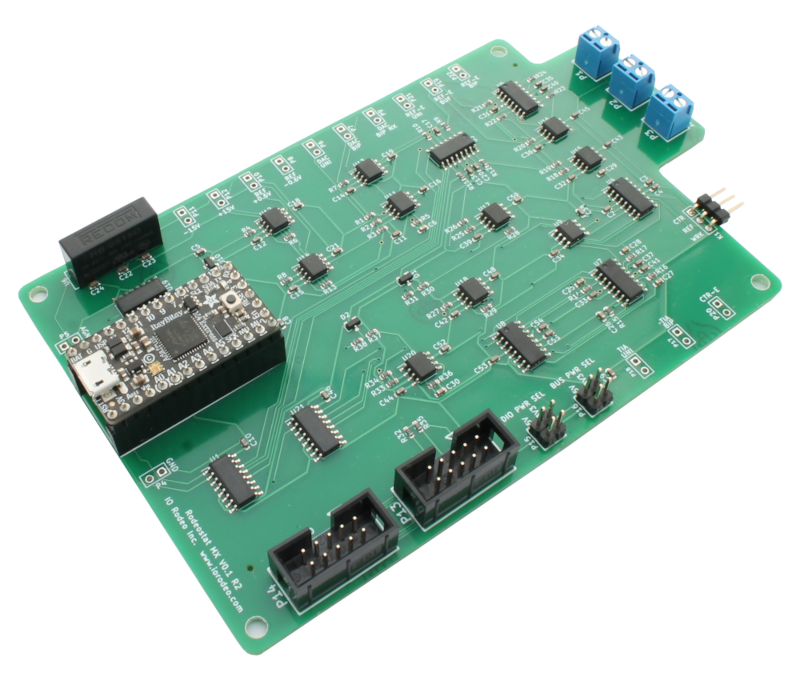
Hardware design, firmware and software for IO Rodeo's Rodeostat Potentiostat.
| Qty | Value | Footprint | References |
|---|---|---|---|
| 8 | 0.1uF | SM0805 | C1, C2, C3, C4, C5, C6, C7, C8 |
| 4 | ADG44X | 16-SOIC-0154 | U1, U2, U3, U4 |
| 4 | VAL** | 4-40 | 4-40, M1, M2, M3 |
| 3 | CONN_5X2 | 5X2_SHRD_HEADER | P1, P2, P5 |
| 2 | CONN_2 | PIN_ARRAY_2X1 | P3, P4 |
| 1 | CONN_3 | PIN_ARRAY_3X1 | K1 |


VoronDesign/Voron-Hardware
Cool Hardware designed by the Voron Design group

hoglet67/RGBtoHDMI
Bare-metal Raspberry Pi project that provides pixel-perfect sampling of Retro Computer RGB/YUV video and conversion to HDMI

hackclub/OnBoard
💡 Join 1,000 teenagers and make your first PCB with a $100 grant!

abhishek-kakkar/BeagleLogic
A Software Suite that implements a logic analyzer with the PRU on the BeagleBone / BeagleBone Black.

Chrismettal/flipper-zero-backpacks
Backpack-style addon boards for the Flipper Zero!


CRImier/MyKiCad
My KiCad boards. Can't be bothered uploading individually anymore, so here you go.
It measures 82.6 × 88.9 mm and has 2 copper layers, 1.6 mm thick.
22 parts. The full list of its parts is on this page, with links to each part's symbol and footprint where PCBKit's library has them.
From the iorodeo/potentiostat repository on GitHub, at the commit this page was made from: the board is hardware/pcbs/multiplexer_v0p2/multiplexer.kicad_pcb. PCBKit opens the board in the browser, with nothing to install.
Its repository publishes it under the CC-BY-4.0 licence: you may reuse it on that licence's terms (keep the author's notice, and for a copyleft licence share your changes alike).